
Flying for Fun
D.B. Mathews 909 North Maize Road, Townhouse 734, Wichita, KS 67212
Cheap Thrills
Last month I chatted about the fun of flying really small Free Flight (FF) models. Those comments were directed primarily at the K&B Infant .020 reproduction that Bob Langelius is selling.
The appeal of sport FF lies in the large amount of fun that is available for very low equipment and material costs, and in the availability of flying fields—many playgrounds and athletic complexes are suitable. It's difficult to fly aerobatics (at least deliberately) with sport FF models, but the beauty of an aircraft following only the commands of wind and gravity can be very rewarding. It saddens me to realize that many readers have never experienced this thing of pure beauty; they're missing out on some of modeling's very special moments.
Building and flying small rubber-powered sport and scale models is really the cornerstone on which the hobby was built. While models of this type have always been popular, a strong revival has taken place during the last decade or so. There are more rubber-powered kits available now than at any time since the 1940s, and modern quality far exceeds anything previously available.
However, some skills and techniques involved in rubber power discourage many younger modelers, and for that reason a surge of interest in small electric-powered models is apparent.
Electric-powered FF models are hardly a new concept (one of my sons has a National Free Flight Society electric FF trophy from the 1974 Nationals). What is new and exciting are the 13–25-inch designs made possible by the recently available, incredibly small and affordable electric motors.
Many kits designed for rubber or CO2 power can easily be converted to mini-electric, as can many magazine plans. If nothing else, replacement of rubber strip with electric power certainly reduces the potential for blown motors, is a far less technique-sensitive power source, and even eliminates messy rubber lube. And you don't need to be able to count higher than 100!
Simple Fun
For years I've carried on correspondence with Dick Gibbs of York, PA. For many years he and several of his "older" flying buddies have had a tradition of gathering early on Saturday mornings and flying tiny electric-powered sport FF models at a local sports complex.
Dick's delightful accounts of their adventures and misadventures are evidence that they have a great thing going. They fly until their stomachs growl loudly enough to annoy each other, then they retreat to a nearby pancake place for breakfast.
Don't assume that these guys have never "progressed" to Radio Control (RC)—some get testy with that presumption. This bunch used to fly RC, but they became bored with all of the hassles, and moved on to the challenges of mini-electrics.
RS Special
The June 1997 Flying Models features a Dick Gibbs mini-electric construction article he describes as an "overgrown Peanut." It is powered with the tiny Kenway geared KR-1 motor, spans 15 inches, and weighs 26 grams with a fully charged battery. The article is informative, the design is delightfully simple, and the construction is well within nearly anyone's skills. This project would be an excellent entry point into the world of micro-electric flying.
More Progress
James Rice, New Port Richey, FL, is another modeler who has progressed to electric sport FF. He built and flew rubber-powered models and gliders in the 1940s; Control Line in the 1950s–1960s; and RC in the 1980s–1990s.
About five years ago, Jim was looking through back issues of Model Aviation and found an October 1987 article by Don Srull on mini-electric FF. Jim decided to give it a try, and he has been hooked ever since.
In his words, "to me it doesn't get any better than to walk across an open field watching a plane doing lazy circles in the sky. Then see it glide in for a landing eight to 10 feet away."
Nuts and Bolts
What power plants and models are electric FFers using? What does one need to get started? Are any special skills needed? The photos and material that Jim has provided give a quick overview. (For simplicity's sake, manufacturers and their addresses appear at the end of this column.)
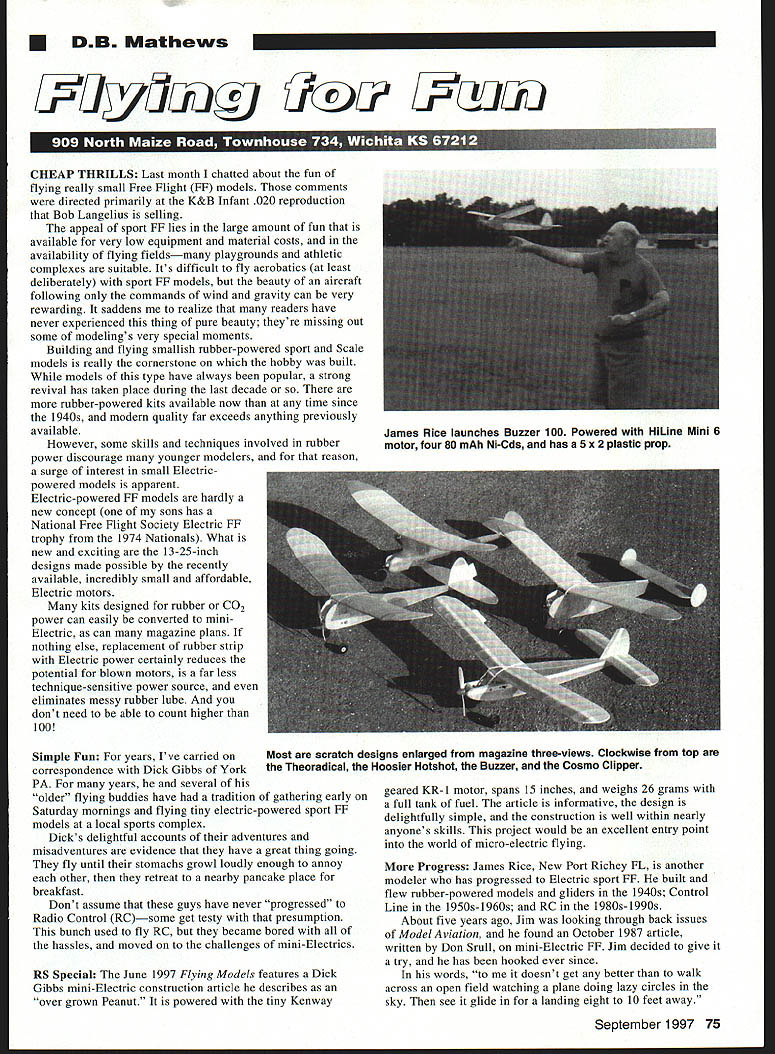
- Photo A: Jim launching a Buzzer 100 built from March 1996 Model Builder plans. The model spans 30 inches, has 120 sq. in. of area, and weighs three ounces. It is powered with a HiLine Mini 6 motor, four 80 mAh Ni-Cd cells, and uses a 5 x 2 plastic propeller.
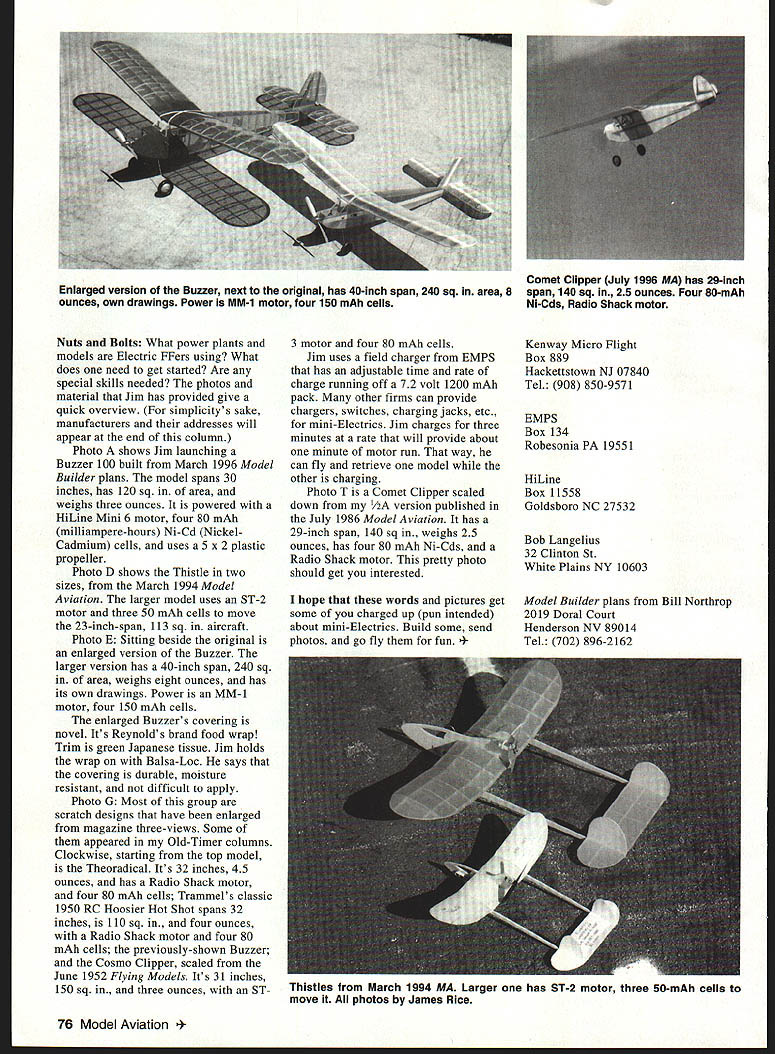
- Photo D: The Thistle in two sizes, from March 1994 Model Aviation. The larger model uses an ST-2 motor and three 50 mAh cells to power the 23-inch span, 113 sq. in. aircraft.
- Photo E: Sitting beside the original is an enlarged version of the Buzzer. The larger version has a 40-inch span, 240 sq. in. of area, weighs eight ounces, and has its own drawings. Power is an MM-1 motor and four 150 mAh cells. The enlarged Buzzer's covering is novel: Reynolds brand food wrap. Trim is green Japanese tissue. Jim holds the wrap on with Balsa-Loc. He says the covering is durable, moisture resistant, and not difficult to apply.
- Photo G: Most of this group are scratch designs that have been enlarged from magazine three-views. Some of them appeared in my Old-Timer columns. Clockwise, starting from the top:
- The Theoradical: 32 inches, 4.5 ounces, Radio Shack motor, four 80 mAh cells.
- Trammel's classic 1950 RC Hoosier Hot Shots: 32 inches, 110 sq. in., four ounces, Radio Shack motor, four 80 mAh cells.
- The previously shown Buzzer.
- The Cosmo Clipper, scaled from the June 1952 Flying Models: 31 inches, 150 sq. in., three ounces, ST-3 motor, four 80 mAh cells.
- Photo T: A Comet Clipper scaled down from my 1/2A version published in the July 1986 Model Aviation. It has a 29-inch span, 140 sq. in., weighs 2.5 ounces, has four 80 mAh Ni-Cd cells, and a Radio Shack motor.
Jim uses a field charger from EMPS that has an adjustable time and rate of charge running off a 7.2 volt 1200 mAh pack. Many other firms can provide chargers, switches, charging jacks, etc., for mini-electrics. Jim charges for three minutes at a rate that will provide about one minute of motor run. That way, he can fly and retrieve one model while the other is charging.
I hope these words and pictures get some of you charged up about mini-electrics. Build some, send photos, and go fly them for fun.
Suppliers
- Kenway Micro Flight
Box 889 Hackettstown, NJ 07840 Tel: (908) 850-9571
- EMPS
Box 134 Robesonia, PA 19551
- HiLine
Box 11558 Goldsboro, NC 27532
- Bob Langelius
32 Clinton St. White Plains, NY 10603
- Model Builder plans from Bill Northrop
2019 Doral Court Henderson, NV 89014 Tel: (702) 896-2162
Transcribed from original scans by AI. Minor OCR errors may remain.

