
Flying for Fun
D.B. Mathews 909 North Maize Road, Townhouse 734, Wichita KS 67212
Another oxymoron: In my March 1997 column I took off on frequently used nonsensical terms. I'm adding "spray can epoxy" to that list. Hopefully my February 1998 column explained why such a product must be a figment of an ad writer's runaway imagination.
Once the separate components of a catalyzed compound are mixed together, an irreversible chemical reaction is started, ending in a cured state regardless of the container or the presence of an atmosphere. Therefore, a premixed epoxy paint—by definition—cannot be stored in an aerosol can, any more than two‑part epoxy adhesives can be sold premixed. Premixed epoxy in a spray can is a chemical impossibility—or is it?
Custom Spray Cans
The convenience of aerosol spray paints is obvious, but limited to paints that set by evaporation. In modeling, the most commonly used spray paints are lacquers (dopes) and noncatalyzed polyurethanes. Both are fine and have been used successfully for years by many modelers. However, they do have several problems: dope is handicapped by thinness and low pigmentation, requiring multiple coats, while uncatalyzed polyurethanes are technique‑sensitive and heavy because of the thickness of the coats.
Consequently, when you want to spray a radio‑control model's cowl and/or wheel pants to finish an aircraft covered with one of the heat‑shrink materials, you are often forced to buy or borrow a compressor/airbrush rig — or choose covering to match colors available in spray cans.
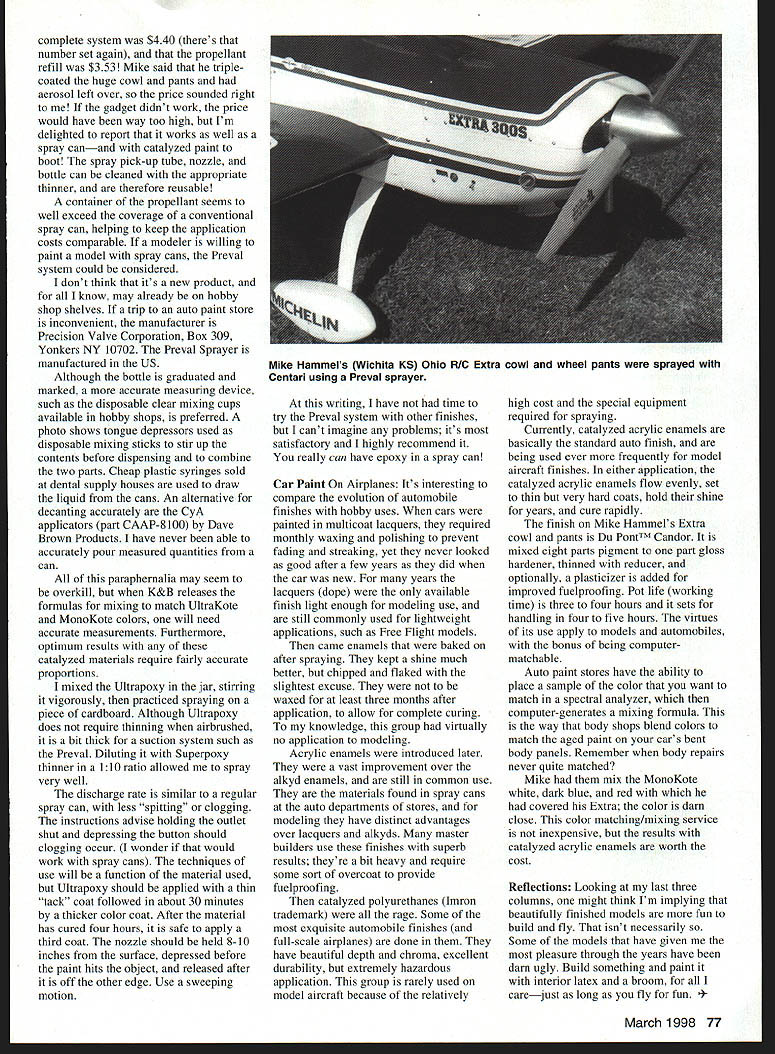
By an odd set of circumstances I stumbled onto a device that provides the modeler with a method of spraying catalyzed finishes with the equivalent of a spray can. Mike Hammel told me that he had finished the cowl and pants on his big Extra with acrylic enamel auto paint, and for months I presumed he had an airbrush. One day I asked him what brand of sprayer and compressor he had, and he told me that he used an aerosol system purchased at an automobile paint store (look in the Yellow Pages under Automobile Body Shop Equipment and Supplies).
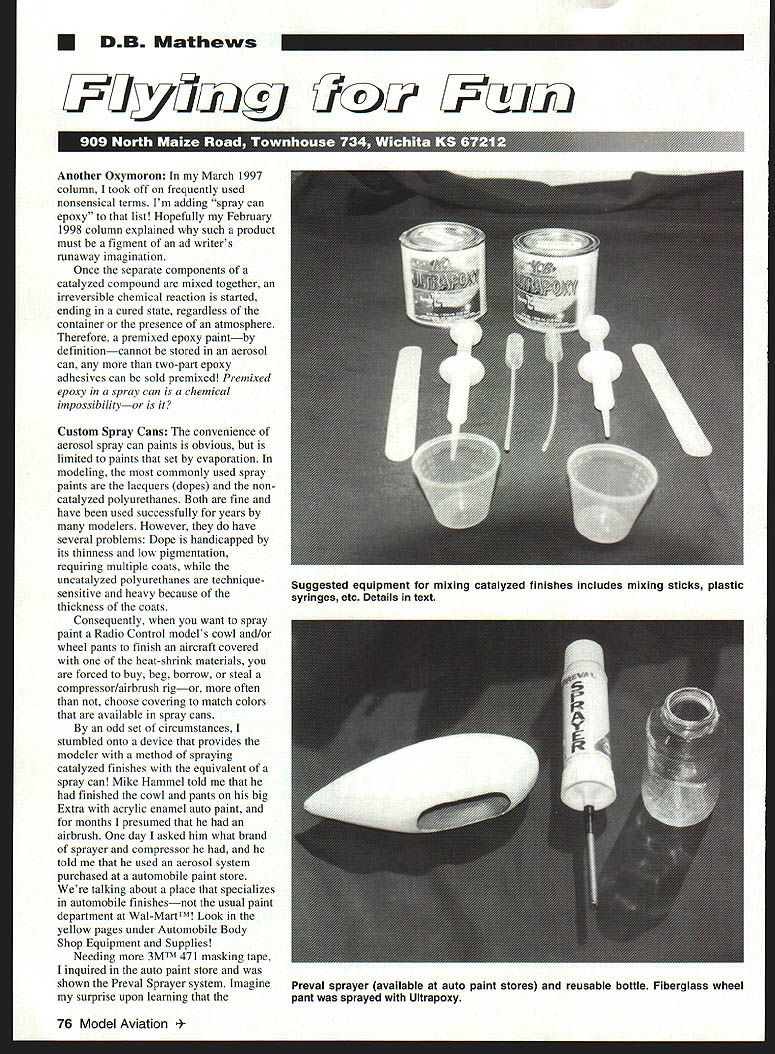
The product is the Preval Sprayer system, sold through auto paint stores and manufactured by Precision Valve Corporation (Box 309, Yonkers, NY 10702). The Preval equipment for mixing catalyzed finishes includes mixing sticks, plastic syringes, and related paraphernalia. I'm delighted to report it works well: the sprayer will spray catalyzed paint, and the spray pick‑up tube, nozzle, and bottle can be cleaned with the appropriate thinner, so the container is reusable. The propellant coverage seems to exceed that of a conventional spray can, helping keep application costs comparable to using many spray cans.
Useful paraphernalia:
- Disposable clear mixing cups (available at hobby shops) — more accurate than the bottle graduations.
- Tongue depressors — handy as disposable mixing sticks.
- Cheap plastic syringes (from dental supply houses) — useful to draw liquids from cans.
- CyA applicators (part CAAP‑8, 100) from Dave Brown Products — an alternative for accurate decanting.
All this may seem like overkill, but when manufacturers (e.g., K&B) release formulas for mixing to match UltraKote and MonoKote colors, accurate measurements are needed. Furthermore, optimum results with catalyzed materials require fairly accurate proportions.
I stirred an Ultrapoxy jar vigorously and practiced spraying on a piece of cardboard. Although Ultrapoxy does require thinning for suction‑feed systems such as the Preval (it is a bit thick for that application), diluting with Superpoxy thinner at a 1:10 ratio allowed it to spray very well. The discharge rate is similar to a regular spray can, with less spitting or clogging. Instructions advise holding the outlet shut and depressing the button should clogging occur.
Application tips for Ultrapoxy:
- Apply a thin tack coat.
- After about 30 minutes apply a thicker color coat.
- After the material has cured four hours it is safe to apply a third coat.
- Hold the nozzle 8–10 inches from the surface when spraying.
The complete Preval system was about $4.40, and a propellant refill about $3.53. Mike said the triple‑coated huge cowl and pants had aerosol left over, so the price seemed right. If the gadget didn't work, the price would have been way too high, but it does work as well as a spray can—and with catalyzed paint to boot.
At this writing I have not had time to try the Preval system with other finishes, but I can't imagine any problems. It's most satisfactory and I highly recommend it. You really can have epoxy in a spray can!
Car Paint on Airplanes
It's interesting to compare the evolution of automobile finishes with hobby uses. When cars were painted in nitrocellulose lacquers, they required monthly waxing and polishing to prevent fading and streaking, and they never looked as good after a few years as when new. For many years lacquers (dope) were the only finish light enough for modeling use, and they are still commonly used for lightweight applications such as free‑flight models.
Then came enamels that were baked on after spraying. They kept a shine much better but chipped and flaked easily and were not to be waxed for at least three months after application. To my knowledge, this group had virtually no application to modeling.
Later, acrylic enamels were introduced and proved a vast improvement over alkyd enamels. They are the materials commonly found in spray cans at auto departments of stores and have distinct advantages over lacquers and alkyds. Many master builders use these finishes with superb results; they're a bit heavy and usually require some sort of overcoat to provide fuelproofing.
Catalyzed polyurethanes (Imron®) then became popular for exquisite automobile and full‑scale airplane finishes: beautiful depth and chroma, excellent durability, but hazardous application. This group is rarely used on model aircraft because of high cost and special equipment required for spraying.
Currently, catalyzed acrylic enamels are basically the standard auto finish and are being used increasingly for model aircraft. They flow evenly, set to thin but very hard coats, hold their shine for years, and cure rapidly.
The finish on Mike Hammel's Extra cowl and pants is DuPont™ Candor. It is mixed one part pigment to one part gloss hardener, thinned a little for spraying, and a plasticizer is added for improved fuelproofing. Pot life (working time) is three to four hours and it sets for handling in four to five hours. The virtues of its use apply to both models and automobiles, with the bonus of being computer‑matchable.
Auto paint stores can place a color sample in a spectral analyzer to computer‑generate a mixing formula. This is how body shops color‑match paint for repairs. Mike had them mix the MonoKote white, dark blue, and red he used on his Extra; the color was close. This color‑matching/mixing service is not inexpensive, but results with catalyzed acrylic enamels are often worth the cost.
Reflections
Looking at my last three columns, one might think I'm implying that beautifully finished models are more fun to build and fly. That isn't necessarily so. Some of the models that have given me the most pleasure through the years have been darn ugly. Build something and paint it with interior latex and a broom, for all I care—just as long as you fly for fun.
Transcribed from original scans by AI. Minor OCR errors may remain.

