
Flying for Fun
D.B. Mathews 909 North Maize Road, Townhouse 734, Wichita, KS 67212
Milestones
There are things that mark passage through life: weddings, births, graduations, moves, new jobs, and other personal events become reference points as we weave the fabric of our lives. However, they are not usually of any particular importance to anyone but ourselves.
I have completed 20 years of writing columns for Model Aviation. I originally prepared this column as a historical retrospective, then realized how insignificant those 20 years are to anyone else, and how arrogant such a column would be.
While two decades of columns seems long, it pales in comparison to the tenure of Clarence Lee, Chuck Cunningham, and earlier writers such as Ed Lorenz and John Pond. One common thread motivates those who write columns regularly: a sense of fulfillment in hopefully entertaining readers with enthusiasm for modeling and adding to their enjoyment.
Columns are probably not written for monetary gain; the pay is likely not even close to what readers might think. Rewards come in complimentary letters, phone calls, and kind words at modeling events; therefore, it would be inappropriate for me to devote this column to a long-winded, vain, and undeserved self-tribute tracing the events that led to writing "RC Old Timers," "Flying For Fun," product reviews, 71 published designs, and how-to pieces in various modeling magazines.
It is, however, appropriate to thank some special people whose guidance and encouragement made it possible:
- Art Schroeder, former editor of Model Airplane News
- the late Don McGovern at Flying Models
- Dick Kidd at Radio Control Modeler
- Bill Northrop, former editor of Model Builder
Major credit goes to Bill Winter, the dean of model aviation writers. He started the contemporary version of the AMA's magazine in July 1975 after the collapse of Potomac Aviation Publishing. In Potomac's ashes were the elements of the first construction article I ever submitted: the Kloud King.
Bill was on a tight timetable, trying to round up material for the first issue of Model Aviation. He called to see if I had duplicate photos and drawings of the Kloud King. I did, but I warned him that the pencils were very amateurish and the text was full of misspelled words and punctuation errors. Bill said, "Doc, I saw it and you're absolutely right, but the concept is good and we can straighten out the problems to make you look like a writer/designer."
In the ensuing years, Bill guided me by telephone and by his "unusual" typing, teaching me a writing style and the mechanics of preparation.
Two favorite Bill Winter quips come to mind. He misspelled a word in a letter, then wrote along the border, "can bad spelling be contagious?" I have always tended to write more words than necessary, leading Bill to tell me, "Doc, you've got to learn to write the Lord's Prayer in fewer words."
If it wasn't for his guidance, kindness, and understanding, I would not be writing a milestone column. Bill offered that same advice and encouragement to many others who became frequent contributors to model publications, from the late Cal Smith to former AMA Vice President George Aldrich.
The true difference between modelers who talk of writing construction articles but never do and those who do write is that the latter are fortunate enough to find mentors such as Bill Winter. As I've told him, I owe him my deepest gratitude for all the joy he has brought into my life.
When Bill retired as editor of this magazine, new editor Ross McMullen asked me to write a general-interest column to replace Bill's "Just for the Fun of It." That's where this column's name came from, and now you know why I am so humbled by the challenge of writing it.
I read club letters all the time with what I think is writing good enough for national publication. That modelers who have information worth sharing do not is likely a result of a lack of encouragement and motivation, and/or a fear of failure.
A monthly magazine has an insatiable appetite for material, so it is to the staff's benefit to encourage development of articles by new writers in order to feed the monster. At one time, one modeling magazine was so desperately short of designs and construction articles that the editor resorted to drawing up models and writing construction articles for airplanes that had never been built.
Some editors allow the use of pen names to avoid repeating the same byline. I don't think I'm revealing any secrets when I point out that John Sprague and Bill Winter are the same person, and a large number of Frank Ehling designs are under a nom de plume. I know several others, but that would spoil the fun.
There has been a shortage of articles and designs for years. Sit down and write something about your special area of interest, take some pictures, and submit it!
Special Graphics
I chose the photos and table for this column, not because they are of the highest quality, but because they are my favorites.
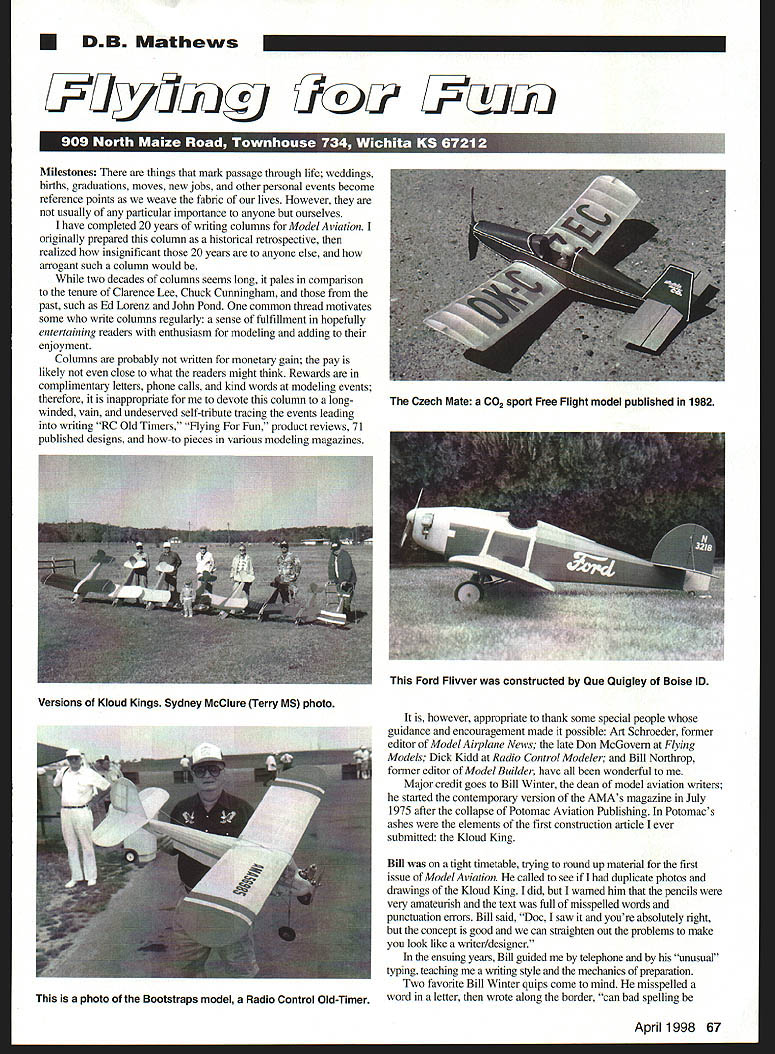
The group photo illustrates why the Kloud King (Model Aviation, July 1975) has remained my favorite published design for more than 22 years. It was sent by Sydney McClure (Terry, MS) and shows Kloud King's sizes from the 1/2A version (Model Aviation, January 1983) through the XL (Flying Models, July 1980), up to an enlarged version at a full nine feet.
Originally designed in 1936 by Mickey de Angeles of Trenton, NJ, I reworked and strengthened the Kloud King's structure in 1937 to facilitate the addition of three radio channels. At that time I presumed Mr. Angeles was deceased—he is anything but! Credit for the aerodynamics and simple construction should go to Mickey, not me.
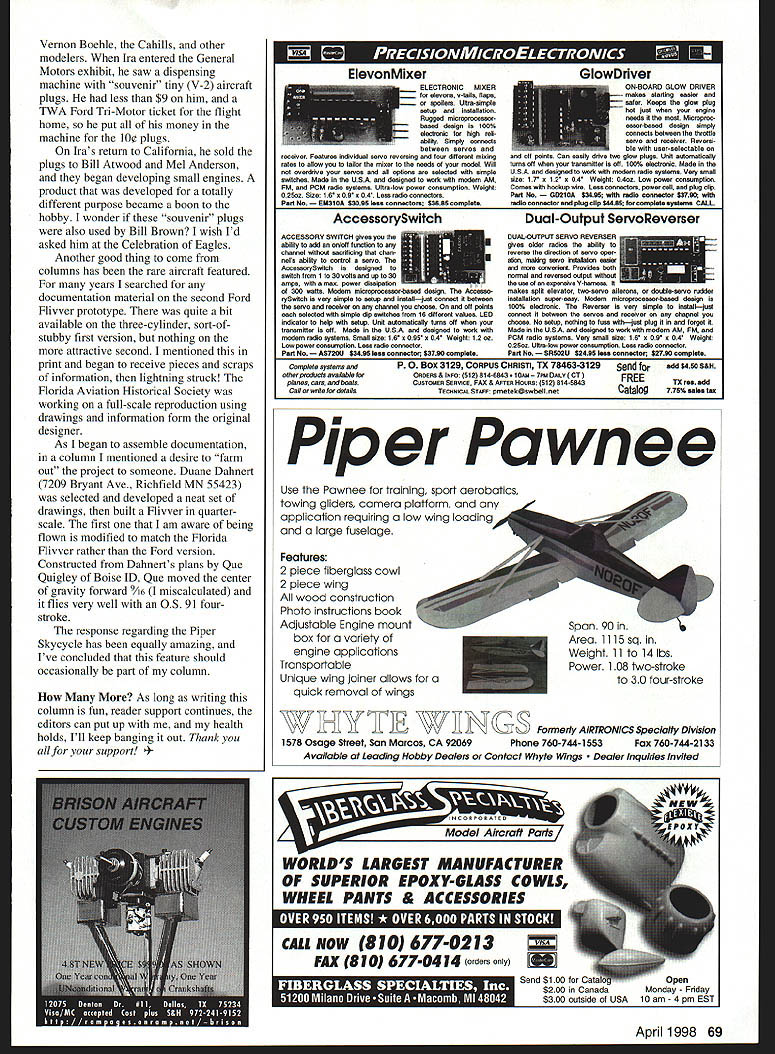
The drill guide was part of the December 1981 column and has proved handy in my workshop, so I thought I'd duplicate it for new readers. It allows me to avoid the "what size hole do I need here?" problem. The conversion table is based on the fact that a .60 cubic-inch engine is also 10 cc. I slide the decimals around to convert, but those who have never used a slide rule (anyone under 40, I suspect) can use the formula. I've added a few things to the table throughout the years to further increase its utility.
The photo of the Czech Mate CO2 sport free-flight model was published in the November 1982 Model Aviation under the name "Joe Johnson" — that's me!
Power?
While many people look at the old phrase "power of the press" with a negative eye, this column has proved that some good things can come from it. Occasionally I've used this forum to seek help with obscure stories and material; among my favorites is the story of the late Carl Goldberg's fabled Valkyrie fly-away at the 1937 Detroit Nats.
Ira Hassad (now deceased) wrote that Carl's airplane was powered by a Brown Jr. that Carl had borrowed from Vernon Boehle (Ira's brother-in-law) when the original Baby Cyclone proved inadequate. Later, Carl told me that he couldn't remember borrowing the engine, but was sure that he had made it right with Vernon.
The same piece contained one of my most memorable musings: the report of that OOS (Out Of Sight) flight indicated that the model was last seen headed south from Detroit toward Canada! I figured that it must be an error and changed my account to north. Man did I catch a ribbing for that! But it is possible to go south of Detroit and be in Canada—look at a map.
Ira gave me a favorite story involving spark plugs. The development of internal-combustion engines made it necessary for early modelers to find good small-engine spark plugs, but the only ones available in 1933 were 12 mm Bosch units, a few handmade mica ones, and cut-down motorcycle plugs the size of small contemporary engines.
Ira was in Indianapolis, Indiana, in 1934 and visited the Chicago World's Fair with Vernon Boehle, the Cahills, and other modelers. When Ira entered the General Motors exhibit, he saw a dispensing machine with "souvenir" tiny (V-2) aircraft plugs. He had less than $9 on him and a TWA Ford Tri-Motor ticket for the flight home, so he put all of his money in the machine for the 10¢ plugs.
On Ira's return to California, he sold the plugs to Bill Atwood and Mel Anderson, and they began developing small engines. A product developed for a totally different purpose became a boon to the hobby. I wonder if these "souvenir" plugs were also used by Bill Brown? I wish I'd asked him at the Celebration of Eagles.
Another good thing to come from columns has been the rare aircraft featured. For many years I searched for any documentation on the second Ford Flivver prototype. There was quite a bit available on the three-cylinder, sort-of-stubby first version, but nothing on the more attractive second. I mentioned this in print and began to receive pieces and scraps of information, then lightning struck: the Florida Aviation Historical Society was working on a full-scale reproduction using drawings and information from the original designer.
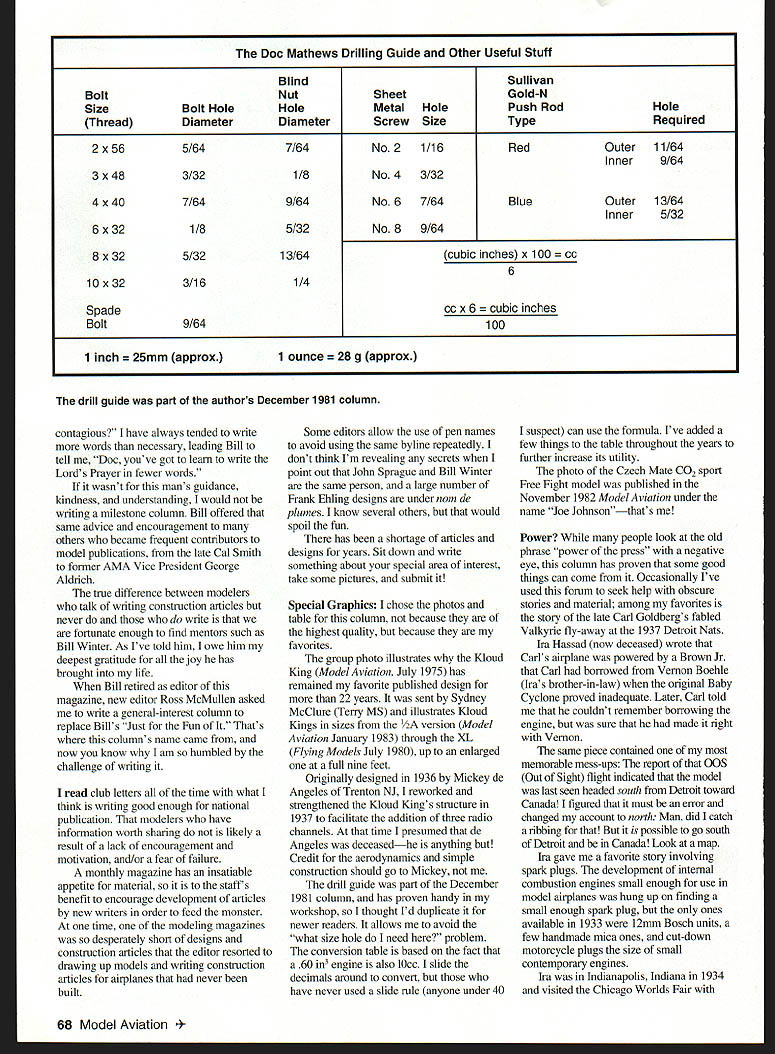
As I began to assemble documentation, I mentioned a desire to "farm out" the project to someone. Duane Dahnert (7209 Bryant Ave., Richfield, MN 55423) was selected and developed a neat set of drawings, then built a Flivver in quarter scale. The first one that I am aware of being flown is modified to match the Florida Flivver rather than the Ford version. Constructed from Dahnert's plans by Que Quigley of Boise, ID, Que moved the center of gravity forward 9/16" (I had miscalculated) and it flies very well with an OS .91 four-stroke.
The response regarding the Piper Skycycle has been equally amazing, and I've concluded that this feature should occasionally be part of my column.
How Many More?
As long as writing this column is fun, reader support continues, the editors can put up with me, and my health holds, I'll keep banging it out. Thank you all for your support!
Transcribed from original scans by AI. Minor OCR errors may remain.

