
D.B. Mathews
909 North Maize Road, Townhouse 734, Wichita KS 67212
Flying for Fun
This month's column was inspired by the nostalgic joy that I experienced in developing the Rudder Bug construction article for the April 1998 issue, and hopefully will increase the readers' appreciation of contemporary Radio Control (RC) equipment.
Measuring Success: Perhaps the most reliable index of a model's impact on the hobby is how often it is plagiarized. Consider how many reincarnations of Joe Bridi's Kaos have been kitted and/or published; the same can be said about a number of other benchmark designs of that period, such as:
- Joe Bridi's Kaos
- Phil Kraft's Ugly Stik
- Carl Goldberg's Zipper and Sailplane
- Sal Taibi's Starduster
- Bob Palmer's Chief
- George Aldrich's Nobler
One need only review the model magazines of the Rudder Bug (1952–1959) era to see its strong influence on other designers of that period. Cosmetic, construction, and size changes were made, but the moments, airfoil, and force arrangements of the Rudder Bug are at the heart of many "original" designs of that period.
The Royal Rudder Bug was the "first RC model" for many for a variety of reasons, the principal one being the removal of the requirement for a Ham license (and its exam, including theory and Morse code) to legally operate a transmitter.
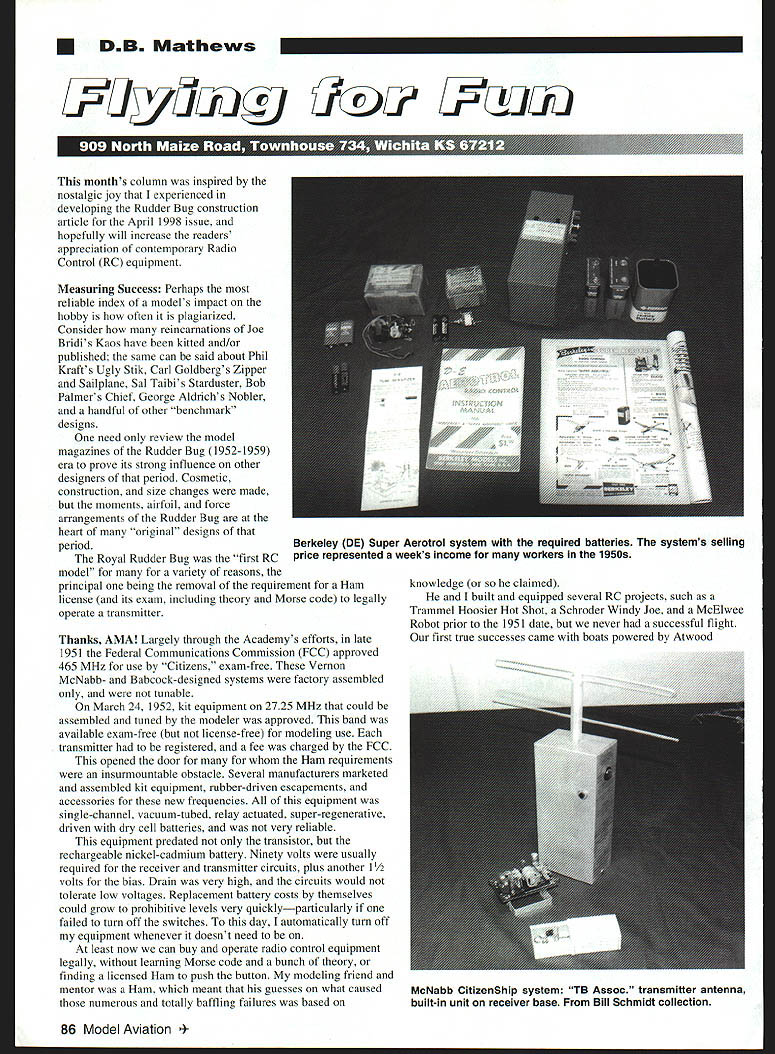
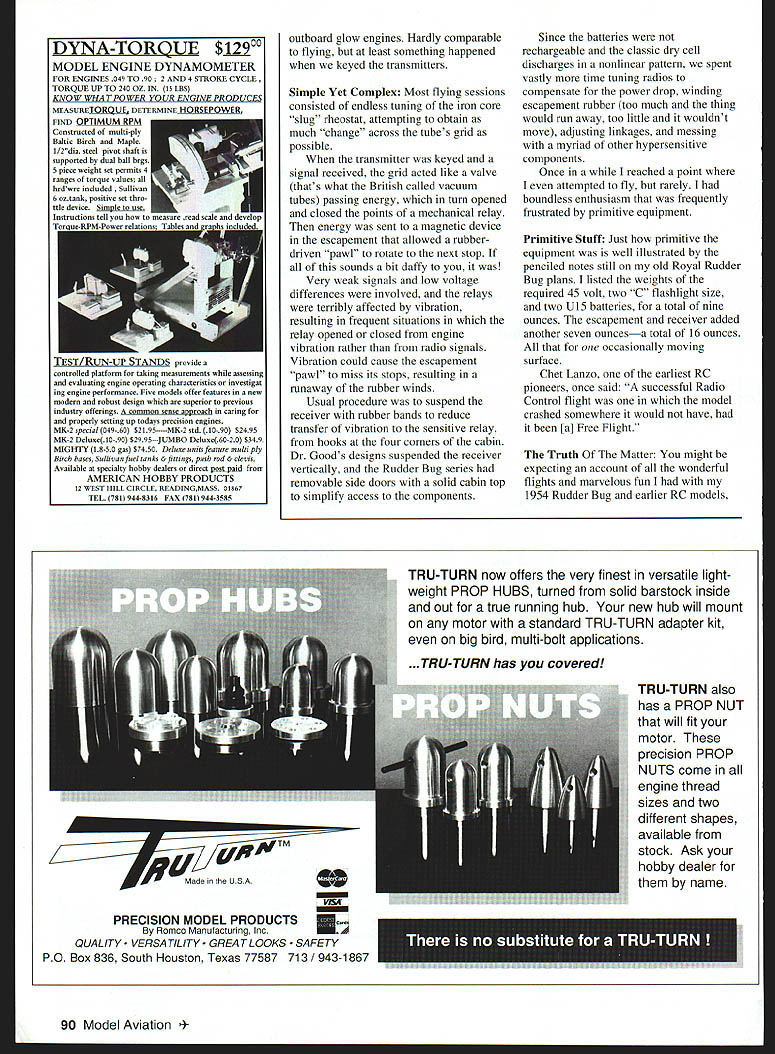
Thanks, AMA! Largely through the Academy's efforts, in late 1951 the Federal Communications Commission (FCC) approved 465 MHz for use by "citizens," exam-free. These Vernon McNabb- and Babcock-designed systems were factory assembled only, and were not tunable.
On March 24, 1952, kit equipment on 27.25 MHz that could be assembled and tuned by the modeler was approved. This band was available exam-free (but not license-free) for modeling use. Each transmitter had to be registered, and a fee was charged by the FCC.
This opened the door for many for whom the Ham requirements were an insurmountable obstacle. Several manufacturers marketed and assembled kit equipment, rubber-driven escapements, and accessories for these new frequencies. All of this equipment was single-channel, vacuum-tubed, relay-actuated, super-regenerative, driven with dry-cell batteries, and was not very reliable.
This equipment predated not only the transistor, but the rechargeable nickel-cadmium battery. Ninety volts were usually required for the receiver and transmitter circuits, plus another 1½ volts for the bias. Drain was very high, and the circuits would not tolerate low voltages. Replacement battery costs themselves could grow to prohibitive levels very quickly—particularly if one failed to turn off the switches. To this day, I automatically turn off my equipment whenever it doesn't need to be on.
At least now we can buy and operate radio control equipment legally, without learning Morse code and a bunch of theory, or finding a licensed Ham to push the button. My modeling friend and mentor was a Ham, which meant that his guesses on what caused those numerous and totally baffling failures were based on knowledge (or so he claimed).
He and I built and equipped several RC projects, such as a Trammel Hoosier Hot Shot, a Schroder Windy Joe, and a McElwee Robot prior to the 1951 date, but we never had a successful flight. Our first true successes came with boats, powered by Atwood outboard glow engines. Hardly comparable to flying, but at least something happened when we keyed the transmitters.
Simple Yet Complex
Most flying sessions consisted of endless tuning of the iron-core "slug" rheostat, attempting to obtain as much "change" across the tube's grid as possible.
When the transmitter was keyed and a signal received, the grid acted like a valve (that's what the British called vacuum tubes), passing energy, which in turn opened and closed the points of a mechanical relay. Then energy was sent to a magnetic device in the escapement that allowed a rubber-driven "pawl" to rotate to the next stop. If all of this sounds a bit daffy to you, it was!
Very weak signals and low voltage differences were involved, and the relays were terribly affected by vibration, resulting in frequent situations in which the relay opened or closed from engine vibration rather than from radio signals. Vibration could cause the escapement "pawl" to miss its stops, resulting in a runaway of the rubber winds.
Usual procedure was to suspend the receiver with rubber bands to reduce transfer of vibration to the sensitive relay, from hooks at the four corners of the cabin. Dr. Good's designs suspended the receiver vertically, and the Rudder Bug series had removable side doors with a solid cabin top to simplify access to the components.
Since the batteries were not rechargeable and the classic dry cell discharges in a nonlinear pattern, we spent vastly more time tuning radios to compensate for the power droop, winding escapement rubber (too much and the thing would run away, too little and it wouldn't move), adjusting linkages, and messing with a myriad of other hypersensitive components.
Once in a while I reached a point where I even attempted to fly, but rarely. I had boundless enthusiasm that was frequently frustrated by primitive equipment.
Primitive Stuff
Just how primitive the equipment was is well illustrated by the penciled notes still on my old Royal Rudder Bug plans. I listed the weights of the required 45-volt, two "C" flashlight-size, and two "D" batteries, for a total of nine ounces. The escapement and receiver added another seven ounces—for a total of 16 ounces. All that for one occasionally moving surface.
Chet Lanzo, one of the earliest RC pioneers, once said: "A successful Radio Control flight was one in which the model crashed somewhere it would not have, had it been a Free Flight."
The Truth of the Matter
You might be expecting an account of all the wonderful flights and marvelous fun I had with my 1954 Rudder Bug and earlier RC models, but I cannot give you that! My Berkeley Models Royal Rudder Bug was a disaster—in no way a reflection of the kit or of Walt Good's design skills, but the fault of my own ineptitude and the marginal radio equipment.
The first flight was a flyaway. The K&B .19 Greenhead engine worked very well, but nothing else did. I launched the model, executed one 90° turn, then had no control whatsoever. Because of its inherent stability, the Royal Bug climbed lazily in wide circles, engine merrily running, obtaining considerable height, while I stood below frantically pushing the transmitter "key," then helplessly watching it slowly disappear downwind.
Only with the help of the local undertaker, who happened to own and fly a Cessna 195, was I able to locate the model—undamaged, but stuck in the top of some very tall sunflowers several miles downwind.
A postmortem (pun intended) revealed that a bolt and nut had vibrated loose, allowing the Bonner compound escapement to drop down on one side, locking the model in neutral rudder.
The second flight was even more bizarre. I hand-launched the Bug, only to watch it fail to gain altitude or respond to me frantically pushing the transmitter button. The model flew about half a mile, level and straight as an arrow, right into a stone fence post! The only damage was messed-up threads on the crankshaft, and a severely wounded ego. One witness to this fiasco was a young lady who later became my wife of 42 years, in spite of model airplanes!
The cause of this disaster was a switch failure—an all-too-common occurrence with RC well into the 1970s.
I Surrender
The summer had run out by then (along with my enthusiasm), and it was time to return to campus for another busy year. The red-silk and clear-doped Royal Rudder Bug was placed in storage, moved around the country by the Air Force, often admired but never flown again, and finally thrown away.
I relate this bit of history with considerable humility, since it is evident from reading accounts of other modelers' great success in the 1950s and 1960s that I must have been a terrible klutz. Or perhaps I'm being more candid than some.
The "fiddlers' delight" aspects of RC modeling during that time period so turned me off that I refused to mess with it further. Instead, I concentrated on Free Flight and Control Line with my sons until 1973, by which time reliable equipment was available at reasonable cost.
I purchased a proportional system from Jim Finley and installed it in a previously Free Flight Buzzard Bombshell, and taught myself to fly it. I advised Jim on the telephone that all was well with the installation, but I could not figure out how to wind the escapement rubber.
Not only was I hopelessly inept, but I must also have been a pack rat since the new Bug version was developed for the original Flying Models and Berkeley plans! I carried them around for 42 years thinking that someday I'd build another Royal Rudder Bug to erase those bad old memories. I finally did it, and am absolutely thrilled with the results.
It's not often in life that we are given the opportunity to erase bad memories, but this project has done so. It is unfortunate that I was not smart enough to make that old Acrotrol system work, because the Royal Rudder Bug is one fine model airplane.
Transcribed from original scans by AI. Minor OCR errors may remain.

