
Flying for Fun
D.B. Mathews 909 North Maize Road, Townhouse 734, Wichita KS 67212
A Splendid Subject
In the last several columns I've been "banging the drum," promoting unusual modeling subjects. This month I have a rare, yet extremely appealing aircraft: the Boeing Model 80.
Many people are familiar, to one extent or another, with the Ford and Junkers trimotors, and to a lesser extent with the American Fokker units. Did you know that they were preceded by trimotor commercial aircraft not only from Boeing and Stinson, but also from Armstrong Whitworth (the Argosy), de Havilland (the Hercules), and several other domestic and foreign manufacturers?
Why three engines? I'd suspect that the answer lies in what was available in reliable power plants at the time the aircraft were designed. Aircraft designs have been dictated by power plant development since the Wright brothers.
A vivid example is the unsuccessful Dornier DoX flying boat. It was conceived as revolutionary in size, capable of carrying 100 passengers across the Atlantic. However, to obtain sufficient power for it to fly, no less than 12 engines of the most powerful design then available (500-hp Daimler-Benz) were needed. If larger engines had been available, the poor thing probably wouldn't have been handicapped by the weight and drag of 12 engines, their nacelles, and all of those propellers.
Following that line of logic, wouldn't you suspect that if two engines of 700 or 800 hp had been available to the Boeing engineers, the Model 80 would have been designed as a twin-engined rather than a three-engined airplane?
A glance through aviation history reveals that many excellent aircraft were failures because the engine builders were unable to perfect new powerplants. Many of the P-70 series of fighters were to be powered with unsuccessful engines such as horizontal 12-cylinder and X-shaped liquid-cooled units.
I seem to be saying, "first the engine, then the airplane."
If you've ever visited the magnificent Seattle Museum of Flight, you might have seen a Model 80 as the centerpiece of the displays. I was very impressed with the appeal of the Model 80 as a modeling subject, and wondered why I'd never seen a flying model of it. The aircraft in Seattle was a 1928 Model 80 12-passenger version with three 425-hp Wasp engines. NC 224M was entered into service in May 1930 by Boeing Air Transport System.
In the early 1930s Boeing, Stearman, Northrop, United Airlines, Pratt & Whitney, Hamilton Standard, and several other firms merged into United Aircraft for a while until the U.S. Justice Department broke it up under the antitrust laws. The reason given was that United Aircraft, converting raw materials into nearly finished components and airplanes, could provide direct government-subsidized airline service. United Aircraft's monopoly gave an unfair advantage over other airlines and manufacturers. I wonder whether those laws were later repealed.
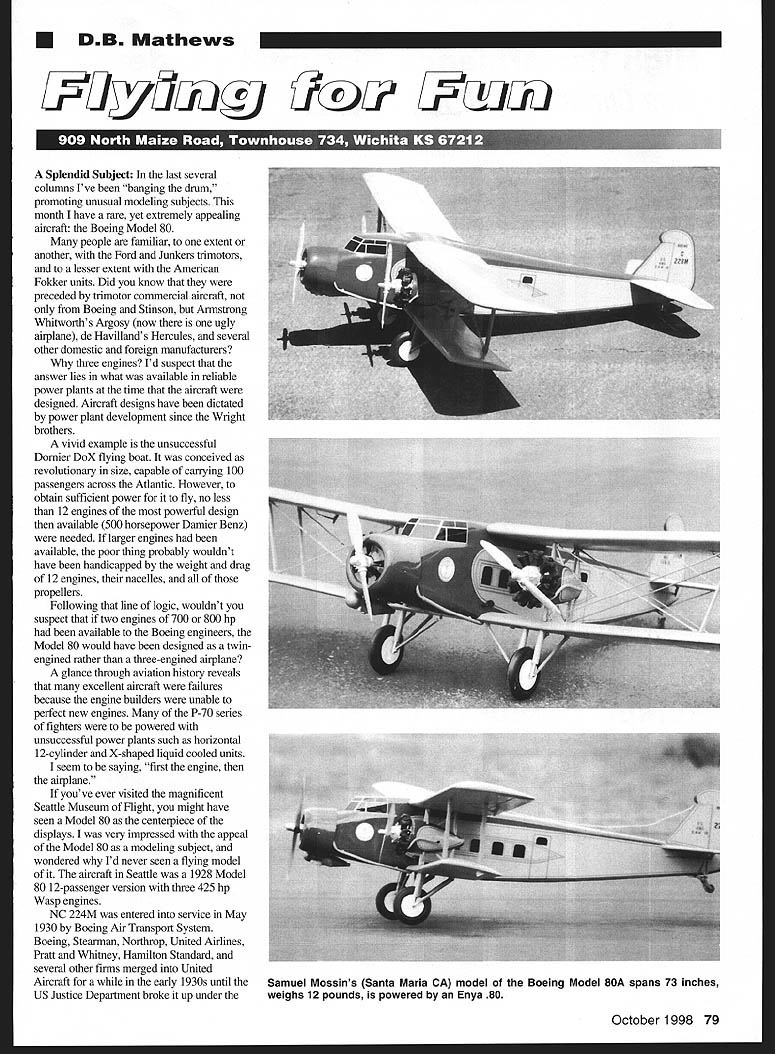
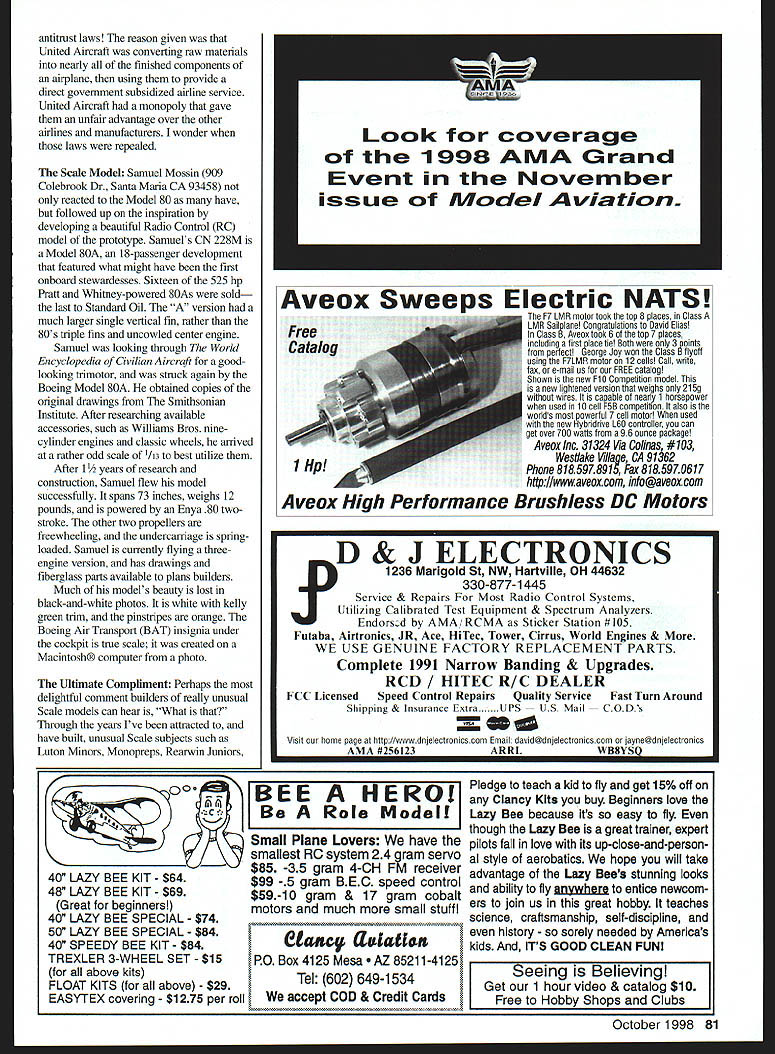
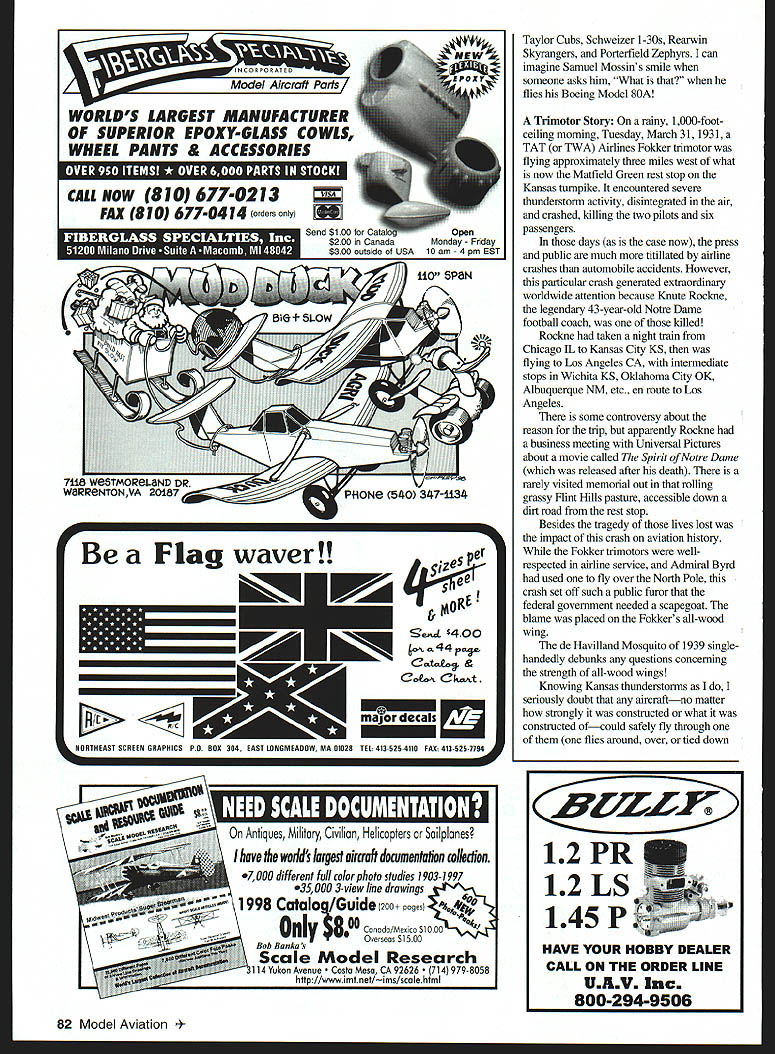
Samuel Mossin (909 Colebrook Dr., Santa Maria, CA 93458) reacted to the Model 80 and followed up that inspiration by developing a beautiful radio control (RC) model prototype. Samuel's Model 80A was an 18-passenger development that featured what might have been the first onboard stewardesses. Sixteen 525-hp Pratt & Whitney–powered 80As were sold. The Standard Oil version had a much larger single vertical fin rather than the 80's triple fins and an uncowled center engine.
Samuel, looking through the World Encyclopedia of Civilian Aircraft, was struck again by the good-looking trimotor and obtained copies of the original drawings from the Smithsonian Institution. After researching available accessories such as Williams Brothers nine-cylinder engines and classic wheels, and after extensive research and construction, Samuel flew his model successfully.
The Scale Model
Samuel's Model 80A spans 73 inches, weighs 12 pounds, and is powered by an Enya .80 two-stroke. The other two propellers freewheel and the undercarriage is spring-loaded. He arrived at a rather odd scale of 1/13 to best utilize available accessories. After 1½ years of research and construction, Samuel flew his model successfully and is currently flying the three-engine version. He has drawings, fiberglass parts, and plans available to builders.
Much of a model's beauty is lost in black-and-white photos. Samuel's model is white with kelly green trim; the pinstripes and the Boeing Air Transport (BAT) insignia under the cockpit are true to scale. The insignia was created on a Macintosh computer from a photo.
The Ultimate Compliment
Perhaps the most delightful compliment builders of really unusual scale models can hear is, "What is that?" I can imagine Samuel Mossin's smile when someone asks him that while he flies his Boeing Model 80A, just as owners of Taylor Cubs, Schweizer 1-30s, Rearwin Skyrangers, and Porterfield Zephyrs enjoy similar reactions.
A Trimotor Story
On a rainy, 1,000-foot-ceiling morning, Tuesday, March 31, 1931, a TAT (or TWA) Fokker trimotor was flying approximately three miles west of what is now the Moffett/Green rest stop on the Kansas Turnpike. It encountered severe thunderstorm activity, disintegrated in the air, and crashed, killing the two pilots and six passengers.
In those days (as is the case now), the press and public are much more titillated by airline crashes than automobile accidents. However, this particular crash generated extraordinary worldwide attention because Knute Rockne, the legendary 43-year-old Notre Dame football coach, was one of those killed.
Rockne had taken a night train from Chicago to Kansas City, then was flying to Los Angeles with intermediate stops in Wichita, Oklahoma City, Albuquerque, etc., en route to Los Angeles. There is some controversy about the reason for the trip, but apparently Rockne had a business meeting with Universal Pictures about a movie called The Spirit of Notre Dame (released after his death). There is a well-remembered memorial out in that rolling Flint Hills pasture, accessible down a dirt road from the rest stop.
Besides the tragedy of the lives lost was the impact of this crash on aviation history. While the Fokker trimotors were well respected in airline service (Admiral Byrd had used one to fly over the North Pole), this crash set off such a public furor that the federal government needed a scapegoat. The blame was placed on the Fokker's all-wood wing.
The de Havilland Mosquito of 1939 single-handedly debunks any questions concerning the strength of all-wood wings.
Knowing Kansas thunderstorms as I do, I seriously doubt that any aircraft—no matter how strongly constructed or what it was constructed of—could safely fly through one of them. One flies around, over, or ties down. The power of thunderstorms is legendary on the high plains of the United States.
I distinctly recall a situation in which a flight of three USAF F-84s attempted to penetrate a "boiler" over Kansas, and not only didn't make it through, but scattered pieces over Kansas, Nebraska, and Colorado. One of the pilots who ejected was whipped around in the storm for nearly an hour before descending (badly battered by hail) more than 100 miles away.
In 1931, anything much above 10,000 feet of altitude—which is about 20,000–30,000 feet below the tops of many Kansas thunderstorms—was a strain for any aircraft. Also, virtually no reliable meteorology, adequate in-flight radio communication, or weather radar existed. One can only presume that the TAT pilots blundered into a thunderstorm in the rain and low ceilings, and the storm destroyed their airplane.
Admitting to the public that commercial airplanes were dangerous in bad weather would never do, so the powers-that-be blamed the wooden wing construction and banned all such aircraft from airline use, leading to the demise of American Fokker shortly thereafter. Guess what huge and highly influential company built the only available large all-metal passenger airplane in the U.S.? American Fokker was a division of General Motors!
Boeing Model Numbers
Did you ever notice that the Boeing jet airliners have a gap in the numbering system? There is 707, 727, 737, 747, 757, 767, and now 777, but what happened to 717? That was the model number assigned to the Supersonic Transport project that died in the mock-up stage. It is my understanding that the 717 model number will be used for the McDonnell Douglas MD-90 as part of the two companies' merger.
Sources
- Rockne, the Coach, the Man, the Legend by Jerry Brandfield
- Flying the Boeing Model 80 from the Museum
- Boeing — A Pictorial History by Pete Bowers
- This Was Air Travel by Henry Palmer
Transcribed from original scans by AI. Minor OCR errors may remain.

