
Flying For Fun
Dr. D.B. Mathews 909 N. Maize Road, Townhouse 734, Wichita, KS 67212
Please glance up to the top of this page and notice that the heading includes my Wichita mailing address. For some reason the small staff at Model Aviation continues to be forced to forward letters addressed to me in Reston, Virginia. This is not only an obvious waste of time for those folks but a needless additional expense in postage.
Most of us columnists are not full-time employees of the magazines; we even have everyday jobs in the real world. Additionally—out of common courtesy—if you would like a response to the letter you send to Wichita, please enclose a business-size (#10) stamped, self-addressed envelope.
Not a bad dilemma: allocating sufficient time to pull together the text for this month's column has been much more difficult than usual. Why? Just pure, old-fashioned procrastination. I keep telling myself, "Let's go fly today; the column can be done tomorrow." Suddenly I'm out the door to go flying, and the column can be done tomorrow. You quickly learn to go flying on those rare days when the wind isn't blowing. There are always lots of windy days to do the nonessential stuff like paying utility bills, getting a haircut, or mowing the grass.
Not so this flying season! We have enjoyed more beautiful flying days in 1992 than I can ever recall. Unfortunately, from observing the national weather on the Weather Channel, I'm certain some of you have not been so fortunate. I hope that you have been blessed with at least enough good weather to do some flying for fun—and to heck with the bills, hair, and grass!
Christmas in July
I've been writing every-other-month columns for Model Aviation for almost 15 years; it seems I've had a disproportionate number of December issues. I've wished readers a Merry Christmas and Happy New Year. What always makes this seem so strange is that the publication schedule causes me to write the words in late July. Regardless of the oddity in timing, I certainly extend the best of the holiday season to each of you.
The year that was
While reflecting on the advent of a new year, it occurs to me that perhaps never before nor never again will there be a year quite as momentous for the future as 1992. Truly, there is reason for joy when we consider the events of the past year.
What many considered to be the most serious threat to personal freedom and world peace has collapsed internally. A new age of great promise has emerged for succeeding generations, and the predicted nuclear holocaust didn't occur. The collapse happened without any major military confrontations and with a minimum of pain in the U.S. Terrible costs in budget deficits are to be sure, but nothing irreparable. Now we must just pay the bills we generated in those 45 years of confrontation and get on with a new and brighter future. I find these events a source of stupendous joy and unbelievable relief—don't you?
A Harley in the heavens?
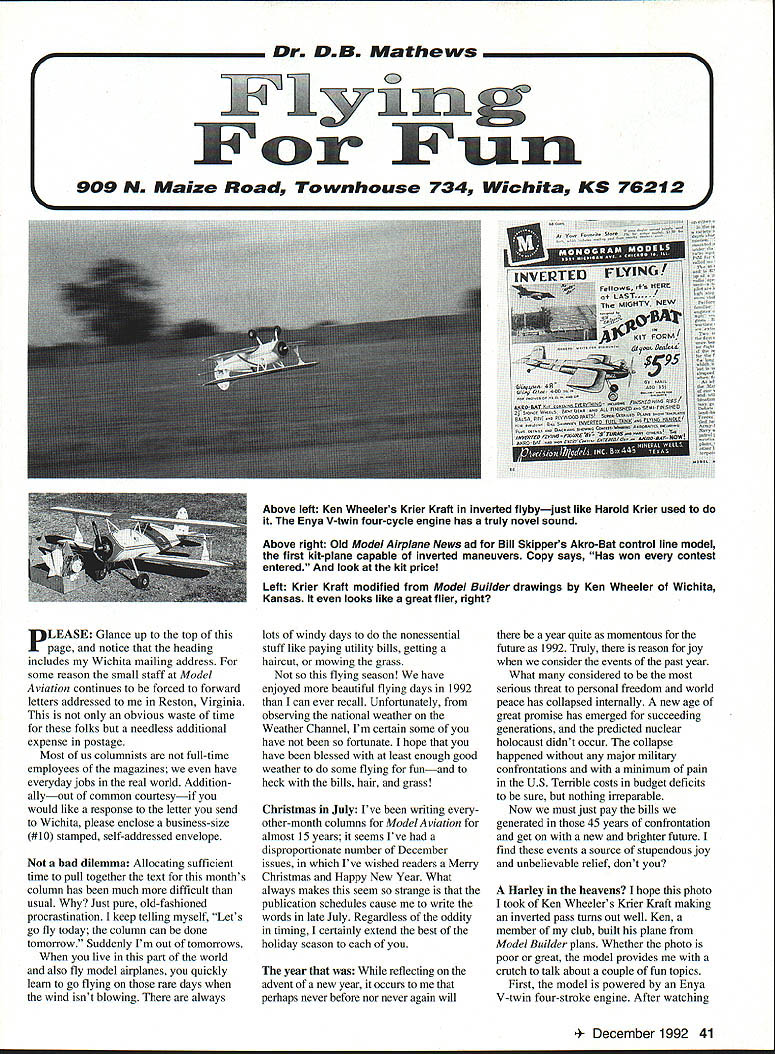
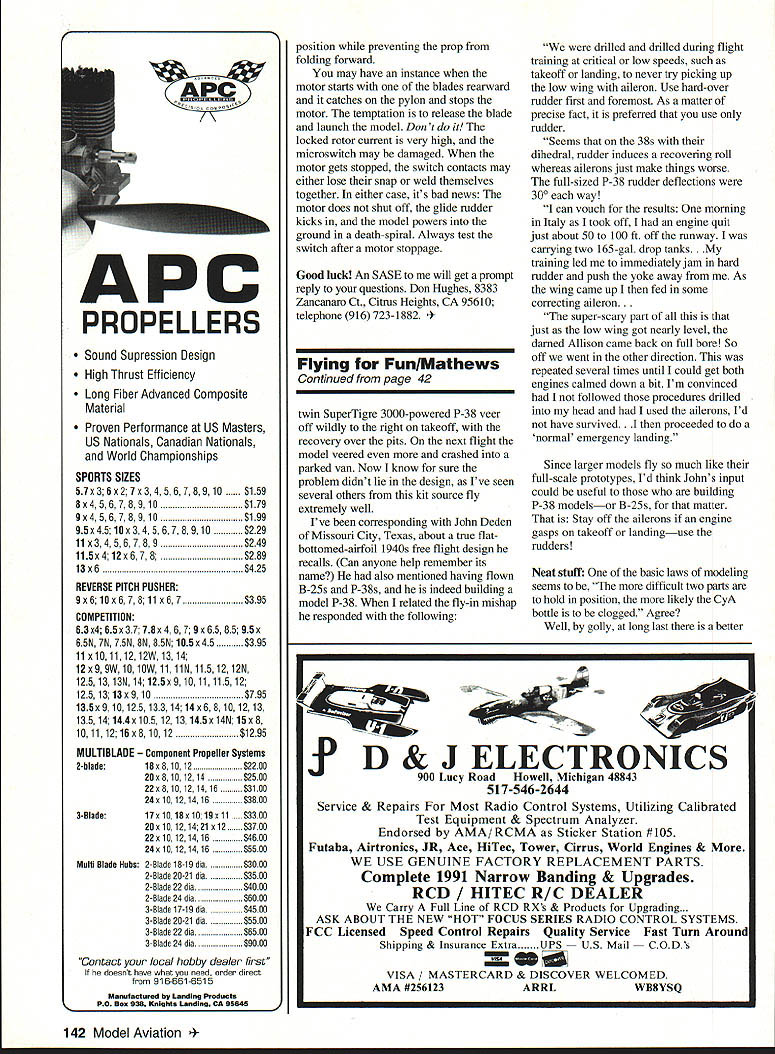
I hope this photo I took of Ken Wheeler's Krier Kraft making an inverted pass turns out well. Ken, a member of my club, built his plane from Model Builder plans. Whether the photo is poor or great, the model provides me with a crutch to talk about a couple of fun topics.
First, the model is powered by an Enya V‑twin four‑stroke engine. The Enya V‑twin has a truly novel sound. If you have heard two‑cylinder motorcycles or miniature twin engines run, you know you're missing a real thrill if you haven't heard one.
Secondly, the Krier Kraft itself has an interesting heritage. It was developed by Harold Krier and his brother years ago. Harold was a fixed‑base operator at the Garden City, Kansas, airport and flew a modified Great Lakes in air shows. He grew up in the tiny southwest Kansas town of Ashland; the local grass‑strip airport there now bears his name as a memorial, and a small museum with artifacts has been established a few miles southwest of the town. Harold practiced dentistry for years, and his patients in Ashland had nice things to say about him.
Tragically, Harold died when his parachute failed during a bailout from an unrecoverable spin while testing a prototype. Friends find the accident incredibly ironic because he was a meticulously careful man with his own aircraft. As an example of his thoroughness, I would trust him to change the oil on my airplane.
When the Ashland airport was dedicated back in the 1960s, Harold and other members of his era helped put aerobatics on the map; Bill Sweets' National Airshow (immortalized in the "Smilin' Jack" cartoon strips) showcased aerobatic displays. Harold had just finished flying his Super Chipmunk in public for the first time and performed the first Lomcevak I'd ever seen. I recall commenting that what he'd just done seemed aerodynamically impossible. I've since seen Lomcevaks done many times by both model and full‑scale aircraft, but I still think it's something special.
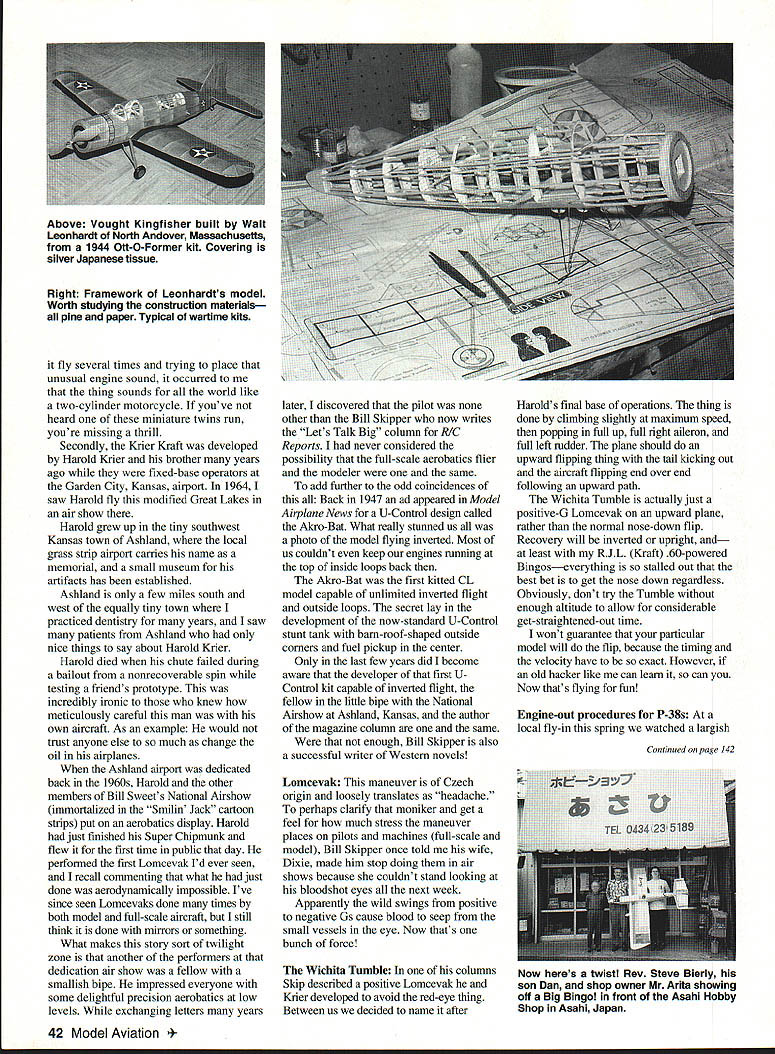
What makes this story even odder is that another performer at that dedication air show was a fellow who impressed everyone with delightful precision aerobatics at low levels. While exchanging letters many years later, I discovered that that pilot was none other than Bill Skipper, who now writes the "Let's Talk Big" column for R/C Reports. I had never considered the possibility that the full‑scale aerobatics flier and the modeler were one and the same. To add further coincidence: back in 1947 an ad appeared in Model Airplane News for a U‑Control design called the Akro‑Bat. What stunned us was a photo of the model flying inverted—most of us couldn't even keep our engines running at the top of inside loops then. The Akro‑Bat was the first kit for the U‑Control field capable of unlimited inverted flight and outside loops, thanks to the development of the now‑standard U‑Control stunt tank with barn‑door‑shaped outside valve and a center fuel pickup.
Only in the last few years did I become aware that the developer of that first U‑Control kit capable of inverted flight, the fellow in the little biplane at the Ashland Airshow, and the author of the magazine column are one and the same. Were that not enough, Bill Skipper is also a successful writer of Western novels!
Lomcevak
This maneuver is of Czech origin and loosely translates as "headache." To perhaps clarify that moniker and get a feel for how much stress the maneuver places on pilots and machines (full‑scale and model), Bill Skipper once told me his wife, Dixie, made him stop doing them in air shows because she couldn't stand looking at his bloodshot eyes all the next week. Apparently the wild swings from positive to negative Gs cause blood to seep from the small vessels in the eye. Now that's one bunch of force!
The Wichita Tumble
In one of his columns, Skip described a positive Lomcevak he and Krier developed to avoid the red‑eye problem. Between us we decided to name it after Harold's final base of operations: the Wichita Tumble.
The maneuver is done by climbing slightly at maximum speed, then popping in full up, full right aileron, and full left rudder. The plane should get an upward flipping motion with the tail kicking out and the aircraft flipping end over end following an upward path. The Wichita Tumble is actually just a positive Lomcevak on an upward plane, rather than the normal nose‑down flip. Recovery will be inverted or upright, and at least with my R.J.L. (Kraft) .60‑powered Bango—everything is so stalled out that the best bet is to get the nose down regardless.
Obviously, don't try the tumble without enough altitude to allow for considerable get‑straightened‑out time. I won't guarantee that your particular model will do the flip, because the timing and the velocity have to be so exact. However, if an old hacker like me can learn it, so can you. Now that's flying for fun!
Continued: models and full‑scale behavior
A twin SuperTiger 3000‑powered P‑38 veered off wildly to the right on takeoff, with the recovery over the pits. On the next flight the model veered even more and crashed into a parked van. I now know for sure the problem didn't lie in the design, as I've seen several others from this kit source fly extremely well.
I've been corresponding with John Deden of Missouri City, Texas, about a true flat‑bottomed‑airfoil 1940s free‑flight design he recalls. (Can anyone help remember its name?) He had also mentioned having flown B‑25s and P‑38s, and he is indeed building a model P‑38. When I related the fly‑in mishap he responded with the following:
"We were drilled and drilled during flight training at critical or low speeds, such as takeoff or landing, to never try picking up the low wing with aileron. Use hand‑over rudder first and foremost. As a matter of precise fact, it is preferred that you use only rudder.
"Seems that on the 38s with their dihedral, rudder induces a recovering roll whereas ailerons just make things worse. The full‑sized P‑38 rudder deflections were 30° each way!
"I can vouch for the results: One morning in Italy as I took off, I had an engine quit just about 50 to 100 ft. off the runway. I was carrying two 165‑gal. drop tanks... My training led me to immediately jam in hard rudder and push the yoke away from me. As the wing came up I then fed in some correcting aileron...
"The super‑scary part of all this is that just as the low wing got nearly level, the darned Allison came back on full bore! So off we went in the other direction. This was repeated several times until I could get both engines calmed down a bit. I'm convinced had I not followed those procedures drilled into my head and had I used the ailerons, I would not have survived... I then proceeded to do a 'normal' emergency landing."
Since larger models fly so much like their full‑scale prototypes, John's input could be useful to those building P‑38 models—or B‑25s, for that matter. That is: stay off the ailerons if an engine gasps on takeoff or landing—use the rudder!
Neat stuff
One of the basic laws of modeling seems to be, "The more difficult two parts are to hold in position, the more likely the CyA bottle is to be clogged." Agree? Well, by golly, at long last there is a better way to dispense CyA (cyanoacrylate glue)—Art Gross Enterprise's Drop‑Ets! These are polypropylene micropipettes similar to those used in hospital labs, but the manufacturer has applied them to our uses, and they work extremely well.
As an experiment, I've left a partially filled Drop‑Et on my workbench for over three weeks, and the darn thing dispensed drops when I finally used it! These micropipettes deliver adhesive in precise amounts, can be heated and stretched to tiny orifices, and if they do clog from some contaminant the end can be cut off with plenty left. However, they absolutely cannot be refilled. Also, placing the contents back into the factory bottle will contaminate the bottle and likely spoil it. That type of contamination is of course the reason the tips on the bottle clog in the first place.
If you haven't tried these, they are distributed nationally by Dave Brown Products as CA/Applicators and can be purchased at your local hobby shop.
The new molded fisherman's tackle boxes from Plano Manufacturing are also really great. I bought mine at a Wal‑Mart. The boxes have a locking drop‑down lid that holds four horizontal pullout compartmented drawers in place, and a lift‑up top for access to another large space. These boxes are just perfect for hauling (or storing) all those darn little nuts, bolts, wheel collars, tools, etc., that we always need at the flying field but can't locate because they're rolling around somewhere in the bottom of our field boxes.
Some of the drawers have compartments large enough to accommodate propellers, ball drivers, and that sort of stuff, while others are small enough to hold little hardware pieces. Don't take my word for it: go take a look at them in the fishing department at your local store.
Ott‑O‑Formers
A year or so ago Walt Leonhardt sent along photos of a Vought Kingfisher he had built in 1944 from a Joe Ott kit. I responded in some amazement since I'd tried building from those kits back then with absolutely zero success. Walt followed with the photos I've included this month and demonstrated that not only was it possible to build from those Ott‑O‑Former kits, but the planes would actually fly. The photographed model was built recently, but from an original kit.
After some thought, it occurs to me that I was a 12‑year‑old kid trying to build something much too complex—not to mention a certain built‑in ineptness. There wasn't that much wrong with the kits after all!
What made kits of that era so memorable was the almost total lack of balsa wood. As I've mentioned in the past, what little balsa made its way past the enemy submarines on its way from Ecuador to the U.S. was needed for life rafts and such; none was available for model airplanes. The Joe Ott Manufacturing Company (and many other kitters) developed designs using alternative woods—and often even cardboard. Although no balsa was available, the GIs and the folks at home were absolutely airplane crazy, and everyone wanted to build models of the airplanes we read about every day and saw in the Movietone newsreels. I'll bet thousands of such kits were built on top of footlockers in barracks all over the world.
A close look at the framework of Leonhardt's model reveals a strip‑and‑stringer box over which cardboard formers were slipped, then stringers added. Formers are easy to work with—almost like cutting out paper dolls with scissors. I've often thought such a construction technique would work really well with balsa formers. Does anyone know of a source of drawings that include templates for the formers for those Joe Ott wartime kits?
The hardware needed and drawings for lots of other wonderful rubber‑power designs of that era, such as double‑sized Earl Stahl scale stuff, are available from Old Time Model Supply, P.O. Box 7334, Van Nuys, CA 91409.
And finally, now that this month's column is finished, I'm still going to need to decide whether to do the chores or go flying. All in favor of flying for fun, start loading your cars!
Transcribed from original scans by AI. Minor OCR errors may remain.

