
Flying for Fun
By D.B. Mathews 909 North Maize Rd., Townhouse 734, Wichita KS 67212
The following fundamental material might lead the reader to say, "I already know that — skip the column." Yet a brief refresher is in order, considering a "failure to remember" in several instances.
It's a Gas
Earth's atmosphere is composed of molecules of several gases, the most common being nitrogen and oxygen and some rare ones such as helium. The atmosphere is held around the Earth's surface by gravity and thins to almost nothing at about 100 miles up. Closer to the Earth's surface the atmosphere is denser.
A law of physics states that heating a gas causes its molecules to disperse in proportion to the temperature; conversely, cooling a gas causes its molecules to move closer to one another and the gas becomes denser.
So What?
Variations in gas density severely affect both full-scale and model flight in several ways:
- Less-dense air has fewer molecules moving across a wing at a given airspeed, so warm air provides less lift.
- Hot, expanded air provides fewer molecules per ingested volume to an internal-combustion engine, adversely affecting its air/fuel mixture and reducing power.
- Propeller efficiency is reduced in less-dense air, much like wing performance.
- When the air contains higher amounts of moisture the power produced per “gulp” is decreased; with increases in humidity, temperature, and altitude the fuel mixture must be leaned because there is less air.
These variables are combined into a mathematical representation of atmospheric conditions called density altitude. Its critical importance in flight cannot be overstated.
Variables that affect density altitude include:
- Temperature
- Humidity
- Pressure/altitude
- (Indirectly) aircraft weight and wind conditions for takeoff/landing performance
Full-Scale Aircraft and Density Altitude
Full-scale aircraft, from a simple single-engine Cub to a high-performance WWII fighter, have methods or checklists to calculate density altitude, temperature, humidity, wind velocity, and takeoff weight so pilots can determine safe takeoff and landing speeds. At controlled airports, tower and meteorological services provide this data. Cropdusters—who often operate from non-updated fields—actually measure heat, humidity, wind velocity, and altitude to calculate safe loading for spray airplanes.
When airport air temperature and/or altitude are higher than normal, aircraft can require 20% to 30% (or more) additional runway to fly. Reduced air density also severely degrades climb rate and affects aerobatic performance.
A tragic example: a Learning Channel Air Disasters piece showed five aerobatic airplanes completing inside loops below ground level at airshows—three Pitts biplanes, a Sukhoi and a restored Spitfire Mk. IX—crashed and burned; the pilots died. Those pilots had probably performed inside loops many times before; otherwise they would have required special FAA clearance to perform below 500 feet. They failed to consider density-altitude factors. Airshows often take place during the hottest part of the day; add unfamiliar airports and a desire to thrill the crowd, and accidents become understandable.
Model Aircraft
The same density-altitude factors apply to model airplanes—Free Flight, Control Line, Radio Control (RC). Have you ever flown models on skis in winter? You may have noticed much shorter takeoff runs, smoother-running engines, and better performance compared with hot summer days.
I attended two fly-ins on very hot days. Several models lifted off after the usual takeoff run length, then staggered side-to-side before accelerating to flying speed. Landings showed the same side-to-side semi-stall behavior; some fliers blamed radio interference. Two models actually crashed on final due to radio failure (thumbs running the sticks). What I observed was reduced lift, engine performance and propeller efficiency associated with heat-related density-altitude changes. That's enough reason to be aware of heat, humidity and altitude and to adjust flying accordingly.
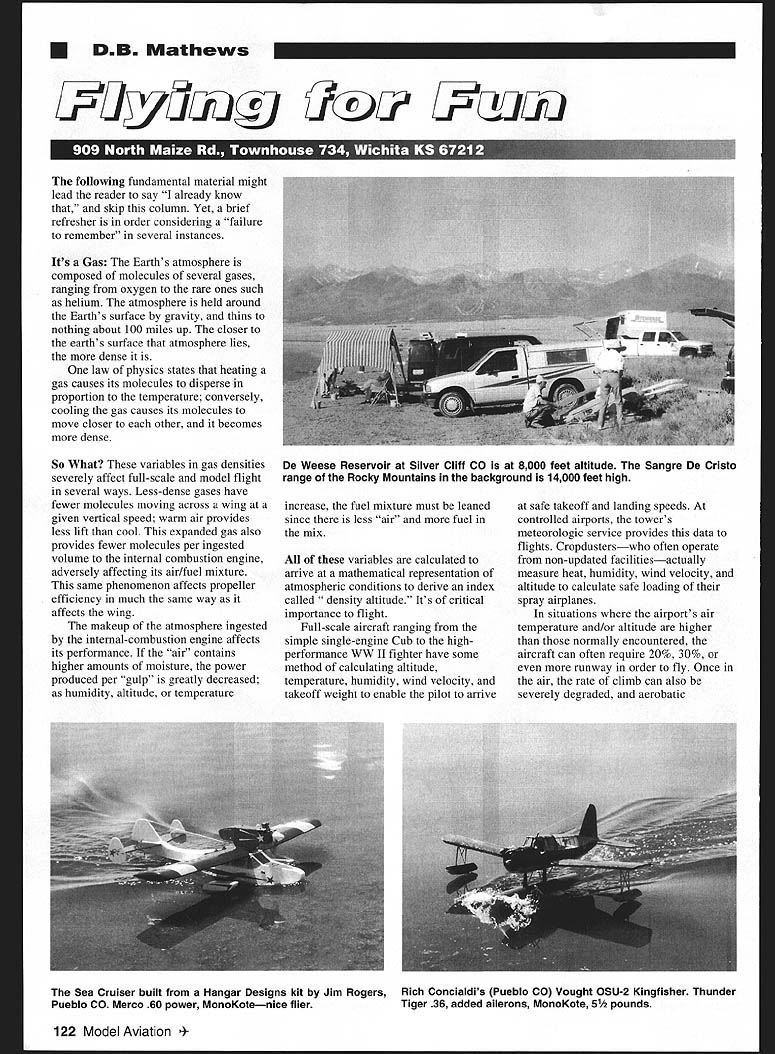
I also attended a Float Fly at Silver Cliff, Colorado, flown from a lake at about 8,000 feet. Flying an RC model on floats always requires more power, longer takeoff runs, and more careful piloting to compensate for added drag and weight. Add high altitude and lowered air density, and the challenge increases.
I took a .60-powered model that had flown well on floats at 1,800 feet and usually jumped right off the water and flew respectable aerobatics. At Silver Cliff I was unable to get the thing to break free from the water. Takeoff runs were extended so much that the slightest misalignment of the floats became a major problem.
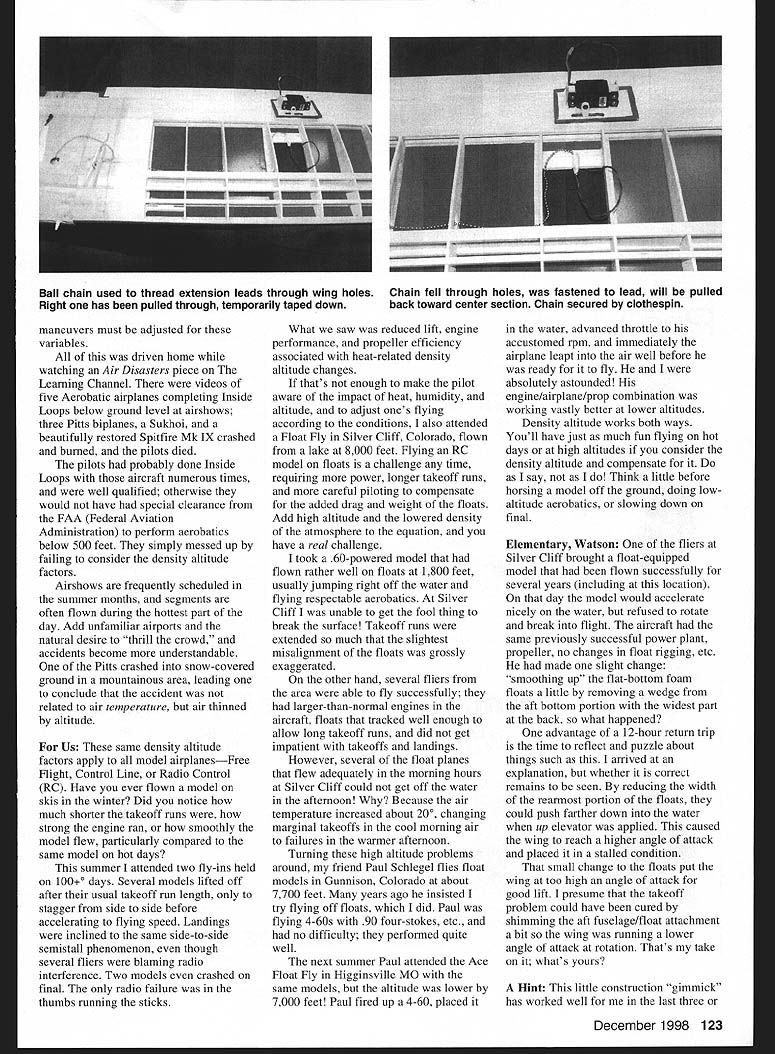
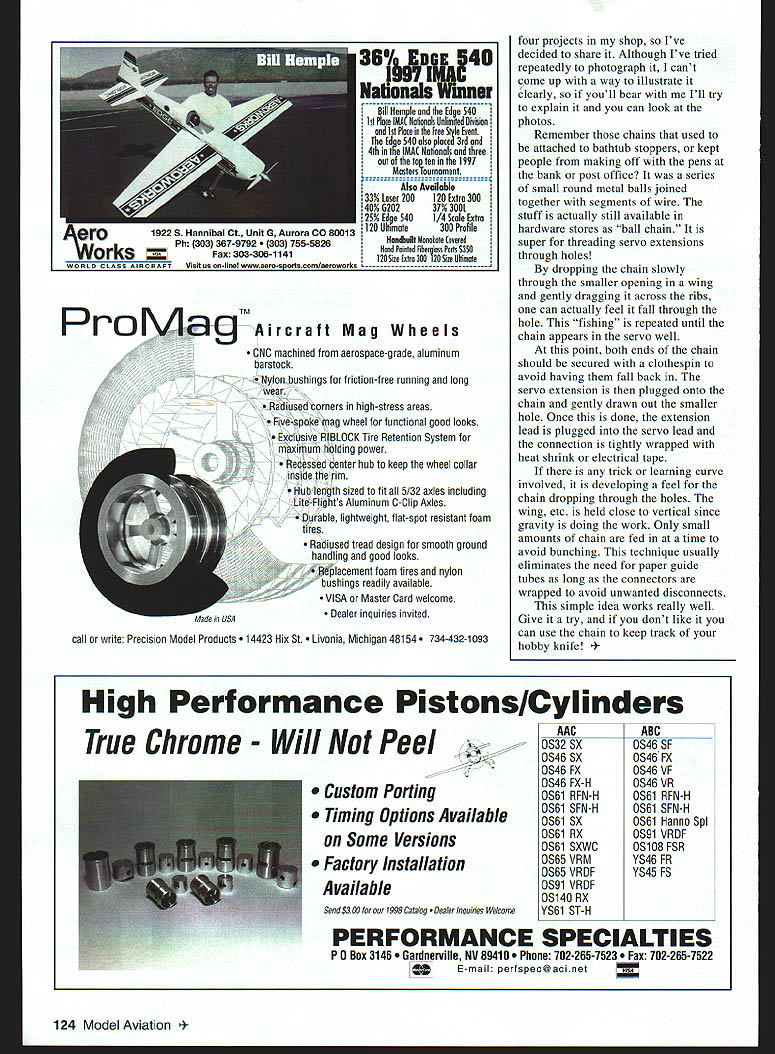
Several local fliers were successful; they used larger-than-normal engines, floats that tracked well for long runs, and the patience to accept long takeoff runs. However, several float planes that flew adequately in the cool morning could not get off the water in the afternoon after temperatures rose roughly 20°F. The marginal morning takeoffs became failures in the warmer afternoon.
Conversely, a friend, Paul Schlegel, flies float models in Gunnison, Colorado at about 7,700 feet. He had no trouble—flying 4-60s with .90 four-strokes and similar powerplants—and the same models performed dramatically better when he later flew them at much lower altitude in Higginsville, MO. At the lower altitude the airplane leapt into the air well before he expected it to. Density altitude works both ways: lower density degrades performance; higher density improves it.
Think before you try to horse a model off the ground, perform low-altitude aerobatics, or slow down on final—consider density altitude and compensate.
Elementary, Watson
One flier at Silver Cliff brought a float-equipped model that had been flown successfully for years, including at that location. On that day the model accelerated nicely on the water but refused to rotate and break into flight. The aircraft had the same power plant, propeller and float rigging as before; the only change was a slight smoothing of the flat-bottom foam floats by removing a wedge from the aft bottom portion with the widest part at the back.
My analysis: by reducing the width of the rearmost portion of the floats, they would push farther down into the water when up elevator was applied. This increased the effective angle of attack of the wing and placed it in a stalled condition, preventing rotation. The small change to the floats put the wing at too high an angle of attack for lift. I presume the takeoff problem could be cured by shifting the tail or fuselage/float attachment point so the wing runs a little further ahead of rotation.
A Hint
A simple construction trick for threading servo extensions through wing holes:
- Buy "ball chain" (the small metal ball chains used on bathtub stoppers or pen chains); it's available at hardware stores.
- Drop the chain slowly through the smaller opening in the wing and gently drag it across the ribs; you can feel it fall through the hole. Repeat until the chain appears in the servo well.
- Secure both ends of the chain with a clothespin to avoid losing them back inside.
- Plug the servo extension onto the chain and gently draw it out through the smaller hole.
- Plug the extension lead into the servo lead and wrap the connection tightly with heat-shrink tubing or electrical tape to prevent disconnects.
Tips: Hold the wing nearly vertical so gravity helps. Feed only small amounts of chain at a time to avoid bunching. This technique usually eliminates the need for paper guide tubes as long as connectors are wrapped to avoid unwanted disconnects.
This simple idea works well. If you don't like it, you can always use the chain to keep track of your hobby knife!
Transcribed from original scans by AI. Minor OCR errors may remain.

