
Flying for Fun
909 North Maize Rd., Townhouse 734, Wichita KS 67212
Last month I tossed out a rule-of-thumb method that I use to loosely predict power requirements for models; in particular, I was attempting to assess the likelihood of Jim Hall's Super Kloud King flying on a Zenoah 445 twin.
Jim's 18-foot model, with a chord of 36.75 inches, gives an area of 54 square feet (sq. ft.), or 7,900 square inches (sq. in.). At 90 pounds, the Super Kloud King would therefore have a wing loading of 26+ ounces/sq. ft.—not at all heavy for a model of such large size.
By comparison, a full-scale Taylor E2 Cub has a wing loading of 70 ounces per sq. ft., and that is very light for a full-scale aircraft.
Now the power question: dividing the 7,900 sq. in. area of the model by my 250–300 factor indicates that the model would fly well on 3.16 cu. in. of power at 250, and 2.6 cu. in. at 300. That doesn't really surprise me; I'd bet that the Super Kloud King would even fly with a Zenoah .45 (2.7 cu. in.).
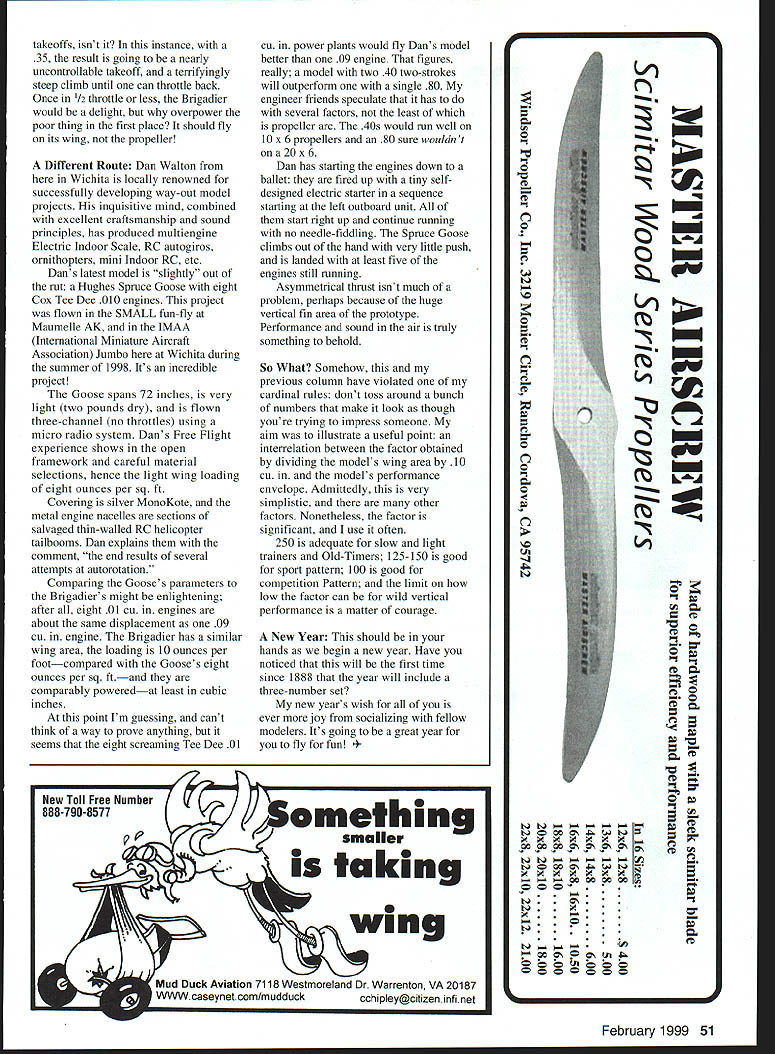
A 9.0 cubic centimeter (cc) twin (5.4 cu. in. × .85 = 4.59 cu. in.) should be more than enough, even considering the 85% allowance factor for smallish twins. The displacement-to-wing-area number would be 175. This is proven by Bill Cohen's (Paso Robles, CA) experience with his 14-foot Sal Taibi Powerhouse; a Quadra 35 would lift the monster almost at idle, and it was very difficult to land power on. Both models are likely overpowered relative to their intended use.
The Powerhouse's area is 4,704 sq. in., its weight is 25 pounds, and it used nine large rolls of MonoKote and 20 bottles of Jet CyA (cyanoacrylate). Using my calculations, the Powerhouse should need 1.5 cu. in. of power; the Quadra would be 2.1 cu. in.
There is no need whatsoever for a reduction drive for Hall's project; some efficiency loss from the frontal area/propeller arc is likely a plus. Jim's health has not allowed a test flight at the time of this writing. I anticipate that it will fly well, but if it does not, I will let you know.
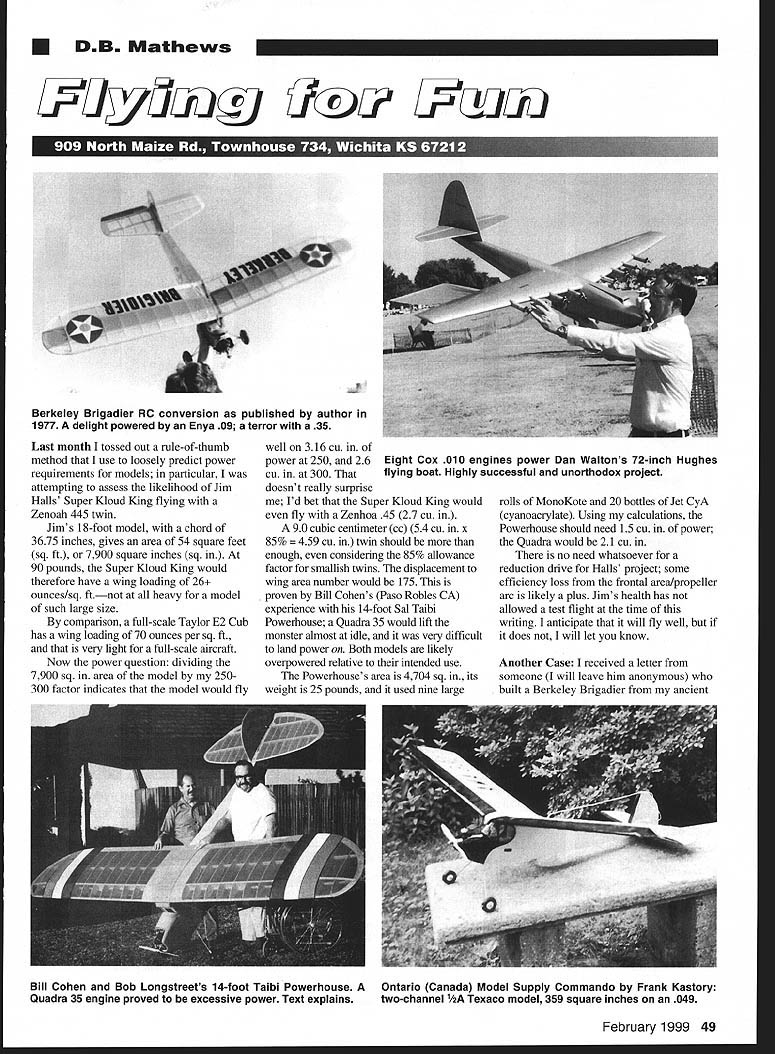
Another case: I received a letter from someone (I will leave him anonymous) who built a Berkeley Brigadier from my construction article in the November 1977 Model Airplane News. His model was almost uncontrollable — on takeoff it would climb; he had to trim with full-down elevator to maintain level flight. Having forgotten details of the design, he rechecked the article.
The Brigadier spanned 56 inches, area 450 sq. in., and weighed 32 ounces (10 ounces per sq. ft.). It was powered by an Enya .09. The drawings state engine .09–.35; using 250 sq. in. per 10 cu. in. power ratio, .15 would be OK.
I later learned that Old-Timer models of this small size don't respond to the rule, and the O.S. Max .15 that the builder was using had badly overpowered the Brigadier.
A model of 450 sq. in. will fly on an .049, if the model doesn't weigh much more than 24 ounces in weight! Doubt that? Look at the size of the popular 1/2A Radio Control Texaco designs; they average 300–350 sq. in. With a stock Black Widow engine and 6 x 3 propeller, they climb like rockets. For that reason, most competition fliers in this event over‑propeller to avoid having the model climb out of sight (OOS) and prolong engine runs with the allowed full stock tank of fuel.
If I could redo the power call on that Brigadier, I'd recommend 1cc–1.5cc (.06–.09 cu. in.). At the time that it was published, the only 1cc engines were imported diesels, but now several wonderful glow power plants of that size are available. Back then I was sure that the structure could handle the power of a .15, but I didn't understand the dynamics involved. We do live and learn!
The solution to taming the Brigadier's wild flying manners would be to install a smaller engine. Barring that, add downthrust of at least 5°, and perhaps the 4° already included in the design should correct the nose-up attitude problem. If it does not, try an oversize-diameter propeller with reduced pitch.
I know that one can use the throttle, but it is difficult to automatically avoid advancing the throttle to wide open on landing.
A Different Route
Dan Walton from here in Wichita is locally renowned for successfully developing way-out model projects. His inquisitive mind, combined with excellent craftsmanship and sound principles, has produced multiengine electric indoor scale, RC autogiros, ornithopters, mini indoor RC, etc.
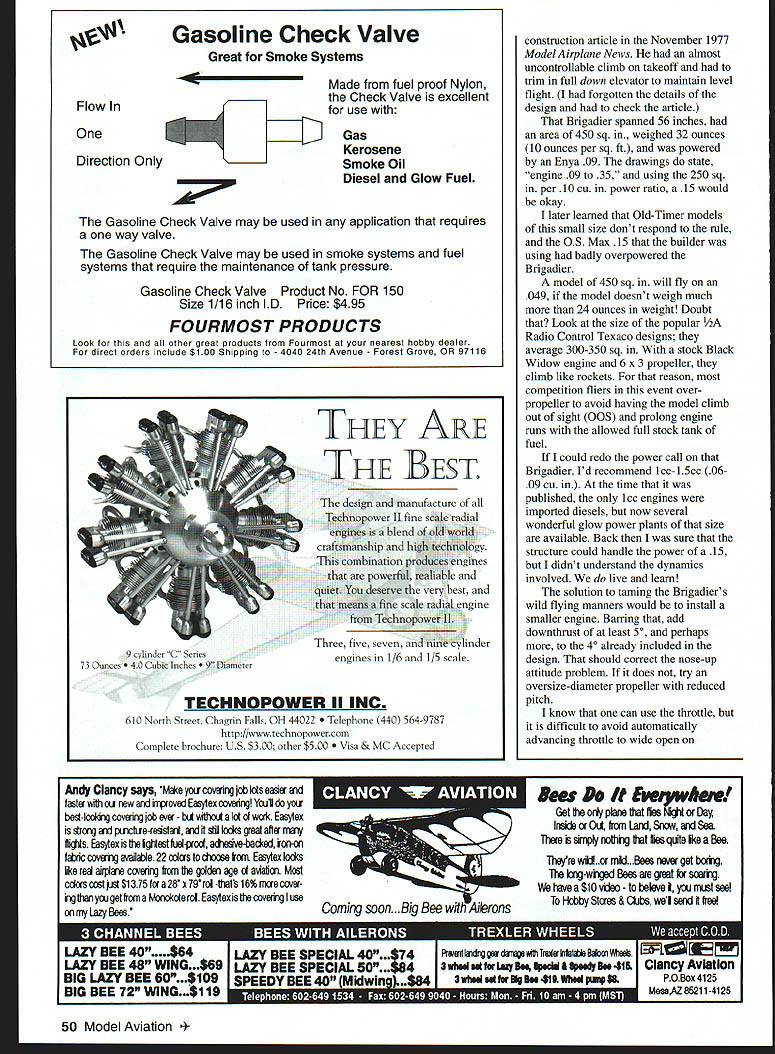
Dan's latest model is "slightly" out of the rut: a Hughes Spruce Goose with eight Cox Tee Dee .010 engines. This project was flown in the SMALL fun-fly at Maumelle, Ark., and in the IMAA (International Miniature Aircraft Association) Jumbo here at Wichita during the summer of 1998. It's an incredible project!
The Goose spans 72 inches, is very light (two pounds dry), and is flown three-channel (no throttles) using a micro radio system. Dan's free-flight experience shows in the open framework and careful material selections, hence the light wing loading of eight ounces per sq. ft.
Covering is silver MonoKote, and the metal engine nacelles are sections of salvaged thin-walled RC helicopter tailbooms. Dan explains them with the comment, "the end results of several attempts at autorotation."
Comparing the Goose's parameters to the Brigadier's might be enlightening; after all, eight .01 cu. in. engines are about the same displacement as one .09 cu. in. engine. The Brigadier has a similar wing area, the loading is 10 ounces per sq. ft.—compared with the Goose's eight ounces per sq. ft.—and they are comparably powered—at least in cubic inches.
At this point I'm guessing, and can't think of a way to prove anything, but it seems that the eight screaming Tee Dee .01 cu. in. power plants would fly Dan's model better than one .09 engine. That figures, really; a model with two .40 two-strokes will outperform one with a single .80. My engine friends speculate that it has to do with several factors, not the least of which is propeller arc. The .40s would run well on 10 x 6 propellers and an .80 sure wouldn't on a 20 x 6.
Dan has the engines starting down to a ballet as they are fired up with a tiny self-designed electric starter in a sequence starting at the left outboard unit. All of them start right up and continue running with no needle-fiddling. The Spruce Goose climbs out of the hand with very little push, and is landed with at least five of the engines still running.
Asymmetrical thrust isn't much of a problem, perhaps because of the huge vertical fin area of the prototype. Performance and sound in the air is truly something to behold.
So What?
Somehow, this and my previous column have violated one of my cardinal rules: don't toss around a bunch of numbers that make it look as though you're trying to impress someone. My aim was to illustrate a useful point: an interrelation between the factor obtained by dividing the model's wing area by .10 cu. in. and the model's performance envelope. Admittedly, this is very simplistic, and there are many other factors. Nonetheless, the factor is significant, and I use it often.
- 250 is adequate for slow and light trainers and Old-Timers.
- 125–150 is good for sport pattern.
- 100 is good for competition Pattern.
- How low the factor can be for wild vertical performance is a matter of courage.
A New Year
This should be in your hands as we begin a new year. Have you noticed that this will be the first time since 1888 that the year will include a three-number set?
My new year's wish for all of you is ever more joy from socializing with fellow modelers. It's going to be a great year for you to fly for fun!
Transcribed from original scans by AI. Minor OCR errors may remain.

