
Flying for Fun
D.B. Mathews 909 North Maize Rd., Townhouse 734, Wichita KS 67212
Really Big
Last month I mentioned 250 sq. in. (square inches) per 0.10 cu. in. (cubic inches) as a benchmark for light, low-speed model aircraft, such as Old-Timers and primary trainers. On the other hand, performance requirements lower that ratio as weight, required velocity, and aerobatic demands increase.
A .60-size sport Pattern model will have, on average, about 800 sq. in., or about 130 sq. in. per 0.10 cu. in. of power. A wild unlimited-vertical-performance model will have as little as 60 sq. in. per 0.10 cu. in.
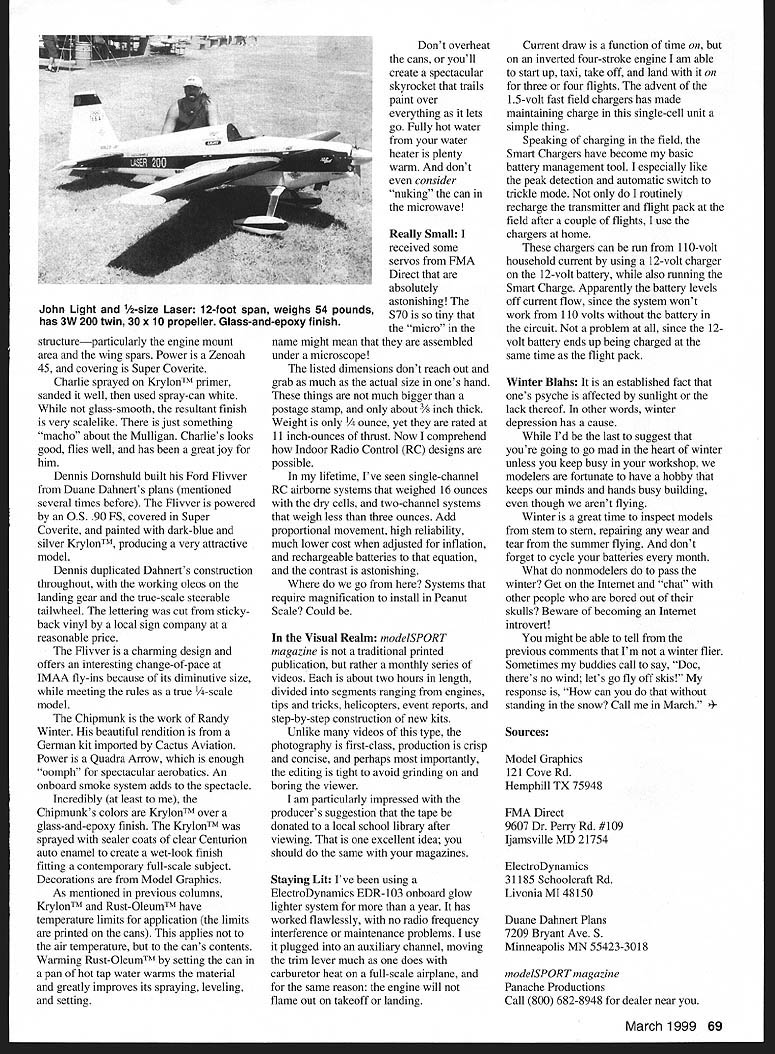
Just for fun, I'll put those ranges into John Light's 1/2-size Laser. The model weighs 54 pounds, spans 144 inches (12 feet), and has about 3,900 sq. in. of wing area. Hence the wing loading is in the neighborhood of 32 ounces per sq. ft. — actually light for a model this size. The power plant is a 3W-200 twin (12 cu. in.) swinging a 30 x 10 propeller.
When twin-cylinder engines get this large, the improved efficiencies of inertia, etc., overcome the losses inherent in smaller twins, so figure this one at full displacement. Stir this into the wing-area-per-0.10-cu.-in. concept and startle yourself! I come up with 32. John's Laser is quite aerobatic and very strong in vertical maneuvers.
I maintain that there is room in this model airplane hobby for everything and everybody, but this Laser does take up a great deal of room.
Fantasy
I first saw John Light fly his 1/2-size Laser at an IMAA (International Miniature Aircraft Association) fly-in at Salina, KS. That wonderful field is at the far south end of the old municipal airport, with concrete runways, etc. About 150 feet west of the runway end is a large metal city water tank.
During one of the Laser's flights, John experienced a radio glitch (a stray radio frequency harmonic bouncing off the tank?) during a low knife-edge pass, and the model veered rather sharply toward the water tank before John recovered it.
Bill Carpenter and I wondered: if the model had actually hit and punctured the tank, would the accident have made the evening news?
Krylon Finishes
In past columns I overviewed several finishing techniques for models. Several paint-type products were mentioned, but one I hadn't recommended was plain old hardware-store spray-can Krylon — mostly because I had poor results with it long ago and had developed a preference for Rust-Oleum.
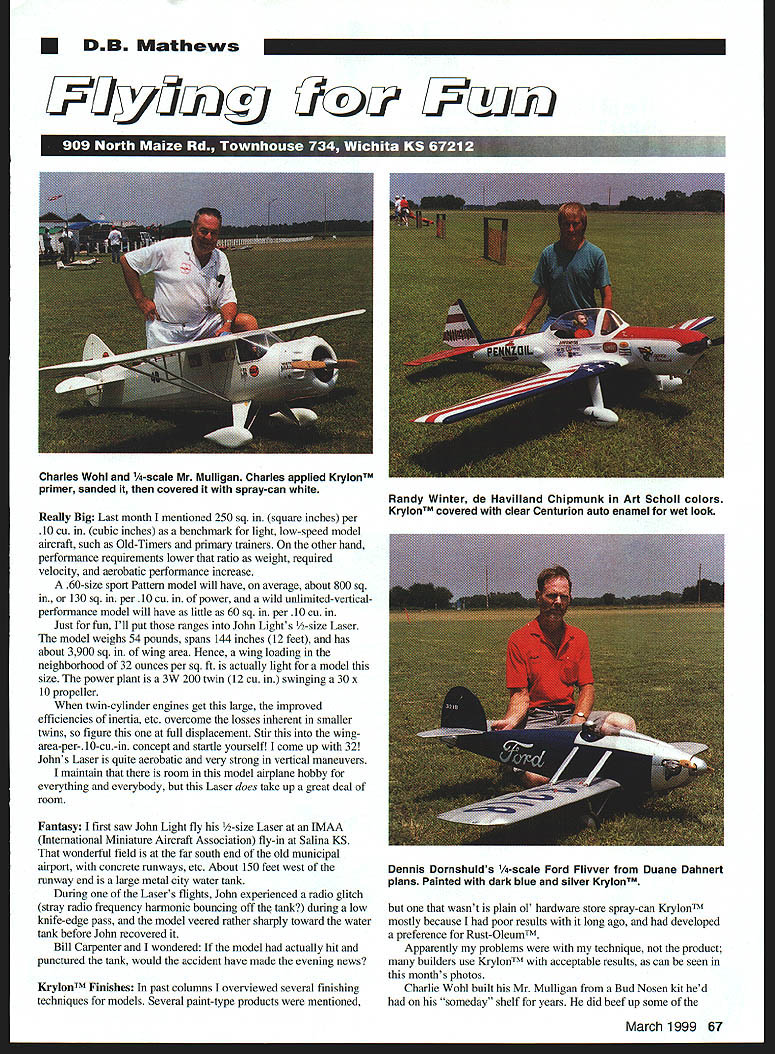
Apparently my problems were with my technique, not the product; many builders use Krylon with acceptable results, as can be seen in this month's photos.
Charlie Wohl — Mr. Mulligan
Charlie Wohl built his Mr. Mulligan from a Bud Nosen kit he'd had on his "someday" shelf for years. He beefed up some of the structure, particularly the engine-mount area and wing spars. Charlie sprayed Krylon primer, sanded well, and used spray-can white to produce a glass-smooth, very scale-like finish. There's just something macho about Mulligan. Charlie's looks good, flies well, and has given him great joy.
Dennis Dornshuld — Ford Flivver
Dennis Dornshuld's 1/4-scale Ford Flivver, from Duane Dahnert plans mentioned several times before, is a charming design and offers an interesting change of pace at IMAA fly-ins because its diminutive size meets true-scale model rules. The Flivver is covered with Super Coverite, painted dark blue and silver Krylon, and powered as shown in the plans. Dennis duplicated Dahnert's construction throughout, using oleo landing gear, a true-scale steerable tailwheel, and lettering cut from sticky-back vinyl at a local sign company for a reasonable price.
Randy Winter — de Havilland Chipmunk
Randy Winter's de Havilland Chipmunk is a beautiful rendition from a German kit imported by Cactus Aviation. Powered suitably to give plenty of oomph for spectacular aerobatics, Randy added an onboard smoke system for additional spectacle. Incredibly, the Chipmunk's colors were achieved with Krylon over a glass-and-epoxy finish. Krylon sprayed sealer coats and a clear Centurion auto-enamel topcoat create a wet-look finish fitting the contemporary full-scale subject.
Application Notes
As mentioned in previous columns, Krylon and Rust-Oleum have temperature and application limits printed on the cans. Warming Rust-Oleum by setting the can in a pan of hot tap water warms the material and greatly improves spraying and leveling. Don't overheat cans — you'll create spectacular skyrocket trails of paint over everything. Fully hot water from the water heater is plenty warm; don't consider nuking a can in the microwave.
Really Small
I received some servos from FMA Direct that were absolutely astonishing. The S70 is so tiny that the "micro" in the name might mean that they are assembled under a microscope!
The listed dimensions don't reach out and grab as much as the actual size in one's hand. These things are not much bigger than a postage stamp, and only about 3/8 inch thick. Weight is only 1/4 ounce, yet they are rated at 11 inch-ounces of torque. Now I comprehend how Indoor Radio Control (RC) designs are possible.
In my lifetime, I've seen single-channel RC airborne systems that weighed 16 ounces with the dry cells, and two-channel systems that weigh less than three ounces. Add proportional movement, high reliability, much lower cost when adjusted for inflation, and rechargeable batteries to that equation, and the contrast is astonishing.
Where do we go from here? Systems that require magnification to install in Peanut Scale? Could be.
In the Visual Realm
modelSPORT magazine is not a traditional printed publication, but rather a monthly series of videos. Each is about two hours in length, divided into segments ranging from engines, tips and tricks, helicopters, event reports, and step-by-step construction of new kits.
Unlike many videos of this type, the photography is first-class, production is crisp and concise, and perhaps most importantly, the editing is tight to avoid grinding on and on. I am particularly impressed with the producer's suggestion that the tape be donated to a local school library after viewing. That is one excellent idea; you should do the same with your magazines.
Staying Lit
I've been using an ElectroDynamics EDR-103 onboard glow-lighter system for more than a year. It has worked flawlessly, with no radio frequency interference or maintenance problems. I use it plugged into an auxiliary channel, moving the trim lever much as one does with the carburetor heat on a full-scale airplane, and for the same reason: the engine will not flame out on takeoff or landing.
Current draw is a function of time on, but on an inverted four-stroke engine I am able to start up, taxi, take off, and land with it on for three or four flights. The advent of the 1.5-volt fast field chargers has made maintaining charge in this single-cell unit a simple thing.
Speaking of charging in the field, Smart Chargers have become my basic battery management tool. I especially like the peak detection and automatic switch to trickle mode. Not only do I routinely recharge the transmitter and flight pack at the field after a couple of flights, I use the chargers at home.
These chargers can be run from 110-volt household current by using a 12-volt charger on the 12-volt battery while also running the Smart Charger. Apparently the battery levels off current flow, since the system won't work from 110 volts without the battery in the circuit. Not a problem at all, since the 12-volt battery ends up being charged at the same time as the flight pack.
Winter Blahs
It is an established fact that one's psyche is affected by sunlight or the lack thereof. In other words, winter depression has a basis.
While I'd be the last to suggest that you're going to go mad in the heart of winter unless you keep busy in your workshop, we modelers are fortunate to have a hobby that keeps our minds and hands busy building, even though we can't fly.
Winter is a great time to inspect models from stem to stern, repairing any wear and tear from the summer flying. And don't forget to cycle your batteries every month.
What do nonmodelers do to pass the winter? Get on the Internet and "chat" with other people who are bored out of their skulls? Beware of becoming an Internet introvert!
You might be able to tell from the previous comments that I'm not a winter flier. Sometimes my buddies call to say, "Doc, there's no wind; let's go fly off skis!" My response is, "How can you do that without standing in the snow? Call me in March."
Sources
- Model Graphics
121 Cove Rd. Hemphill, TX 75948
- FMA Direct
9607 Dr. Perry Rd. #109 Ijamsville, MD 21754
- ElectroDynamics
31885 Schoolcraft Rd. Livonia, MI 48150
- Duane Dahnert Plans
7209 Bryant Ave. S. Minneapolis, MN 55423-3018
- modelSPORT magazine — Panache Productions
Call (800) 682-8948 for dealer near you.
Transcribed from original scans by AI. Minor OCR errors may remain.

