
Flying for Fun
909 North Maize Road, Townhouse 734, Wichita KS 67212
Bill Winter: With the passing of my guru, it would seem logical for me to write a eulogy to Bill. Fortunately, I did that before his death — in my April 1998 column. Isn't it a joy to send flowers to the living?
One of my most treasured mementos is framed and hangs above this word processor. It's a letter from Bill Winter dated 12/6/94 in which he reflects on his encouragement of Cal Smith, H.A. Thomas, Paul Plecan, and "perhaps dozens or even hundreds of others." The letter ends, "Doc, you run with the baton for a while."
That "baton" is far too large for any one person, and most certainly for someone as weak as I. The challenge is for each of you to help carry on Bill Winter's baton. Share the fun of creating and flying model airplanes with others.
A Problem
Last month we took a quick look at modelers and modeling during World War II. A recent column in another magazine ties in with those remembrances.
The writer related a situation in which he was asked to talk to a group of recently retired men about model airplanes as a potential hobby. He took along several types of models and a video. He was stunned at the reaction: several expressed doubt about their ability to be successful in our hobby. They felt they didn't have the patience needed to complete a model, lacked the fine motor skills required, and/or couldn't create a flyable model.
The reactions of that group are highly significant for the future of our hobby. The recent retiree/empty-nester is the prime source of future modelers. If our hobby is to continue to grow, this group is the "mother lode."
I have no problem with efforts—past and present—aimed at luring youngsters into our hobby. Rather, I'm suggesting we direct some additional effort toward a different age group that is less distracted by a multitude of activities.
I offer the following as possible enlightenment to better understand the attitudes toward model airplanes held by many in this adult age group, and to hopefully offer some solutions.
A recent retiree mathematically has to have been born sometime between 1930 and 1936, and that is highly significant. Most kids develop an interest in building model airplanes at about age 9–12, which would place attempts at building models around 1940–46.
For those who weren't around then, some pertinent facts about modeling in that wartime era are germane to those attitudes. Building model airplanes during World War II was extremely challenging and fraught with frustrations. Only the most obsessed, driven by nearly impossible dreams, found any reason to further pursue the activity.
I know, because I was born in 1932, and only through a stroke of good fortune did I personally find enough success in building model airplanes to become addicted.
Wartime kits substituted poster board paper formers and ribs, into which one attempted to position strips of very roughly cut pine. The completion ratio on those projects was very low. Those recently retired men had likely either attempted to build those miserable kits, or knew classmates and neighborhood kids who had tried, and almost certainly were never able to complete them.
Solution: A sensitive response to the very negative experiences this age group associates with modeling can allay concerns by demonstrating the fantastic materials, adhesives, coverings, and kit quality now available. Group conceptions can be altered.
Modeling can help replace much of the work-related fulfillment lost in retirement—the joy of work, accomplishment, time management, new social contacts, activities that occupy hours and hours, and rewarding, intellectually stimulating pursuits. It certainly would be a wholesome alternative to becoming couch potatoes.
The Way It Is
Saying that building model aircraft is easier now than in the 1940s is a massive understatement. Unfortunately, many who attempted to do so back then have no inkling of the incredible changes that have occurred, and it seems to me we are obligated to inform the children of the '30s of this fact.
We can gain much joy from them, and they from us; a true win–win situation. Generally speaking, they have time, money, experience in the working world, and maturity in search of fulfilling activity. Their presence can greatly enrich any club or flying group, and our own lives.
They need to know about modern adhesives such as aliphatic resins and cyanoacrylates. Would you be willing to return to using Testor's and LePage's cements? Yet a whole mass of people think that's what we're using.
Other advances to point out include:
- Die-cutting and laser-cutting, which are far superior to cutting parts from rubber-stamped outlines on a sheet of balsa or paper.
- Modern covering materials, from superb-quality Japanese tissue to heat-shrinkable coverings and shiny Mylar, which speed construction compared with wrapping tissue or silkspan.
- Preformed hardware available in hobby shops: light, simple, accurate, and durable parts (for example, plastic props for rubber power instead of carving from a balsa block).
- Modern tools in a typical toolbox versus the rusty pliers and used razor blades of their youth.
- Kits with superb drawings, complete instruction manuals, instructional videos, informative magazines, and abundant Internet resources.
Model Aviation offers a bimonthly column with loads of information on Free Flight Sport and Scale authored by Fernando Ramos. Even if you don't fly such models, it's worth reading those columns.
Building and flying simple rubber-powered models is still a very good starting point for newcomers, whether they are 10 or 65. There is a lot of fun for the buck, and the personal rewards are higher than they have ever been.
If recent retirees choose the rubber-powered Free Flight route, they are almost guaranteed success. On the other hand, learning to fly RC may be a daunting challenge, since it requires developing new motor skills, a reasonably healthy body, and adequate vision (bifocals are an example). I feel it's a disservice to set up a standard that says, "If you can't fly RC, there is nothing in this hobby for you."
So how can we show these potential modelers what we now know? Possible approaches include:
- Model-building classes through adult-education programs at colleges and universities.
- Special classes for seniors or programs through churches and community centers.
- Volunteer-led workshops at senior groups or hobby clubs.
- Demonstrations and short courses at flying fields and club meetings.
Some of us would have to volunteer to teach, but that would also be a lot of fun.
Please don't misconstrue these comments: in-school building classes for youngsters, AMA Cub building events, and the usual emphasis on getting kids into the hobby are certainly not misdirected. Even if most programs don't develop future modelers, they are still worthwhile as adult-driven opportunities to direct young people. As Jim Simpson says about the school program he has organized, "these are not just kids—they're future engineers, scientists, pilots, technicians, and maybe even astronauts."
I am implying, however, that some recruitment efforts directed at recent retirees and empty-nesters could be rewarding to us all. Think about it!
Just Having Fun
Recent visitors to my shop were Jeff Renz, who recently moved to Wichita from Seattle, and his friend and neighboring mentor Clive Wienker of Friday Harbor, WA. Although I had never met either, I was stunned to learn that Jeff was the nephew of a girl I had dated in high school.
Jeff is on fire with enthusiasm for all phases of modeling. He has revitalized the newsletter of the Whidbey Island Free Flight Club in this area, has spoken to schools, and his vitality seems contagious and most welcome.
Clive Wienker is one of the men carrying on Bill Winter's legacy. Jeff encountered him at the First Island event; he found himself in the presence of someone who had enabled him to build his wing and evangelized him into shifting his interest from RC to rubber power.
Clive is given to influencing young people in many diverse ways. He tells of spotting two young brothers sitting on the floor of a supermarket in some small Montana town, reading model airplane magazines off the rack. Clive supplied those two youngsters of humble means with materials and designs; they exchanged many letters back and forth and developed into very excited new modelers.
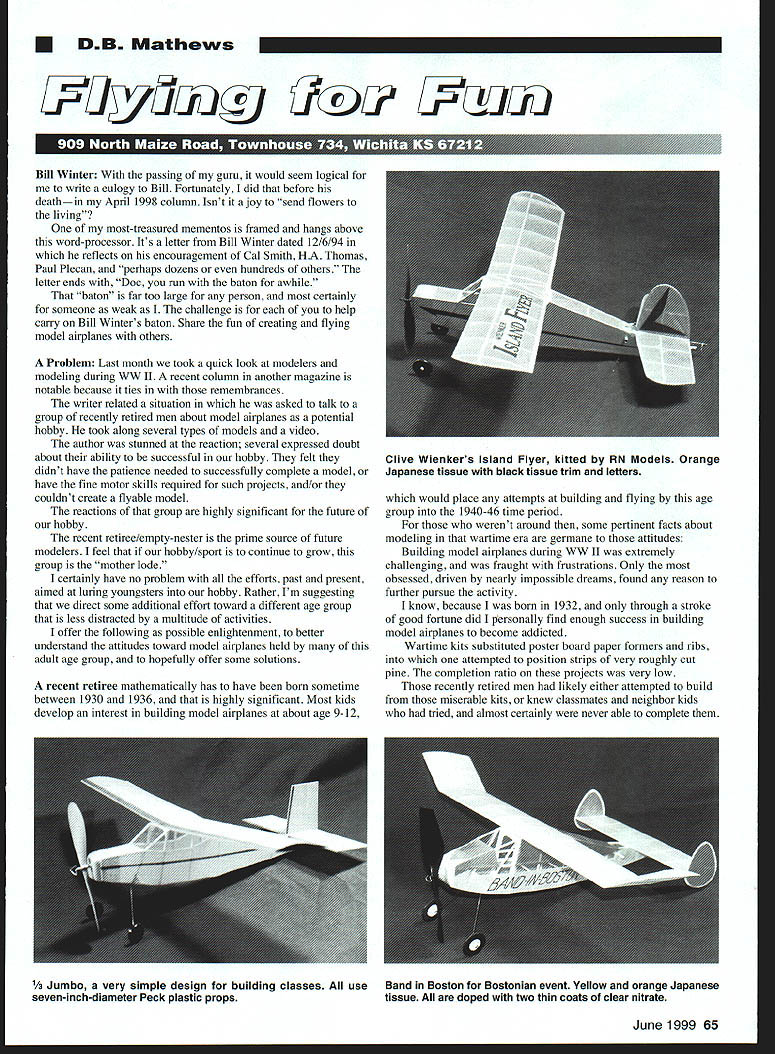
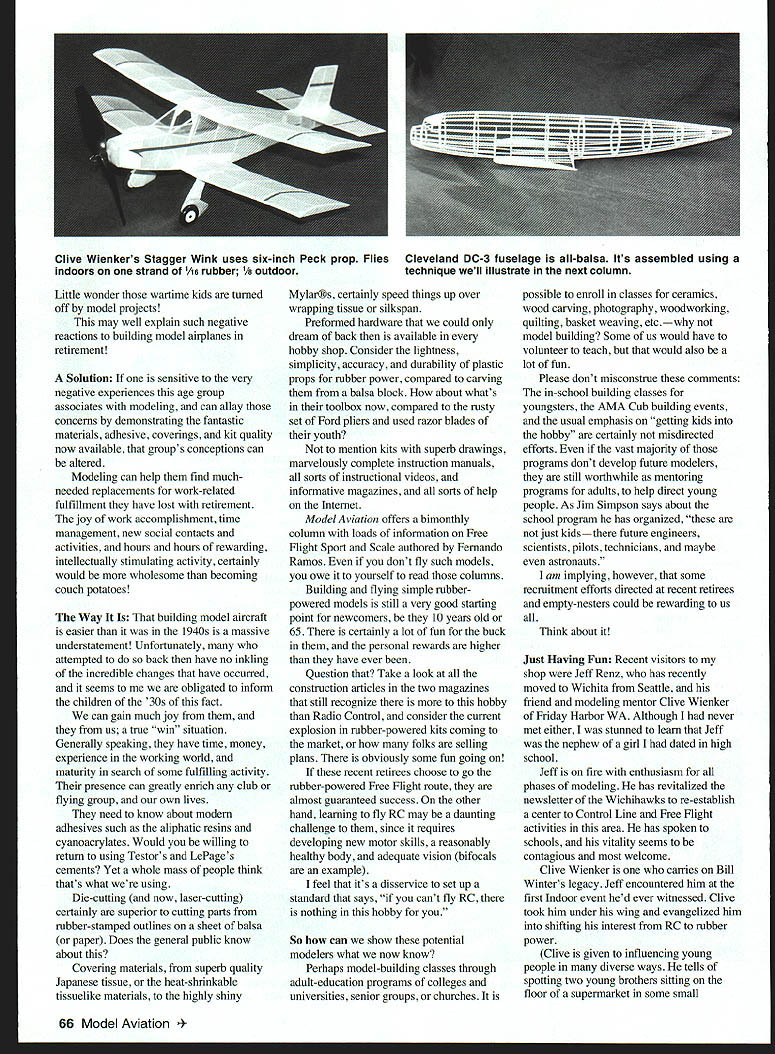
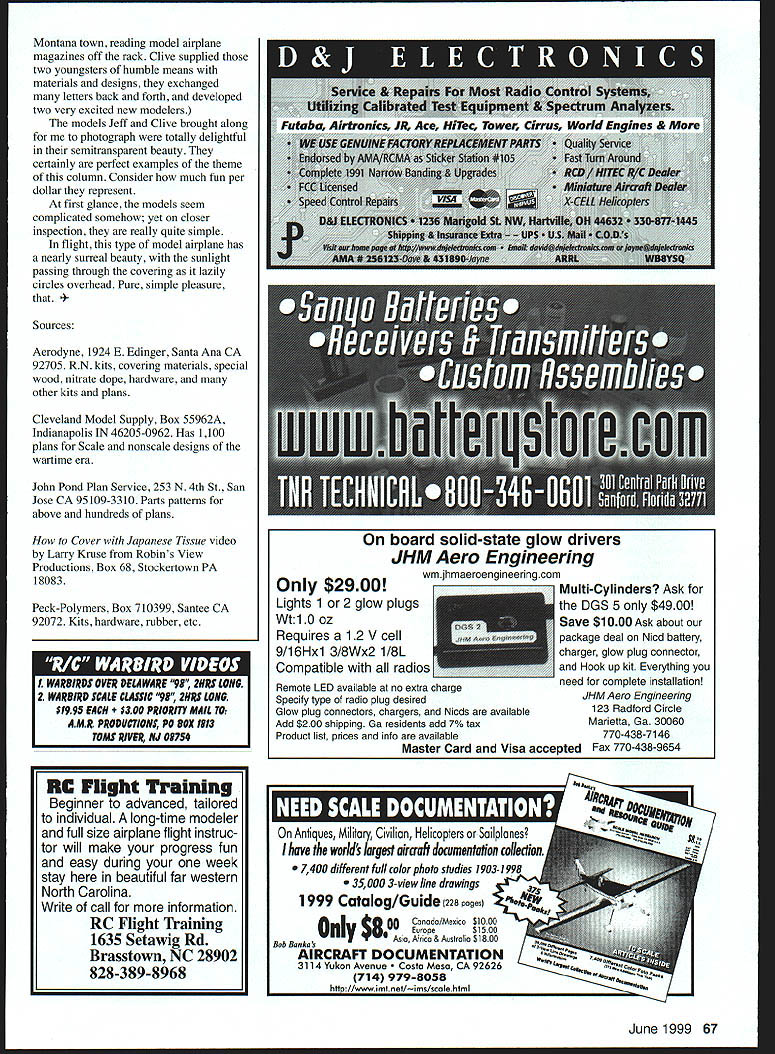
The models Jeff and Clive brought along for me to photograph were delightful in their permanent-seaman beauty. They are perfect examples of the theme of this column. Consider how much fun per dollar they represent. At first glance the models seem complicated; yet on closer inspection they are really quite simple. In flight, this type of model airplane has a nearly surreal beauty, with sunlight passing through the covering as it lazily circles overhead. Pure, simple pleasure.
Sources
- Aerodyne, 1924 E. Edinger, Santa Ana, CA 92705. R.N. kits, covering materials, special wood, nitrated dope, hardware, and many other kits and plans.
- Cleveland Model Supply, Box 55962A, Indianapolis, IN 46205-0962. Has 1,100 plans for scale and nonscale designs of the wartime era.
- John Pond Plan Service, 253 N. 4th St., San Jose, CA 95109-3310. Parts patterns and hundreds of plans.
- How to Cover with Japanese Tissue video by Larry Kruse, Robin's View Productions, Box 68, Stockertown, PA 18083.
- Peck-Polymers, Box 710399, Santee, CA 92072. Kits, hardware, rubber, etc.
Transcribed from original scans by AI. Minor OCR errors may remain.

