
Flying for Fun
D.B. Mathews 909 North Maize Rd., Townhouse 734, Wichita, KS 67212
Art and Technology: When reflecting on the evolution of designing, building, and flying model aircraft, it is difficult to separate the continuous changes in sizes and types of models built from the development of new technical devices for them.
Throughout aviation history, the development of power plants has led to the development of new full-scale aircraft. The same phenomenon—technology followed by suitable aircraft designs—applies to model aircraft.
There is an interrelation between art and technology in aeromodeling. If you doubt that, take a trip back in time through old model magazines.
It used to be extremely difficult to tow a model glider in a straight line; it would invariably wander off to one side or the other, and nothing could be done but release the towline. Then a simple device called the "auto rudder" came along.
Fundamentally, a washer and short line were pulled off the hook as the tow ring slid off. This allowed the rudder to move away from straight ahead during the tow to a turn position in the glide. It was simplistic to a fault, but usually most effective.
Old-timers might recall the frustration of attempting to tow a Jasco Thermic 50 or Berkeley Sinbad straight (even with that oddball "golf club thing" on the Sinbad).
Now, very complex, beautifully machined devices are available commercially for use in towline gliders. These not only provide auto rudder, but also produce the ability to tow in circles, and launch the model with a "zoom" and a bunt when the line is released. A case of technology altering art.
Consider the evolution of dethermalizers for Free Flight models. Back when there were no dethermalizers, models got into thermals and just floated away, with fliers madly pursuing them across hill and dale.
Later, we used a short length of chemically treated cotton fuse, which was lit and eventually burned through a rubber band, allowing the stabilizer to pop up about 45°. This stalled the model and returned it to earth.
The fuse has been replaced with clockwork timers, or even tiny units that utilize the resistance of a viscous fluid. Technology radically altered the art of Free Flight. One wouldn't dare allow Free Flight models to climb so high without dethermalizers.
Think about the dramatic reduction in size and weight of radio-control equipment. As servos and receivers get smaller and smaller, new and exciting models are being designed around them.
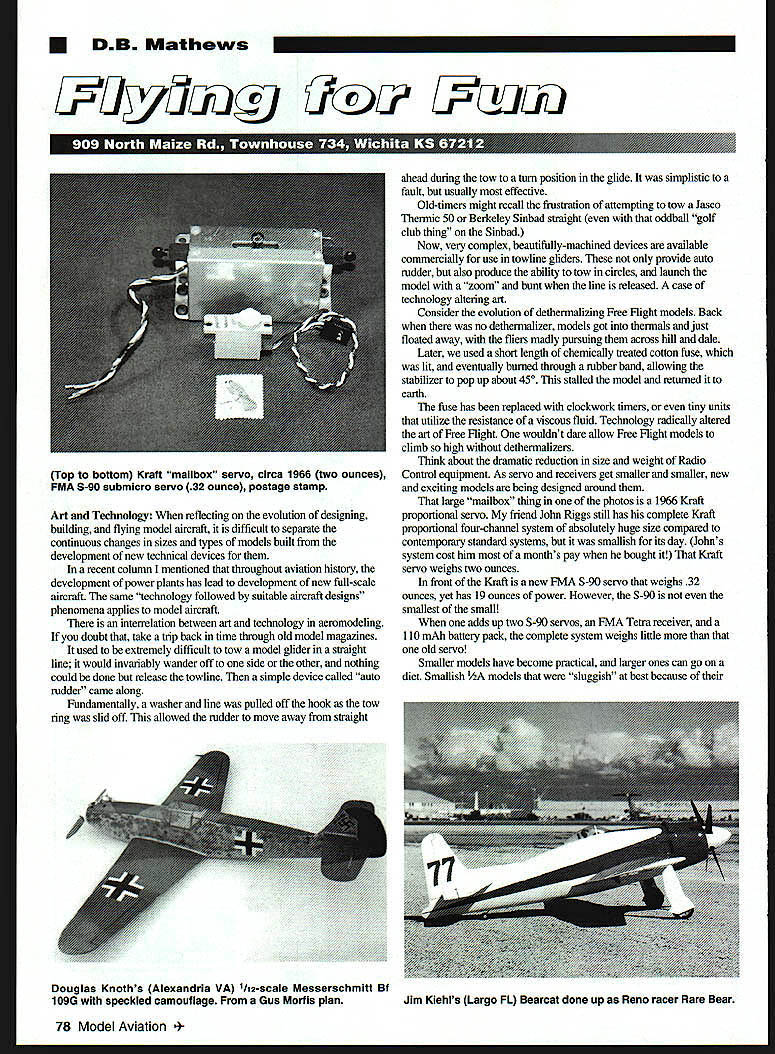
That large "mailbox" thing in one of the photos is a 1966 Kraft proportional servo. My friend John Riggs still has his complete Kraft proportional four-channel set. In comparison to contemporary standard systems it was smallish for its day. John's system cost him most of a month's pay when he bought it! That Kraft servo weighs two ounces.
In front of the Kraft is a new FMA S-90 servo that weighs 0.32 ounce, yet has 19 ounces of power. However, the S-90 is not even the smallest of the small!
When one adds up two S-90 servos, an FMA Tetra receiver, and a 110 mAh battery pack, the complete system weighs little more than that one old servo.
Smaller models have become practical, and larger ones can go on a diet. Smallish 1/2A models that were "sluggish" at best because of their weight can now come alive. .020 and smaller electric RC is now within technical reach of us — not just the gifted few.
The introduction of micro and submicro equipment has opened some exciting new areas of radio control. Such things as backyard and park RC are cropping up. I'll have some observations soon; next month I'll look at 1/12-scale fighters—designs motivated by the provisional 1/12-scale Combat event as a source of fun sport models.
Adding landing gear would also seem logical; small models light enough to hand-launch and belly-land successfully could carry landing gear, which would also make possible fly-offs from simple grass strips.
1/12-scale fighters, because of their relatively small size and resultant low materials cost, coupled with an almost limitless selection of colors and markings and great flying characteristics at low weight, can create models that ooze fun. This development is a direct result of advancing technology.
Most single-engine 1/12-scale warbirds span 36 to 40 inches, come in at about 2 to 2½ pounds, and fly moderately fast—beyond speeds once thought only possible with 15- to 20-cubic-inch engines with round cowlings. Kits range from all-molded foam units to fully built-up balsa structures.
Several suppliers have construction drawings for little warbirds; some drawings cover unusual prototypes. Gus Morfis has 36-inch Vultee Vanguard and Macchi M.202 drawings. These subjects, often seen flying at fields, seem to fit the concept and are exciting to many fliers. Contact suppliers for details.
Should your interests run to flying 1/12-scale models with crepe-paper streamers attached and chasing someone else's model, the Radio Control Combat Association is a Special Interest Group within the AMA structure (Web site: www.scalemobot.com). Several magazine columnists are writing monthly on this subject.
The technology side of the hobby has once again added to the art, and a fun addition it is. Isn't technology grand?
Out of common courtesy, when corresponding with any columnist or supplier, include a #10 stamped, self-addressed envelope!
Sources
- Air-Kill Products (balsa and foam kits)
14 Shady Lake Ct. Sacramento, CA 95834 (916) 425-9933
- Check Six Plans (plans only)
29696 Birch Cir. Mechanicsville, MD 20659
- Gus Morfis Plans (37 different plans)
4709 Green Meadows Ave. Torrance, CA 90505 (310) 378-5679
- Hobby Hangar (complete kits)
1862 Petersburg Rd. Hebron, KY 41048 (606) 334-4431
- DBW Models (wide range)
1063 W. 125 S. Blackfoot, ID 83221 (208) 684-9365
- JDB Aero Tec (foam and balsa kits and Almost Ready-to-Flys)
2202 Beck Ln. Lafayette, IN 47905 (765) 474-1738
- Collins Scientific (short kits)
7300 NW Expy. Oklahoma City, OK 73132 (405) 721-4502
- Quad Model Designs (balsa-and-plywood kits)
2510 119th Ave. Ct. W. Milan, IL 61264
- Zigg's Originals (foam wings and fuselages)
105 Swanton Rd. Madison, WI 53714 (608) 249-4480
Transcribed from original scans by AI. Minor OCR errors may remain.

