
Flying for Fun
909 North Maize Rd., Townhouse 734, Wichita KS 67212
The Wing Will Fly
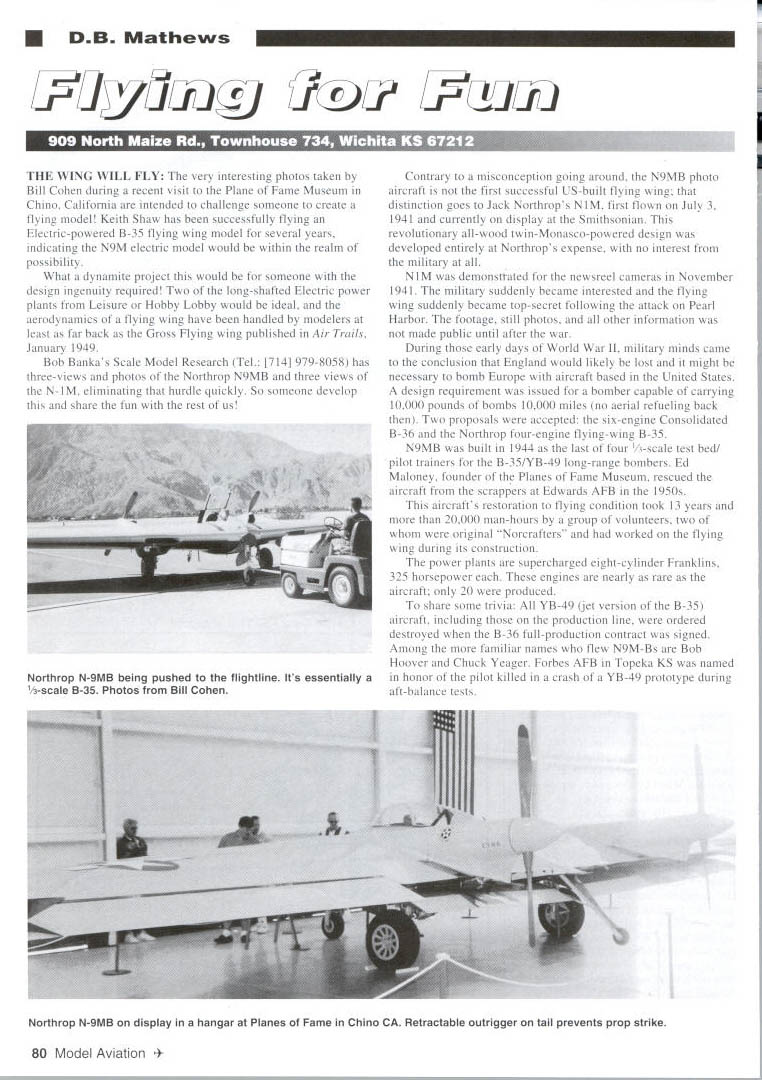
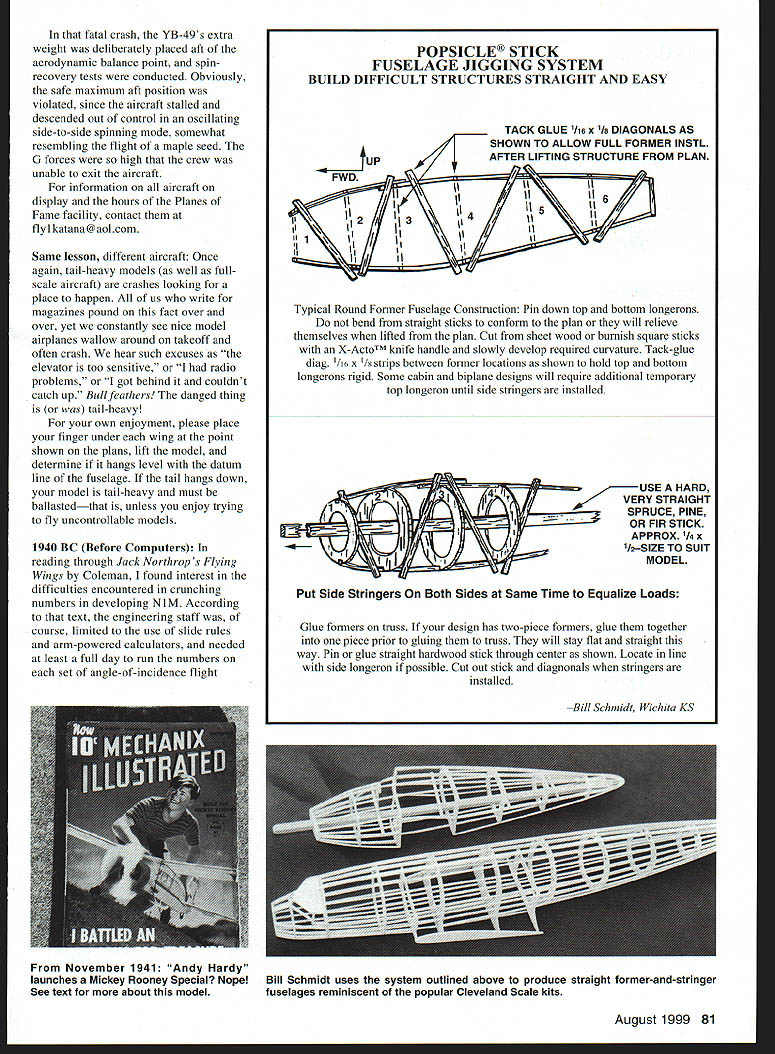
The very interesting photos taken by Bill Cohen during a recent visit to the Planes of Fame Museum in Chino, California are intended to challenge someone to create a flying model. Keith Shaw has been successfully flying an electric-powered B-35 flying wing model for several years, indicating an N9M electric model would be within the realm of possibility.
What a dynamite project this would be for someone with the design ingenuity required! Two of the long-shafted electric power plants from Leisure or Hobby Lobby would be ideal, and the aerodynamics of a flying wing have been handled by modelers at least as far back as the Gross Flying Wing published in Air Trails, January 1949.
Resources
Bob Bankas' Scale Model Research (Tel.: [714] 979-8058) has three-views and photos of the Northrop N9MB and three views of the N1M, eliminating that hurdle quickly. So someone develop this and share the fun with the rest of us!
N9MB and the N1M
Contrary to a misconception going around, the N9MB photo aircraft is not the first successful U.S.-built flying wing; that distinction goes to Jack Northrop's N1M, first flown on July 3, 1941 and currently on display at the Smithsonian. This revolutionary all-wood, Menasco-powered design was developed entirely at Northrop's expense, with no interest from the military at all.
N1M was demonstrated for the newsreel cameras in November 1941. The military suddenly became interested and the flying wing became top-secret following the attack on Pearl Harbor. The footage, still photos, and all other information were not made public until after the war.
Wartime Requirement and Proposals
During the early days of World War II, military planners concluded England might be lost and that it could be necessary to bomb Europe with aircraft based in the United States. A design requirement was issued for a bomber capable of carrying 10,000 pounds of bombs 10,000 miles (no aerial refueling back then). Two proposals were accepted: the six-engine Consolidated B-36 and the Northrop four-engine flying-wing B-35.
N9MB Restoration and Engines
N9MB was built in 1944 as the last of four 1/3-scale test-bed/pilot trainers for the B-35/YB-49 long-range bombers. Ed Maloney, founder of the Planes of Fame Museum, rescued the aircraft from the scrappers at Edwards AFB in the 1950s.
This aircraft's restoration to flying condition took 13 years and more than 20,000 man-hours by a group of volunteers, two of whom were original Norcrafters and had worked on the flying wing during its construction.
The power plants are supercharged eight-cylinder Franklins, 325 horsepower each. These engines are nearly as rare as the aircraft; only 20 were produced.
YB-49 Trivia and Accident
All YB-49 (jet version of the B-35) aircraft, including those on the production line, were ordered destroyed when the B-36 full-production contract was signed. Among the more familiar names who flew N9M-Bs are Bob Hoover and Chuck Yeager. Forbes AFB in Topeka, KS was named in honor of the pilot killed in a crash of a YB-49 prototype during aft-balance tests.
Fatal crash: extra weight was deliberately placed aft of the aerodynamic balance point during spin-recovery tests. Obviously the safe maximum aft position was violated since the aircraft stalled, descended out of control, and oscillated side-to-side in a spinning mode somewhat resembling a maple seed. G forces were high and the crew were unable to exit the aircraft. Information on the aircraft is on display at the Planes of Fame facility; contact flykatana@aol.com.
Modelers' Lesson: Tail-Heavy Equals Trouble
Same lesson, different aircraft. Once again tail-heavy models — and full-scale aircraft crashes — show where problems happen. We write and magazines pound the fact over and over, yet constantly see nice model airplanes wallow around on takeoff and often crash. Typical excuses:
- Elevator too sensitive
- Radio problems
- Got behind
- Couldn't catch up
Bull feathers! If the danged thing is tail-heavy and won't fly, for your own enjoyment please place your finger under the wing at the point shown on the plans, lift the model and determine if it hangs level. If the datum line of the fuselage tail hangs down, the model is tail-heavy and must be ballasted — that is, unless you enjoy trying to fly uncontrollable models.
1940 BC — Before Computers
Reading through Jack Northrop's Flying Wings, Coleman found interesting difficulties encountered in crunching numbers developing the N1M. According to the text, the engineering staff, of course, had limited-use slide rules and arm-powered calculators and needed at least a full day to run numbers to set angle-of-incidence and other flight parameters. Not only that, they felt satisfied with an error factor of plus or minus three percent. In other words, much of the design of the original flying wing was governed by the "looks about right" concept of engineering.
Compare that to the paperless design of the Boeing 777; no classic blueprints were used. It was completely designed, fabricated, and tested with Computer Aided Design programs.
Hand-Launched Prototypes
That same biography mentions scale balsa N1M gliders that were tossed from the balcony of a gymnasium in the very earliest developmental stages of the flying wings. None other than Jack Northrop himself tossed them, with the engineering staff madly observing flight behavior and retrieving the things for him. Now there's some high-priced retrievers.
Lost Potential and the B-2
One cannot fail to notice what an incredible waste of potential accumulated flight data it was to destroy those YB-49s. Many years later, when the need for a stealth bomber led to the development of the B-2 by Northrop, it was necessary to start almost at square one because of the politics involved in that long-ago decision and order.
The decision to cancel the YB-49 project damaged Jack Northrop's health. This man had spent most of his lifetime overcoming the skepticism and derision of the conservative majority in the aircraft industry with his truly revolutionary flying-wing concepts. He did live to see his dream vindicated, however. Shortly before his death, a special emergency top-secret clearance was issued to him so he could be wheelchaired into the area where the B-2 was being built. Imagine the emotions of that scene.
Mickey Rooney Special
Ever wonder what that design looks like? Bet you've never seen one at a SAM (Society of Antique Modelers) meet. It most certainly has no resemblance to the magazine cover we illustrate this month, either.
Several movie stars were modelers, including Henry Fonda and Jimmy Stewart. I've tried every possible avenue to obtain still photos that I know exist of the two building and flying a Dennyplane, but without any success.
Reginald Denny was not only a well-known actor, he operated a hobby shop, kit manufacturing, and engine factory for many years. Why this gentleman is not in the AMA Hall of Fame is something of a mystery. He brought lots of excellent publicity and some degree of respectability to our hobby through his connections in the movie industry.
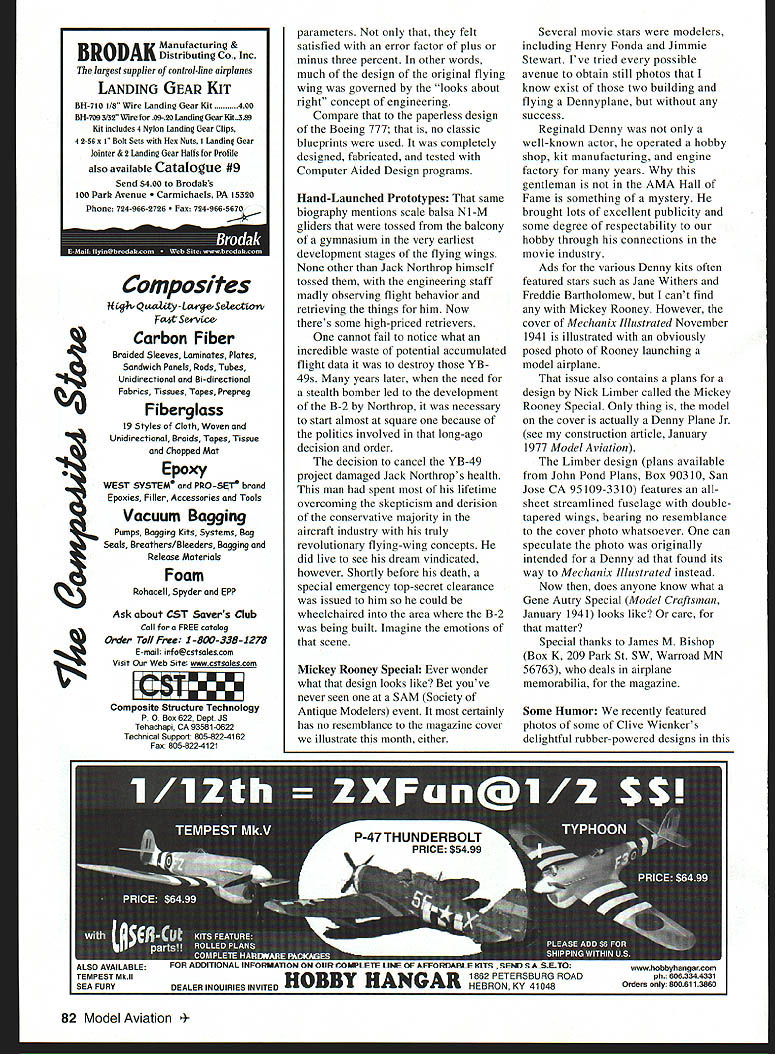
Ads for the various Denny kits often featured stars such as Jane Withers and Freddie Bartholomew, but I can't find any with Mickey Rooney. However, the cover of Mechanix Illustrated, November 1941 is illustrated with an obviously posed photo of Rooney launching a model airplane.
That issue also contains a plan for a design by Nick Limber called the Mickey Rooney Special. The only thing is, the model on the cover is actually a Denny Plane Jr. (see my construction article, January 1971 Model Aviation).
The Limber design (plans available from John Darr, P.O. Box 90310, San Jose CA 95109-3310) features an all-sheet streamlined fuselage with double-tapered wings, bearing no resemblance to the cover photo whatsoever. One can speculate the photo was originally intended for a Denny ad that found its way to Mechanix Illustrated instead.
Now then, does anyone know what a Gene Autry Special (Model Craftsman, January 1941) looks like? Or care, for that matter?
Special thanks to James M. Bishop (Box K, 209 Park St. SW, Warroad MN 56763), who deals in airplane memorabilia, for the magazine.
Some Humor
We recently featured photos of some of Clive Wincker's delightful rubber-powered designs in this column. This gentleman has more fun with these simple models than should be legal. A recent Wincker clip from the Bat Sheet newsletter of Seattle's Strat-O-Bats tickled our funny bone and should be shared.
Clive recently attended a reunion of his WWII B-24 Weather Squadron in Milwaukee. The 53rd Weather Reconnaissance Squadron of Keesler AFB, Mississippi flew in a C-130 weather plane for these older gentlemen to tour.
"The whole crew was there to explain to our pleasure their equipment and procedures, but I soon realized they were asking us more about our wartime experiences. This was unexpected and very flattering, until the light went off in my head and I realized this fuzzy-checked crew was looking and listening to us as if they had just discovered the Jurassic Park of wartime airmen."
Acronyms Again
There might be some moral or message to the following, but I refuse to consider what.
Are you old enough to remember the comic strip "Little Orphan Annie"? Yes, the little girl without pupils in her eyes who wore the same dress for decades. Annie had a faithful dog named Sandy, and what did Sandy say to Annie? "Arf"!
We notice some of the manufacturers are now referring to their products as AWAFRs (All Wood Almost Ready to Fly) to differentiate them from the "eggshell" units. This is a most unfortunate choice of acronym. Had they chosen to point out that their products were mostly balsa, the result would have been BARF.
Transcribed from original scans by AI. Minor OCR errors may remain.

