
Flying For Fun
Fun explosion
Golly, what a great year 1992 was for fly-ins — at least in this area. Out of curiosity, I looked through my mileage records: I attended 14 events in the 23-week span between May 9 and October 18, and all were within a four-hour drive from home. I skipped other events when it was obvious the wind would be too strong. These were noncompetitive gatherings; anyone who also attended the SAM, Quickie 500, and pattern competitions would have been on the road every weekend.
Never in my memory have I seen anything like it. Fly-ins are held all over the country every weekend, and attendance is exploding. Several activities have outgrown available flying facilities. One IMAA event drew so many models that the pit area was overfilled, necessitating double-rowing parked models. Several fly-ins swamped local volunteers so badly that nonmembers had to pitch in with flight-line, inspection, and frequency-control chores. I don't know what's causing this boom, but it's a delight to see so many people having a really good time.
If you aren't into fly-ins, give them some serious thought for next flying season. You won't be judged on anything but your smile — so come Fly for Fun.
Cuckoo Challenge
Every now and then a contest announcement pushes my humor button. One outlandish example: the second annual Cuckoo Challenge. Yes, there actually is a Cuckoo, Virginia. They held a combination AMA- and SAM-rules, small-field, free-flight event on August 22–23, 1992. Refreshments were served at the Pauper's Ridge snack bar. I am not making this up!
Field gear: ESV and FFC
Almost everyone agrees the first supplemental device needed after buying a basic radio system is an expanded-scale voltmeter (ESV). I suggest the second-most-needed device is a fast field charger (FFC). With an FFC you can stay at the flying field and recharge radio batteries from the car battery or the starter battery.
Most of us here use the Ace R/C unit because it has a sensor that detects full charge and shifts into trickle mode; other brands may offer similar features. Avoid chargers designed for R/C cars — their voltage and amp cutoffs are not matched to model-flying parameters.
An FFC helps avoid the classic "the meter's in the red, but I can get one more flight" disaster and prevents the "I forgot to charge after last week's flying" mistake. The device is flat-darned indispensable. If I had to give up either the ESV or the FFC, I'd give up the ESV.
More gyros
Remember the R/C gyrocopter photos and information included in this column about a year ago? That started with material supplied by Charles Beck, who built one from plans given him by a friend in Australia. Initially I sent those drawings to readers, but later learned they were from a kit produced in England by DB Models. Not wanting to distribute another's property improperly, I began directing readers to the correct source in England; David Boddington (the owner) did not always answer inquiries.
Now Peter H. Johnson of Walton Hills, Ohio, has provided useful information. He discovered the Gyrace, a later DB Models design that Boddington published in RCM&E some years ago. Drawings are available from Bob Holman Plans (see ad in this issue) — plan number RC 1553. The Model Aircraft Plan Book also illustrates hundreds of free-flight, control-line, and R/C construction plans published in England over the years.
Johnson says the Gyrace will loop, roll, hover, and fly backward in a breeze. Specs: 25-inch rotors, 26-inch centers, about 5° negative pitch. Power .05–.25 FSR. Frankly, the Gyrace is an attractive DB Models gyro to build — a true Flying For Fun project.
Trainer research and Peter Russell
As previously related, this column spent a huge amount of time developing a trainer. Ace R/C tried several airfoil variations and finally concluded that a moderately thick semi-symmetrical airfoil is superior to the traditional flat-bottom section in calm conditions. As is often the case, the discovery was not original at all; I just thought it was.
Ted Ott of Ventura, California, sent copies of a series of columns written in 1981–1982 for RCM&E by Peter Russell. Russell is considered the preeminent authority on modeling matters in England and much of the English-speaking world — essentially the Bill Winter or Ken Willard of Europe. Had I seen Russell's material earlier, my trainer project would have been simpler.
I'll quote sections of Russell's columns (September 1981, December 1981, May 1982):
"I have done a lot of experimenting with matching aerofoils to aeroplanes and have come to the conclusion that a plain, straightforward symmetrical wing of between 10 and 15% thickness located at about 35% of the chord takes a lot of beating for practically any powered model aircraft.
"I say this because on a symmetrical section, although the lifting capability is less than that of a cambered section, so is the drag and so is the pitching moment due to angle-of-attack variation. This latter point makes it particularly suitable for trainers.
"The traditional flat-bottom section used on trainers since the year dot gives very little improvement in lift. Most flat-bottom sections will also be more pitch sensitive, tending to produce a twitchy model, than would the normal symmetrical section with a well-rounded nose."
Russell goes on to describe comparative tests: trainers with a 12% symmetrical section handled better than flat-bottom sections. Differences in stalling speed were negligible; handling and pitch sensitivity were the distinguishing factors. A flat-bottom, constant-chord wing with no washout can be nasty with a rearward CG; a symmetrical section of the same dimensions gives superior handling.
Another benefit: a symmetrical section's center of pressure moves little with varying angle of attack, whereas a typical flat-bottom section can have its center of pressure vary substantially (Russell cites movement from about 70% of chord at 2° nose-up to 27% near stall). That variation creates a destabilizing effect and makes CG location critical. By comparison, a symmetrical or nearly symmetrical section shows small, manageable center-of-pressure movement.
I wish I'd known of Russell's experiments earlier. My own tests confirm better pitch stability and tracking in wind when a symmetrical section is used on a high-wing, lightly loaded, low-powered trainer. Unfortunately, prejudice in favor of flat-bottom sections has led many experts to dismiss symmetrical sections without a fair trial.
A final bit of advice I received long ago from Art Schroeder applies here: when reviewing a kit, describe how the kit builds and flies as designed; if you detail your own modifications, that's a construction article, not a review.
Bob Benjamin's Big Bingo! (electric)
While at the June Float Fly in Higginsville, Washingtonian Bob Benjamin called to propose a Big Bingo! built around a prototype Astro Flight 90 electric motor. Initially I thought, "You've got to be kidding," but after talking with Bob, the idea seemed feasible. Bob's knowledge of electric flying is well known; if anyone could set up an electric power model of this size, he could.
The plan required reducing the bare airframe weight by roughly the weight of a 32-cell, 2,500‑mAh battery pack. The electric motor weighed less than a 1.20 stroker and its fuel. By substituting balsa for the wing leading edge and tail feathers, using a Klett fiberglass landing gear (as in the Ace R/C C‑4 120 kit), and eliminating some light ply in the forward fuselage (vibration control is less of an issue with electric), the Big Bingo! could be built within required weight parameters.
Some numbers: the electric unit turns a 16×8 prop at about 7,000 rpm while drawing ~30 amps — comparable to the performance figures for a 1.20 stroker. With the 32‑cell, 2,500‑mAh pack, the Electric Big Bingo! weighs about 18 pounds (roughly four pounds more than the usual Big Bingo!). Using a reworked 18×6 prop (thinned and given slight overcamber), the airplane breaks ground after a run of about 100 feet on moderately rough grass.
Bob reports the Electric Bingo! doesn't fly particularly fast but climbs surprisingly well — a sustained 30° climb on takeoff is possible. Rolls are slow but positive; loops are slow and solid; stall turns are crisp. Low-speed handling is good, and the extra weight and moderate wing loading make it pleasant to fly and land in wind. Flight duration on the 2,500‑mAh pack is on the order of seven to eight minutes.
Bob has demonstrated the feasibility of electric power for larger models. Designs tailored to the lower vibration levels and quieter operation of electric power are a viable solution where noise is a problem. Congratulations to Bob for opening up an exciting new way to Fly for Fun.
On the other hand (small electrics)
Longtime pen pal Dick Gibbs has long extolled the fun of tiny electric free-flight models in his Flying Models column. The increasing availability of very small electric powerplants — and the simplicity of no gum bands or Cox cartridges — makes these appealing.
Ed Toner of Howell, New Jersey, has been bitten by the little-electric bug. He sent photos of his enlarged Bill Hannan Stringless Wonder, powered by a tiny Ken Bassett geared electric unit. Ed calls his version the Wired Wonder.
Charging is done with an ELE-Flyer charger, a handy handheld device that holds four C cells. Ed doesn't use a charging stick or switch; he clips small alligator clips directly to the motor's protruding copper points. A 50‑second charge yields about 10 seconds of full power plus roughly 20 seconds of decreasing transitional power. Flight times are between two and three minutes in dead air.
A previous attempt at the original 10‑inch Hannan design with a small plastic prop zipped along at high speed but wouldn't climb. The new version uses 6° of downthrust (the original had none), which improved climb performance. Ed speculates the geared Bassett unit would fit a Bostonian rubber design nicely — a real treat for indoor modeling.
More Darts and related items
I previously got sidetracked on the Culver/Driggs Dart full-scale aircraft. If you're interested in the Driggs Dart, a superb set of two-inch-to-full-scale three-view drawings is available from B2 Streamlines, P.O. Box 976, Olalla, WA 98359. These are full-scale, highly detailed drawings (not model-construction plans) and are excellent for adding detail to an existing model. B2 Streamlines also offers a long list of existing and unusual gliders and related construction plans; write to them for a catalog.
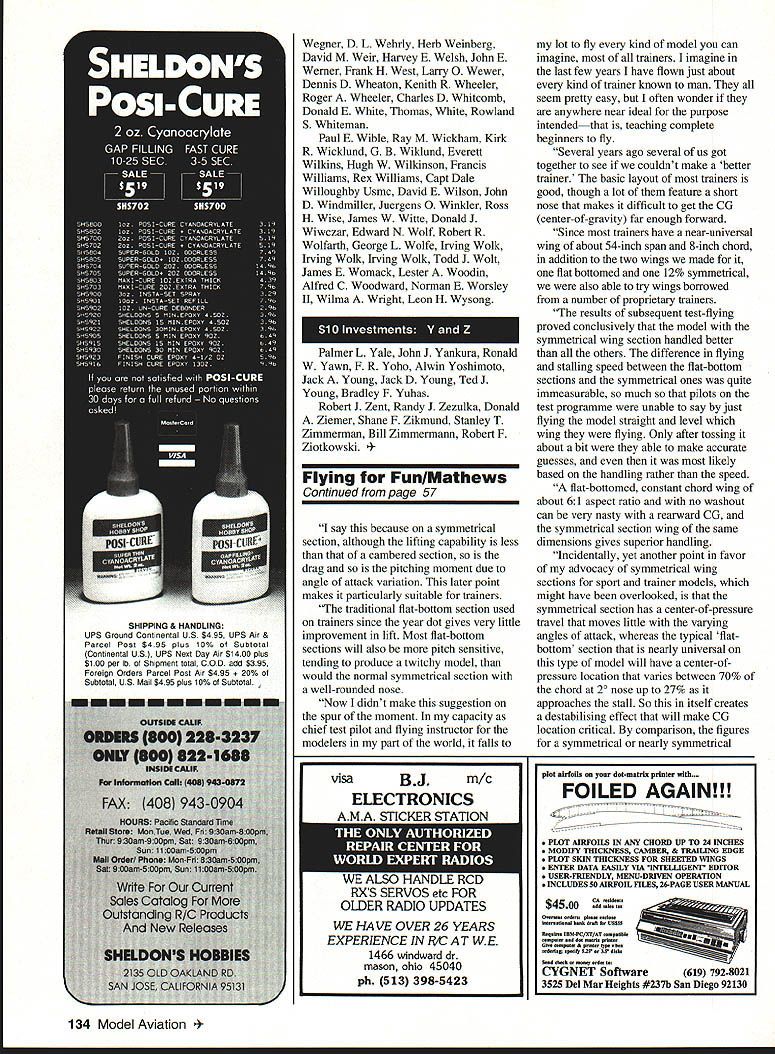
Fran Paszkiewicz (whose deBolt Bipe was featured in October's column) sent a photo of a Culver Dart he spotted at the Niagara Falls Air Show in 1982, plus the Anderson Greenwood photo of the plane next to the Dart. Paul Matt three-views of the Anderson are available, and the design looks like a good candidate for an RC or free-flight model. With fiberglass fuselage techniques, building one should present few hurdles.
Some new stuff
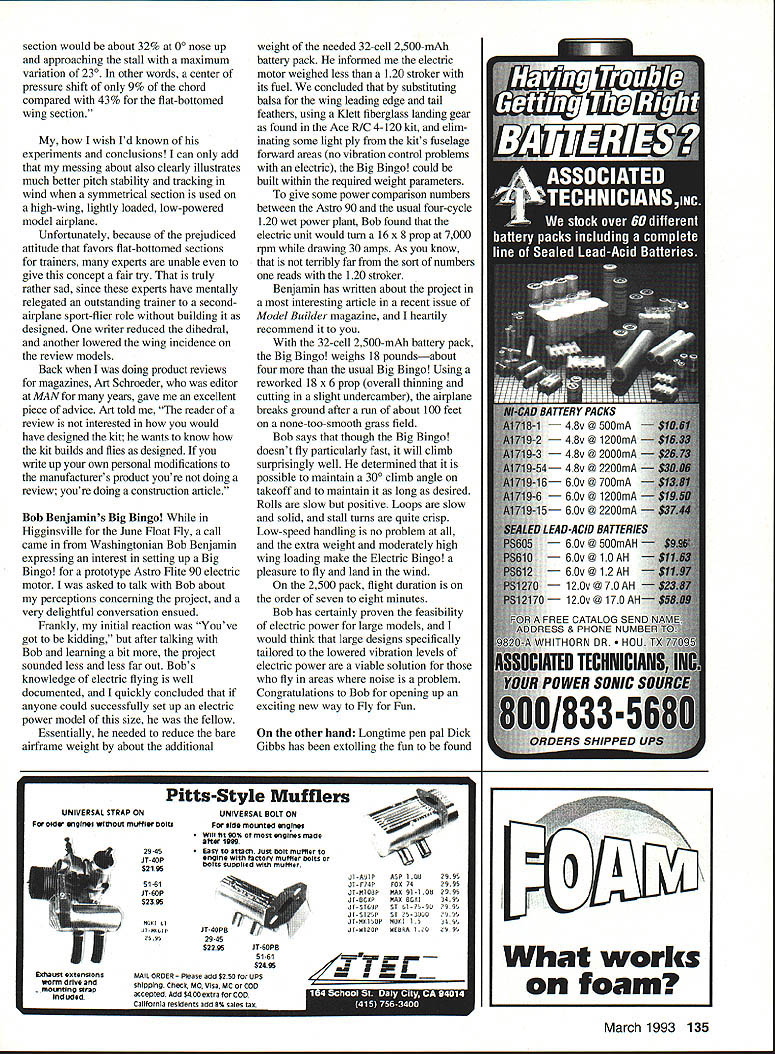
- A short, flexible rubber antenna (prototype) from Ace R/C has been in use since May 1992. I've flown in many environments with it — often with several other models in the air — without a single problem. As someone who once crashed a Big Bingo! when a transmitter antenna broke off, I really appreciate this design. The "Rubber Ducky" antenna is available as a replacement for Ace transmitters and possibly other brands. Contact the factory for information.
- Myron Pickard of Fiberglass Master (see ad in this issue) now offers an accessory cowl for the Big Bingo! The unit is designed to enclose an inverted Zenoah or Quadra gas burner and tapers into a 3½‑inch spinner. It looks really neat.
Finally
All the fly-ins and perfect weather have put me seriously behind on correspondence. I make every effort to answer all letters that include an SASE — sooner or later. Unfortunately, this year it's been later. But I'll get them done.
As always, send photos of any unusual model aircraft — but please make the subject exclusive to this magazine. And I do mean anything!
Transcribed from original scans by AI. Minor OCR errors may remain.

