
D.B. Mathews
Flying for Fun
909 North Maize Rd., Townhouse 734, Wichita KS 67212
Now and again, my column idea file folder overflows with items that are very interesting, but are just not of sufficient length for a full column. In the past, I've called a column built on short items by several fancy names, but I'll stick with "pot luck" this time.
As one does at such social events, look through what this column has to offer, select some choices for your plate, and chew on them for a while. Whether you swallow them or not depends on you.
Care and Handling of CyA
I received a sample of the best thin cyanoacrylate glue (CyA) I've used in years from Model Research Laboratories (MRL), 25108 Marguerite #160, Mission Viejo CA 92692; Tel.: (949) 707-4450.
The working behavior of MRL's Premium CyA glue is reminiscent of samples that Bob and Bill Hunter handed out at the 1974 Nationals to those of us who had never used those adhesives before.
Those who build virtually entire model aircraft with CyA adhesives have likely noticed a wide variance in CyA adhesives from bottle to bottle. Some batches don't set as quickly as others, and they don't have equal strength. Also, shelf life varies greatly from batch to batch. Have you ever wondered why?
Included with this new MRL CyA was a short paper written by owner Curt Stevens, with some facts that everyone should know about CyA adhesives.
"CyA glues must be stored at a temperature of five degrees Celsius or lower (40° Fahrenheit or less). They are perfectly safe in your food freezer. Note that the CyA does not actually freeze, and can be stored for at least three years with no thickening or loss of strength. The shelf life of pure CyA glue at room temperature is about 60 days. After that, the integrity of the glue joints begins to drop off slowly until about the 180-day point, and then much more rapidly until the 360-day point, where the glue becomes unusable.
"Commercially available hardware-store CyA glues have additives to extend this time frame, but such glues are only 30–50% as strong as they could be."
Curt had previously mentioned storing CyA in the freezer, but I didn't clearly understand why.
Once removed, the bottle of CyA should be allowed to warm to room temperature for several hours. Moisture will condense on the bottle's exterior; therefore, it should be wiped dry before opening. Moisture is a big enemy of CyA adhesives.
I have noted poor adhesion with hardware-store CyA and with older stock from hobby shops. One might wonder if CyA adhesives with expiration dates on the container might not be a good marketing tool for one of the manufacturers.
Those samples at the long-ago Nationals were fresh stock, and had not set on the shelf in a hot warehouse or store for months!
Applied Knowledge and CyA Adhesives
The following information is included with Model Research Laboratories' Premium CyA:
- A proper CyA glue joint does not fail; the substrate (usually wood) fails in stress. The more the CyA penetrates the substrate, the stronger the joint.
- The better the parts fit, the stronger the glue joint.
- The strongest CyA glues are water-thin.
- CyA glues are very heavy. Piling on coats of CyA glue as a "fillet" does not add strength to the joint.
- The thicker the CyA, the less penetration and the weaker the joint.
- The more catalyst used, the weaker the joint. Use microballoons or baking soda instead.
- Good CyA has a maximum shelf life of three to six months at room temperature. Long-term storage must be in the freezer.
- CyA glues can be chemically modified to extend shelf life, increase viscosity, and increase flexibility; such modifications will decrease strength. A typical unmodified thick CyA, two to three years from the original vat, has about 20% of original strength.
- CyA will bond anything. Oily or waxy surfaces cannot get rid of oil or wax — at least rough up the surface.
- When CyA begins to thicken in the bottle, give it away or toss it.
- The known solvents for CyA glues are nitromethane, MEK (methyl ethyl ketone), and acetone.
- The best way to remove CyA from fingers is to soak in soapy warm water.
- The most difficult wood to glue is very thin plywood (1/64–1/32 in.), very tight-grained, often oily from processing. Spruce should have turpentine or other oils removed and the surface sanded before bonding.
Orphans
Some of us have been modeling a few years and have box engines, electronics and other hardware items that can no longer be repaired because the manufacturer is no longer in business and parts are unobtainable — parts orphans.
I've used Ace R/C transmitters and receivers since the company acquired ProLine years ago. I've grown comfortable with MicroPro transmitters; they've become like a favorite pair of old shoes. Imagine the panic if the computer processor died. If Ace R/C no longer exists, or if the distributor or hobby shop no longer has a service department, radios or transmitters can become orphaned.
I purchased an imported computer transmitter, but perhaps because of a negative attitude I was never able to master the programming. I considered advertising for a workable used MicroPro at any price. Then, through a stroke of luck, I found someone with a stock of parts and the skill to repair Ace transmitters.
D&J Electronics, 1236 Marigold St. N.W., Hartville OH 44632; Tel.: (330) 877-1455, can not only repair Ace transmitters and receivers, but offers quality full service on other brands as well. I highly recommend this company.
However, D&J cannot repair other Ace electronics, such as chargers and meters.
Crunch!
I received a nice letter (one of many) from Jay Wallace, Ashland OR, about my comments on building model airplanes in the 1940–1946 era.
"Your comments on the Comet Company were particularly appealing. When I was a kid in about 1938, we went to the Comet Company in Chicago. I remember on their boxes they showed this big plant. Actually, they were on the second floor via a fire escape. I was impressed with the great stacks of balsa wood, band saws, and such. At one time they made 25-cent kits under the AMCO label.
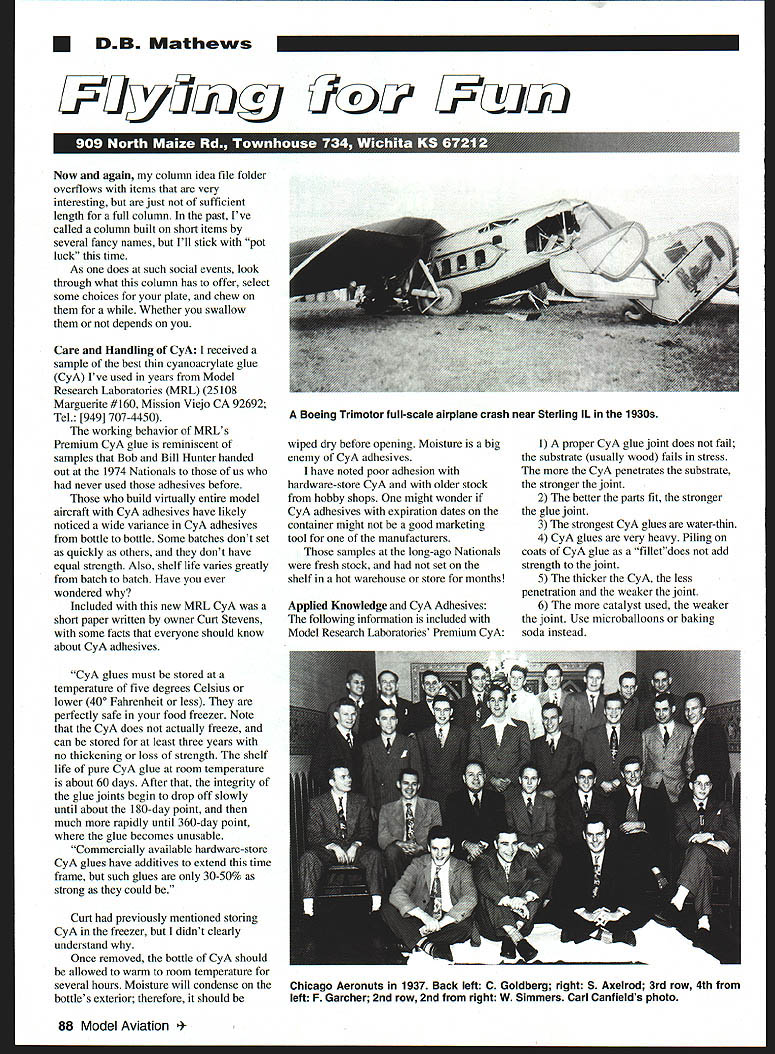
"When we lived in Sterling IL, one day this Boeing Trimotor crashed there. I know you had an article about these planes and thought you might find it interesting."
I surely do, Jay.
On the photo's back are some penciled notes, including "cost $80,000"! Notice that all of the identification has been painted over on the main rudder — even the NC designation 292M has been hidden.
Could this airplane have been in transit to Canada or Latin America after being removed from some airline's inventory? The remaining paint scheme might make one wonder.
Solutions to these sorts of mysteries are what make Skyways magazine such a delightful read. Skyways features aircraft of the 1920–1940 period, with wonderfully written articles about prototypes and production aircraft, with extensive photography and details.
The aircraft range from Martin and Osa Johnson's Sikorsky flying boats, and the restoration of one for Johnson's "Wax," to the Northrop/Vought V-141s. The contributors usually include a list of serial numbers, and the final disposition of each.
Printed on high-quality enameled paper, the photographs are stunning — particularly considering the age of many of them. Three-views and structural drawings are often featured.
Skyways is issued quarterly, with back issues available. A minimum $35 annual contribution to Leonard E. Opdycke, 15 Crescent Rd., Poughkeepsie NY 12601, is required.
Indoor/Yard/Park Fliers
As I mentioned in the July column, the development of incredibly small radio equipment was followed by the development of equally incredible small, light, and slow electric RC models.
Interest in electric RC models is apparently expanding around the world, and it's not hard to see why. Costs are reasonable, structures are easy to build, flights are very slow and relaxing, and the convenience of flying RC in locations previously unusable, such as soccer fields, vacant lots, and even some parks, is wonderful.
It has been said that if the leaves are moving much on the trees, it's too windy to fly micromodels. While that is likely an exaggeration, Kansas winds pretty much limit such models to indoors here. Darn!
Spark Plugs
Some months ago, I retold the Ira Hassid/miniature Champion plugs story. The plugs were sold from a co-op operated spare parts warehouse at the 1934 Chicago World's Fair.
I asked if Bill Brown would use these plugs on his early engines, as the West Coast engine pioneers had. Otto Curth, Northbrook IL, responded:
"You should know Ir. Motor's part no. 10 was a 3/64 spark plug supplied with early Brown Jr. engines in the mid-1930s. I have one in my collection; the plug could be disassembled, the point was even lighter. It is shorter than the Champion V-1 plug."
Well, you've looked at the potluck, and hopefully chosen some of the morsels. Now it's time to go fly for fun.
Transcribed from original scans by AI. Minor OCR errors may remain.

