
Flying for Fun
D.B. Mathews 909 N. Maize Rd., Townhouse 734, Wichita KS 67212
AIAA Design/Build/Fly event
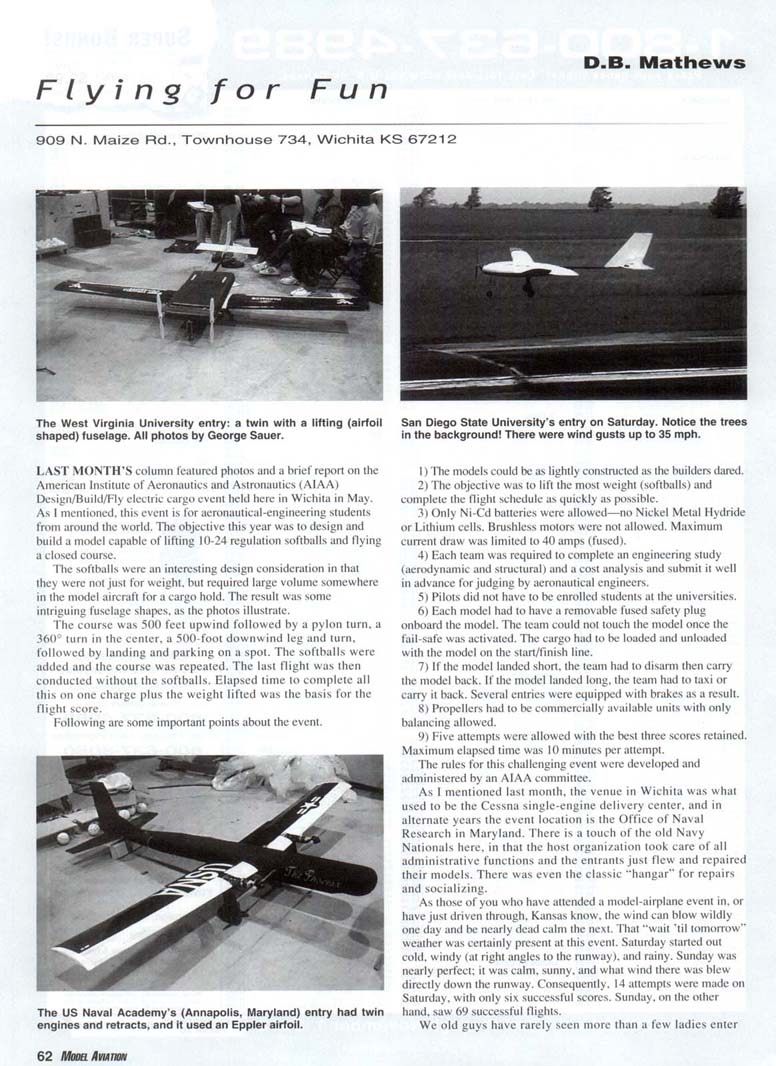
Last month's column featured photos and a brief report on the American Institute of Aeronautics and Astronautics (AIAA) Design/Build/Fly electric cargo event held in Wichita in May. This event is for aeronautical-engineering students from around the world. The objective this year was to design and build a model capable of lifting 10–24 regulation softballs and flying a closed course.
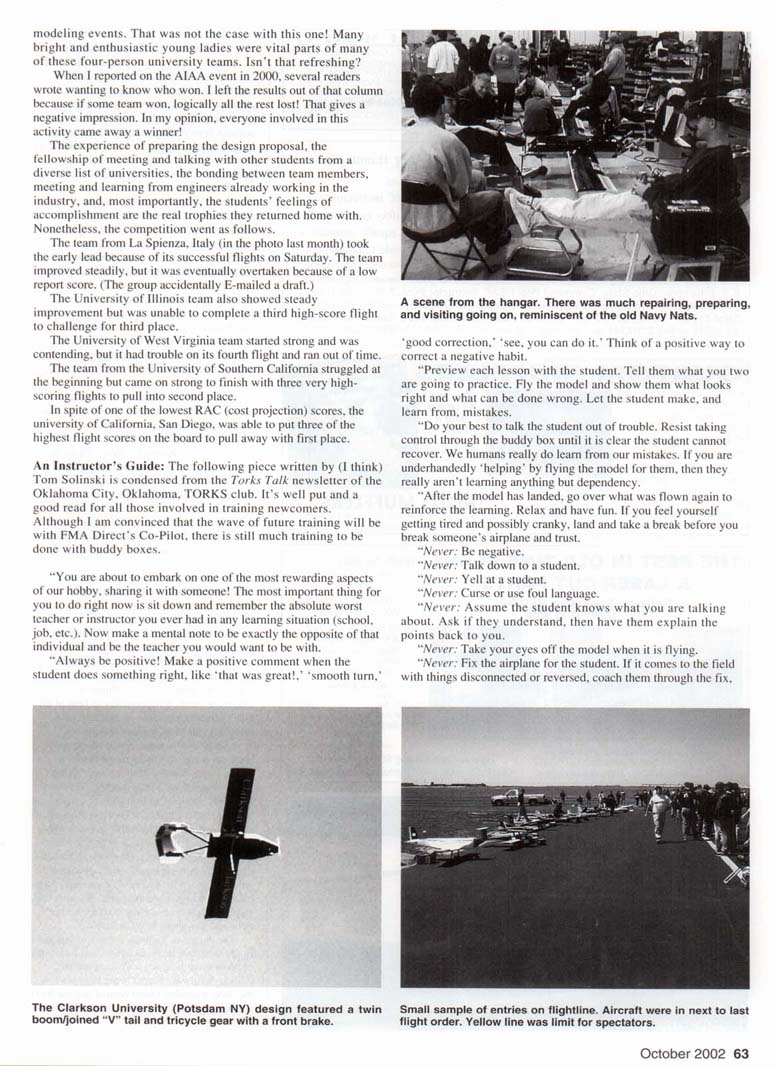
The softballs were an interesting design consideration: they were not just for weight but required large volume somewhere in the model for a cargo hold. The result was some intriguing fuselage shapes.
The course was: 500 feet upwind, a pylon turn, a 360° turn in the center, a 500-foot downwind leg and turn, followed by landing and parking on a spot. The softballs were added and the course was repeated. The last flight was then conducted without the softballs. Elapsed time to complete all this on one charge, plus the weight lifted, formed the basis for the flight score.
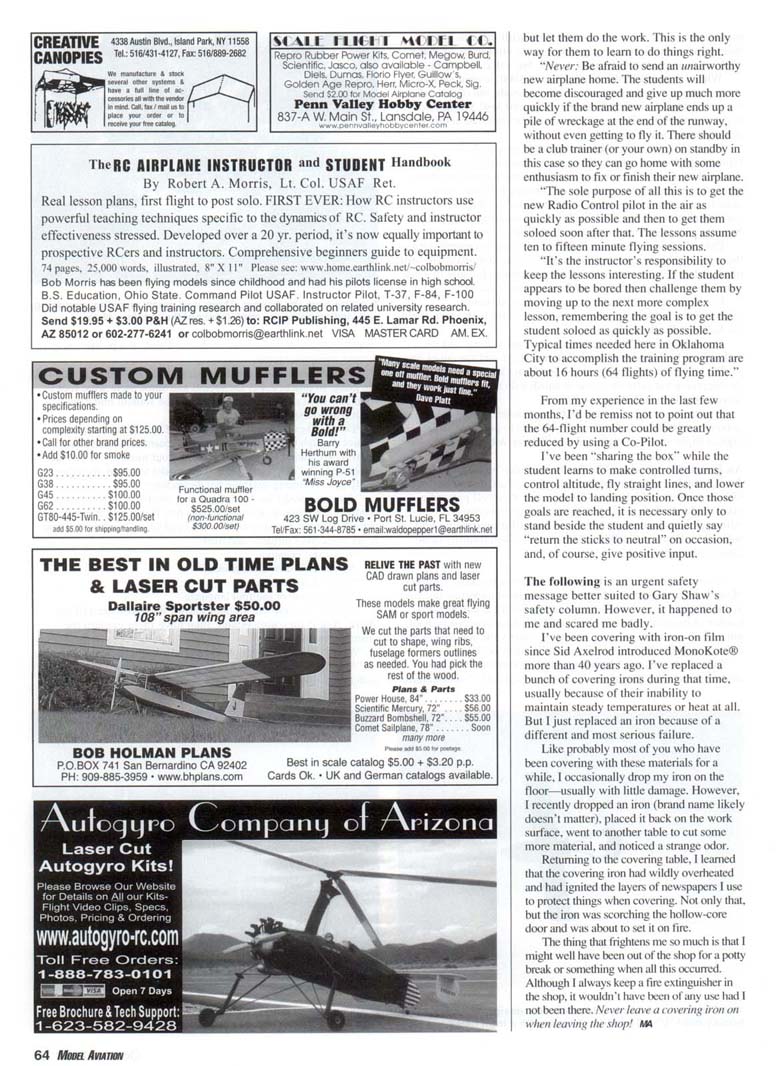
One noteworthy entry: the U.S. Naval Academy (Annapolis, Maryland) entry had twin engines, retracts, and used an Eppler airfoil.
Event rules
- The models could be as lightly constructed as the builders dared.
- The objective was to lift the most weight (softballs) and complete the flight schedule as quickly as possible.
- Only Ni-Cd batteries were allowed—no nickel-metal-hydride or lithium cells. Brushless motors were not allowed. Maximum current draw was limited to 40 amps (fused).
- Each team was required to complete an engineering study (aerodynamic and structural) and a cost analysis and submit it in advance for judging by aeronautical engineers.
- Pilots did not have to be enrolled students at the universities.
- Each model had to have a removable fused safety plug onboard. The team could not touch the model once the fail-safe was activated. Cargo had to be loaded and unloaded with the model on the start/finish line.
- If the model landed short, the team had to disarm it and carry the model back. If it landed long, the team had to taxi or carry it back. Several entries were equipped with brakes as a result.
- Propellers had to be commercially available units with only balancing allowed.
- Five attempts were allowed with the best three scores retained. Maximum elapsed time was 10 minutes per attempt.
The rules for this challenging event were developed and administered by an AIAA committee.
Venue, weather, and participation
The venue in Wichita was what used to be the Cessna single-engine delivery center; in alternate years the event is held at the Office of Naval Research in Maryland. The host organization took care of all administrative functions so entrants could focus on flying and repairing their models. There was even the classic "hangar" for repairs and socializing.
As those who have attended model-airplane events or driven through Kansas know, the wind can blow wildly one day and be nearly dead calm the next. That "wait 'til tomorrow" weather showed up at this event. Saturday started out cold, windy (at right angles to the runway), and rainy; Sunday was nearly perfect—calm, sunny, with the wind blowing directly down the runway. Consequently, 14 attempts were made on Saturday with only six successful scores, while Sunday saw 69 successful flights.
We old guys have rarely seen more than a few women enter modeling events. That was not the case here—many bright and enthusiastic young women were vital parts of many of these four-person university teams. That was refreshing.
When I reported on the AIAA event in 2001, several readers wrote asking who won. I left the results out of that earlier column because if some team won, logically all the rest lost—an impression I did not want to convey. In my opinion, everyone involved in this activity came away a winner. The real trophies were the experience of preparing the design proposal, the fellowship of meeting students from diverse universities, bonding between team members, meeting and learning from engineers in the industry, and, most importantly, the students' feelings of accomplishment.
Results
- La Sapienza (Italy) took the early lead with successful Saturday flights and improved steadily, but was eventually overtaken because of a low report score (the group accidentally e-mailed a draft).
- The University of Illinois showed steady improvement but could not complete a third high-scoring flight to challenge for third place.
- The University of West Virginia started strong and was contending, but had trouble on its fourth flight and ran out of time.
- The University of Southern California struggled at the beginning but finished strong with three very high-scoring flights to take second place.
- The University of California, San Diego, despite one of the lowest RAC (cost projection) scores, put three of the highest flight scores on the board and won first place.
---
An Instructor's Guide
The following piece, written by (I think) Tom Solinski, is condensed from the Torks Talk newsletter of the Oklahoma City TORKS club. It's well put and a good read for those training newcomers. Although I am convinced that the wave of future training will be with FMA Direct's Co-Pilot, there is still much training to be done with buddy boxes.
You are about to embark on one of the most rewarding aspects of our hobby: sharing it with someone. The most important thing for you to do right now is sit down and remember the absolute worst teacher or instructor you ever had in any learning situation (school, job, etc.). Now make a mental note to be exactly the opposite of that individual and be the teacher you would want to have.
Always be positive. Make a positive comment when the student does something right, like "that was great," "smooth turn," "good correction," or "see, you can do it." Think of a positive way to correct a negative habit.
Preview each lesson with the student. Tell them what you two are going to practice. Fly the model and show them what looks right and what can be done wrong. Let the student make, and learn from, mistakes.
Do your best to talk the student out of trouble. Resist taking control through the buddy box until it is clear the student cannot recover. We humans learn from our mistakes. If you are underhandedly "helping" by flying the model for them, they aren't learning anything but dependency.
After the model has landed, go over what was flown again to reinforce the learning. Relax and have fun. If you feel yourself getting tired and possibly cranky, land and take a break before you break someone's airplane and trust.
- Never: Be negative.
- Never: Talk down to a student.
- Never: Yell at a student.
- Never: Curse or use foul language.
- Never: Assume the student knows what you are talking about—ask if they understand, then have them explain the points back to you.
- Never: Take your eyes off the model when it is flying.
- Never: Fix the airplane for the student. If it comes to the field with things disconnected or reversed, coach them through the fix.
But let them do the work. This is the only way for them to learn to do things right.
Never be afraid to send an unairworthy new airplane home. Students will become discouraged and give up much more quickly if a brand-new airplane ends up a pile of wreckage at the end of the session without even getting to fly. There should be a club trainer (or your own trainer) on standby so they can go home with enthusiasm to fix or finish their new airplane.
The sole purpose is to get the new radio-control pilot in the air as quickly as possible and then to get them soloed soon after that. The lessons assume ten- to fifteen-minute flying sessions.
It's the instructor's responsibility to keep the lessons interesting. If the student appears bored, challenge them by moving up to the next, more complex lesson—remembering the goal is to get the student soloed as quickly as possible. Typical times needed in Oklahoma City to accomplish the training program are about 16 hours (64 flights) of flying time.
From my recent experience, the 64-flight number can be greatly reduced by using a Co-Pilot. I've been "sharing the box" while the student learns to make controlled turns, control altitude, fly straight lines, and lower the model to landing position. Once those goals are reached, it is necessary only to stand beside the student and quietly say "return the sticks to neutral" on occasion, and, of course, give positive input.
---
Covering-iron safety
The following is an urgent safety message. I've been covering with iron-on film since Sid Axelrod introduced MonoKote more than 40 years ago. I've replaced a bunch of covering irons during that time, usually because of their inability to maintain steady temperatures or heat at all. I just replaced an iron because of a different and more serious failure.
Like many who have been covering for a while, I occasionally drop my iron on the floor—usually with little damage. Recently I dropped an iron, placed it back on the work surface, went to another table to cut more material, and noticed a strange odor. Returning to the covering table, I found the iron had wildly overheated and had ignited the layers of newspapers I use to protect things. The iron was scorching the hollow-core door and was about to set it on fire.
What frightens me most is that I might have been out of the shop for a short break when this occurred. Although I always keep a fire extinguisher in the shop, it wouldn't have been of any use had I not been there. Never leave a covering iron on when leaving the shop!
MA
Transcribed from original scans by AI. Minor OCR errors may remain.

