
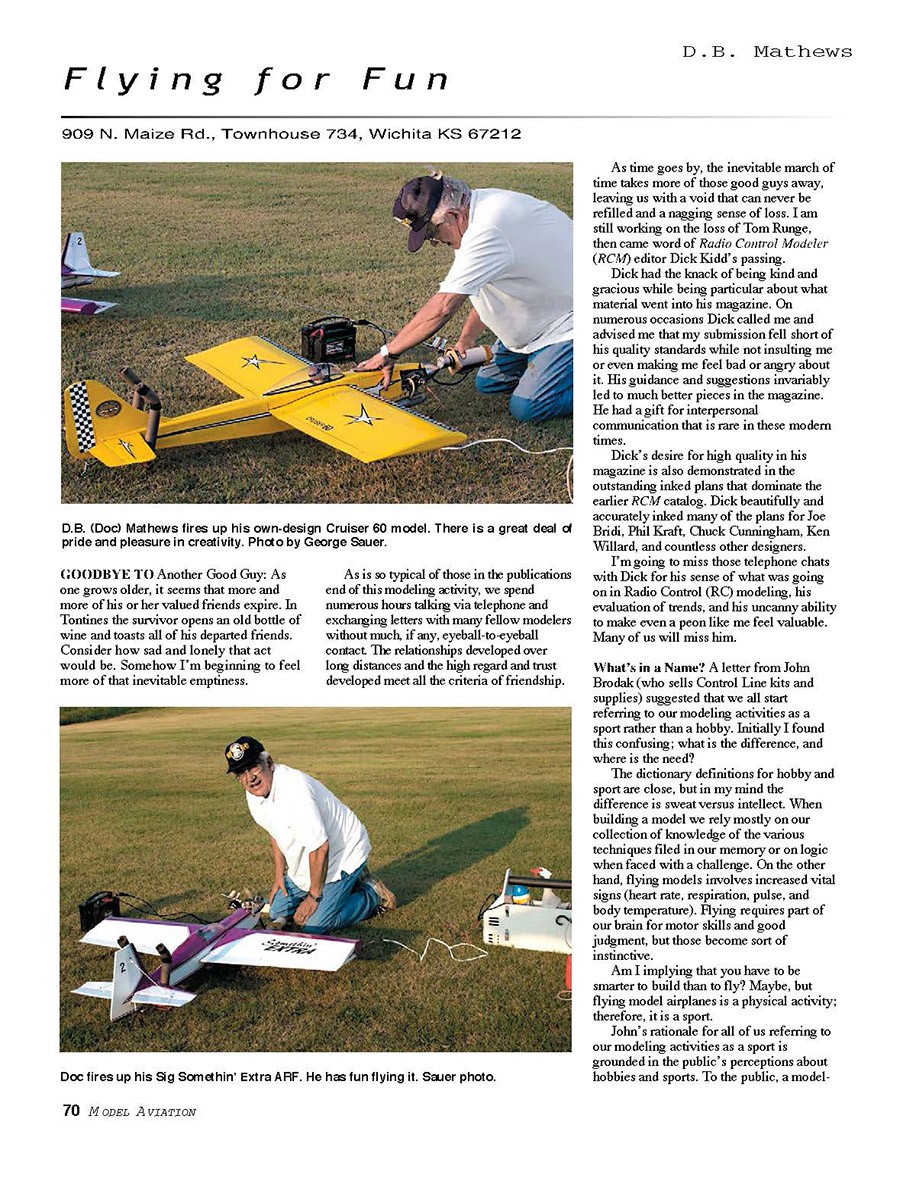
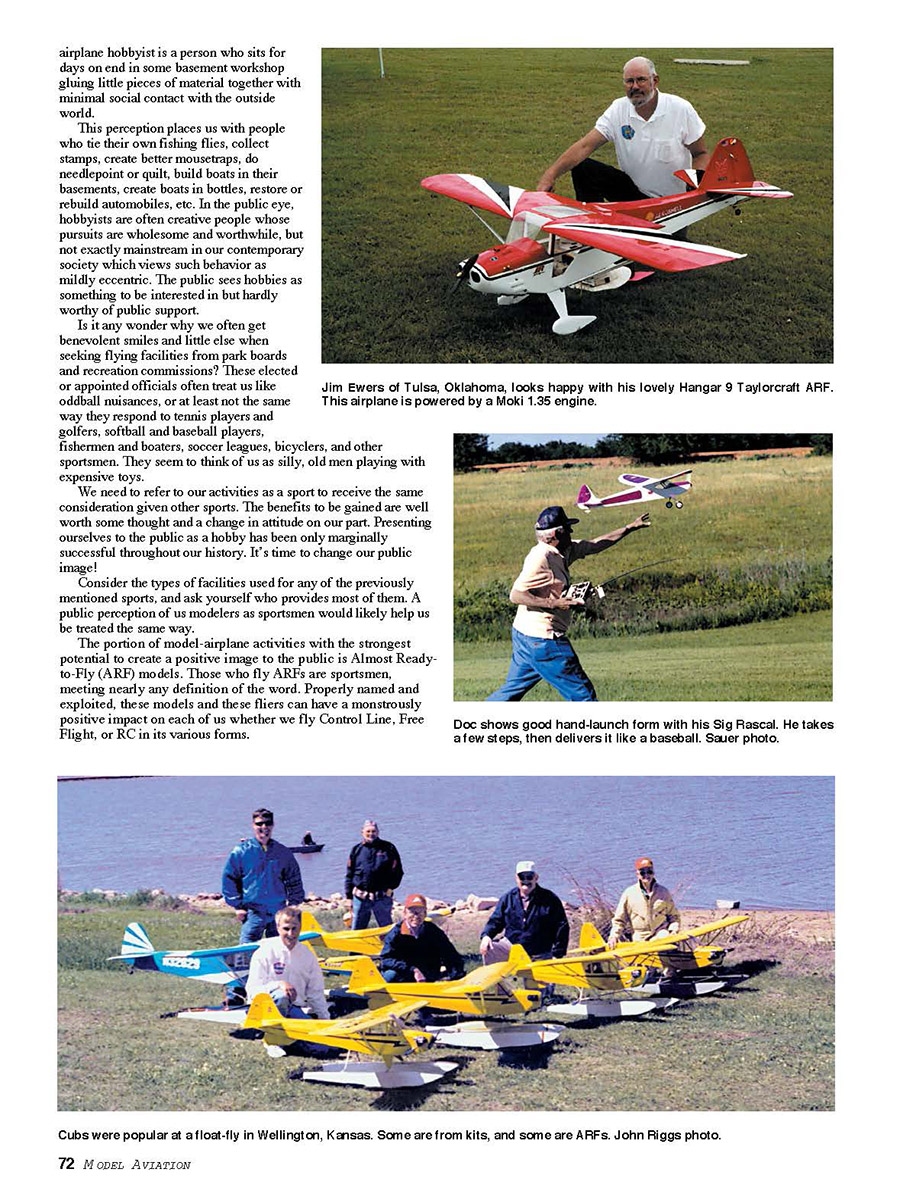
Flying for Fun
909 N. Maize Rd., Townhouse 734, Wichita KS 67212
Goodbye to Another Good Guy
As one grows older, it seems that more and more of his or her valued friends expire. In tontines the survivor opens an old bottle of wine and toasts all of his departed friends. Consider how sad and lonely that act would be. Somehow I'm beginning to feel more of that inevitable emptiness.
As is so typical of those in the publications end of this modeling activity, we spend numerous hours talking via telephone and exchanging letters with many fellow modelers without much, if any, eyeball-to-eyeball contact. The relationships developed over long distances and the high regard and trust developed meet all the criteria of friendship.
As time goes by, the inevitable march of time takes more of those good guys away, leaving us with a void that can never be refilled and a nagging sense of loss. I am still working on the loss of Tom Runge; then came word of Radio Control Modeler (RCM) editor Dick Kidd's passing.
Dick had the knack of being kind and gracious while being particular about what material went into his magazine. On numerous occasions Dick called me and advised me that my submission fell short of his quality standards while not insulting me or even making me feel bad or angry about it. His guidance and suggestions invariably led to much better pieces in the magazine. He had a gift for interpersonal communication that is rare in these modern times.
Dick's desire for high quality in his magazine is also demonstrated in the outstanding inked plans that dominated the earlier RCM catalog. Dick beautifully and accurately inked many of the plans for Joe Bridi, Phil Kraft, Chuck Cunningham, Ken Willard, and countless other designers.
I'm going to miss those telephone chats with Dick—for his sense of what was going on in Radio Control (RC) modeling, his evaluation of trends, and his uncanny ability to make even a peon like me feel valuable. Many of us will miss him.
What's in a Name?
A letter from John Brodak (who sells Control Line kits and supplies) suggested that we all start referring to our modeling activities as a sport rather than a hobby. Initially I found this confusing: what is the difference, and where is the need?
The dictionary definitions for hobby and sport are close, but in my mind the difference is sweat versus intellect. When building a model we rely mostly on our collection of knowledge of the various techniques filed in our memory or on logic when faced with a challenge. On the other hand, flying models involves increased vital signs (heart rate, respiration, pulse, and body temperature). Flying requires part of our brain for motor skills and good judgment, but those become sort of instinctive.
Am I implying that you have to be smarter to build than to fly? Maybe, but flying model airplanes is a physical activity; therefore, it is a sport.
John's rationale for all of us referring to our modeling activities as a sport is grounded in the public's perceptions about hobbies and sports. To the public, a model-airplane hobbyist is a person who sits for days on end in some basement workshop gluing little pieces of material together with minimal social contact with the outside world. This perception places us with people who tie their own fishing flies, collect stamps, do needlepoint or quilting, build boats in their basements, create boats in bottles, restore or rebuild automobiles, etc. In the public eye, hobbyists are often creative people whose pursuits are wholesome and worthwhile, but not exactly mainstream in our contemporary society which views such behavior as mildly eccentric. The public sees hobbies as something to be interested in but hardly worthy of public support.
Is it any wonder why we often get benevolent smiles and little else when seeking flying facilities from park boards and recreation commissions? These elected or appointed officials often treat us like oddball nuisances, or at least not the same way they respond to tennis players and golfers, softball and baseball players, fishermen and boaters, soccer leagues, bicyclists, and other sportsmen. They seem to think of us as silly, old men playing with expensive toys.
We need to refer to our activities as a sport to receive the same consideration given other sports. The benefits to be gained are well worth some thought and a change in attitude on our part. Presenting ourselves to the public as a hobby has been only marginally successful throughout our history. It's time to change our public image!
Consider the types of facilities used for any of the previously mentioned sports, and ask yourself who provides most of them. A public perception of us modelers as sportsmen would likely help us be treated the same way.
The portion of model-airplane activities with the strongest potential to create a positive image to the public is Almost Ready-to-Fly (ARF) models. Those who fly ARFs are sportsmen, meeting nearly any definition of the word. Properly named and exploited, these models and these fliers can have a monstrously positive impact on each of us whether we fly Control Line, Free Flight, or RC in its various forms.
I will be the first to admit I looked at such model aircraft with disdain for many years. A diminishing number of us still much prefer to build what we fly and feel totally out of tune with those who would rather fly ARFs. After some serious soul-searching on the subject in the last few years, I’ve concluded that these sportsman pilots have the potential to benefit everyone involved in modeling, and it is much to the advantage of all of us to alter our attitudes toward them.
We need to recognize the incredible numbers of new fliers that these ready-built models are attracting to the sport. In sheer numbers we have an increasing influence on governmental agencies, from local park boards to the Federal Communications Commission. There is strength in numbers! These sport fliers are going to get more attention from the media, the public, and governments.
There is also an increasing economic impact; no longer is modeling a kid’s activity involving inexpensive kits purchased at the local drugstore. We are mostly grown-ups who spend a significant amount of money on our models and on attending out-of-town modeling events. Tourism and visitor bureaus should take note of the amount of money fly-in and contest attendees contribute to local economies. They buy gas, food, lodging, and their spouses might even spend some time shopping while in town. Communities should be seeking us out, hoping that we might schedule such events in their towns.
The explosion in the numbers of people flying models as a sport can be a positive thing for modeling. For the sake of public relations, we should refer to all flying of model aircraft as sport.
As I mentioned, I and many other modelers have viewed the ARF as a disturbing aberration in our modeling lives. Why would anyone want to miss out on the fun and good feelings of building model airplanes?
Watching my young adult children work their way through their daily lives, I see that they simply do not have time to build! What little recreation time they have is so precious that they are lucky to have time to play. Perhaps when their children are grown and their jobs require less of them, they will have more leisure time. At that point they might find creating model airplanes fulfilling, but they don’t now.
Those same limits on recreation time probably describe the bulk of 25- to 55-year-olds. Considering their ages, older modelers would be most wise to offer all the help, experience, and knowledge we can provide. After all, the younger group holds the key to much better public relations for us and the benefits that can come from that.
So, John Brodak, you are absolutely correct; we are participating in a sport.
As we use more and more electricity to power our models, a perverse thing runs through my mind. It is considered correct to refer to power plants for these models as "motors" since they produce their power without fuel combustion (actually the expansion of a gas), whereas internal-combustion units are referred to as "engines"; as are steam-powered and CO2 units.
So, in correct terms we modelers fly our airplanes with electric or rubber motors and glow or CO2 engines. Then shouldn’t it be "General Motors" and "Ford Engine Co.," and shouldn’t Detroit be "Engine Town"?
Transcribed from original scans by AI. Minor OCR errors may remain.

