
Dr. D.B. Mathews
Flying For Fun
909 N. Maize Road, Townhouse 734, Wichita, KS 76212
BUILDIN' TIME:
This should be reaching you at about the time of year when your workbench has been open for business for a while and your new projects are approaching that almost-finished point. Hope whatever you are building has been of excellent quality and that everything went smoothly.
With the incredible number of model kits in everything from micro free flight to jumbo scale on the market, it certainly isn't difficult to find something with appeal. Additionally, the magazines are full of published designs that are most interesting, and the "plans peddlers" can help fill in any gaps for the scratch-builder.
A short note on that subject needs to be interjected here: some plans peddlers have not built or flown what they peddle. You are being asked to build their prototypes for them. I'd insist on seeing a photo of the model built from those drawings if you haven't seen that particular design fly — or at least see photos of a model built from the plans in the magazines.
I have no accurate way to judge, but from the activity I see in the local hobby shops, modeling doesn't seem to be in any recession. Either that, or modeling attracts more participants when limited funds are available for leisure-time activities. That was certainly the case in the Depression years of the 1930s, wasn't it? I recently read that the Junior Birdmen promotion had over 500,000 members under age 21 in 1936!
For what it's worth, model airplane building actually is a rather inexpensive recreational activity on a cost-per-hour basis — at least if we compare the costs of building models (particularly free flight and control line) with the costs of golf, water skiing, hunting, etc. Think about it!
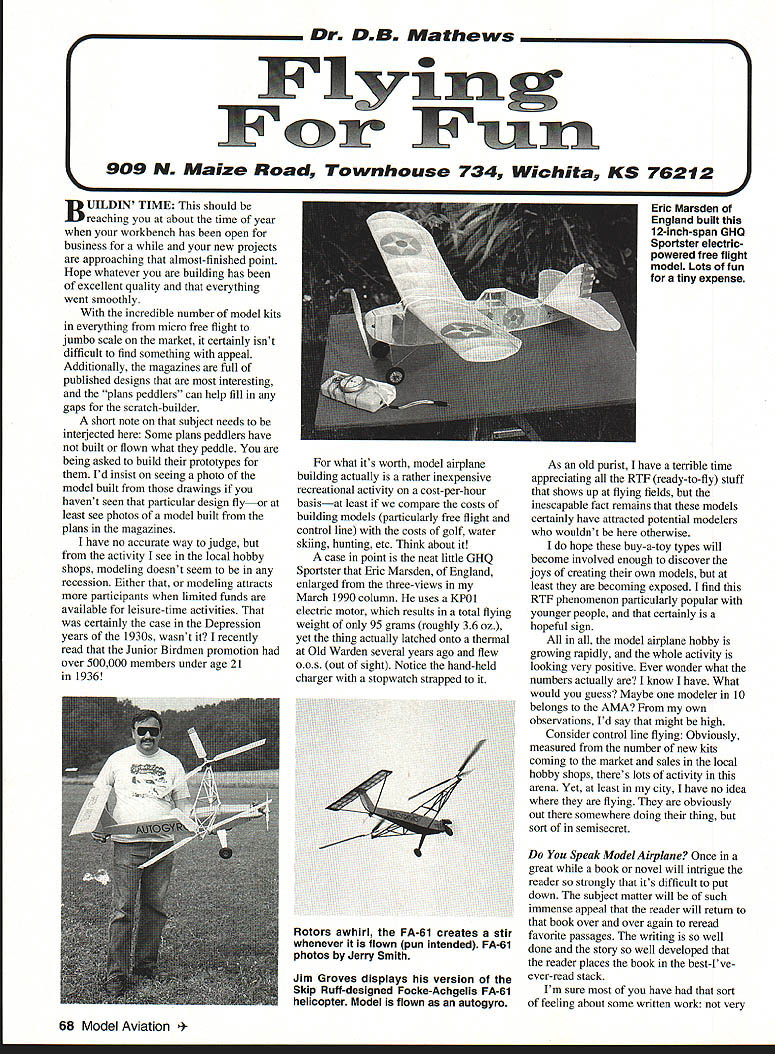
A case in point is the neat little GHQ Sportster that Eric Marsden, of England, enlarged from the three-views in my March 1990 column. He uses a KPO1 electric motor, which results in a total flying weight of only 95 grams (roughly 3.6 oz.), yet the thing actually latched onto a thermal at Old Warden several years ago and flew O.O.S. (out of sight). Notice the hand-held charger with a stopwatch strapped to it.
As an old purist, I have a terrible time appreciating all the RTF (ready-to-fly) stuff that shows up at flying fields, but the inescapable fact remains that these models certainly have attracted potential modelers who wouldn't be here otherwise.
I do hope these buy-a-toy types will become involved enough to discover the joys of creating their own models, but at least they are becoming exposed. I find this RTF phenomenon particularly popular with younger people, and that certainly is a hopeful sign.
All in all, the model airplane hobby is growing rapidly, and the whole activity is looking very positive. Ever wonder what the numbers actually are? I know I have. What would you guess? Maybe one modeler in 10 belongs to the AMA? From my own observations, I'd say that might be high.
Consider control line flying: obviously, measured from the number of new kits coming to the market and sales in the local hobby shops, there's lots of activity in this arena. Yet, at least in my city, I have no idea where they are flying. They are obviously out there somewhere doing their thing, but sort of in semi-secret.
Do You Speak Model Airplane?
Once in a great while a book or novel will intrigue the reader so strongly that it's difficult to put down. The subject matter will be of such immense appeal that the reader will return to that book over and over again to reread favorite passages. The writing is so well done and the story so well developed that the reader places the book in the best-I've-ever-read stack.
I'm sure most of you have had that sort of feeling about some written work; not very often, but at least once in your lifetime. Such a work is Dave Thornburg's Do You Speak Model Airplane? In my opinion, this may well be the best-written, most beautifully crafted, fascinating, informative (and all the other superlatives available) model airplane book I've ever read. I do not say this lightly; I honestly mean it! If you love your hobby, you just absolutely, positively must read this book.
I have no intention of doing a book review here, but some things Dave mentions are so true and so frightening I must quote:
"America's lifetime modelers. Take away their hobby, take away their endless fascination with things that fly, and you take away the raw material of their daydreams, their chief creative outlet, and much of their motivation for getting out of bed in the morning.
"There are in America fewer than a hundred thousand such people left; people for whom building and flying miniature aircraft is a passion, an obsession, a source of energy and enthusiasm virtually inseparable from their life force — people who are hooked by this unique hobby/sport not for a year or a decade, but forever. Lifers."
A fine mess this time
Hal Roach recently passed away in his hundredth year. He brought us many of the most delightful comedy movies of all time, including the Our Gang and Laurel and Hardy series. This leads to the memorable and often-used line from those Laurel and Hardy classics, "A fine mess you've gotten us into this time!" I think that has an application to modeling.
It seems to me that we need to reach the "unwashed modelers" to create a loud voice in the local and federal government scheme of things. Look at the NRA, EAA, Little League, youth soccer, etc., groups in your community. It's a matter of numbers, folks! If everyone in your community who flies models — be they free flight, control line, or radio control — were to appear at a city council meeting, would they draw attention?
I often read in this magazine of the unified efforts put together in various communities by modelers who have lost flying fields or whose fields are threatened. Obviously, in many instances this group response is effective and certainly admirable. Maybe, though, it would make better sense to unite well in advance of problems. That is, an active — as opposed to reactive — position. Don't wait until we have "gotten into a fine mess"; anticipate and act.
A beautiful illustration of this is the recent AMA action in gathering up the chairman of the FCC, taking him out one weekend, and introducing him to RC flying with an Ace Micropro buddy box and a Whiz 40. Not because of any current threat to our airspace, no favors to ask, just a friendly introduction to our activity. Action, not reaction. Darn smart that; don't you agree?
Balsa for paper:
In the December "Flying for Fun," I included photos of a Joe Ott OT-O-Former kit built by Walt Leonhardt. In the text, I asked if anyone might have drawings of the wood/paper parts. I was conjecturing how much easier and more satisfactory it would be to substitute balsa for the original paper formers and hardwood strip.
Well, by golly, Dan Shea, P.O. Box 467, Londonderry, NH 03053, advises he has complete kits of the following 27-inch-span series:
- Curtiss P40F
- Douglas Dauntless
- Grumman Wildcat
- Vought-Sikorsky Kingfisher
He also has the Curtiss Owl O-52, but it has been partially assembled. Dan is willing to have the drawings and parts reproduced for those who are interested.
The significant factor is not the availability of the construction drawings; those are available from other sources. What matters are the formers and other parts not shown on the plans. Anyone who is interested should contact Dan to work out the costs and such. I'd be delighted to receive photos and flying reports on these — whether rubber, electric, or CO2 powered.
Another gyro
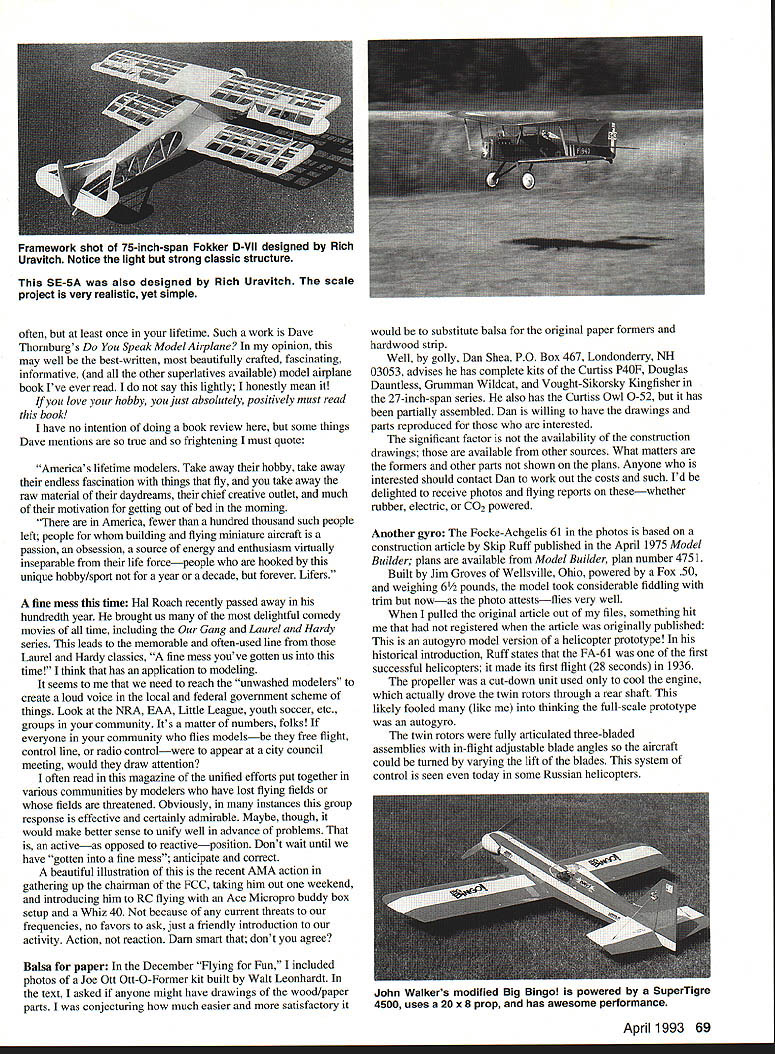
The Focke-Achgelis 61 in the photos is based on a construction article by Skip Ruff published in the April 1975 Model Builder; plans are available from Model Builder, plan number 4751.
Built by Jim Groves of Wellsville, Ohio, powered by a Fox .50, and weighing 6-1/2 pounds, the model took considerable fiddling with trim but now — as the photo attests — flies very well.
When I pulled the original article out of my files, something hit me that had not registered when the article was originally published: this is an autogyro, not a helicopter prototype! In his historical introduction, Ruff states that the FA-61 was one of the first successful helicopters; it made its first flight (28 seconds) in 1936.
The propeller was a cut-down unit used only to cool the engine, which actually drove the two rotor hubs through a gear shaft. This likely fooled many (like me) into thinking the full-scale prototype was an autogyro.
The twin rotors were fully articulated three-bladed assemblies with in-flight adjustable blades so the aircraft could be turned by varying the lift of the blades. This system of control is seen even today in some Russian helicopters.
Those of us who are faithful watchers of Wings and the other aviation documentaries on the Discovery Channel have seen old footage of the FA-61 flying indoors in a sports stadium and an interview with Hanna Reitsch, the pilot.
By definition, the model is not a helicopter. The rotors are not driven mechanically, but instead freewheel in the headwind created by forward movement. Unlike the DB Models and Gyracs units we've shown in the past, the FA-61 uses no downthrust, and the stab is set at zero.
Both Dave and Bob Boddington gyros are set up with the rotors tilted toward the back at 5°, inclined toward the outside about 8°, and use 8° to 10° of downthrust. On the Gyracs, the airfoiled stab is set at 4° positive, while the DB models design uses a half-section stab with 6° positive.
Just as I was ready to submit this month's column, I received several highly interesting illustrated plan catalogs from Bob Holman. One of these catalogs illustrates a superb selection of construction drawings for models published in Radio Control Model World of England.
Included is a set of drawings for still another twin-rotor autogyro, the Whirligig. This model, intended for .29 to .40 engines, is plan MW 2247. This Keith Humber design is neat and attractive. For drawings, contact Bob Holman (see ad this issue).
All four designs place the fore-and-aft balance point at or near the rotor shaft's centerline.
One unusual feature of the FA-61 model's design is a clever rotor bearing setup. Skip Ruff uses the crankcase and shaft from old, discarded Cox .049 engines! Should work well, as they are easily and inexpensively available at many garage sales, that's for sure.
Classic classics:
If you've been around this hobby for a spell, I'll bet you first glanced at the Fokker D.VII skeleton photo and thought you were looking at a Sterling U-Control frame-up. Or — for that matter — one of the classic free-flight scale designs. At least, that was my first reaction.
Not so! What we have here are two IMAA-legal jumbo scale projects (also available is a neat SE-5) from the fertile mind of Rich Uravitch. They obviously use time-proven classic construction techniques. Both are 70-plus-inch-span RC models intended for 1.20 strokers, .90–.108 two-cycles, or .38/.042 gas burners.
Plans, excellent building instructions, and vacuum-formed cowl are available from Rich at 15 Newcomb Trail, Ridge, NY 11962; or call (516) 929-4132. Current price is a reasonable $38.95 postpaid.
I am impressed with their straightforward construction and the use of four-spar wings! They build up in the 15-to-19-pound range, with 1,959 square inches of wing on the SE-5 and 1,748 on the D.VII. As you know, that is a reasonable wing loading for models of this size.
Should you be interested, but not willing to cut out the wing ribs and bend the wire, Chuck Gill (The Airplane Works, 2184 Gilbride Road, Martinsville, NJ 08836; Tel.: [908] 356-8557) has kits available that are priced at $225. Build both, and restart WW I?
Stress test:
One recurrent nightmare associated with designing a model airplane kit for a manufacturer is the possibility of structural failures either from poor workmanship or overpowering the design. As a consequence, I tend to over-structure — just in case. That then leaves me wondering just how much excess power the design could actually handle.
John Walker's Big Bingo! in the photo is powered by a Super Tigre 4500J. John modified the vertical fin and turtledeck former, but made no changes to the rest of the fuselage or to the wings. The two-part wing with aluminum-pipe/phenolic-tube joiner was retained.
He frightened me a bit, admittedly, but the 20-pound model will climb at an 80° angle right out of sight, has spectacular pulling power through inside and outside maneuvers, and is just plain awesome. After more than 60 flights, no sign of surface flutter or structural cracking has been observed. So I really still don't know what too much power for the Big Bingo! might be.
Transcribed from original scans by AI. Minor OCR errors may remain.

