
Flying For Fun
Dr. D.B. Mathews
909 N. Maize Road, Townhouse 734, Wichita, KS 76212
Anyone who has ever faced a time deadline for written material—be it a term paper or business report—knows the hopeless feeling of writer's block. Somehow one's inspiration enters a holding pattern while the little cursor blinks at us or the ink dries in our ballpoint.
I'm having a problem with writer's block for this column. I just can't seem to get started. Time is screaming, "Do something," and my brain keeps saying, "I dunno."
It's not so much that I have nothing to write about as it is attempting to come up with something new, fresh, and noncontroversial—or at least with broad enough interest to use as the theme of a column. Oh, the ideas are jumping all right; it's just that none seems exactly right, somehow.
I could write about several topics, for example:
- Something nasty about Ken Willard's Drake II design being kitted under a different name without credit given to Ken. The culprit has likely already heard about his dirty trick from many of Ken's friends.
- The federal bureaucracy that led us into updating or buying new radio equipment for our new 91 frequencies, and now—less than 18 months later—covering those frequencies for commercial users, which could render our equipment useless.
- The futility of responding in anger to the FCC and how much more effective calm, reasoned responses would be—particularly if mature, well-thought-out, and numerous personal letters were sent to members of Congress.
- The division in the modeling community at a moment when unity is critically important: two squabbling organizations appearing before the FCC to represent us, and the freeloading by non-AMA members who expect AMA to foot the bill and fight the fight.
- The Ace Float-Fly coming up the first weekend of June; it's become the highlight of the flying season for many of us, and the protocols and techniques for off-water flying have been covered in past issues.
Most of those topics have already been debated or covered enough to make them unsuitable as the focus of this column at this late date. So, since I can't break out of writer's block mode, let's talk a bit about the photos—sort of a People magazine approach this month: not much stimulating text, but lots of pictures to look at. Possibly that's what most readers would prefer in every column!
A Delightful Day and the PuddleMaster
One thing can blunt the sting of being dead wrong: company. The Friday before the Ace Float-Fly I spent the day discussing the latest model projects at an airport facility and learned all sorts of things—some I wanted to know, some I'd rather not. Last year I spent considerable time with Cal Orr, who writes Radio Spectrum for RCM.
Cal, having flown in California, was asked to help organize and instruct the Big Bingo exhibition team. Pilots Tom Runge and other Ace folks kept bugging Cal to take PuddleMaster prototypes over the lake to fly. Obviously Cal's experiences with electric-powered sport models paralleled mine: "heavy, sluggish, and slightly tricky to fly." Neither of us felt any overwhelming desire to attempt to fly an electric flying boat.
As the sun began to set, we discovered that only he and I were left at the airport, and it was a really beautiful evening. So we decided, what the heck; let's go try it. We actually flipped a coin to see who would have to fly first—that's how enthusiastic we were.
What I'm saying here is that we anticipated struggling the model off the water, sweating the elevator to gain altitude without stalling, and staggering the model about for a few minutes before landing.
Man, were we ever wrong! This darn thing jumps off the water right away, will do the full complement of three-channel aerobatics, flies almost totally silently for five to seven minutes, and lands like a feather. Cal and I both found the flight envelope astonishing—particularly since the motor was a simple "can" unit, not an expensive rare-earth type.
I honestly have no idea why the PuddleMaster performs so well; however, it most assuredly does. At the float-fly on Saturday and Sunday, they were flown by everyone who wanted to fly them, and the comment we heard over and over was, "I can hardly believe how well this thing flies."
Upon reflection, the PuddleMaster has immense appeal for many of us. I live in a development with a decorative pond about two blocks from my house. Our covenants strictly forbid running any sort of internal combustion engine (trail bikes, motorcycles, chain saws, and particularly model airplanes) inside the common grounds.
Needless to say, although the pond is large enough to fly glow R.O.W., I don't. But now, with the advent of this nearly silent electric-powered model, I can see chucking it to the pond after work for a few delightful flights without upsetting anyone.
At about this point, many readers are thinking about those bodies of water—be they creek (or "krick"), lake, pond (or stock tank), river, bayou, or, yes, even a puddle—close to your home. These would not be satisfactory for glow power R.O.W. because of noise, but would be perfect for electric flying. Many in-town locations lack space for a runway but would be perfect for water flying. Designer Scott Hartman seems to have some special magic, providing a quantum leap forward in electric sport designs. Now here is something to really fly for fun!
Twilight Zone... Again
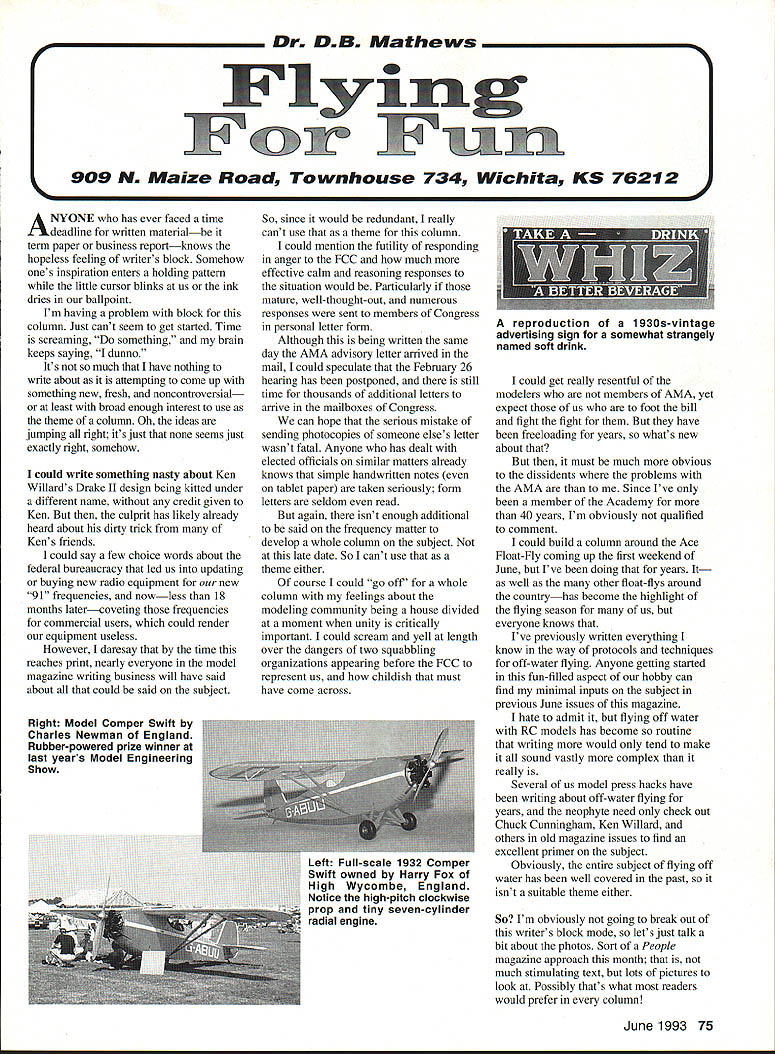
Regular readers will recall the string of strange things that happen to me involving model aircraft. The latest occurred while I was Christmas shopping in an "educational" toy store for my granddaughters. I happened to glance up on the wall above the cash register and was astonished to see a reproduction of a 1930s-vintage sign advertising a strangely named soft drink.
Belatedly, well after completing the Whiz 40 project, I learned that the name is a colloquial vulgarism. Before seeing the sign I absolutely did not know that. Do any readers have any historical information on the subject?
On a related note: older readers will recall a brand of cigarettes called Wings. These were packaged with some rather neat trading cards featuring aircraft of the period. In cruising through a current catalog from one of the aircraft memorabilia sellers, I noticed that some of these cards are now available nicely framed at $400 a dozen. And we feel bad about having tossed our childhood baseball cards?
Credit Where Credit Is Due: The Kingfisher
Yes, we've run a photo of this model before. The first time I couldn't find the information and ran it without an adequate caption. That was a disservice to the builder and to the designer.
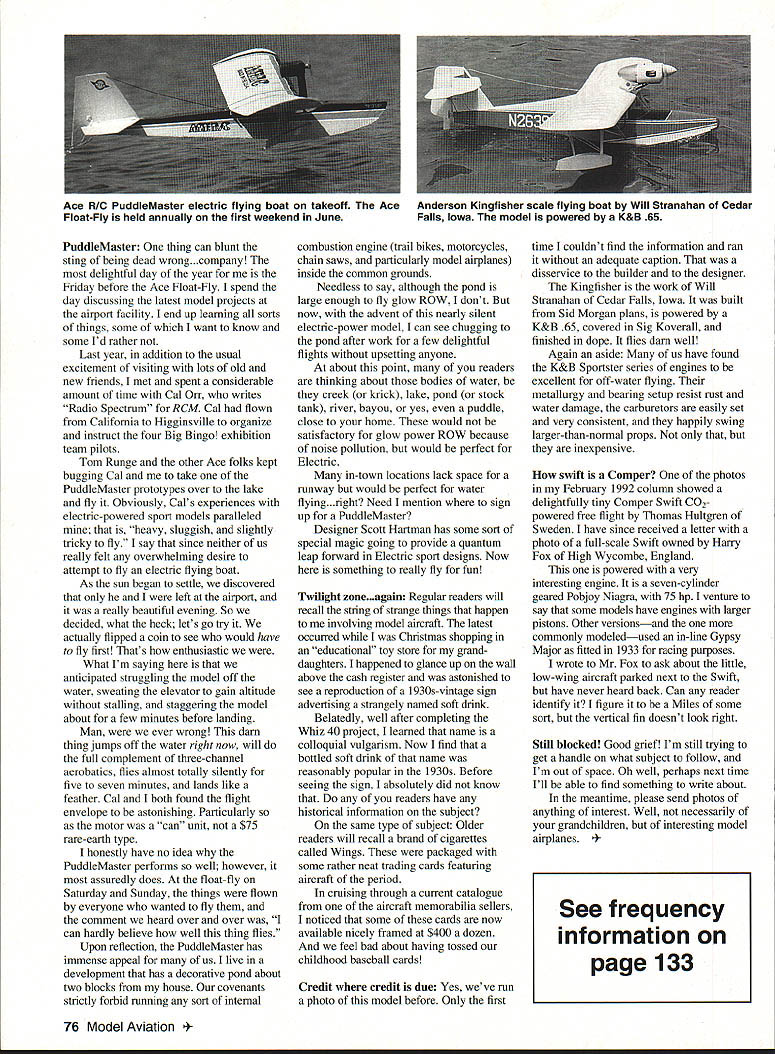
The Kingfisher is the work of Will Stranahan of Cedar Falls, Iowa. It was built from Sid Morgan plans, is powered by a K&B .65, covered in Sig Koverall, and finished in dope. It flies darn well!
Engines Aside: K&B Sportsters
Many of us have found the K&B Sportster series of engines to be excellent for off-water flying. Their metallurgy and bearing setup resist rust and water damage, the carburetors are easily set and very consistent, and they happily switch to larger-than-normal props. Not only that, they are inexpensive.
How Swift Is a Comper?
One of the photos in my February 1992 column showed a delightfully tiny Comper Swift (CO-?)-powered free flight by Thomas Hultgren of Sweden. I have since received a letter with a photo of a full-scale Swift owned by Harry Fox of High Wycombe, England.
This one is powered with a very interesting engine: a seven-cylinder geared Pobjoy Niagara, with 75 h.p. I venture to say that some models have engines with larger cylinders. Other versions—and the one more commonly modeled—used an in-line Gypsy Major as fitted in 1933 for racing purposes.
I wrote to Mr. Fox to ask about the little, low-wing aircraft parked next to the Swift, but have never heard back. Can any reader identify it? I figure it to be a Miles of some sort, but the vertical fin doesn't look right.
Still blocked! Good grief—I’m still trying to get a handle on what subject to follow, and I'm out of space. Oh well, perhaps next issue I'll be able to find something to write about.
In the meantime, please send photos of anything of interest. Well, not necessarily photos of your grandchildren, but of interesting model airplanes.
Transcribed from original scans by AI. Minor OCR errors may remain.

