
Flying for Fun
909 North Maize Road, Townhouse 734, Wichita, KS 76212
Loose Ends
A few assumptions have been made in the last several columns that left some readers confused; let's try to clear things up.
In the little piece that accompanied the photo of the Anderson Greenwood, I presumed everyone knew where to obtain Paul Matt materials. Paul's magnificent three-view drawings and books are now available through Aviation Heritage Books, P.O. Box 2065, Terre Haute, IN 47802; Tel.: (800) 999-0141.
Second, several readers wrote for my expertise on microelectric free flight. Simply put, I have none. I would suggest they write the columnists in the various magazines for answers to their questions. Dick Gibbs at Flying Models would be a good choice for help on these neat little silent projects.
Way Out of the Rut
This column's faithful readers seem to enjoy out-of-the-rut, innovative, and inventive model aircraft projects. Certainly easily understood, since the more conventional models are well covered in other columns. This month's feature model is no exception.
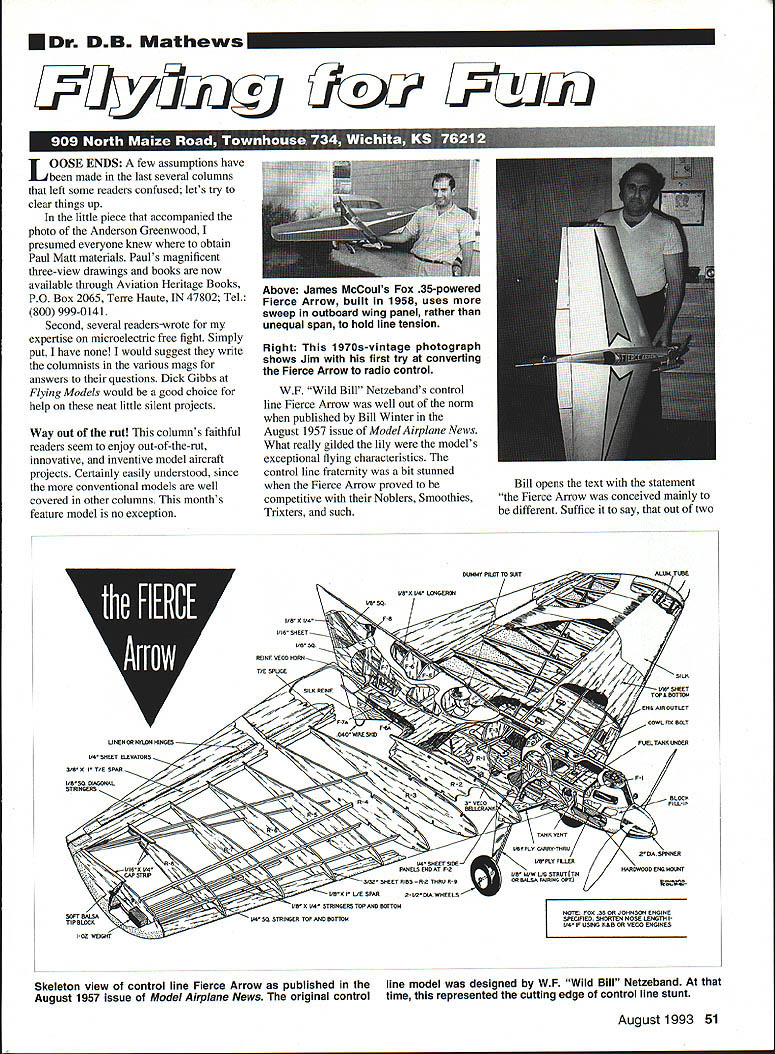
W.F. "Wild Bill" Netzeband's control line Fierce Arrow was well out of the norm when published by Bill Winter in the August 1957 issue of Model Airplane News. What really gilded the lily were the model's exceptional flying characteristics. The control line fraternity was a bit stunned when the Fierce Arrow proved to be competitive with their Noblers, Smoothies, Trixters, and such.
Bill opens the text with the statement, "The Fierce Arrow was conceived mainly to be different." Suffice it to say, out of two meets it has won two firsts, one of them being the King Orange Meet.
The name itself is a rather innovative play on the Pierce-Arrow automobile, which was a huge luxury car of the 1920s. I believe they were used as presidential automobiles, and Gloria Swanson's car in the movie Sunset Boulevard was a Pierce-Arrow.
I distinctly recall the publication of Bill's design and reacting in total amazement to it. He had previously published a somewhat less unusual wing named the Half Fast, but a large, full-competition stunter using this configuration was just plain stunning.
I've noticed photos of this design now being flown in old-time stunt events, which certainly would substantiate its appeal and flying characteristics as a control line design even 35 years later.
Control Line to RC
Converting control line stunt models to RC flying seems to work out rather well, as witness Leon Shulman's Secret Weapon published in the magazine a few months ago. After all, the force arrangements, airfoils, and power requirements aren't that distant from each other. Many construction techniques we now commonly use in RC were originally developed for control line.
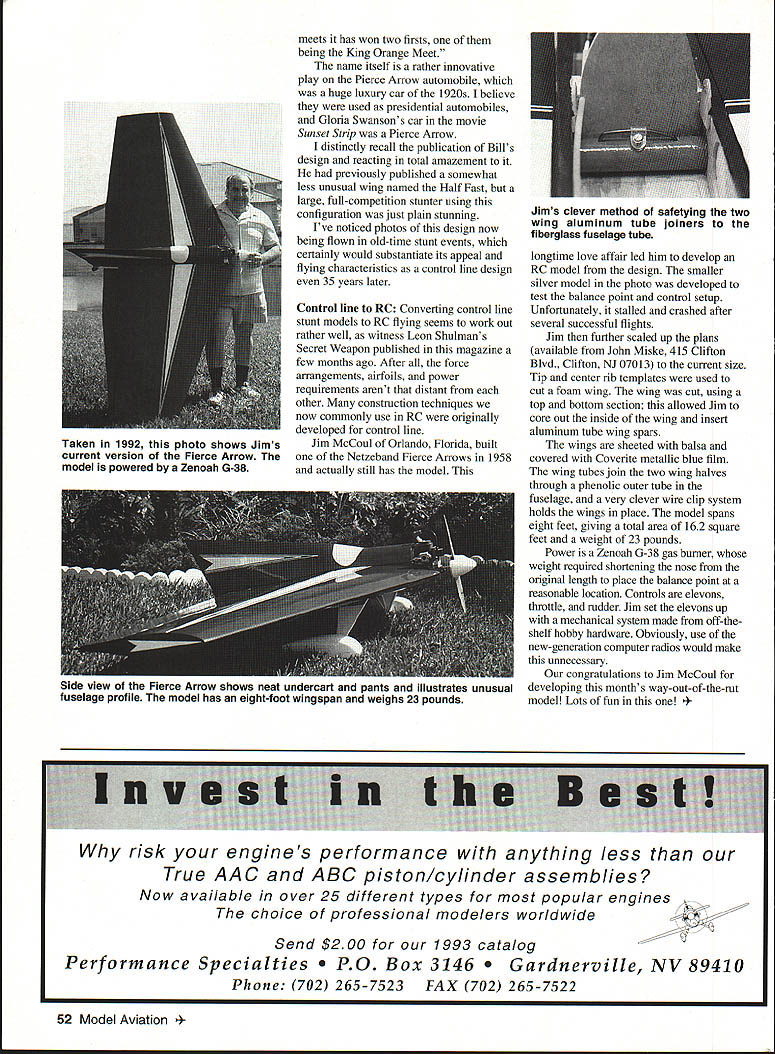
Jim McCoul of Orlando, Florida, built one of the Netzeband Fierce Arrows in 1958 and actually still has the model. This longtime love affair led him to develop an RC model from the design. The smaller silver model in the photo was developed to test the balance point and control setup. Unfortunately, it stalled and crashed after several successful flights.
Jim then further scaled up the plans (available from John Miske, 415 Clifton Blvd., Clifton, NJ 07013) to the current size. Tip and center rib templates were used to cut a foam wing. The wing was cut using a top and bottom section; this allowed Jim to core out the inside of the wing and insert aluminum-tube wing spars.
The wings are sheeted with balsa and covered with Coverite metallic blue film. The wing tubes join the two wing halves through a phenolic outer tube in the fuselage, and a very clever wire-clip system holds the wings in place. The model spans eight feet, giving a total area of 16.2 square feet and a weight of 23 pounds.
Power is a Zenoah G-38 gas engine, whose weight required shortening the nose from the original length to place the balance point at a reasonable location.
Controls are elevons, throttle, and rudder. Jim set the elevons up with a mechanical system made from off-the-shelf hobby hardware. Obviously, use of the new-generation computer radios would make this unnecessary.
Our congratulations to Jim McCoul for developing this month's way-out-of-the-rut model! Lots of fun in this one!
Transcribed from original scans by AI. Minor OCR errors may remain.

