
Flying For Fun: At Last
Now is the time for all good modelers to get around to doing what they've been dreaming about all winter long—flying. How great it is to slip away from work a bit early and head to the field for a few quick flights before darkness! It's warm enough for those wondrous early Saturday-morning flying sessions, for the absolute thrill of a long thermal flight or a perfect eight-point roll—or simply to get out of the shop and go flying. I thought winter would never end.
Now there's a chance to trim out and debug the winter project, check out what everyone else has been building, and, most important, just fly. The evenings are an hour longer, the grass is greener, and the sun is overhead instead of off the south end of the runway. A light jacket is adequate; no more need for heavy insulated overalls and gloves. Another kind of thermal is popping up all over the place—nature's life-renewal process has begun again. I love spring.
Of course, those living in the Sun Belt are smiling smugly at the rest of us, but golly—it must be boring to fly year-round.
Country Club Approach
Like many small cities in America, Wichita has several adequate flying sites. Although we have a greater-than-average number of people interested in full-scale and model aviation, our model flying sites are no better off than elsewhere. In Wichita most flying facilities sit on property that belongs to a governmental agency (city, county, state, school district) or to private landowners (individuals and corporations). For example, Beech Aircraft has provided a spot on its employee recreation grounds. Wichita modelers have been flying there for over thirty years.
Various site owners have been cooperative and encouraging, but the guest–host relationship can wear thin and modelers may be asked to leave. The alternative that offers security is private leases.
Many other leisure activities—fishing, hunting, trap shooting, golfing, tennis—use leased private sites. Those groups don't depend on the largess of a governmental agency; they found locations, paid a modest amount, and now control their destinies.
Ten years ago a handful of veteran, highly active R/C fliers grew alarmed at the temporary nature of their flying sites and decided to act before they were forced out. They located several potential sites and settled on a former gun club on the western edge of the city: a 15-acre parcel with grassy run-off between terraced fields and a small collection pond at one end. The landowner had become disenchanted with the gun club because of large crowds, drinking, litter, control problems, and safety concerns for cattle in adjoining fields.
An agreement was reached with the fliers that included:
- Limiting membership to 20.
- Keeping the area spotlessly clean.
- Being considerate of the ecology and acting like responsible adults.
- Annual lease cost per member roughly equal to two days' greens fees for many private fishing/golf leases.
Membership is by invitation and can be revoked by a majority vote (it has happened). The group owns and maintains two riding mowers; teams of two mow about three times a year. Strict safety rules are enforced:
- No training.
- No guests.
- No mixing gliders and powered models.
- Established time windows for flying.
- Careful frequency-control rules with a circulated list to minimize duplications.
This group meets formally once a year and is the envy of the area. There is a long waiting list; I waited three years and was admitted only after the unfortunate death of a member. Openings normally occur only when someone moves away from Wichita.
This is not a utopian field for the rich—just a plain bunch of dedicated fliers who solved a problem themselves instead of begging city councils for help. It's a bit more costly than flying in a park as someone's guest, but compared to most outdoor activities it's a bargain. Considering the risk of being shot out of the air at a crowded public facility or tangled in a midair with a student, this place is cheap. This approach is viable for many fliers who want a secure field under their control; perhaps we should all get rid of the mindset that someone owes us a place to fly and do it for ourselves.
GHQ
Several mentions were made in previous columns concerning the ghastly reputation of the pre- and post-war GHQ engines. These little engines were available throughout the war when no other manufacturer was in production. They sold for as little as $3.95, making them an affordable option for many fliers despite their reputation.
Edco Gyro Plans
Through the kindness of Frank Zelinka of Coral Gables, Florida, I now have enough drawings to pursue the Control-Line gyro I mentioned in the last column. Frank writes that his dad, Nick, saw one fly around 1951 and immediately bought the kit and built it.
Frank was born in 1953; his dad taught him to fly control line by the time he was five. Frank took third at a Nationals Jr./Sr. stunt event when he was six with a deBolt All American powered by a Johnson .35.
Frank and his dad tried to fly the gyro with a .29. Like mine, it would not fly properly: after release it would run along the ground and sometimes cut into the circle, forcing you to run away to avoid being hit. As several readers pointed out (though the instructions did not mention it), the only way to get the gyro airborne was to give the blades a vigorous spin before release. One that was pre-spun almost on the field flew well—there simply wasn't enough slipstream from the prop to drive the rotors otherwise.
I'll keep you posted as I get farther into this project.
Another of Those Weird Coincidences
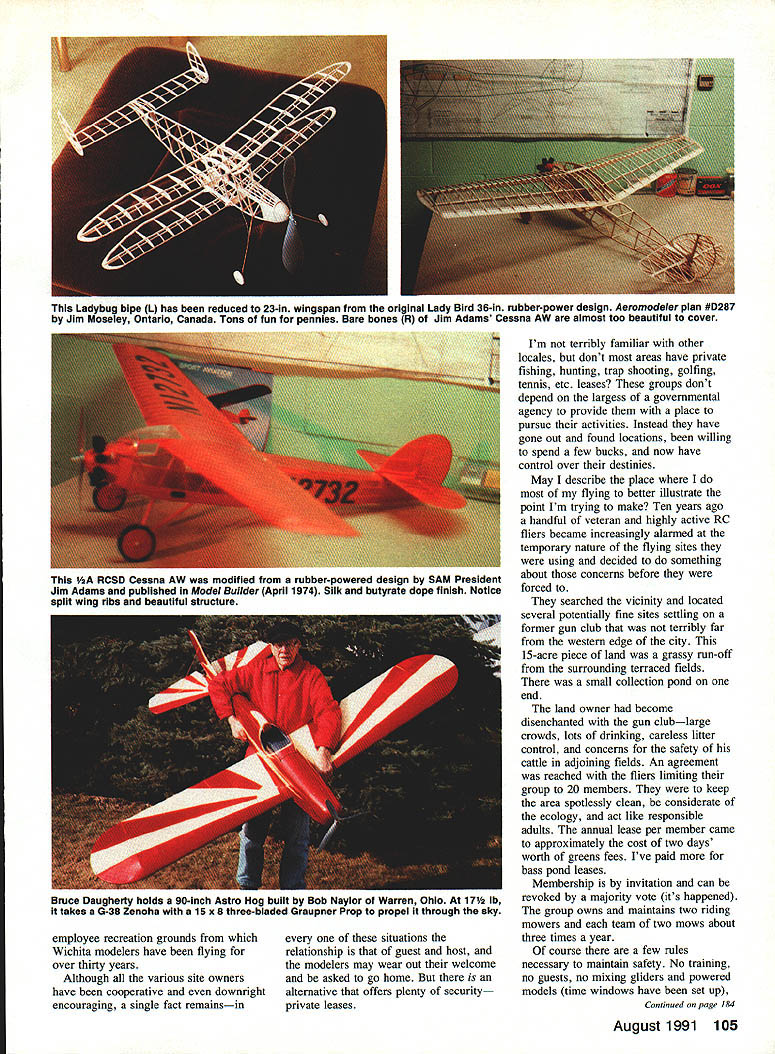
These sorts of coincidences keep happening to me. I had been planning to use photos of the enlarged Astro Hog in this month's column and to mention Bruce Daugherty's connection with the Astro Hog and the old control-line D1-Do. Along comes the May issue and George Aldrich runs a three-view and information on the D1-Do—welcome to the twilight zone!
D.D.C. was the firm that kitted the D1-Do; the principals were Bruce Daugherty, Fred Dunn, and Herb Consider. When Dunn moved from Ohio to California, he developed the Astro Hog, which swept the top four places at the 1958 Nationals and became a legend. Wonder if George knew this—see George's "Up and Around" for a photo of the earlier-mentioned All American stunter.
DeBolt and Fran's Memories
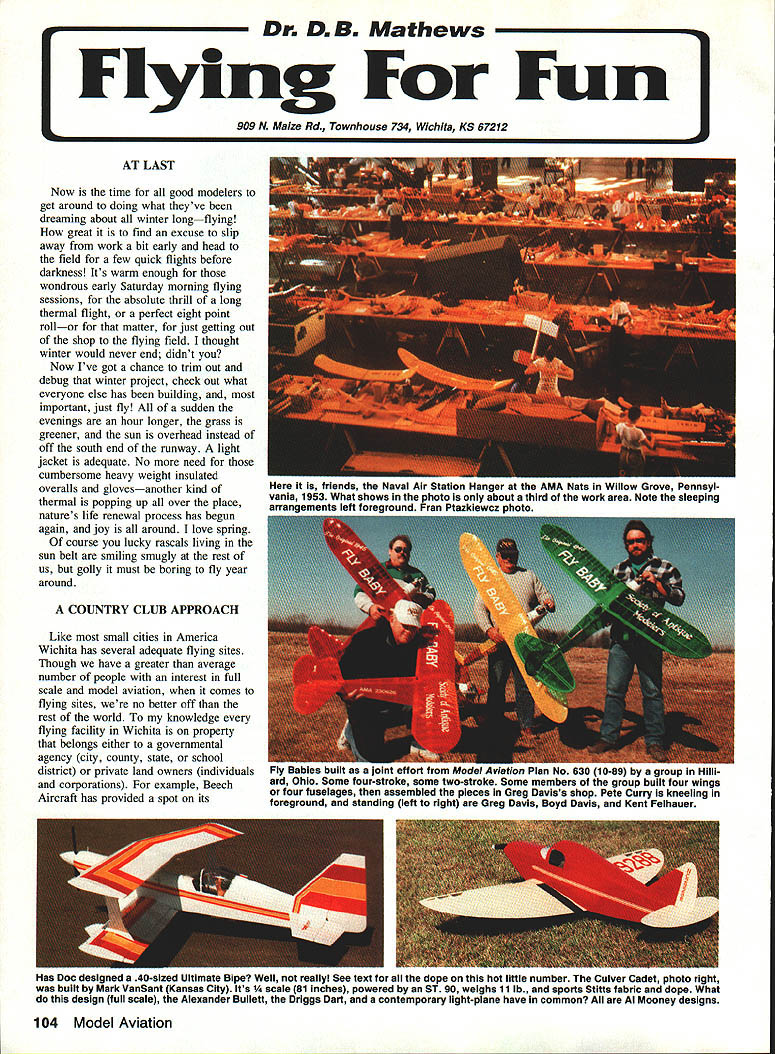
Fran recalls a night flight of a pulse-jet–powered control-line model in the space between two hangars at the 1950 Nationals in Dallas: “It was neat to see the glowing tube going round and round. If you've ever heard one run you can imagine the noise echoing off the two adjacent hangar walls. When he landed he was asked to cease and desist because of the lateness of the hour and the area of flying; he did, of course.
“Also I remember two stunt models tied tail-to-tail involved in an engine tug-of-war to see whose engine was more powerful, and Jim Walker doing his ceiling-walker and glider routines in the hangar with all manner of tricks.”
Fran is the source of reprints of the old deBolt kit plans. Contact him at 23 Marlee Drive, Towanda, New York 14150 for information.
A Little White Bipe
The little white biplane is not an original Ultimate design—it's a heavily modified 4-40 biplane. I started with a 4-40 kit and reworked the cockpit and turtledeck, reshaped the vertical fin, and swept the wings. Under the skin it's still a 4-40 biplane.
Early flight testing indicates that the K&B .45 Sportster is the top end of the power curve; it is wildly fast at full throttle with breathtaking vertical performance. I'm sure it would also fly nicely on a .25 if lighter power is wanted. At this point it's an exercise with no definite decision about publication, but it sure did turn out pretty.
Photos Please
Support from the R/C groups has been excellent; now I need more material from the Free Flighters. If you folks will send me some material I'll gladly report on sport free-flight activities.
Transcribed from original scans by AI. Minor OCR errors may remain.

