
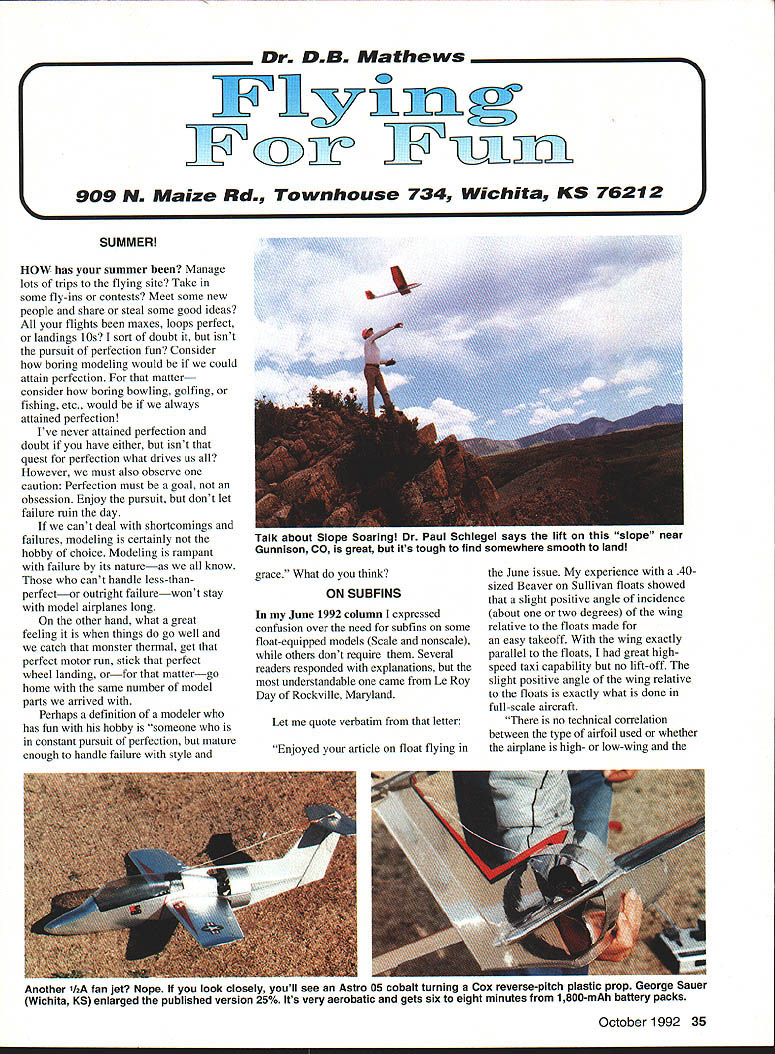

SUMMER!
How has your summer been? Managed lots of trips to the flying site? Taken in some fly‑ins or contests? Met some new people and shared — or stolen — some good ideas? Have all your flights been maxes, loops perfect, and landings 10s? I sort of doubt it, but isn't the pursuit of perfection fun? Consider how boring modeling would be if we could attain perfection. For that matter — consider how boring bowling, golfing, or fishing would be if we always attained perfection!
I've never attained perfection and doubt if you have either, but isn't that quest for perfection what drives us all? However, we must also observe one caution: perfection must be a goal, not an obsession. Enjoy the pursuit, but don't let failure ruin the day.
If we can't deal with shortcomings and failures, modeling is certainly not the hobby of choice. Modeling is rampant with failure by its nature — as we all know. Those who can't handle less‑than‑perfect — or outright failure — won't stay with model airplanes long.
On the other hand, what a great feeling it is when things go well and we catch that monster thermal, get that perfect motor run, stick that perfect wheel landing, or, for that matter — go home with the same number of model parts we arrived with.
Perhaps a definition of a modeler who has fun with his hobby is: someone who is in constant pursuit of perfection, but mature enough to handle failure with style and grace. What do you think?
ON SUBFINS
In my June 1992 column I expressed confusion over the need for subfins on some float‑equipped models (scale and non‑scale), while others don't require them. Several readers responded with explanations, and the most understandable one came from Le Roy Day of Rockville, Maryland. Let me quote verbatim from that letter:
"Enjoyed your article on float flying in the June issue. My experience with a .40‑sized Beaver on Sullivan floats showed that a slight positive angle of incidence (about one or two degrees) of the wing relative to the floats made for an easy takeoff. With the wing exactly parallel to the floats, it had great high‑speed taxi capability but no lift‑off. The slight positive angle of the wing relative to the floats is exactly what is done in full‑scale aircraft."
There is no technical correlation between the type of airfoil used or whether the airplane is high‑ or low‑wing and the need for a subfin. The airplane is quite stable in yaw with a long tail moment and large vertical tail area. Floats, when added, increase the portion of side area forward of the CG, destabilizing yaw. The opposite effect occurs if the tail and aft fuselage side area are increased. Of course, if the side area of the floats is aft, it contributes some small amount of positive yaw stability, but forward area usually dominates. Hence, you usually must add additional vertical surface to get back the same degree of yaw stability. Look at the side view of an airplane with floats and I think you can visualize this easily — without worrying about engineering.
Le Roy is an independent aerospace management consultant. Need I say more?
WEATHERS WESTERNER
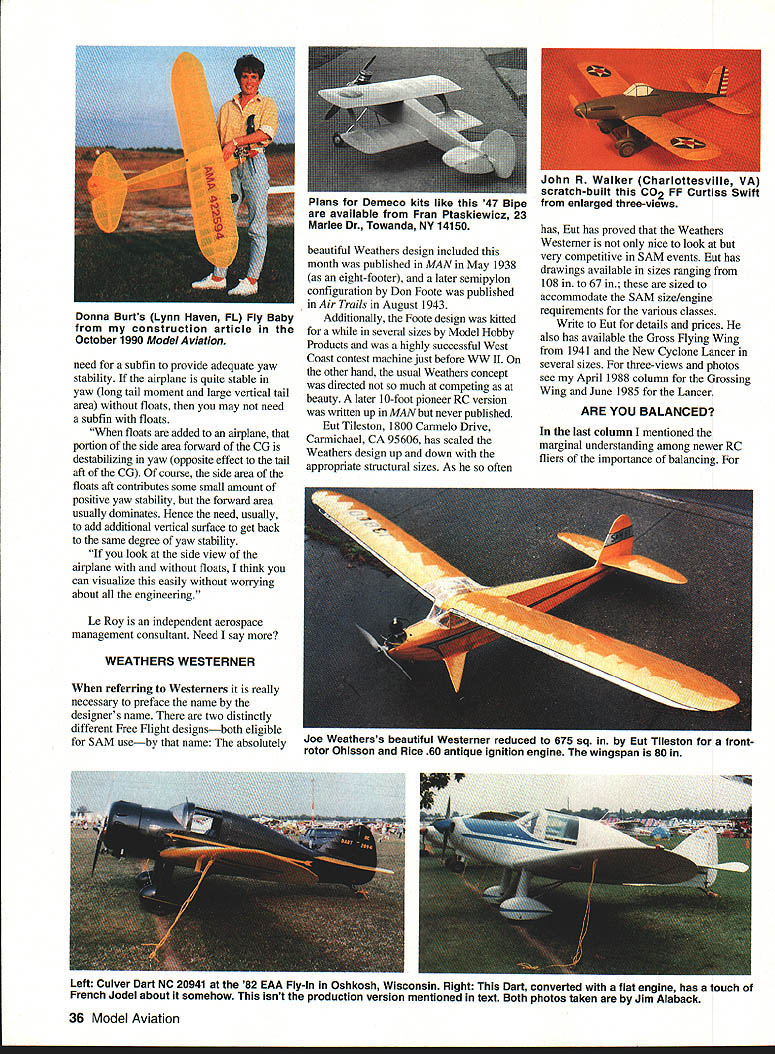
When referring to the Westerner it is really necessary to prefix the name by the designer's name. There are two distinctly different Free Flight designs — both eligible for SAM use — by that name:
- The absolutely beautiful Weathers design (included this month) was published in MAN in May 1938 as an eight‑footer, and later appeared in a semipylon configuration.
- A later semipylon configuration by Don Foote was published in Air Trails in August 1943 and was kitted in several sizes by Model Hobby Products. Foote's version was a highly successful West Coast contest machine just before WWII.
The usual Weathers concept was directed more toward competing as a beauty. A later 10‑foot pioneer RC version was written up in MAN but never published.
Eut Tileston, 1800 Carmelo Drive, Carmichael, CA 95606, has scaled the Weathers design up and down with appropriate structural sizing. As he so often has, Eut has proved the Weathers Westerner is not only nice to look at but very competitive in SAM events. Eut has drawings available in sizes ranging from 108 in. to 67 in.; these are sized to accommodate SAM size/engine requirements for the various classes. Write to Eut for details and prices.
He also has available the Gross Flying Wing from 1941 and the New Cyclone Lancer in several sizes. For three‑views and photos see my April 1988 column for the Gross Flying Wing and June 1985 for the Lancer.
ARE YOU BALANCED?
In the last column I mentioned the marginal understanding among newer RC fliers of the importance of balancing. For those who started in this hobby with 10‑cent hand‑launched gliders, the following is so obvious as to be instinctive.
Unfortunately, many modelers who buy ready‑to‑fly or prebuilt models presume that they have no need to balance them. We have all seen it, and it is both irritating and tragic.
I'm going to quote from the Getting Started guide I wrote for Ace R/C to vent my feelings. Incidentally, that handbook is available as a separate item and would be worth considering as a present to someone getting started in the hobby or as part of a club library for newcomers. I'm prejudiced, to be sure, but there really is some excellent material in it.
"You must be absolutely certain the model balances on the point shown as the 'CG' or Balance Point on the drawings. Carefully mark that point on your model's wing or the fuselage side. Pick up the assembled model using your fingertips as a beam, placing them on your marks. Keep your fingertips near the fuselage. If the model is properly balanced, it should hang level with the floor when you pick it up.
"If the tail hangs down, it means the model is tail‑heavy and would be very unsafe to fly. If your model needs nose weight, add it! The slight increase in gross weight is still much safer than trying to fly a tail‑heavy model. A tail‑heavy model will be totally unstable and uncontrollable. We've seen more new models destroyed from tail heaviness than all other causes combined. A tail‑heavy model will crash... always!
"Should your model hang nose down, it is obviously nose‑heavy. This is not nearly as dangerous to the model's longevity as tail‑heaviness, since it will actually be more stable within reason. However, nose‑heavy models tend to be more sluggish on the controls and will produce a tendency for a steep angle of descent when landing, making it difficult to flare out on touchdown.
"Every model airplane must be individually balanced, simply because there are too many variables in wood density, adhesive quantities used, finishing materials, size and location of the radio equipment, etc., for one model to balance exactly like another."
So this fundamental stuff applies only to beginners—right? Wrong! I recently was told of a situation in which a veteran flier's Jumbo model had been flown repeatedly with good results. All of a sudden the big model became wild and squirrelly. The owner had several other pilots try the thing, and they all had landing and takeoff problems with it.
After checking out all the systems and finding nothing amiss, the owner concluded something had gone wrong with his radio and returned the entire system to the service department. They could find nothing wrong with the receiver, servos, switch, or battery pack.
As the owner was reinstalling the returned radio system, it dawned on him where the problem had originated. He had previously removed the tank to repair a faulty "klunk." To simplify getting the tank out, he had removed the battery pack as well. When he reinstalled the tank, it was difficult to stuff the battery under the tank, and there was plenty of room ahead of the servos, so he placed the pack there.
At this point we all know why the Jumbo aircraft suddenly became unstable in pitch and roll! It was tail‑heavy — not much, but enough to mess up the flight characteristics dangerously!
A great deal of grief could have been prevented had the owner rechecked the balance point after working on the model. Just a little tail‑ or nose‑heavy is a bit like being a little dead or a little pregnant — there just isn't any room for compromise in any of those situations.
WAY OFF BASE
In my August 1992 column I got all steamed up on the Driggs/Culver Dart thing. Contrary to what I thought, they are totally different aircraft and don't even look alike. Please disregard that error, and try to forgive me.
To make matters even more embarrassing, Jim Alaback of San Diego wrote up the Culver Dart in the June issue of The Aero News. Strangely, that club newsletter arrived just about the time it was too late to correct my material.
After reading John Underwood's Of Monocoupes and Men, I find how I got so far afield on this subject. One Ivan H. Driggs was involved in the development of the Monocoupe D‑145. He came to the firm after previously developing an aircraft called the Driggs Dart. He and Donald Luscombe later left for Kansas City, but that is another story.
Jim Alaback has a personal interest in the Culver Dart, as it was the aircraft he learned to fly at Parks Air College in St. Louis beginning in the summer of 1942. In his short article in the Aero News and a much more comprehensive article he wrote for Air Wars, several interesting things that bear sharing are mentioned.
As an example: I mentioned several Al Mooney aircraft designs in my write‑up, but Jim says Mooney was responsible for 23 different aircraft ranging from the M‑1 of 1925 for Alexander Aircraft through an M‑23 he did for Lockheed Georgia in 1968. The latter I don't know at all.
Mooney's 10th design, which was to become the Culver Dart, was originally done for Monocoupe Aircraft of Moline, Illinois, in 1935. It was an open‑cockpit, two‑seat, side‑by‑side unit intended as a trainer addition to the Monocoupe line. It was originally designated Model G Monoprep, but put into production.
That is most interesting, as in 1929 the Mono Aircraft Co. produced and sold a Monoprep that was a high‑wing, open‑cockpit version of the Monocoupe. I'm sensitive to this, since I designed a .40‑cu.‑in.‑size semiscale model that was published in MAN in June 1981. Obviously, the name was changed from Monoprep to Monosport.
A Monocoupe dealer named Knight Culver of Columbus, Ohio, visited the factory during the summer of 1937 and flew the Monosport prototype. He liked it and expressed an interest in buying the project from Monocoupe. He purchased enough parts and tooling for three at about $25,000 to $30,000. As Alaback says in the article I'm reviewing here, that doesn't seem like much until you realize that amount would have bought about 15 new Cadillacs at the time.
Parks Air College purchased four units from the Columbus, Ohio, factory in 1938 and 1939. One was powered by a Lambert, and three by Warners. Jim details color and markings of these aircraft and relates several wild flight accidents as the students were trained in the Darts. He also mentions an aerobatic version flown by Rod Jocelyn in the 1952–54 era.
Two Darts appear in the 1958 air‑racing movie "The Tarnished Angels." Along with the Darts, the movie stars Dorothy Malone, Robert Stack, and Rock Hudson. I believe it's available on videotape.
At the end of WWII, the Dart's design and its tooling were purchased by Applegate and Weyant, and production resumed in Tecumseh, Michigan. These Darts were modified to use flat six‑cylinder Continentals. Jim has a photo of this version as well.
Available records indicate a total production run of only 61 Darts. Oddly, approximately 25 of these are still flying!
Should the photo of the full‑size aircraft plus the model photo in the August column stimulate you to model this delightful bulldog of an airplane, you are invited to contact Jim Alaback, 12399 Nacido Drive, San Diego, CA 92128; telephone: (619) 487‑6716. He has sufficient three‑views and photos for almost any Scale project.
AND THE DAYS GROW SHORT . . .
When you reach September! This issue should be coming to you at about that time of year. Even though we know full well the flying season in the northern climes is winding down, those absolutely gorgeous days of fall still lie ahead to provide many opportunities to get out and Fly For Fun! So do it, and send some pictures already!
Transcribed from original scans by AI. Minor OCR errors may remain.

