

Flying For Fun: TAKE A CHANCE!
Dr. D. B. Mathews 909 N. Maize Rd., Townhouse 734, Wichita, KS 67212
Do you suffer from the same malady as I do? Maybe this story will help. I have a hang‑up about the technical aspects of most electronic gadgets. This likely goes clear back to my early years of messing with Aerotrol single‑channel radio control equipment. In 1948, when exempt frequencies first came along, I had an arrangement with an older modeling friend who had taken a radio correspondence course. He agreed to help me wire and set up my radio equipment.
Most of the time my equipment didn't work, and, of course, his did. As a consequence, I felt completely inept when it became necessary to figure out electronic theory and turn it into practicality.
You younger readers may be interested to know that in those days radio control equipment did not always come pre‑wired and ready to plug in. As a matter of fact, it was usually supplied as a bag of parts to be soldered together and then tuned; and I usually tuned, and tuned, and tuned. I could make the stuff work, but only with the help of someone who was a qualified electronics service person.
Those feelings of inadequacy have been pervasive throughout my adult life. Whenever I have been faced with learning how to set up and operate any electronic gadget a small inner voice keeps saying, "You can't do this; you'll mess it up."
Much like Johnny Carson's, my VCR flashed 12:00 for a long time before I could decipher the peculiar syntax of its oriental instructions.
Even though I'd purchased a computer and programs for the group dental practice, the Ace MicroPro transmitter made setting up a radio surprisingly simple. Tom Runge tried valiantly to convince me a programmable computer radio was not difficult to set up — theoretically well within the abilities of anyone who can read. So I finally broke down and bought one. Lo and behold, the programmable features and the simple flow‑chart, comprehensible instructions made setting up the transmitter super simple. I've told folks the Ace MicroPro should be mentioned in the same breath as those VCRs people have trouble setting up.
Ross McMullen and other magazine publishers have been telling us for several years we should have used computer word processing. The suggestion just spooked me out. My mind could think of all sorts of reasons I could never learn the computer thing: "I'm much too old," "I might have trouble running a typewriter," "I sure wouldn't be able to make heads or tails out of the language kids use daily when talking about computers." Excuses, I told myself.
Now, after finding out the simple, follow‑the‑flow‑chart instructions, a slight glimmer of hope has begun to glow. I finally agreed to let Tom Runge and Steve Kaluf lend me a laptop computer while preparing the Kit Builder's Handbook included with the new trainer kit. A few evenings using the device clearly indicated a klutz like me can run a computer. I bit the bullet and purchased an IBM PS/1. The learning curve has been challenging primarily because the feelings of ineptitude took several days to get over — the fear of punching the wrong button and causing the machine to melt down into a puddle of molten plastic at my feet. Incredible as it may seem, it certainly felt that way.
I've now built confidence to the point I'm expanding my skills. Time spent at the computer has at least halved the time required to prepare copy; spelling is vastly improved; and the printed copy is cleaner and neater. Much as I hate to admit it, it's fun. If you feel that way about computers, take heart — if I can learn, anyone can.
CAD and Tom Stults' Program
So what does all this have to do with model airplanes? We've heard about CAD — computer‑aided design — used in industry where functions formerly done with calculators, slide rules and drawing boards can now be done on a computer. Tom Stults, 2504 Del Rio Drive, Yukon, OK, has a program available for home computers that contains average component proportions for a variety of different styles and sizes of model aircraft. You can select engine size and basic model type (glider, Ugly Stick, etc.), and the program will bring up average component proportions.
While Tom's program isn't capable of doing the drawings, the numbers it generates can rather easily be transferred to drafted form. To illustrate, suppose you have a wing for a 100‑in. span Gentle Lady: bring up the Gentle Lady parameters, punch in 100 in., and the program provides all the necessary measurements needed. Or suppose you want to lay out an Ugly Stick for an .30 engine; simply bring up the proper worksheet, punch in the engine size, and the program does the math for the sizes. Contact Tom for more details.
SO WHAT R YA BUILDIN'?
Ever notice that's the first thing two dedicated modelers ask each other when they meet during the winter months? Sure, there are those intensely dedicated sorts who fly with their feet in snow and the temperature below 30°F. But most of us prefer to spend our modeling time in a warm shop on those cold winter days building things to fly when the weather becomes more hospitable.
These are also awfully good days for spending some time repairing those little things on last flying season's models. That temporary repair can be fixed correctly, worn‑out components replaced, the radio equipment returned to the repair station for annual servicing, and, of course, the batteries cycled every month.
I'm growing about half paranoid over hinges. Last flying season seemed to be my "hinge year." I had a total wipe‑out of one prototype when an aileron fell off, and I managed to land another model with the rudder hanging on by the pushrod only. In another instance I did my usual preflight pull test only to have an elevator come loose in my fingers.
I don't think it's fair to condemn any particular brand of hinges for last season's troubles. Rather, the blame lies with lots of use and my own poor technique. The point is, never presume the hinges are tight; check them!
ON SAFETY CHECKS
That brings another thing to mind. As anyone who has flown at an IMAA event knows, that group insists on safety checks before allowing any model to fly. One would at least presume that models built would be well above average in construction and maintenance skills. Yet, at nearly every fly‑in I've attended, the safety inspectors have discovered at least one model with defects that would not only have endangered the model, but the spectators and other pilots as well.
Some fliers seem offended by safety checks. That seems rather vain to me. Regardless of how well a model is built and maintained, or how well the owner has preflighted it, there are a host of things he might miss. It's a redundancy thing as I see it. The more times something is inspected the less likelihood of some little detail slipping by; that's called quality control, isn't it?
Frankly, I can only speculate as to why safety inspections aren't part of the fun fly scene. I'd sure hate to hurt someone or be hurt by someone as a result of some little thing failing because I'd grown so accustomed to looking at it that I no longer really saw it. Wouldn't you?
JUMBO RUBBER POWER
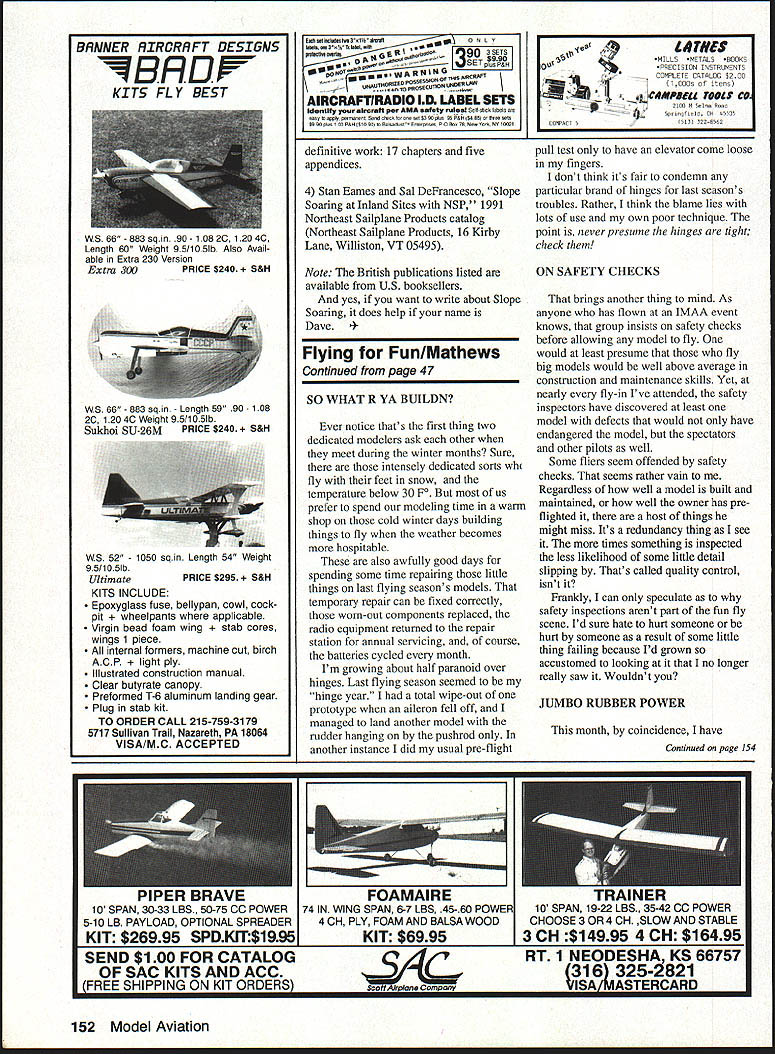
This month, by coincidence, I have photos of two huge rubber‑powered models. One is from 1991, and the other from 1934! It's remarkable to notice the peculiar spirit of novelty that inspires both projects even though 57 years separate them. The quest for lots of fun never ceases, does it?
Some modelers always seem willing to expand the envelope of the usual and venture into the realm of the unusual, despite the well‑meaning advice of so‑called experts. The willingness to take chances and run against the grain of convention is one of the most intriguing factors of modeling.
Also consider the ever‑present skepticism that these innovators must learn to ignore. I'll bet Jim Walker encountered all sorts of naysayers when he began to demonstrate his U‑Control models. Bill Brown and the other early engine developers likely heard more reasons not to develop their products than they did words of encouragement. The early radio‑control people were considered exotic (at the very least) by the rest of us, I can assure you.
I'll wager almost all of you readers have at least one of these exceptionally innovative people in your flying groups. Much to the considerable credit of the modeling press, such developments have almost always been presented to the rest of us without prejudgment. The old Nationals always featured off‑the‑wall developments, and many of us saw and examined them with considerable interest.
Such indelible memories I have: Jim Walker flying three Fireballs at once (one handle attached to a leather football helmet on his head), Charlie Siegfried flying R/C using a telephone dial to send the input, demonstrations of the Mini Jet pulse units being flown three at a time in Wichita in 1946, Ray Arden's micro engines, or a CO2 single‑channel R/C at Dayton in 1976. And this is not to mention the really bizarre cargo designs that pop up every year.
Thank goodness there is room in our hobby for those willing to be branded eccentrics by the rest of us.
Bob Fife of Columbus, Ohio, provided the neat KG‑1, Goodyear dirigible hanger and other photos featured in the December 1991 Model Aviation. He also sent along a whole bunch of other very interesting photos and materials — some of which I'm using this month. I put it all in a folder marked (what else?) The File File.
Bob says the six‑foot SE‑5 model was scratch‑built of balsa in 1934 as a rubber‑powered free‑flight model. However, they found it took a whole skein (225 feet) of 1/4‑in. rubber, and due to the bulk they had trouble winding and storing it.
EVEN FURTHER OUT!
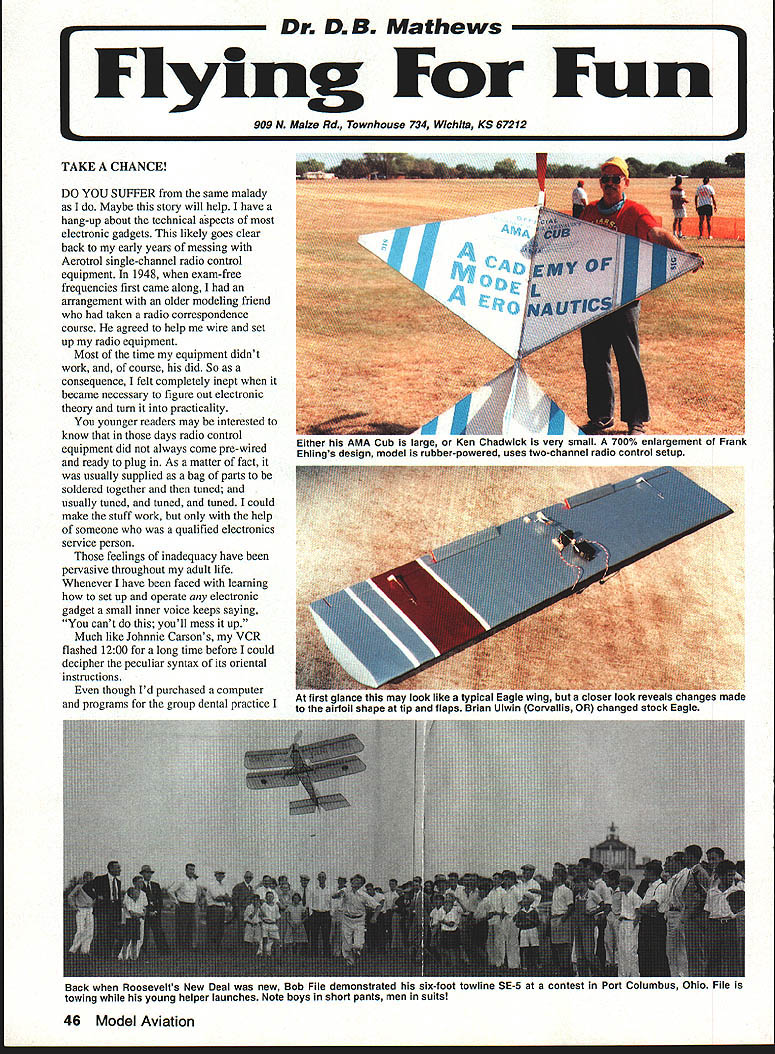
The first thing that flashed through my mind upon seeing the seven‑times enlargement of Frank Ehling's AMA Cub design was that someone had one‑upped Frank! It's sort of appropriate to see someone get really innovative with one of Frank's designs since Ehling still holds the record for being the all‑time world champion rule‑loophole finder. There are those who say he was hired as AMA's technical director to stop him from embarrassing the rule writers with his constant finding of loopholes.
At any rate, the enlarged AMA Cub is the work of Ken Chadwick of Wichita, Kansas. It made its first appearance at a Jumbo fly‑in at Lake Afton, Kansas last summer. It's for two‑channel radio control and, yes, it is rubber powered. Wild and crazy? You bet, but it sure looks like lots of fun. At the time the picture was taken it had not been flown, but I understand it has been since.
One can only wonder if the rubber winder needs to be in the same scale as the model! Or, for that matter, who was strong enough to turn it — or brave enough to hold it!
Ken developed the enlarged logo and trim via a computer and the thing looks for all the world like the classic Ehling design — only slightly larger. Did you ever have the feeling you'd shrunk? Sort of a reverse Gulliver feeling?
AN EAGLE 1.5?
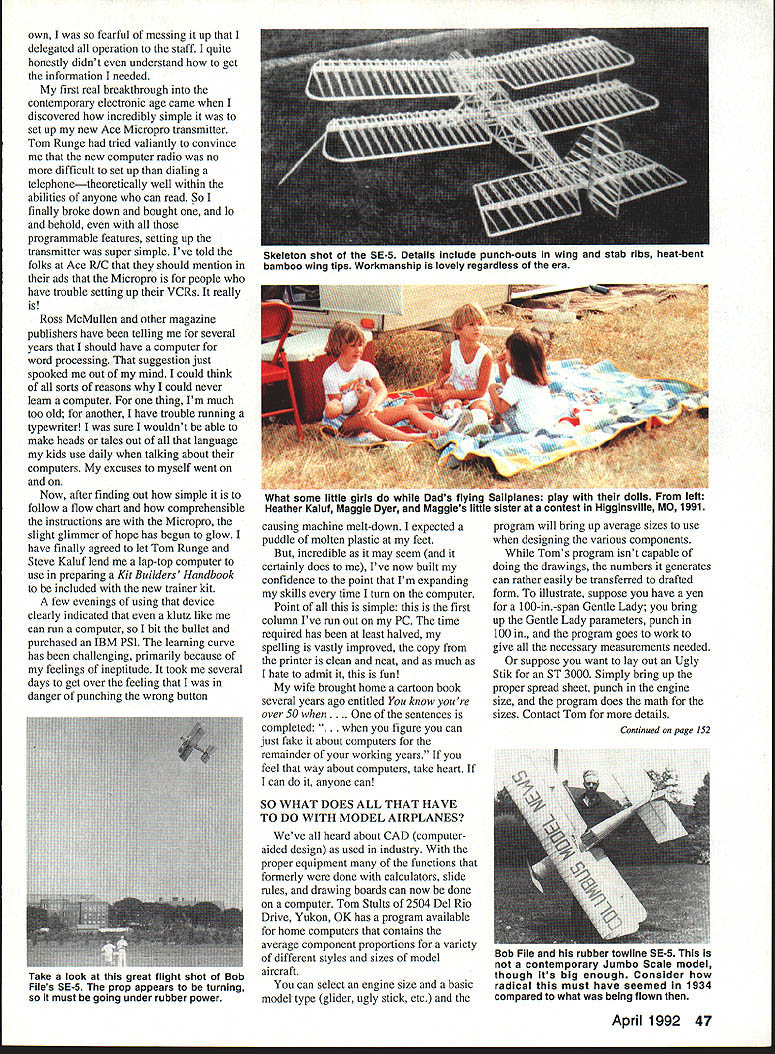
Brian Ulwin of Corvallis, Oregon, sent photos and some drawings back in April 1991 of a very interesting series of changes he'd made to a Goldberg Eagle. These confirmed my own findings when developing the Whiz project and were very welcome.
Brian changed the stock kit airfoil that he had flown for over two years to the one I have illustrated here, and he found that he had a totally different model. He says, "The very first flight with the new wing exceeded my expectations. The model was rock steady and very predictable. Outside loops are possible at full throttle, takeoffs are incredibly short, and a low‑speed flyby has the spectators wondering how it can still be flying. One experienced flier even said he'd build another trainer if it would fly like mine."
A slight modification to the airfoil greatly increased the flying fun for Brian; it's worth considering. I found it interesting that Brian changed to the raised entry wing section because he was so pleased with the way his scale J‑3 Cub flew with a similar airfoil.
As I mentioned in the last column, flat‑bottom wing sections don't exist in the full‑scale airplane world. I sometimes wonder how they found their way into modeling. I'm certain some of you just thought, "Boy oh boy, some Old‑Timers have flat‑bottomed airfoils." No, they don't — they have Clark Y or clones thereof, but I don't know of a flat‑sectioned Old‑Timer — not even hand‑launched gliders!
I have no vendetta against flat‑bottomed airfoils; it's just that I now know there's a better way.
IMPATIENT!
Although you're reading this late in February, it was written just before Christmas. If you live in the sun belt you likely have no idea what cabin fever is all about. The rest of us can only build, repair, and impatiently wait for spring to arrive so we can get out to the flying field and do lots and lots of Flying For Fun! We are ready any time!
Transcribed from original scans by AI. Minor OCR errors may remain.

