


Flying High With Solar Power
Larry Blakely
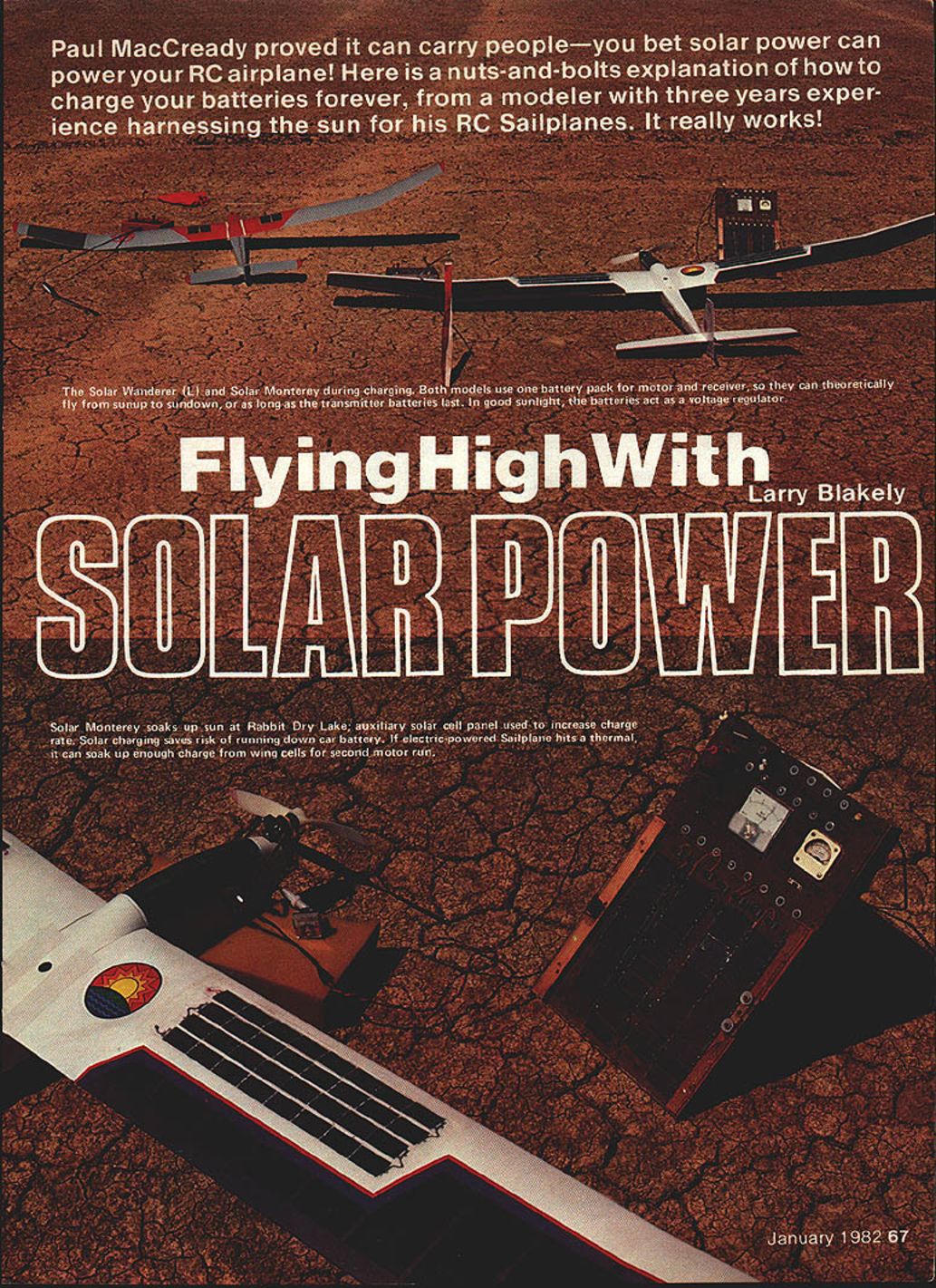
Paul MacCready proved it can carry people — you bet solar power can power your RC airplane! Here is a nuts-and-bolts explanation of how to charge your batteries indefinitely, from a modeler with three years' experience harnessing the sun for RC sailplanes. It really works.
Uses
Solar cells can be used to charge and maintain onboard NiCd batteries in a variety of ways:
- Receiver battery (most obvious candidate).
- Battery pack for an electric motor in an electric-powered plane.
- Glow-plug battery or onboard ignition batteries.
- Batteries for retractable gear.
- A separate ground-mounted panel can power the transmitter.
Advantages
- If the current provided by the solar cells somewhat exceeds the battery's needs, conventional preflight battery charging can become unnecessary. You can decide on the spur of the moment to go fly without worrying about the state of charge.
- On perfectly clear days, batteries may not be required at all, although small batteries are advisable because you cannot always keep the cells in direct sun during maneuvers, loops, sharp turns, or inverted flight.
- Solar installations can reduce weight and save space if very small batteries suffice.
Background and examples
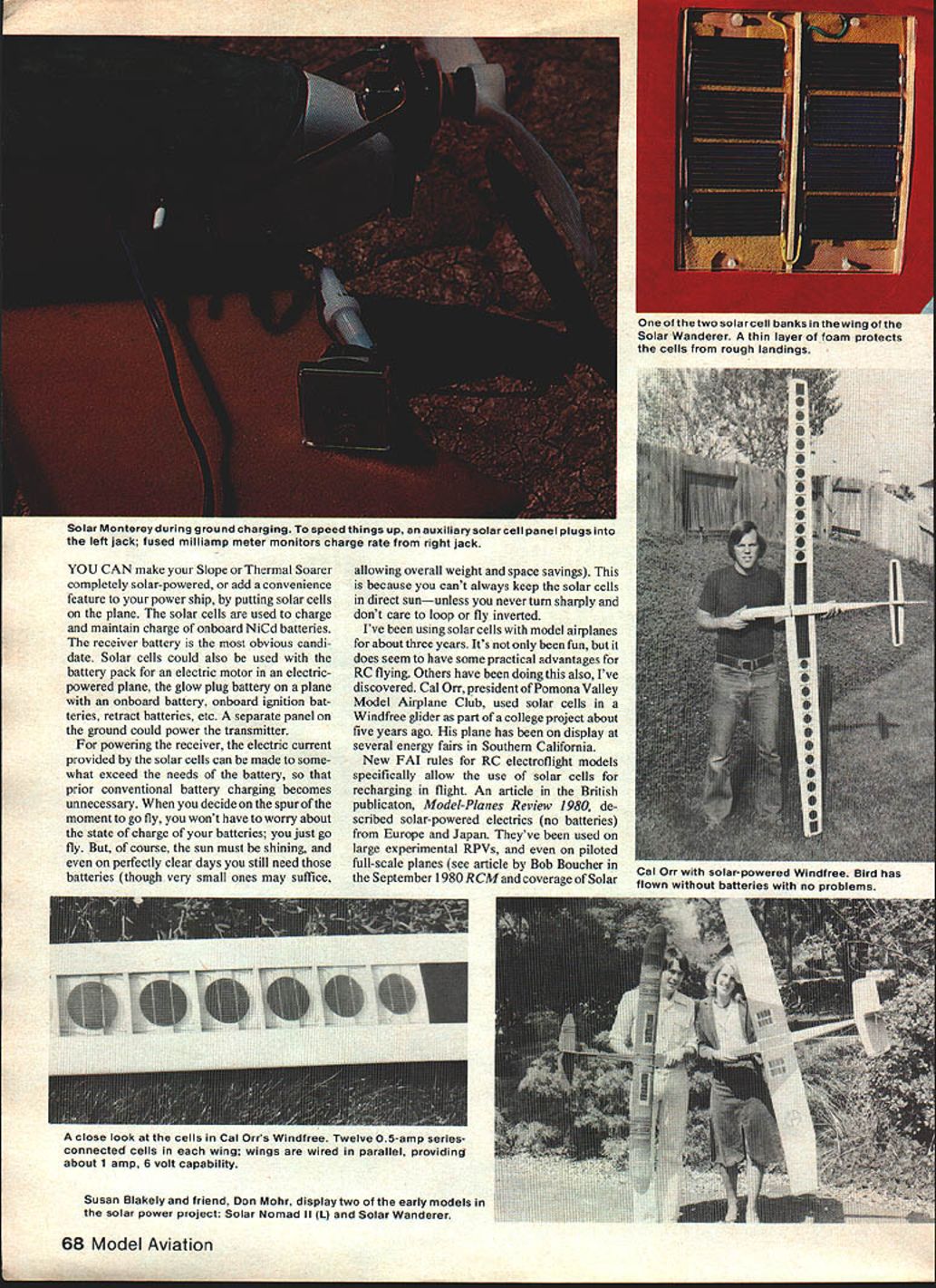
- Others have experimented successfully: Cal Orr (president of Pomona Valley Model Airplane Club) used solar cells in a Windfree glider as part of a college project about five years ago; his plane has been displayed at energy fairs in Southern California.
- New FAI rules for RC electroflight models specifically allow the use of solar cells for recharging in flight.
- A British article (Model-Planes Review, 1980) described solar-powered electrics (no batteries) from Europe and Japan. Solar cells have been used on large experimental RPVs and even piloted full-scale planes (see Bob Boucher, RCM, September 1980; coverage of Solar Challenger in Model Aviation, October 1981).
- At an EAA-sponsored air show in Chino, CA, several Vari-Eze lightplanes had solar cells on the fuselage, presumably to trickle-charge onboard batteries.
How solar cells work
- Light on a solar cell separates negatively charged electrons from positively charged "holes." Free electrons accumulate on the front (negative) side; the back is positive.
- A wire connecting front and back allows electrons to flow and do electrical work.
- Silicon solar cells convert sunlight to electrical energy with about 10–15% efficiency (typical).
Electrical characteristics
- A single open-circuit silicon cell exposed to sunlight develops about 0.5 volt regardless of cell size. Higher voltages are obtained by connecting cells in series.
- When the circuit is closed the voltage drops; if short-circuited the voltage drops to zero.
- Current (amperage) depends on:
- Surface area of the cell.
- Electrical load.
- Amount of light (irradiance).
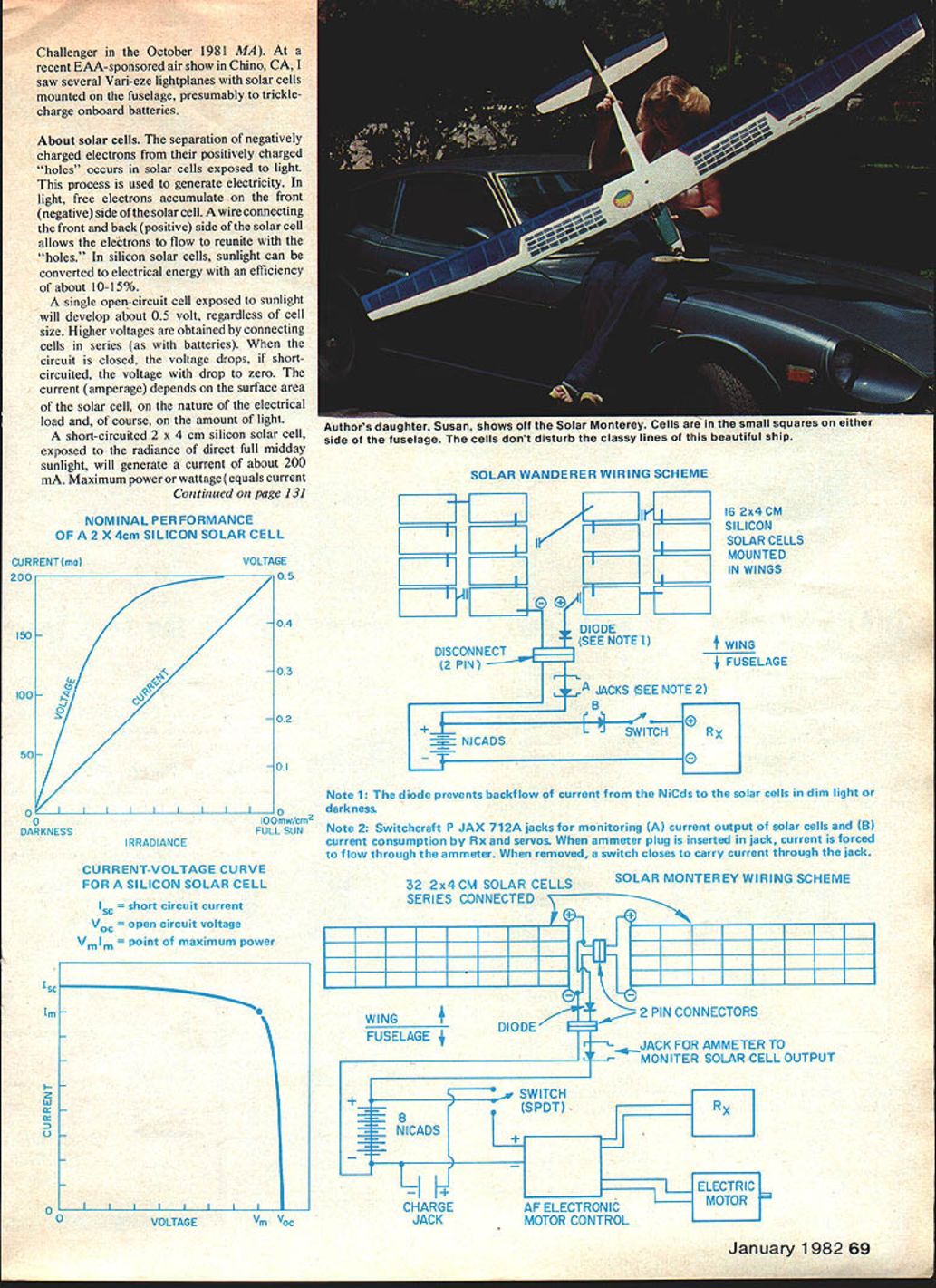
- Example: A short-circuited 2 × 4 cm silicon cell exposed to direct full midday sunlight will generate about 200 mA.
- Maximum power (watts) is current times voltage. Maximum power occurs at a point (Vm, Im) somewhat below the open-circuit voltage (Voc) and the short-circuit current (Isc).
- Isc = short-circuit current
- Voc = open-circuit voltage
- Vm = point of maximum power
- Connecting cells in series increases voltage; connecting cells in parallel increases current.
- A cell aimed away from direct sun receives less irradiance and generates less current.
- When solar cells heat up in full sunlight they become less efficient; installation design should attempt to minimize heat buildup.
Installation and components
- Diode: Include a diode to prevent backflow of current from the NiCd batteries to the solar cells in dim light or darkness.
- Monitoring jacks: Switchcraft PJAX 712A jacks can be used for monitoring:
- One jack for solar-cell current output.
- One jack for receiver and servo current consumption.
- When an ammeter plug is inserted, current is forced through the ammeter. When removed, a switch closes to carry current through the jack.
- Ground auxiliary panel: An auxiliary ground-mounted solar panel can plug into a jack for faster ground charging.
- Fused milliammeter: A fused milliammeter can be used to monitor charge rate.
Examples of installations
- Solar Wanderer: Two solar-cell banks are built into the wing. A thin layer of foam protects the cells during rough landings. Its NiCds have never been conventionally charged; the plane has hundreds of hours and is still in active service.
- Solar Nomad II: Completed spring 1978; another successful sailplane installation.
- Windfree (Cal Orr): Twelve 0.5-amp cells are series-connected in the wing; the wings are wired in parallel to provide about 1 amp at roughly 6 volts capability. The Windfree has flown with batteries installed without problems.
- At Solar Monterey and other events, auxiliary panels and jacks are used for quicker ground charging and monitoring.
Practical tips
- Design to minimize heat buildup on the cells.
- Aim cell arrays to maximize exposure to the sun; remember maneuvers and orientation changes reduce available power.
- Use series connections to reach required voltage; use parallel connections to increase available current.
- Include simple monitoring and protection (diode, fused milliammeter, and jacks) to prevent battery discharge and to observe charge rates.
Solar cells have proven practical and fun for RC flying — with thoughtful installation they can reliably maintain or extend flight capability and simplify preflight preparation.
Transcribed from original scans by AI. Minor OCR errors may remain.

