
Flying Wing Fever
John Oldenkamp
It may be classified as a "single-design" contest, but the variety of configurations and schemes devised by the contestants was anything but singular.
FLYING WINGS? Flying wings? It's a concept that's intrigued and bedeviled aeronautical-minded people ever since man got the idea he could imitate birds. After all, only a few natural forms fly without the benefit of a stabilizing tail structure: the manta ray, the maple seedpod (more a helicopter than anything else), and—that master of locomotion, the bat. For the most part, nature doesn't mirror our efforts to achieve the feat of tailless flight.
But the scarcity of natural examples from which to copy hasn't discouraged aeronautical designers from efforts to develop effective flying wing designs. The "tailless chase," in fact, has been under way for almost a century now, although with more focus on models than on full-scale designs. Both England and Germany have long held regular flying wing competitions, similar in spirit to the now-defunct Zaic annuals in the U.S., that are dedicated to the advancement of the configuration.
On the other hand, we could count the really viable flying wing airplanes and still have fingers and toes left over.
Enthusiasm for flying wings isn't limited to Europe; many American modelers are also fascinated by the concept. To our delight, in 1966 the Northrop Corporation started a modeling competition based on these esoteric designs, and under the aegis of Bill Northrop (not related) and Model Builder Magazine the contest has become an annual event. The contest, known as the Northrop Flying Wing (NFW) contest, had been held for the past six years at Mile Square Park in Costa Mesa. In 1987 the venue moved to Taft, CA, presumably for the wider spaces that would allow the flying wings full song and test their ultimate endurance. It worked!
Given the weather—hot, hot, hot—and the number of entries, the Taft meet proved to be a good trial of the format for the event. Owing in large part to the perseverance of Barnaby and Lynn Wainfan, who have made a thorough study of the flying "problem," there was much excitement, tough competition, and airing of many interesting design points of view. In the end, it was the Barnaby and Lynn show—the two picked up justly deserved wins in all three categories: Rubber, Power, and Glider.
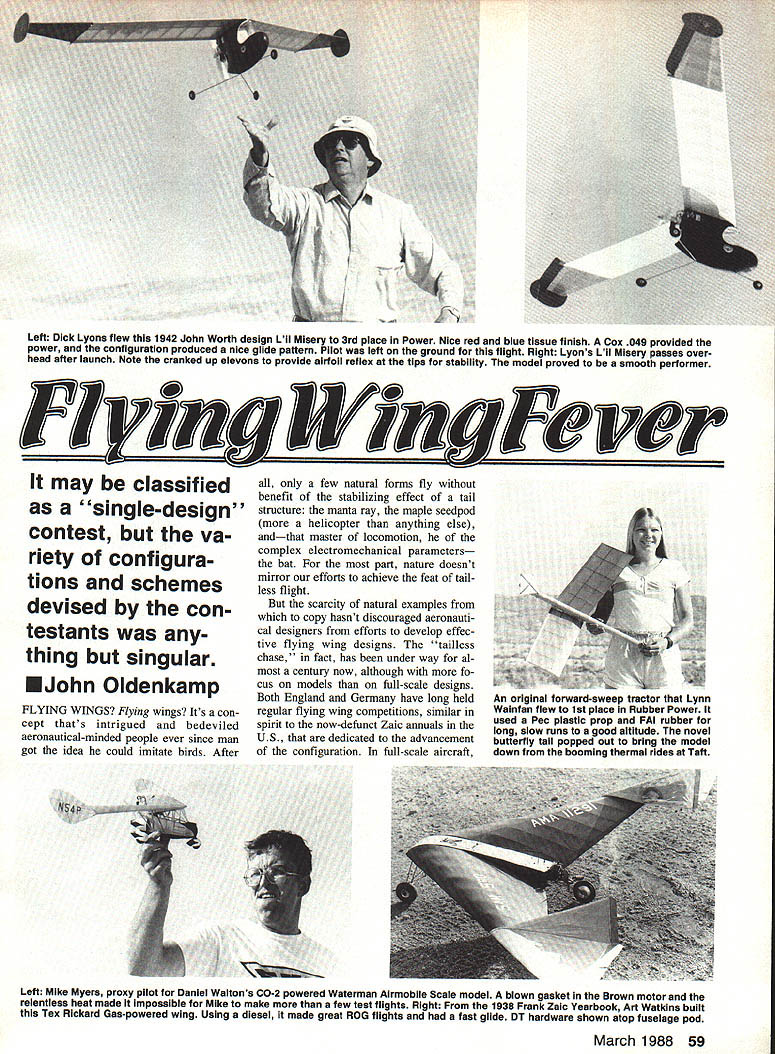
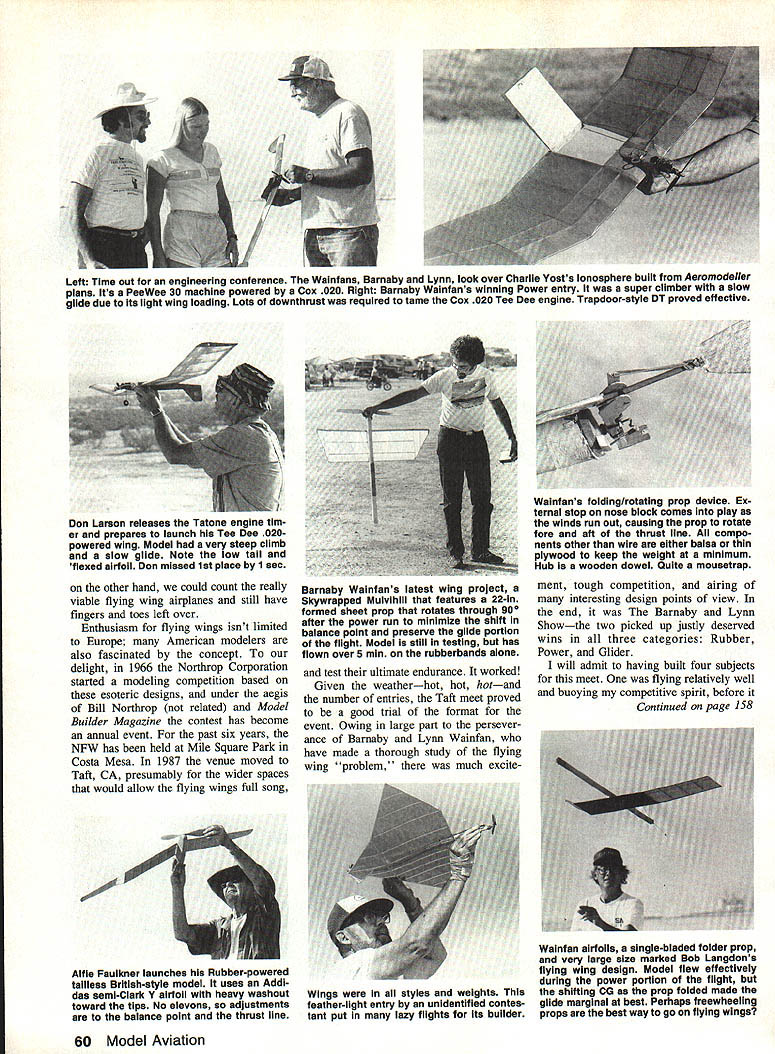
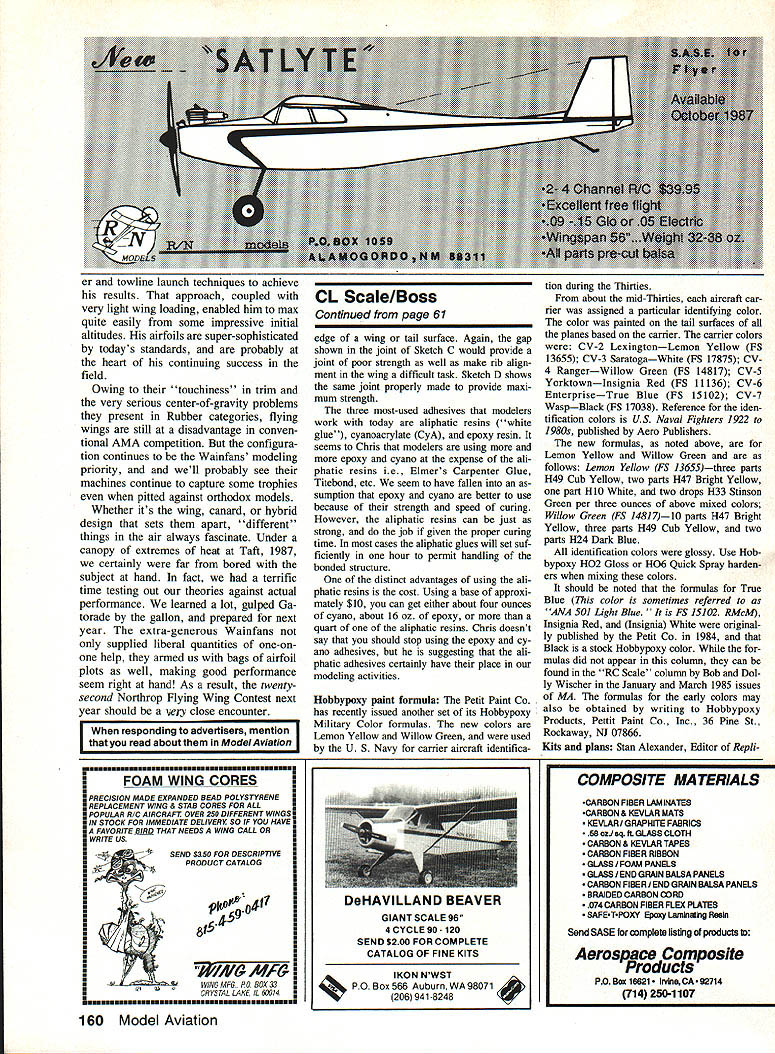
I will admit to having built four subjects for this meet. One was flying relatively well and buoying my competitive spirit before it suffered an embarrassing (and entertaining) midair collision with a six-pound RC glider on the eve of the contest, making me a Did Not Fly! Others had a whole lot more luck. Since the OT Southern California Ignition Fliers (SCIFS) also had a meet that same weekend, there were a number of flying-wing models from the Thirties on hand to challenge the contemporary, Wainfan-influenced variants. In fact, AMA Executive Director John Worth's Lil Misery, from 1942, actually started off to place third in Power! It had a strong climbout, a decent power run, and a very respectable glide. There was also a very nice 1938 Tex Rickard wing in silver-and-red MonoKote.
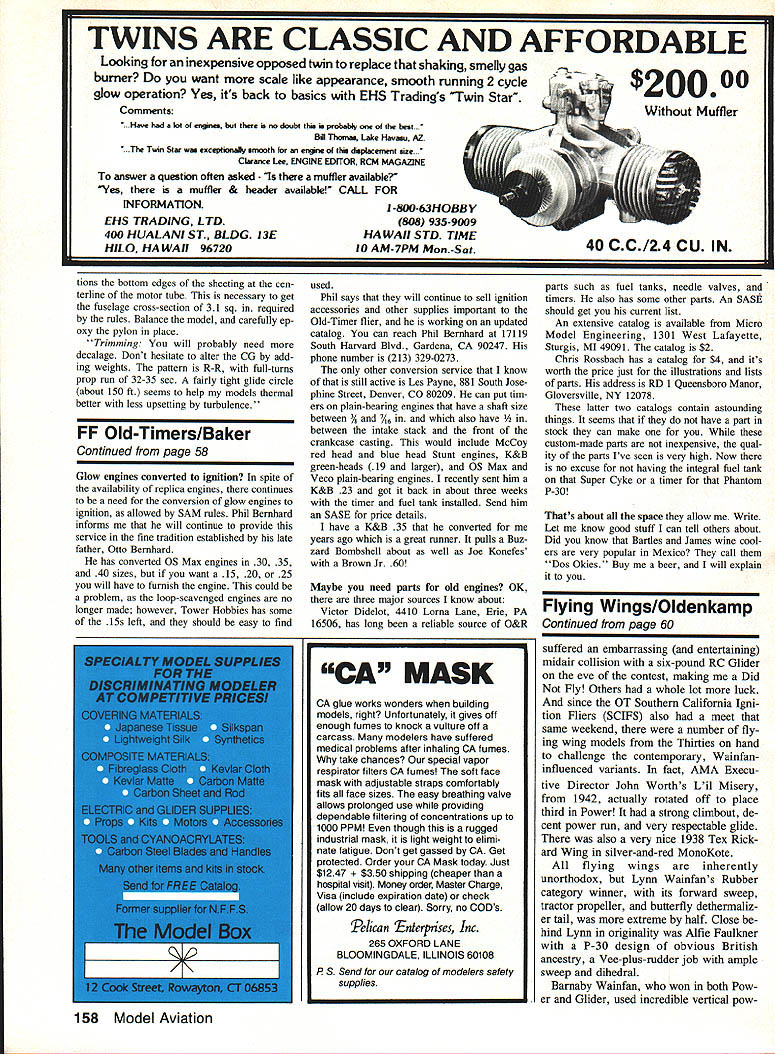
All flying wings are inherently unorthodox, but Lynn Wainfan's Rubber category winner, with its forward sweep, tractor propeller, and butterfly-differential elevator tail, was more extreme by half. Close behind Lynn in originality was Alfie Faulkner with a P-30 design of obvious British ancestry, a vee-plus-rudder job with ample sweep and dihedral.
Barnaby Wainfan, who won in both Power and Glider, used incredible vertical power and towline launch techniques to achieve his results. That approach, coupled with very light wing loading, enabled the mix to make quite easily from some impressive initial altitudes. His airfoils are super-sophisticated by today's standards and are probably at the heart of his continuing success in the field.
Owing to their "touchiness" in trim and the very serious center-of-gravity problems they present in Rubber categories, flying wings are still at a disadvantage in conventional AMA competition. But the configuration continues to be the Wainfans' modeling priority, and we'll probably see their machines continue to capture some trophies even when pitted against orthodox models.
Whether it's the wing, canard, or hybrid design that sets them apart, "different" things in the air always fascinate. Under a canopy of extremes of aircraft at Taft, 1987, we certainly were far from bored with the subject at hand. In fact, we had a terrific time testing out our theories against actual performance. We learned a lot, gulped Gatorade by the gallon, and prepared for next year. The extra-generous Wainfans not only supplied liberal quantities of one-on-one help, they armed us with bags of airfoil plots as well, making good performance seem right at hand! As a result, the twenty-second Northrop Flying Wing Contest next year should be a very close encounter.
Transcribed from original scans by AI. Minor OCR errors may remain.

