
Focal Point - 2003/04
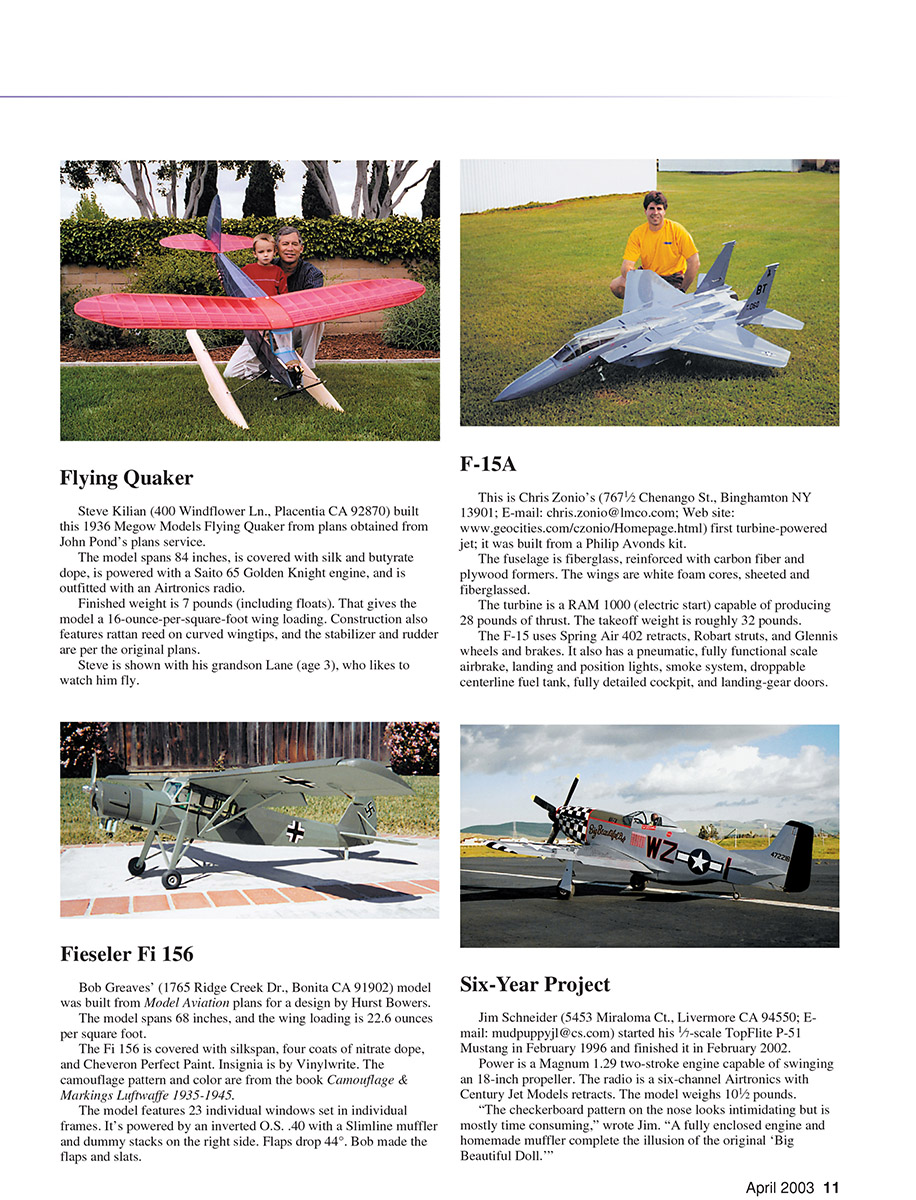
Flying Quaker
Steve Kilian (400 Windflower Ln., Placentia CA 92870) built this 1936 Megow Models Flying Quaker from plans obtained from John Pond’s plans service.
The model spans 84 inches, is covered with silk and butyrate dope, is powered with a Saito 65 Golden Knight engine, and is outfitted with an Airtronics radio. Finished weight is 7 pounds (including floats), giving the model a 16-ounce-per-square-foot wing loading. Construction features rattan reed on curved wingtips; the stabilizer and rudder follow the original plans.
Steve is shown with his grandson Lane (age 3), who likes to watch him fly.
Fieseler Fi 156
Bob Greaves (1765 Ridge Creek Dr., Bonita CA 91902) built this model from Model Aviation plans for a design by Hurst Bowers.
The model spans 68 inches and has a wing loading of 22.6 ounces per square foot. The Fi 156 is covered with Silkspan, four coats of nitrate dope, and Chevron Perfect Paint. Insignia is by Vinylwrite; the camouflage pattern and colors are from the book Camouflage & Markings Luftwaffe 1935–1945. The model features 23 individual windows set in individual frames. It’s powered by an inverted O.S. .40 with a Slimline muffler and dummy stacks on the right side. Flaps drop 44°. Bob made the flaps and slats.
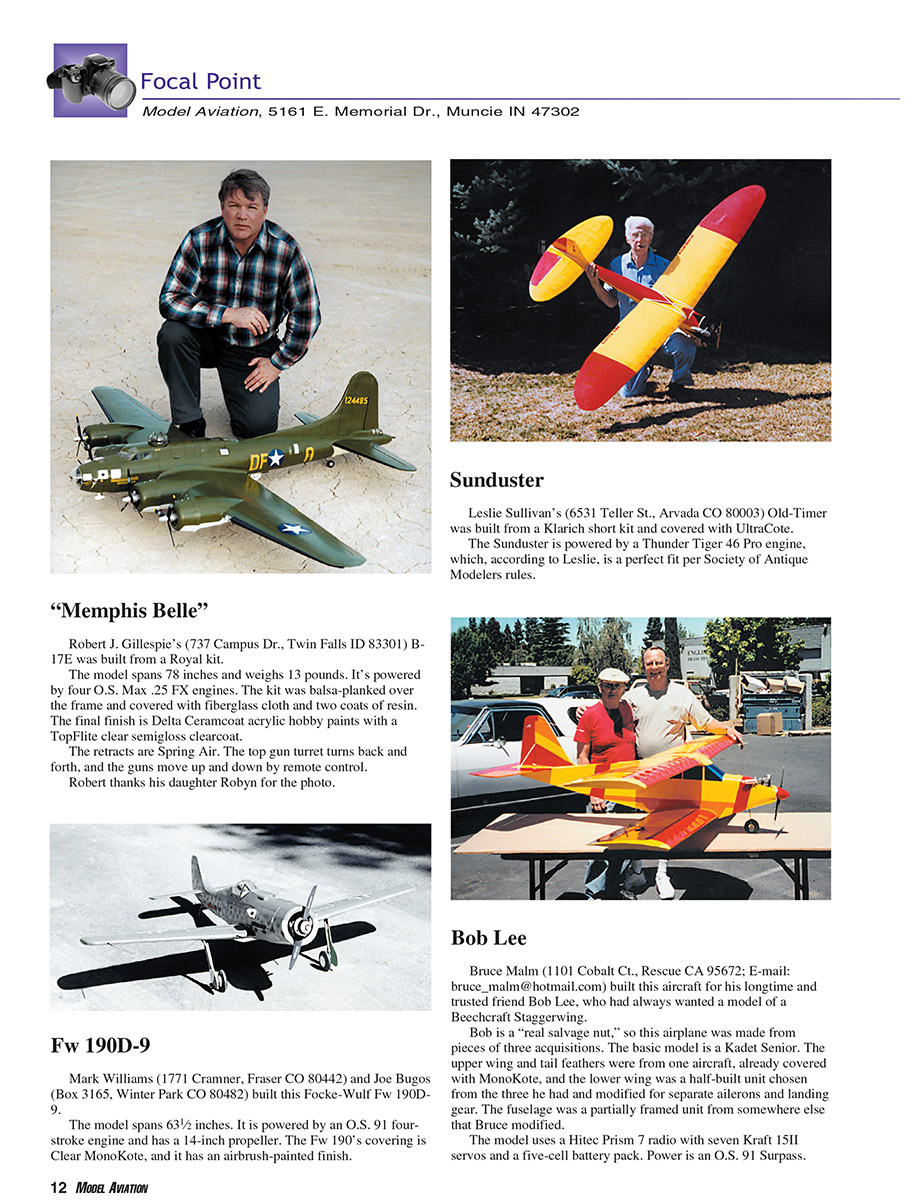
Bob Lee
Bruce Malm (1101 Cobalt Ct., Rescue CA 95672; E-mail: bruce_malm@hotmail.com) built this Beechcraft Staggerwing model for his longtime friend Bob Lee, who had always wanted one.
Bob is a “real salvage nut,” so the airplane was made from pieces of three acquisitions. The basic model is a Kadet Senior. The upper wing and tail feathers came from one aircraft already covered with MonoKote; the lower wing was a half-built unit chosen from the three and modified for separate ailerons and landing gear. The fuselage was a partially framed unit Bruce modified. The model uses a Hitec Prism 7 radio with seven Kraft 15II servos and a five-cell battery pack. Power is an O.S. 91 Surpass.
Sunduster
Leslie Sullivan (6531 Teller St., Arvada CO 80003) built this Old-Timer from a Klarich short kit and covered it with UltraCote. The Sunduster is powered by a Thunder Tiger 46 Pro engine, which, according to Leslie, is a perfect fit per Society of Antique Modelers rules.
Memphis Belle
Robert J. Gillespie (737 Campus Dr., Twin Falls ID 83301) built this B-17E from a Royal kit. The model spans 78 inches and weighs 13 pounds. It’s powered by four O.S. Max .25 FX engines.
The kit was balsa-planked over the frame and covered with fiberglass cloth and two coats of resin. The final finish is Delta Ceramcoat acrylic hobby paints with TopFlite semigloss clearcoat. The retracts are Spring Air. The top gun turret turns back and forth, and the guns move up and down by remote control.
Robert thanks his daughter Robyn for the photo.
F-15A
Chris Zonio (767½ Chenango St., Binghamton NY 13901; E-mail: chris.zonio@lmco.com; Web site: www.geocities.com/czonio/Homepage.html) built his first turbine-powered jet from a Philip Avonds kit.
The fuselage is fiberglass, reinforced with carbon fiber and plywood formers. The wings are white foam cores, sheeted and fiberglassed. The turbine is a RAM 1000 (electric start) capable of producing 28 pounds of thrust. Takeoff weight is roughly 32 pounds.
The F-15 uses Spring Air 402 retracts, Robart struts, and Glennis wheels and brakes. It also has a pneumatic, fully functional scale airbrake, landing and position lights, smoke system, droppable centerline fuel tank, fully detailed cockpit, and landing-gear doors.
Six-Year Project
Jim Schneider (5453 Miraloma Ct., Livermore CA 94550; E-mail: mudpuppyjl@cs.com) started his 1/7-scale TopFlite P-51 Mustang in February 1996 and finished it in February 2002.
Power is a Magnum 1.29 two-stroke engine capable of swinging an 18-inch propeller. The radio is a six-channel Airtronics with Century Jet Models retracts. The model weighs 10½ pounds. “The checkerboard pattern on the nose looks intimidating but is mostly time consuming,” wrote Jim. “A fully enclosed engine and homemade muffler complete the illusion of the original ‘Big Beautiful Doll.’”
Fw 190D-9
Mark Williams (1771 Crammer, Fraser CO 80442) and Joe Bugos (Box 3165, Winter Park CO 80482) built this Focke-Wulf Fw 190D-9.
The model spans 63½ inches. It is powered by an O.S. 91 four-stroke engine and uses a 14-inch propeller. The covering is Clear MonoKote with an airbrush-painted finish.
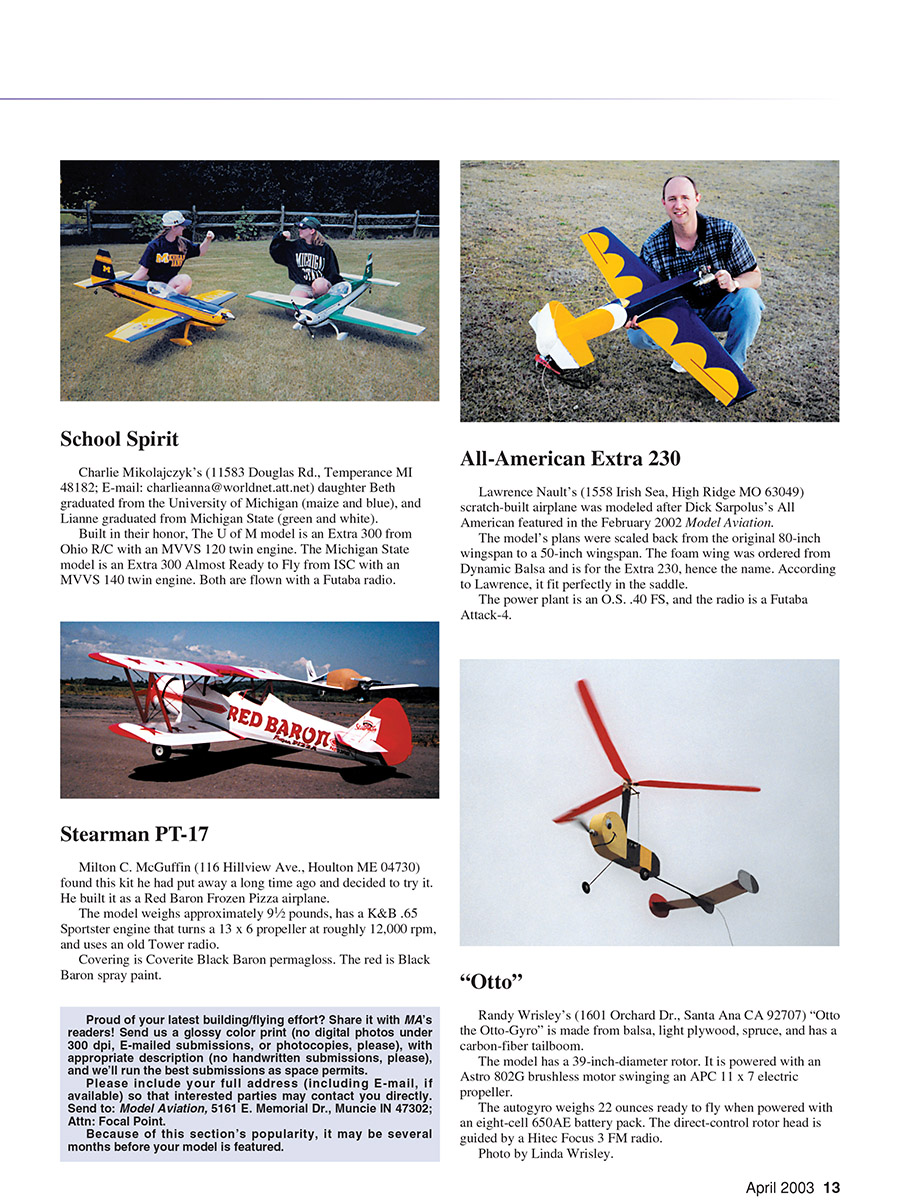
School Spirit
Charlie Mikolajczyk’s (11583 Douglas Rd., Temperance MI 48182; E-mail: charlieanna@worldnet.att.net) daughters Beth and Lianne graduated from the University of Michigan (maize and blue) and Michigan State (green and white), respectively.
Built in their honor, the U of M model is an Extra 300 from Ohio R/C with an MVVS 120 twin engine. The Michigan State model is an Extra 300 Almost Ready to Fly from ISC with an MVVS 140 twin engine. Both are flown with a Futaba radio.
All-American Extra 230
Lawrence Nault (1558 Irish Sea, High Ridge MO 63049) scratch-built this airplane modeled after Dick Sarpola’s All American featured in the February 2002 Model Aviation.
The plans were scaled from the original 80-inch wingspan to a 50-inch wingspan. The foam wing was ordered from Dynamic Balsa and is for the Extra 230, hence the name; it fit perfectly in the saddle. The power plant is an O.S. .40 FS, and the radio is a Futaba Attack-4.
Stearman PT-17
Milton C. McGuffin (116 Hillview Ave., Houlton ME 04730) found a kit he had put away long ago and decided to build it as a Red Baron Frozen Pizza airplane.
The model weighs approximately 9½ pounds, has a K&B .65 Sportster engine that turns a 13 x 6 propeller at roughly 12,000 rpm, and uses an old Tower radio. Covering is Coverite Black Baron permagloss; the red is Black Baron spray paint.
"Otto"
Randy Wrisley’s (1601 Orchard Dr., Santa Ana CA 92707) "Otto the Otto-Gyro" is made from balsa, light plywood, spruce, and has a carbon-fiber tailboom.
The model has a 39-inch-diameter rotor and is powered with an Astro 802G brushless motor swinging an APC 11 x 7 electric propeller. The autogyro weighs 22 ounces ready to fly when powered with an eight-cell 650AE battery pack. The direct-control rotor head is guided by a Hitec Focus 3 FM radio.
Photo by Linda Wrisley.
Transcribed from original scans by AI. Minor OCR errors may remain.

