
Focal Point
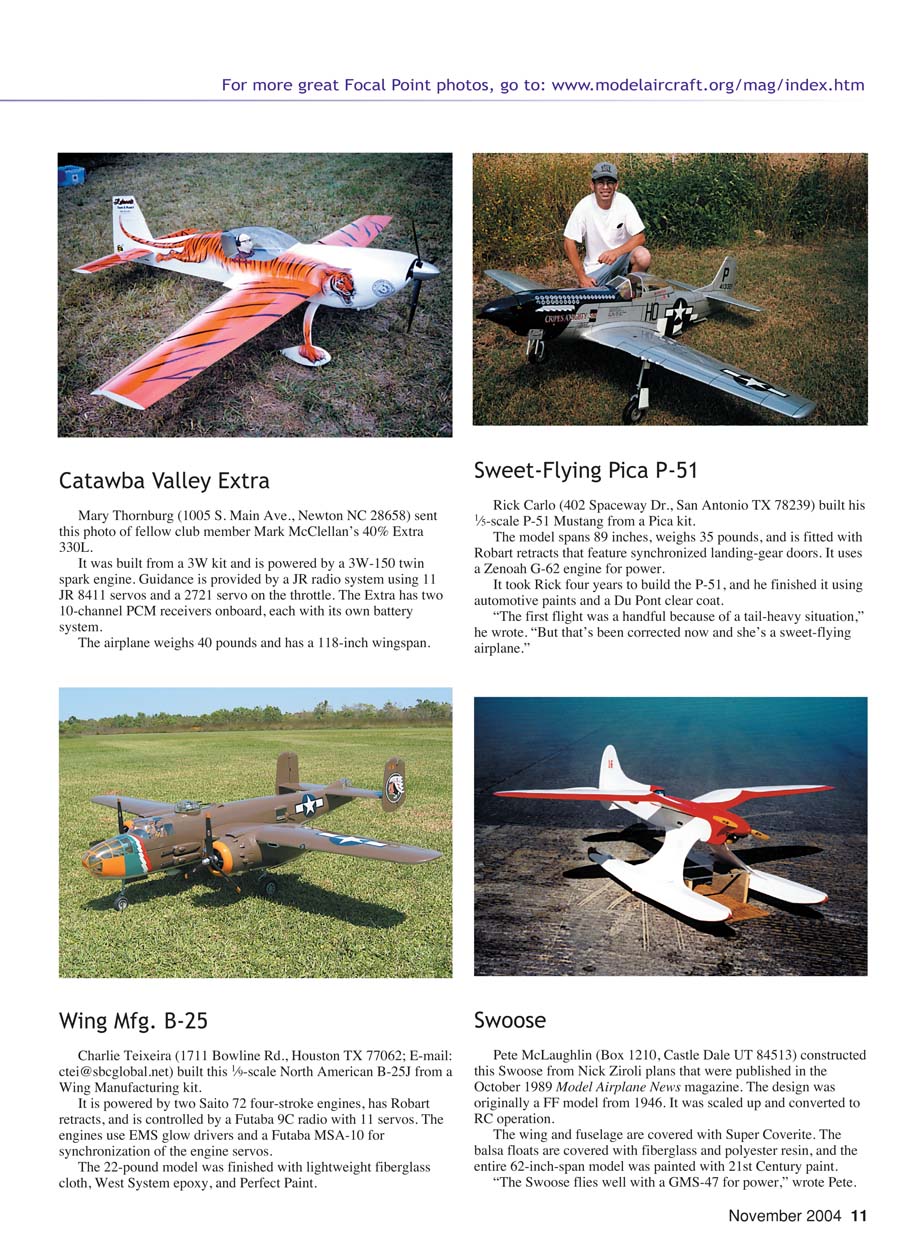
Giles Stunters
Phil Cartier (1249 Jill Dr., Hummelstown, PA 17036), left, and Gil Reedy fly these Giles Stunters. The big-profile design is modeled after the full-scale aerobatic airplane.
The Giles features a unique hollow-foam wing with I-beam construction, resulting in a light, stiff structure. Most of the fuselage is a foam-core profile sheeted with 1/16" balsa. The front end is solid 3/4" balsa covered with fiberglass for stiffness.
The model spans 60 inches with 750 square inches of wing area. All-up weight is roughly 45 ounces. An O.S. Max 40 LA provides plenty of power to turn an 11 x 4 or 12 x 4 propeller. "These airplanes turn in a heck of a pattern and are easy and fast to build to boot," wrote Phil.
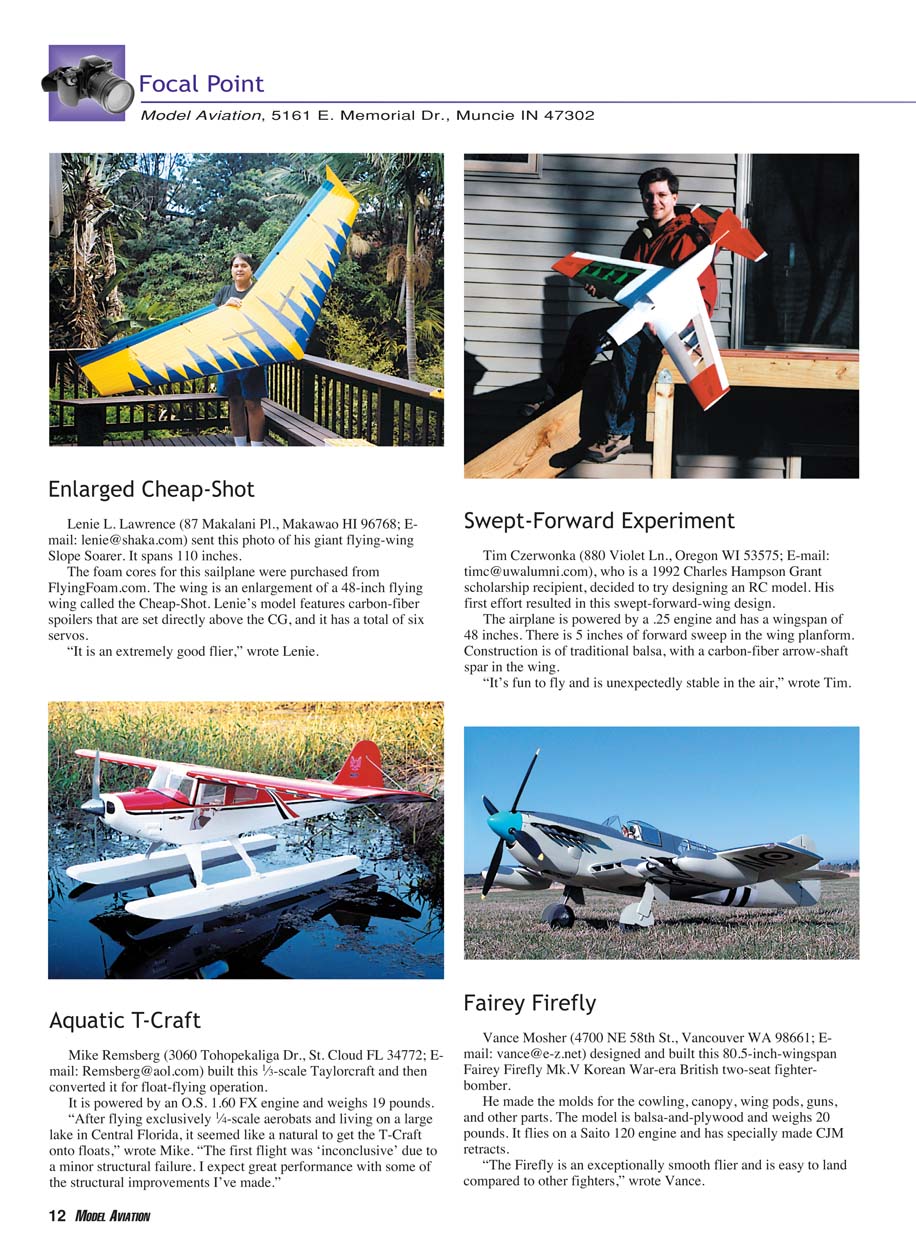
Comet Clipper
Raymond H. Barnes (3215 Seven Lakes West, Seven Lakes, NC 27376) scratch-built this Comet Clipper 43 years after the first one he built in 1939, when he was 14.
This airplane is powered by a Saito 30 engine. According to him, it "...purrs on high throttle for 10 or 15 minutes at altitude."
The model is equipped with throttle, elevator, and rudder control. "It is good to be alert for an unexpected thermal, as the Clipper gets very small up there," wrote Ray.
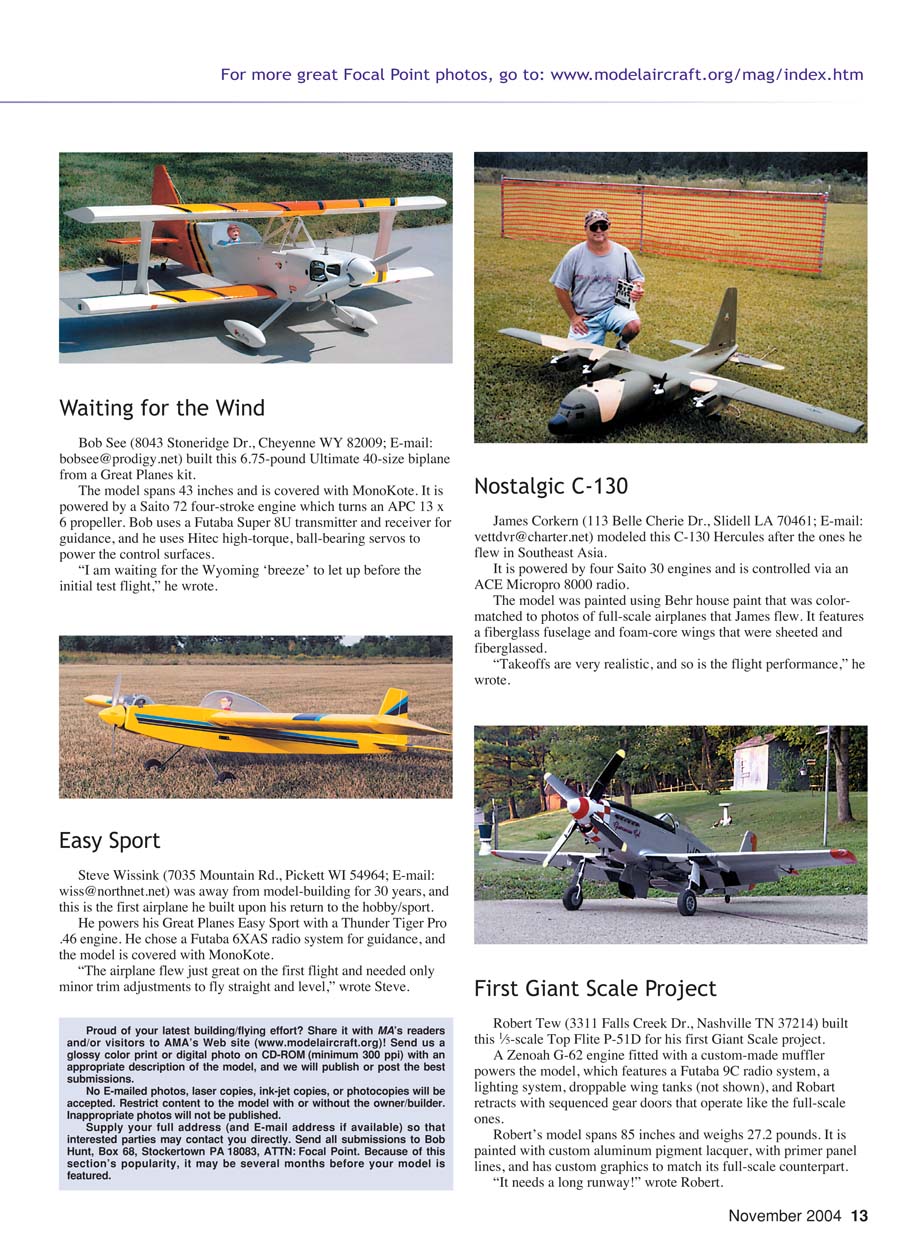
Verville-Sperry R-3
Gerald W. Bunn (1225 NW 21st St., Apt. 314, Stuart, FL 34994; E-mail: bbunn@highstream.net) scratch-built this airplane from a Paul Matt three-view. He modeled it after the full-scale airplane that won the 1924 Pulitzer Prize race at a speed of 219 mph.
The model has a wingspan of 80 inches and weighs roughly 10 pounds. It is powered by a Thunder Tiger .120 two-stroke engine. According to Gerald, it flies very well.
Kit-Bashed Albatros
Herman Burton (2918 Sea Ledge Dr., Seabrook, TX 77586; E-mail: heburto@attglobal.net) kit-bashed the Fred Reese–designed vintage biplane into a model that resembles Gerhard Bassenge's Albatros D.III of 1917.
Herman added many scale features, including Williams Bros. scale machine guns and scale wheels, a leather-padded cockpit opening, flying wires, a tail skid with functional bungee cords, and an instrument panel using J'Tec instruments.
He painted the model using The Home Depot's Painter's Choice paint, and then fuel-proofed it with a coat of cross‑linked, water‑based polyurethane from Nelson Hobby Specialties.
Catawba Valley Extra
Mary Thornburg (1005 S. Main Ave., Newton, NC 28658) sent this photo of fellow club member Mark McClellan’s 40% Extra 330L.
It was built from a 3W kit and is powered by a 3W-150 twin-spark engine. Guidance is provided by a JR radio system using 11 JR 8411 servos and a 2721 servo on the throttle. The Extra has two 10-channel PCM receivers onboard, each with its own battery system.
The airplane weighs 40 pounds and has a 118-inch wingspan.
Sweet-Flying Pica P-51
Rick Carlo (402 Spaceway Dr., San Antonio, TX 78239) built his 1/5-scale P-51 Mustang from a Pica kit.
The model spans 89 inches, weighs 35 pounds, and is fitted with Robart retracts that feature synchronized landing-gear doors. It uses a Zenoah G-62 engine for power.
It took Rick four years to build the P-51, and he finished it using automotive paints and a DuPont clear coat. "The first flight was a handful because of a tail‑heavy situation," he wrote. "But that's been corrected now and she's a sweet-flying airplane."
Wing Mfg. B-25
Charlie Teixeira (1711 Bowline Rd., Houston, TX 77062; E-mail: ctei@sbcglobal.net) built this 1/9-scale North American B-25J from a Wing Manufacturing kit.
It is powered by two Saito 72 four-stroke engines, has Robart retracts, and is controlled by a Futaba 9C radio with 11 servos. The engines use EMS glow drivers and a Futaba MSA-10 for synchronization of the engine servos.
The 22-pound model was finished with lightweight fiberglass cloth, West System epoxy, and Perfect Paint.
Swoose
Pete McLaughlin (Box 1210, Castle Dale, UT 84513) constructed this Swoose from Nick Ziroli plans that were published in the October 1989 Model Airplane News magazine. The design was originally a free-flight model from 1946. It was scaled up and converted to RC operation.
The wing and fuselage are covered with Super Coverite. The balsa floats are covered with fiberglass and polyester resin, and the entire 62-inch-span model was painted with 21st Century paint.
"The Swoose flies well with a GMS-47 for power," wrote Pete.
Enlarged Cheap-Shot
Lenie L. Lawrence (87 Makalani Pl., Makawao, HI 96768; E-mail: lenie@shaka.com) sent this photo of his giant flying‑wing Slope Soarer. It spans 110 inches.
The foam cores for this sailplane were purchased from FlyingFoam.com. The wing is an enlargement of a 48-inch flying wing called the Cheap‑Shot. Lenie's model features carbon-fiber spoilers that are set directly above the CG, and it has a total of six servos.
"It is an extremely good flier," wrote Lenie.
Swept-Forward Experiment
Tim Czerwionka (880 Violet Ln., Oregon, WI 53575; E-mail: timc@uwalumni.com), a 1992 Charles Hampson Grant scholarship recipient, decided to try designing an RC model. His first effort resulted in this swept‑forward‑wing design.
The airplane is powered by a .25 engine and has a wingspan of 48 inches. There is 5 inches of forward sweep in the wing planform. Construction is traditional balsa, with a carbon‑fiber arrow‑shaft spar in the wing.
"It's fun to fly and is unexpectedly stable in the air," wrote Tim.
Aquatic T-Craft
Mike Remsberg (3060 Tohopakaliga Dr., St. Cloud, FL 34772; E-mail: Remsberg@aol.com) built this 1/3-scale Taylorcraft and then converted it for float-flying operation.
It is powered by an O.S. 1.60 FX engine and weighs 19 pounds.
"After flying exclusively 1/4-scale aerobatics and living on a large lake in Central Florida, it seemed like a natural to get the T‑Craft onto floats," wrote Mike. "The first flight was 'inconclusive' due to a minor structural failure. I expect great performance with some of the structural improvements I've made."
Fairey Firefly
Vance Mosher (4700 NE 58th St., Vancouver, WA 98661; E-mail: vance@e-z.net) designed and built this 80.5-inch-wingspan Fairey Firefly Mk. V, a Korean War–era British two-seat fighter-bomber.
He made the molds for the cowling, canopy, wing pods, guns, and other parts. The model is balsa-and-plywood and weighs 20 pounds. It flies on a Saito 120 engine and has specially made CJM retracts.
"The Firefly is an exceptionally smooth flier and is easy to land compared to other fighters," wrote Vance.
Waiting for the Wind
Bob See (8043 Stoneridge Dr., Cheyenne, WY 82009; E-mail: bobsee@prodigy.net) built this 6.75-pound Ultimate .40-size biplane from a Great Planes kit.
The model spans 43 inches and is covered with MonoKote. It is powered by a Saito 72 four-stroke engine which turns an APC 13 x 6 propeller. Bob uses a Futaba Super 8U transmitter and receiver for guidance, and he uses Hitec high-torque, ball-bearing servos to power the control surfaces.
"I am waiting for the Wyoming 'breeze' to let up before the initial test flight," he wrote.
Nostalgic C-130
James Corkern (113 Belle Cherie Dr., Slidell, LA 70461; E-mail: vettdvr@charter.net) modeled the C-130 Hercules after the ones he flew in Southeast Asia.
It is powered by four Saito 30 engines and is controlled via an ACE Micropro 8000 radio.
The model was painted using Behr house paint that was color-matched to photos of full-scale airplanes that James flew. It features a fiberglass fuselage and foam-core wings that were sheeted and fiberglassed.
"Takeoffs are very realistic, and so is the flight performance," he wrote.
Easy Sport
Steve Wissink (7035 Mountain Rd., Pickett, WI 54964; E-mail: wiss@northnet.net) was away from model-building for 30 years, and this is the first airplane he built upon his return to the hobby/sport.
He powers his Great Planes Easy Sport with a Thunder Tiger Pro .46 engine. He chose a Futaba 6XAS radio system for guidance, and the model is covered with MonoKote.
"The airplane flew just great on the first flight and needed only minor trim adjustments to fly straight and level," wrote Steve.
First Giant Scale Project
Robert Tew (3311 Falls Creek Dr., Nashville, TN 37214) built this 1/5-scale Top Flite P-51D for his first Giant Scale project.
A Zenoah G-62 engine fitted with a custom-made muffler powers the model, which features a Futaba 9C radio system, a lighting system, droppable wing tanks (not shown), and Robart retracts with sequenced gear doors that operate like the full-scale ones.
Robert’s model spans 85 inches and weighs 27.2 pounds. It is painted with custom aluminum pigment lacquer, with primer panel lines, and has custom graphics to match its full-scale counterpart.
"It needs a long runway!" wrote Robert.
Share Your Work
Proud of your latest building/flying effort? Share it with Model Airplane News readers and visitors to AMA's website (www.modelaircraft.org). Send a glossy color print or a digital photo on CD-ROM (minimum 300 ppi) with an appropriate description of the model, and we will publish or post the best submissions.
- No e-mailed photos, laser copies, ink-jet copies, or photocopies will be accepted. Restrict content to the model with or without the owner/builder. Inappropriate photos will not be published.
- Supply your full address (and e-mail address if available) so that interested parties may contact you directly.
- Send all submissions to: Bob Hunt, Box 68, Stockertown, PA 18083, ATTN: Focal Point.
Because of this section's popularity, it may be several months before your model is featured.
Transcribed from original scans by AI. Minor OCR errors may remain.

