
Focal Point
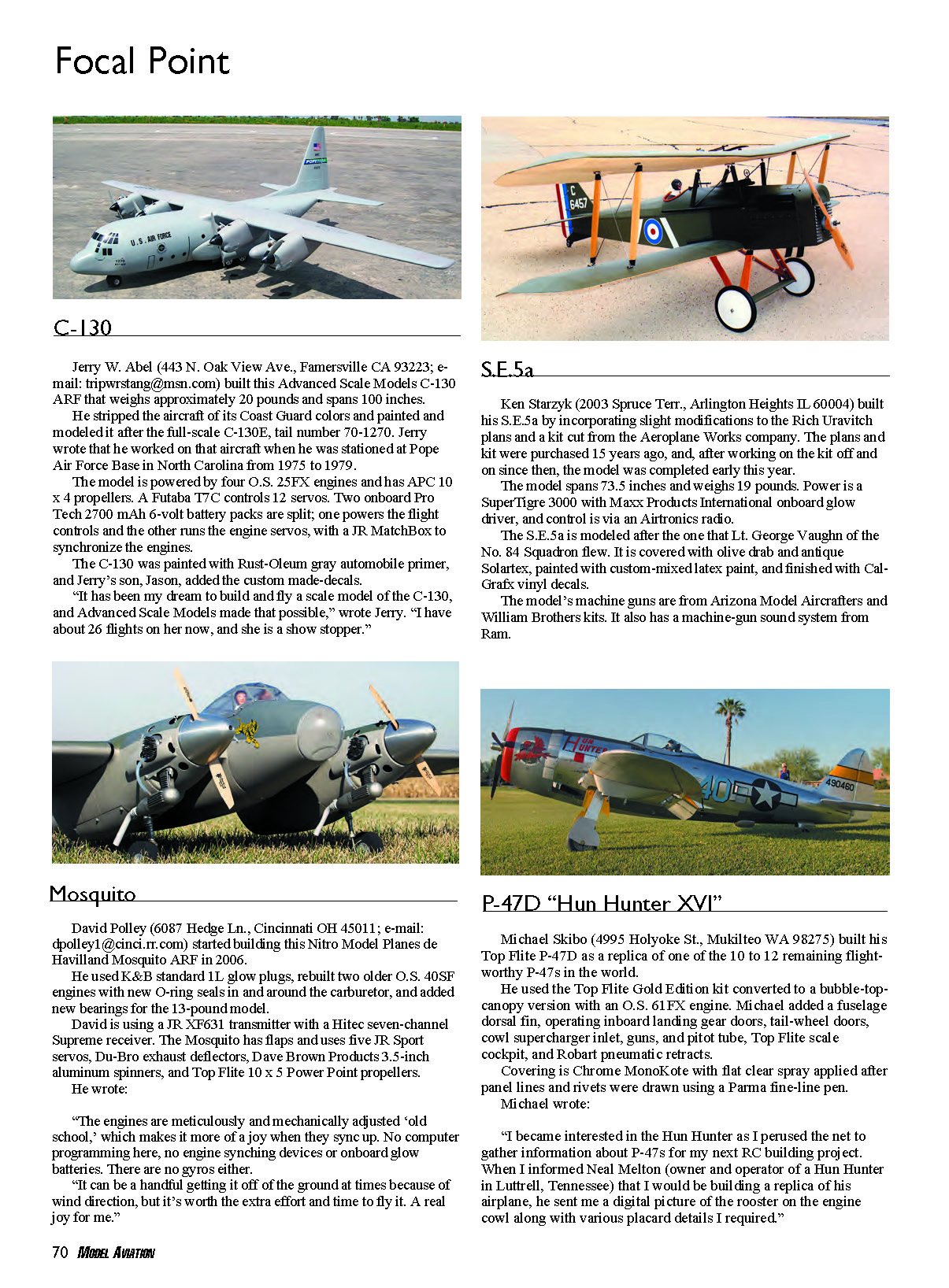
C-130
- Builder: Jerry W. Abel (443 N. Oak View Ave., Farmersville, CA 93223; e-mail: tripwrstang@msn.com)
- Model: Advanced Scale Models C-130 ARF
- Span / Weight: 100 inches / approximately 20 pounds
- Prototype: Modeled after full-scale C-130E, tail number 70-1270 (stripped of Coast Guard colors)
- Power: Four O.S. 25FX engines; APC 10x4 propellers
- Radio / Servos: Futaba T7C controlling 12 servos
- Batteries / Engine Sync: Two Pro Tech 2700 mAh 6-volt packs (one for flight controls, one for engine servos); JR MatchBox to synchronize engines
- Finish: Painted with Rust-Oleum gray automobile primer; custom-made decals applied by son Jason
- Notes: Jerry worked on the full-scale aircraft while stationed at Pope AFB, NC (1975–1979). Approximately 26 flights to date.
"It has been my dream to build and fly a scale model of the C-130, and Advanced Scale Models made that possible. I have about 26 flights on her now, and she is a show stopper."
S.E.5a
- Builder: Ken Starzyk (2003 Spruce Terr., Arlington Heights, IL 60004)
- Plans / Kit: Slight modifications to Rich Uravitch plans; kit cut from Aeroplane Works
- Span / Weight: 73.5 inches / 19 pounds
- Power: SuperTigre 3000 with Maxx Products International onboard glow driver
- Radio: Airtronics
- Covering / Finish: Olive drab and antique Solartex; custom-mixed latex paint; Cal-Grafx vinyl decals
- Details: Modeled after the aircraft flown by Lt. George Vaughn of No. 84 Squadron. Machine guns from Arizona Model Aircrafters and William Brothers kits. Machine-gun sound system from Ram.
Mosquito
- Builder: David Polley (6087 Hedge Ln., Cincinnati, OH 45011; e-mail: dpolley1@cinci.rr.com)
- Model: Nitro Model Planes de Havilland Mosquito ARF (build started in 2006)
- Weight: 13 pounds
- Engines / Ignition: Rebuilt two older O.S. 40SF engines with new O-ring seals and new bearings; K&B standard 1L glow plugs
- Radio / Servos: JR XF631 transmitter with Hitec seven-channel Supreme receiver; five JR Sport servos
- Equipment: Flaps; Du-Bro exhaust deflectors; Dave Brown Products 3.5-inch aluminum spinners; Top Flite 10x5 Power Point propellers
- Notes: Engines adjusted mechanically (no computer programming, engine-synching devices, onboard glow batteries, or gyros). Can be challenging to get off the ground in certain wind conditions, but very rewarding to fly.
"The engines are meticulously and mechanically adjusted 'old school,' which makes it more of a joy when they sync up. No computer programming here, no engine synching devices or onboard glow batteries. There are no gyros either.
"It can be a handful getting it off of the ground at times because of wind direction, but it's worth the extra effort and time to fly it. A real joy for me."
P-47D "Hun Hunter XVI"
- Builder: Michael Skibo (4995 Holyoke St., Mukilteo, WA 98275)
- Kit / Conversion: Top Flite Gold Edition kit converted to bubble-top canopy version
- Power: O.S. 61FX engine
- Modifications / Scale Details:
- Fuselage dorsal fin
- Operating inboard landing gear doors
- Tail-wheel doors
- Cowl supercharger inlet
- Guns and pitot tube
- Top Flite scale cockpit
- Robart pneumatic retracts
- Covering / Finish: Chrome MonoKote; panel lines and rivets drawn with Parma fine-line pen; flat clear spray applied afterward
- Notes: Michael researched one of the remaining flightworthy P-47s and corresponded with Neal Melton (owner/operator of a Hun Hunter) for rooster and placard details.
"I became interested in the Hun Hunter as I perused the net to gather information about P-47s for my next RC building project. When I informed Neal Melton (owner and operator of a Hun Hunter in Luttrell, Tennessee) that I would be building a replica of his airplane, he sent me a digital picture of the rooster on the engine cowl along with various placard details I required."
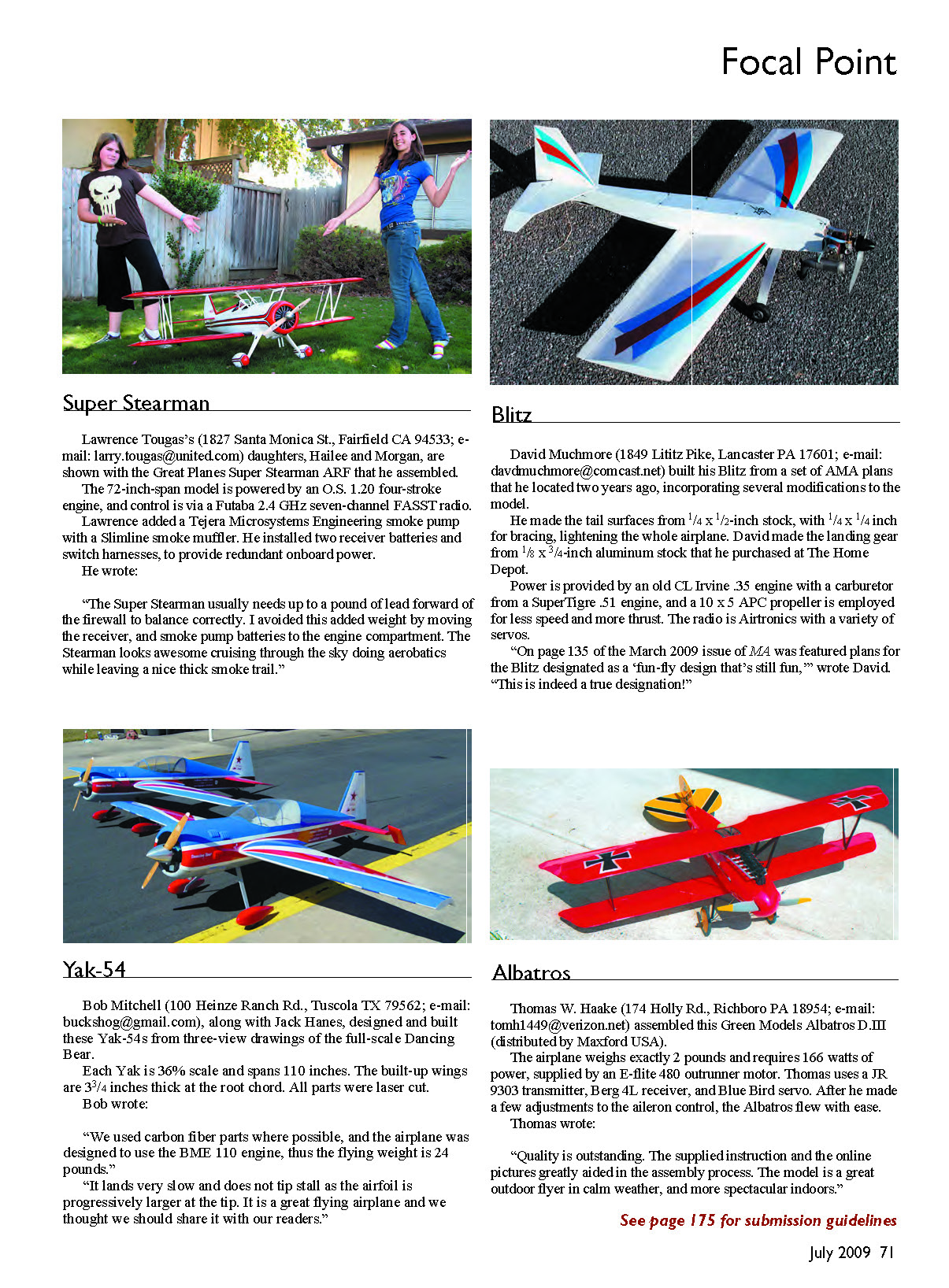
Super Stearman
- Builder: Lawrence Tougas (1827 Santa Monica St., Fairfield, CA 94533; e-mail: larry.tougas@united.com)
- Model: Great Planes Super Stearman ARF (assembled by Lawrence; daughters Hailee and Morgan pictured with it)
- Span: 72 inches
- Power: O.S. .120 four-stroke engine
- Radio: Futaba 2.4 GHz seven-channel FASST
- Smoke System: Tejera Microsystems Engineering smoke pump with Slimline smoke muffler
- Power Redundancy: Two receiver batteries and switch harnesses for redundant onboard power
- Setup / Balance: Typically needs up to a pound of lead forward of the firewall to balance; Lawrence avoided added ballast by relocating receiver and smoke pump batteries to the engine compartment
- Notes: Performs well in aerobatics while leaving a thick smoke trail.
"The Super Stearman usually needs up to a pound of lead forward of the firewall to balance correctly. I avoided this added weight by moving the receiver, and smoke pump batteries to the engine compartment. The Stearman looks awesome cruising through the sky doing aerobatics while leaving a nice thick smoke trail."
Blitz
- Builder: David Muchmore (1849 Lititz Pike, Lancaster, PA 17601; e-mail: davidmuchmore@comcast.net)
- Plans: AMA plans located two years prior; incorporated several modifications
- Construction:
- Tail surfaces: 1/4 x 1/2-inch stock; braced with 1/4 x 1/4-inch stock to lighten the airplane
- Landing gear: Made from 1/8 x 3/4-inch aluminum stock (sourced from The Home Depot)
- Power: CL Irvine .35 engine with a carburetor from a SuperTigre .51 engine
- Propeller: 10x5 APC for less speed and more thrust
- Radio: Airtronics with various servos
- Notes: Built as a fun-fly design, true to the designation featured in the March 2009 issue of MA.
"On page 135 of the March 2009 issue of MA was featured plans for the Blitz designated as a 'fun-fly design that's still fun.' This is indeed a true designation!"
Yak-54
- Designers / Builders: Bob Mitchell (100 Heinze Ranch Rd., Tuscola, TX 79562; e-mail: buckshog@gmail.com) and Jack Hanes
- Basis: Designed and built from three-view drawings of the full-scale "Dancing Bear"
- Scale / Span: 36% scale; 110 inches span
- Wing: Built-up wings 3-3/4 inches thick at the root chord
- Construction: All parts laser cut; carbon-fiber parts used where possible
- Power / Weight: Designed for BME 110 engine; flying weight approximately 24 pounds
- Flight Characteristics: Lands very slowly and resists tip-stalling due to progressively larger airfoil toward the tip
"We used carbon fiber parts where possible, and the airplane was designed to use the BME 110 engine, thus the flying weight is 24 pounds.
"It lands very slow and does not tip stall as the airfoil is progressively larger at the tip. It is a great flying airplane and we thought we should share it with our readers."
Albatros
- Builder: Thomas W. Haake (174 Holly Rd., Richboro, PA 18954; e-mail: tomh1449@verizon.net)
- Model: Green Models Albatros D.III (distributed by Maxford USA)
- Weight / Power: 2 pounds exactly; requires 166 watts supplied by an E-flite 480 outrunner motor
- Radio / Servos: JR 9303 transmitter, Berg 4L receiver, Blue Bird servo
- Assembly / Flight: After a few aileron control adjustments, the Albatros flew easily
- Notes: High build quality; supplied instructions and online photos aided assembly. Great outdoor flyer in calm weather and spectacular indoors.
Transcribed from original scans by AI. Minor OCR errors may remain.

