
Focal Point
True Joy Tripacer
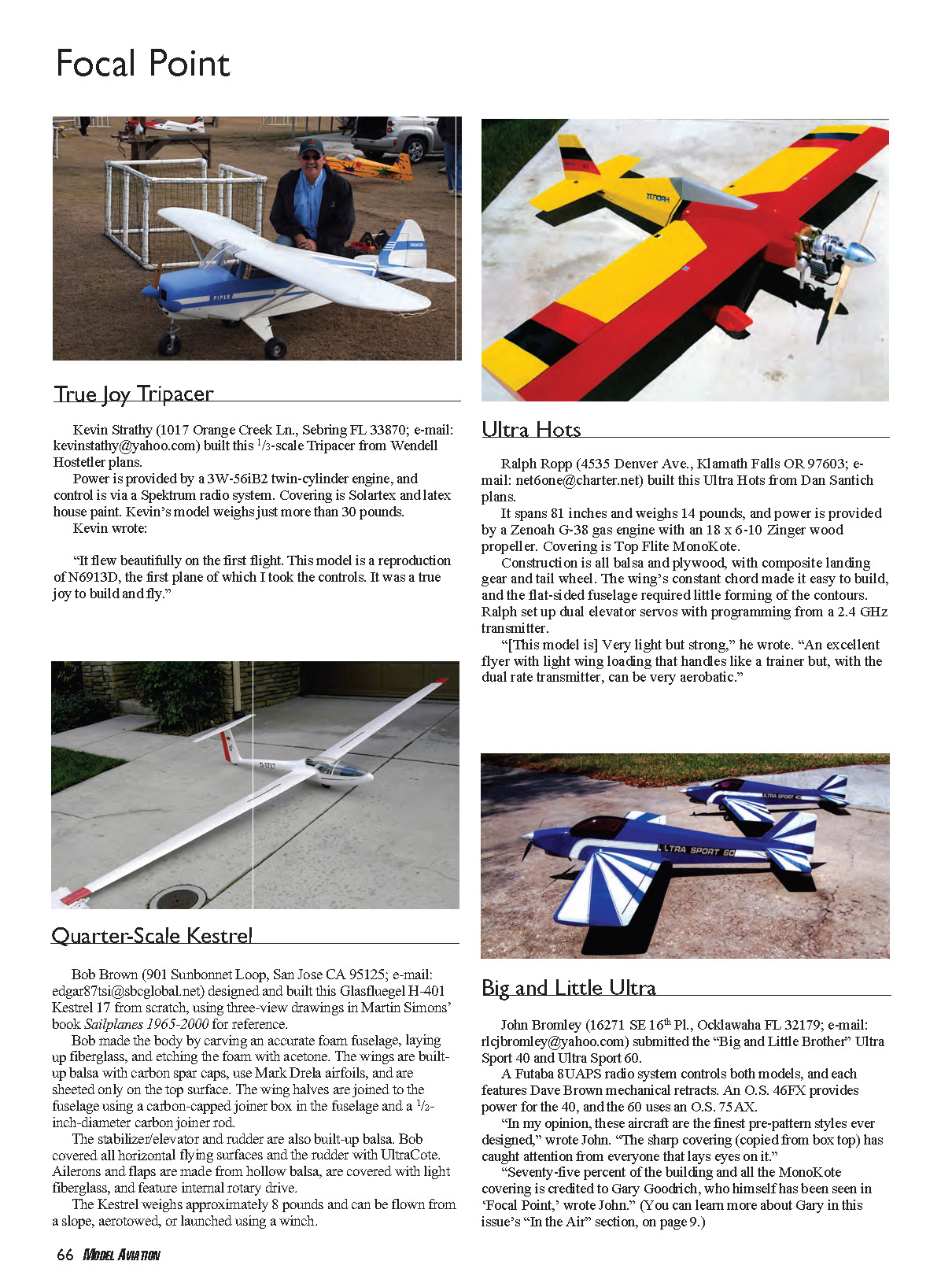
Kevin Strathy (1017 Orange Creek Ln., Sebring FL 33870; e-mail: kevinstathy@yahoo.com) built this 1/3-scale Tripacer from Wendell Hostetler plans.
Power is provided by a 3W-56iB2 twin-cylinder engine, and control is via a Spektrum radio system. Covering is Solartex and latex house paint. Kevin’s model weighs just more than 30 pounds.
Kevin wrote: "It flew beautifully on the first flight. This model is a reproduction of N6913D, the first plane of which I took the controls. It was a true joy to build and fly."
Quarter-Scale Kestrel
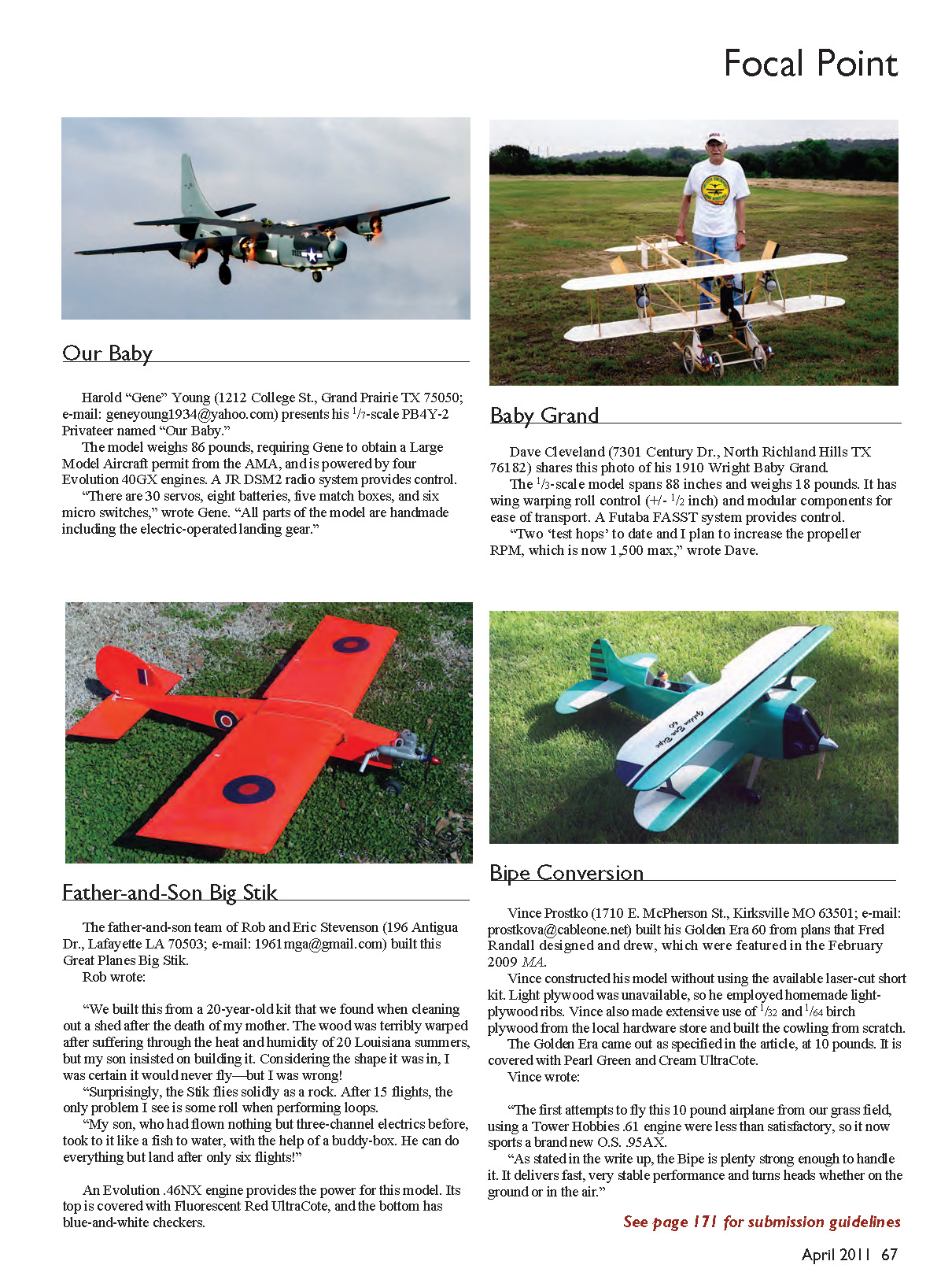
Bob Brown (901 Sunbonnet Loop, San Jose CA 95125; e-mail: edgar87tsi@sbcglobal.net) designed and built this Glasfluegel H-401 Kestrel 17 from scratch, using three-view drawings in Martin Simons' book Sailplanes 1965–2000 for reference.
Bob made the body by carving an accurate foam fuselage, laying up fiberglass, and etching the foam with acetone. The wings are built-up balsa with carbon spar caps, use Mark Drela airfoils, and are sheeted only on the top surface. The wing halves are joined to the fuselage using a carbon-capped joiner box in the fuselage and a 1/2-inch-diameter carbon joiner rod.
The stabilizer/elevator and rudder are also built-up balsa. Bob covered all horizontal flying surfaces and the rudder with UltraCote. Ailerons and flaps are made from hollow balsa, are covered with light fiberglass, and feature internal rotary drive.
The Kestrel weighs approximately 8 pounds and can be flown from a slope, aerotowed, or launched using a winch.
Ultra Hots
Ralph Ropp (4535 Denver Ave., Klamath Falls OR 97603; e-mail: net6one@charter.net) built this Ultra Hots from Dan Santich plans.
It spans 81 inches and weighs 14 pounds. Power is provided by a Zenoah G-38 gas engine with an 18 x 6–10 Zinger wood propeller. Covering is Top Flite MonoKote.
Construction is all balsa and plywood, with composite landing gear and tail wheel. The wing’s constant chord made it easy to build, and the flat-sided fuselage required little forming of the contours. Ralph set up dual elevator servos with programming from a 2.4 GHz transmitter.
"[This model is] Very light but strong," he wrote. "An excellent flyer with light wing loading that handles like a trainer but, with the dual rate transmitter, can be very aerobatic."
Big and Little Ultra
John Bromley (16271 SE 16th Pl., Ocklawaha FL 32179; e-mail: rlcjbromley@yahoo.com) submitted the "Big and Little Brother" Ultra Sport 40 and Ultra Sport 60.
A Futaba 8UAPS radio system controls both models, and each features Dave Brown mechanical retracts. An O.S. 46FX provides power for the 40, and the 60 uses an O.S. 75AX.
"In my opinion, these aircraft are the finest pre-pattern styles ever designed," wrote John. "The sharp covering (copied from box top) has caught attention from everyone that lays eyes on it."
"Seventy-five percent of the building and all the MonoKote covering is credited to Gary Goodrich, who himself has been seen in 'Focal Point,'" wrote John. (You can learn more about Gary in this issue’s "In the Air" section, on page 9.)
Our Baby
Harold "Gene" Young (1212 College St., Grand Prairie TX 75050; e-mail: geneyoung1934@yahoo.com) presents his 1/7-scale PB4Y-2 Privateer named "Our Baby."
The model weighs 86 pounds, requiring Gene to obtain a Large Model Aircraft permit from the AMA, and is powered by four Evolution 40GX engines. A JR DSM2 radio system provides control.
"There are 30 servos, eight batteries, five match boxes, and six micro switches," wrote Gene. "All parts of the model are handmade including the electric-operated landing gear."
Baby Grand
Dave Cleveland (7301 Century Dr., North Richland Hills TX 76182) shares this photo of his 1910 Wright Baby Grand.
The 1/3-scale model spans 88 inches and weighs 18 pounds. It has wing warping roll control (+/– 1/2 inch) and modular components for ease of transport. A Futaba FASST system provides control.
"Two 'test hops' to date and I plan to increase the propeller RPM, which is now 1,500 max," wrote Dave.
Father-and-Son Big Stik
The father-and-son team of Rob and Eric Stevenson (196 Antigua Dr., Lafayette LA 70503; e-mail: 1961mga@gmail.com) built this Great Planes Big Stik.
Rob wrote: "We built this from a 20-year-old kit that we found when cleaning out a shed after the death of my mother. The wood was terribly warped after suffering through the heat and humidity of 20 Louisiana summers, but my son insisted on building it. Considering the shape it was in, I was certain it would never fly—but I was wrong!
"Surprisingly, the Stik flies solidly as a rock. After 15 flights, the only problem I see is some roll when performing loops.
"My son, who had flown nothing but three-channel electrics before, took to it like a fish to water, with the help of a buddy-box. He can do everything but land after only six flights!"
An Evolution .46NX engine provides the power for this model. Its top is covered with Fluorescent Red UltraCote, and the bottom has blue-and-white checkers.
Bipe Conversion
Vince Prostko (1710 E. McPherson St., Kirksville MO 63501; e-mail: prostkova@cableone.net) built his Golden Era 60 from plans that Fred Randall designed and drew, which were featured in the February 2009 MA.
Vince constructed his model without using the available laser-cut short kit. Light plywood was unavailable, so he employed homemade light-plywood ribs. Vince also made extensive use of 1/32 and 1/64 birch plywood from the local hardware store and built the cowl from scratch.
The Golden Era came out as specified in the article, at 10 pounds. It is covered with Pearl Green and Cream UltraCote.
Vince wrote: "The first attempts to fly this 10 pound airplane from our grass field, using a Tower Hobbies .61 engine were less than satisfactory, so it now sports a brand new O.S. .95AX.
"As stated in the write up, the Bipe is plenty strong enough to handle it. It delivers fast, very stable performance and turns heads whether on the ground or in the air."
Transcribed from original scans by AI. Minor OCR errors may remain.

