
Focal Point
Huey
Bill Maciborski (434 Carol St., Stedman, NC 28391) built a Huey — a gas X-Cell helicopter in a Darrell Sprayberry Bell UH-1B fuselage. The model has working navigation lights and retractable landing gear.
"It's light, a great-flying helicopter, and very impressive-looking," wrote Bill.
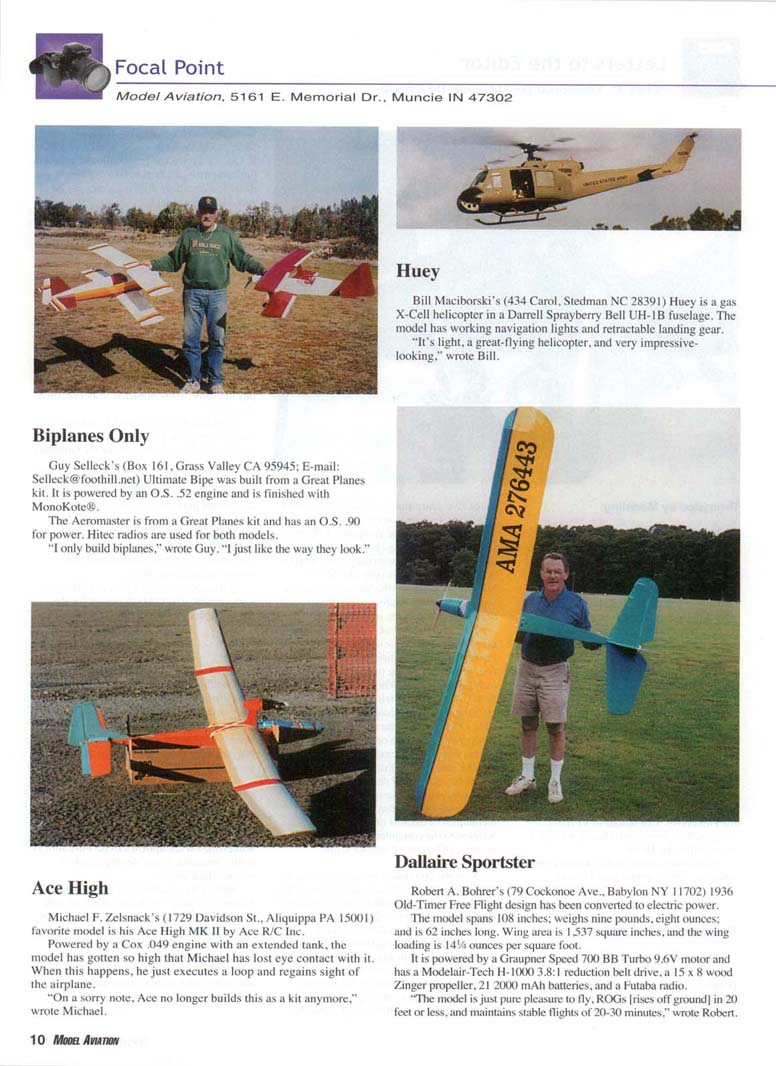
Biplanes Only
Guy Selleck (Box 161, Grass Valley, CA 95945; E-mail: Selleck@foothill.net) built an Ultimate Bipe from a Great Planes kit. It is powered by an O.S. .52 engine and is finished with MonoKote®.
He also built an Aeromaster from a Great Planes kit, powered by an O.S. .90. Hitec radios are used for both models.
"I only build biplanes," wrote Guy. "I just like the way they look."
Ace High
Michael F. Zelsnack (1729 Davidson St., Aliquippa, PA 15001) favors his Ace High MK II by Ace R/C Inc.
Powered by a Cox .049 engine with an extended tank, the model flies so high that Michael sometimes loses eye contact. When this happens, he executes a loop to regain sight of the airplane.
"On a sorry note, Ace no longer builds this as a kit anymore," wrote Michael.
Dallaire Sportster
Robert A. Bohrer (79 Cockonoe Ave., Babylon, NY 11702) converted a 1936 Old-Timer Free Flight design to electric power.
- Span: 108 inches
- Weight: 9 lb 8 oz
- Length: 62 inches
- Wing area: 1,537 sq in
- Wing loading: 14 1/4 oz per sq ft
Power is provided by a Graupner Speed 700 BB Turbo 9.6V motor with a Modelair-Tech H-1000 3.8:1 reduction belt drive and a 15 x 8 wood Zinger propeller. The model uses twenty-one 2000-mAh batteries and a Futaba radio.
"The model is just pure pleasure to fly, ROGs [rises off ground] in 20 feet or less, and maintains stable flights of 20–30 minutes," wrote Robert.
DC-3/C-47
William B. Just (211-46 Forest Lake Dr., Stephens City, VA 22655) built this model from a TopFlite® kit.
- Span: 82 1/2 inches
- Weight: 9 pounds
- Power: O.S. Max 40 engine
- Radio: Futaba with five servos
"It has the markings of a C-47A of the 96th Troop Carrier Squadron/440th Troop Carrier Group based at Exeter, England," wrote William. "It was used in the invasion of France. A real delight to build."
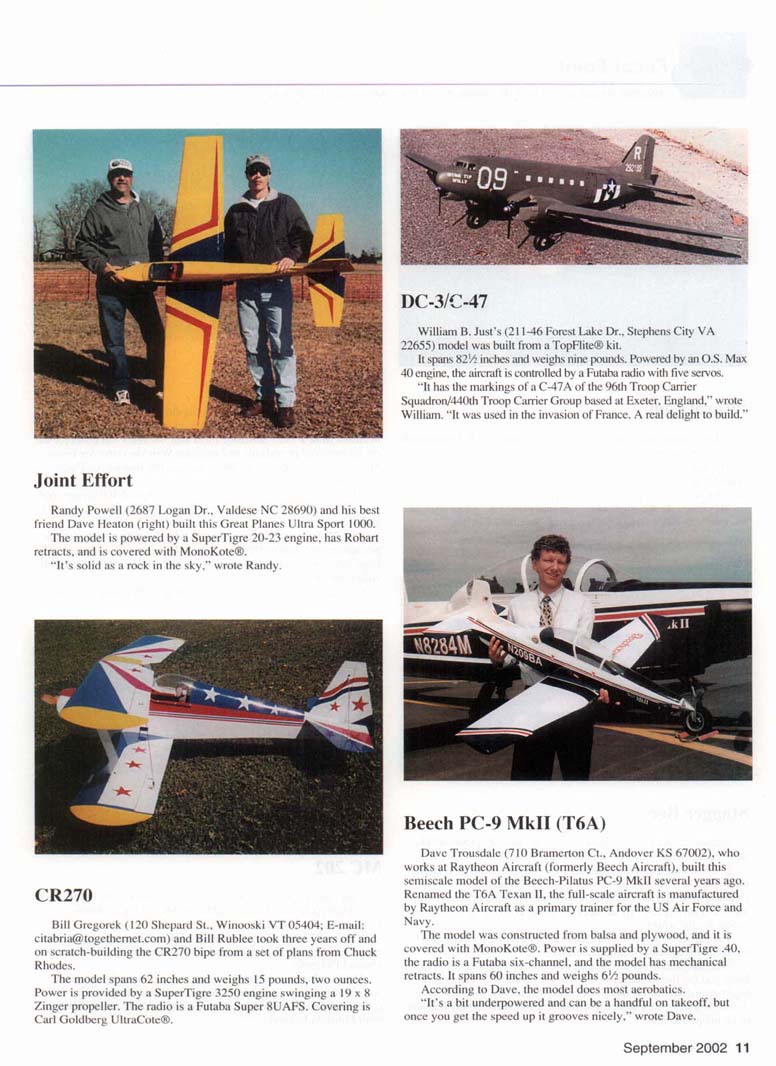
Joint Effort
Randy Powell (2687 Logan Dr., Valdese, NC 28690) and his best friend Dave Heaton built a Great Planes Ultra Sport 1000.
The model is powered by a SuperTigre 20-23 engine, has Robart retracts, and is covered with MonoKote®.
"It's solid as a rock in the sky," wrote Randy.
CR270
Bill Gregorek (120 Shepard St., Winooski, VT 05404; E-mail: citabria@togethernet.com) and Bill Rublee spent three years off and on scratch-building the CR270 biplane from plans by Chuck Rhodes.
- Span: 62 inches
- Weight: 15 lb 2 oz
- Power: SuperTigre 3250 engine, 19 x 8 Zinger propeller
- Radio: Futaba Super 8UAFS
- Covering: Carl Goldberg UltraCote®
Beech PC-9 MkII (T6A)
Dave Trousdale (710 Bramerton Ct., Andover, KS 67002), who works at Raytheon Aircraft (formerly Beech Aircraft), built a semiscale model of the Beech-Pilatus PC-9 MkII several years ago.
Renamed the T6A Texan II, the full-scale aircraft is manufactured by Raytheon Aircraft as a primary trainer for the U.S. Air Force and Navy.
The model is constructed from balsa and plywood and is covered with MonoKote®. Power is supplied by a SuperTigre .40, the radio is a Futaba six-channel, and the model has mechanical retracts.
- Span: 60 inches
- Weight: 6 1/2 pounds
According to Dave, the model performs most aerobatics. "It's a bit underpowered and can be a handful on takeoff, but once you get the speed up it grooves nicely," he wrote.
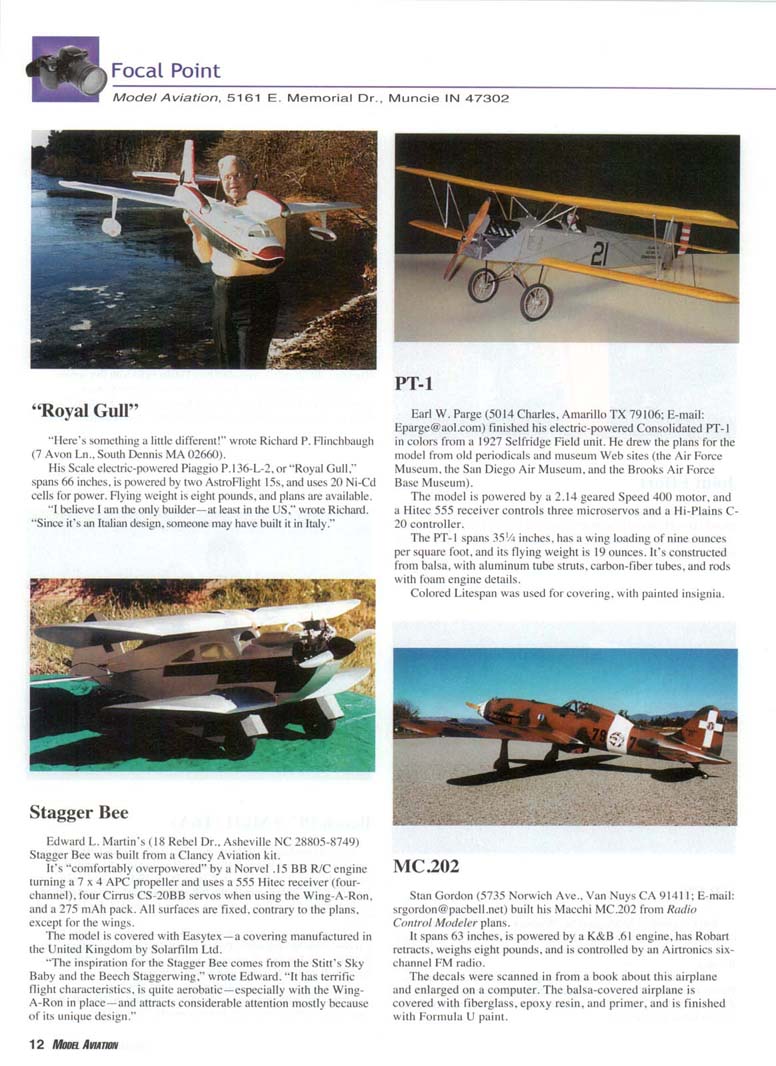
"Royal Gull"
Richard P. Flinchbaugh (7 Avon Ln., South Dennis, MA 02660) built a scale electric-powered Piaggio P.136-L-2, nicknamed the "Royal Gull."
- Span: 66 inches
- Power: two AstroFlight 15 motors
- Power source: 20 Ni-Cd cells
- Flying weight: 8 pounds
- Plans: available
"I believe I am the only builder—at least in the U.S.," wrote Richard. "Since it's an Italian design, someone may have built it in Italy."
Stagger Bee
Edward L. Martin (18 Rebel Dr., Asheville, NC 28805-8749) built his Stagger Bee from a Clancy Aviation kit.
- Engine: Norvel .15 BB R/C turning a 7 x 4 APC propeller
- Radio: 555 Hitec receiver (four-channel)
- Servos: four Cirrus CS-20BB servos when using the Wing-A-Ron
- Battery: 275 mAh pack
- Covering: Easytex (Solarfilm Ltd., UK)
All surfaces are fixed, contrary to the plans, except for the wings.
"The inspiration for the Stagger Bee comes from the Stitt's Sky Baby and the Beech Staggerwing," wrote Edward. "It has terrific flight characteristics, is quite aerobatic—especially with the Wing-A-Ron in place—and attracts considerable attention mostly because of its unique design."
PT-1
Earl W. Parge (5014 Charles, Amarillo, TX 79106; E-mail: EParge@aol.com) finished an electric-powered Consolidated PT-1 in colors from a 1927 Selfridge Field unit. He drew the plans from old periodicals and museum Web sites (the Air Force Museum, the San Diego Air & Space Museum, and the Brooks Air Force Base Museum).
- Motor: 2.14 geared Speed 400
- Radio: Hitec 555 receiver controlling three microservos
- Controller: Hi-Planes C-20
- Span: 35 1/4 inches
- Wing loading: 9 oz per sq ft
- Flying weight: 19 ounces
- Construction: balsa with aluminum tube struts, carbon-fiber tubes and rods, foam engine details
- Covering: Colored Litespan with painted insignia
MC.202
Stan Gordon (5735 Norwich Ave., Van Nuys, CA 91411; E-mail: srgordon@pacbell.net) built a Macchi MC.202 from Radio Control Modeler plans.
- Span: 63 inches
- Power: K&B .61 engine
- Retracts: Robart
- Weight: 8 pounds
- Radio: Airtronics six-channel FM
The decals were scanned from a book and enlarged on a computer. The balsa-covered airframe was finished with fiberglass, epoxy resin, primer, and Formu-La paint.
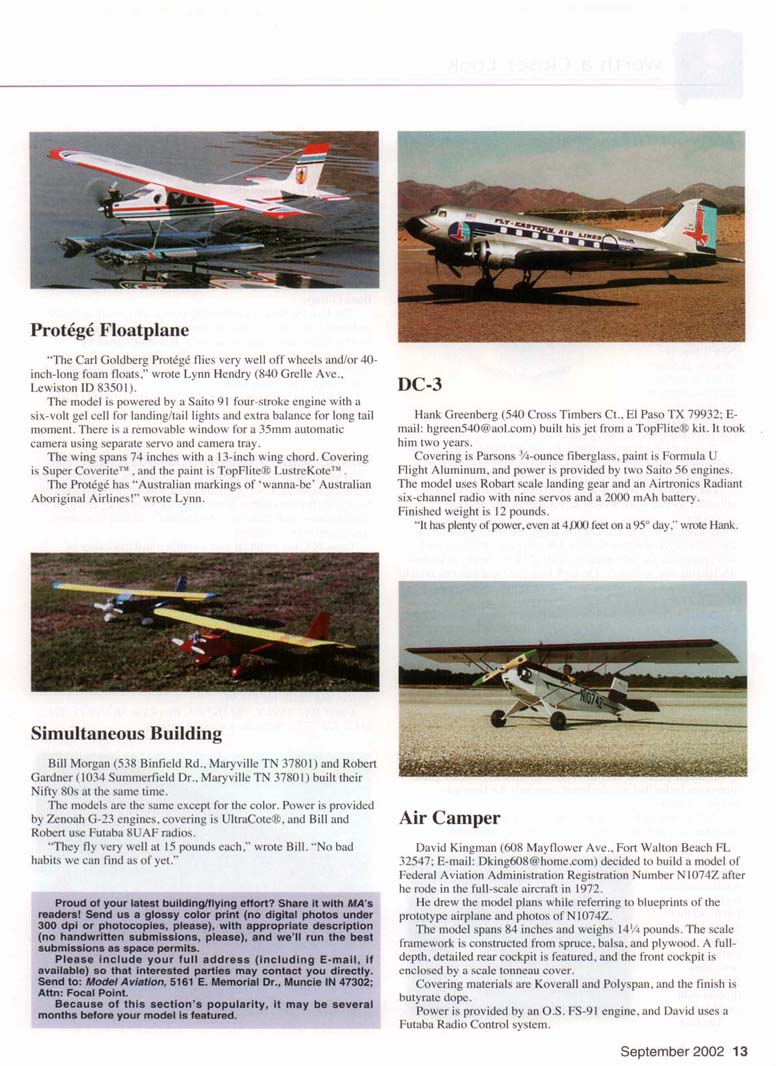
Protégé Floatplane
Lynn Hendry (840 Grelle Ave., Lewiston, ID 83501) reports that the Carl Goldberg Protégé flies very well off wheels and/or 40-inch-long foam floats.
- Engine: Saito 91 four-stroke
- Electrical: six-volt gel cell for landing/tail lights and extra balance for long tail moment
- Camera: removable window for a 35mm automatic camera with separate servo and camera tray
- Wing span: 74 inches
- Wing chord: 13 inches
- Covering: Super Coverite™
- Paint: TopFlite® LustreKote™
The Protégé carries "Australian markings of 'wanna-be' Australian Aboriginal Airlines!" wrote Lynn.
DC-3
Hank Greenberg (540 Cross Timbers Ct., El Paso, TX 79932; E-mail: hgreen540@aol.com) built his DC-3 from a TopFlite® kit over two years.
- Covering: Parsons 3/4-ounce fiberglass
- Paint: Formula U Flight Aluminum
- Power: two Saito 56 engines
- Landing gear: Robart scale gear
- Radio: Airtronics Radiant six-channel with nine servos
- Battery: 2000 mAh
- Finished weight: 12 pounds
"It has plenty of power, even at 4,000 feet on a 95° day," wrote Hank.
Simultaneous Building
Bill Morgan (538 Binfield Rd., Maryville, TN 37801) and Robert Gardner (1034 Summerfield Dr., Maryville, TN 37801) built Nifty 80s at the same time.
- Engines: Zenoah G-23
- Covering: UltraCote®
- Radio: Futaba 8UAF
"They fly well for about 15 pounds each," wrote Bill. "No bad habits we can find as of yet."
Share Your Model
Proud of your latest build/giving effort? Share it with Model Aviation's readers!
Send a glossy color print (no digital photos under 300 dpi or photocopies, please) with an appropriate description (no handwritten submissions, please), and we’ll run the best submissions as space permits.
Please include your full address (including E-mail, if available) so interested parties may contact you directly. Send to:
Model Aviation 5161 E. Memorial Dr. Muncie, IN 47302 Attn: Focal Point
Because of this section's popularity, it may be several months before your model is featured.
Air Camper
David Kingman (608 Mayflower Ave., Fort Walton Beach, FL 32547; E-mail: Dking608@home.com) built a model of FAA registration N1074Z after flying in the full-scale aircraft in 1972.
He drew the model plans using blueprints of the prototype and photos of N1074Z.
- Span: 84 inches
- Weight: 14 1/2 pounds
- Construction: spruce, balsa, plywood (scale framework)
- Cockpits: full-depth detailed rear cockpit; enclosed front cockpit with scale tonneau cover
- Covering: Koverall and Polyspan
- Finish: butyrate dope
- Power: O.S. FS-91 engine
- Radio: Futaba Radio Control system
Transcribed from original scans by AI. Minor OCR errors may remain.

