
A Note From the Technical Director
Bob Underwood
Let's start with a great big thank you to the clubs that provided copies of club rules and site layouts. When rechartering information was sent out this year, clubs were asked to submit operational rules, safety rules, site layout, constitution and bylaws, frequency management plans, etc. We are building a database to use when clubs request that type of information.
One issue we'd like each club to study carefully is the division of site rules into two groups: operational and safety. Often the posted rules mix the two. Because of item three in the General section of the AMA Safety Code, mixing these categories can create confusion about which club rules become part of the Code and which remain club operational rules. For instance, "No low passes over the runway" is a safety rule, whereas "No flying before 9 a.m." is an operational rule.
Flying Site Safety Rules
- Deliberate flying behind the flight line is prohibited.
- Each transmitter must display frequency identification.
- No taxiing in the pit area.
- First-time flights for new or repaired aircraft shall be done during peak spectator attendance periods.
- Children are permitted beyond the spectator area only under the direct supervision of an adult.
- The established club frequency control plan will be in force at all times.
- Control-line equipment shall be inspected before the initial flight each day.
- Helicopter flights are allowed in designated areas only.
---
Focus on Competition
Addition to List of Experimental RC Aircraft Inspectors
A joint AMA/FAA program to qualify large models (55–100 lb.) for demonstration flights at AMA‑sanctioned events uses inspectors to oversee qualifications and approve/certify compliance with safe practices.
The following individual has been added to the inspector list published in the July 1991 edition of Focus on Competition (page 134):
- District II — Terry Terroneiro, 101 Smithfield Drive, Endicott, NY 13760
Additional information about this program may be obtained by contacting Technical Director Bob Underwood at AMA HQ. Attention CDs: a list of aircraft approved under this program can be obtained from Bob Underwood at AMA HQ.
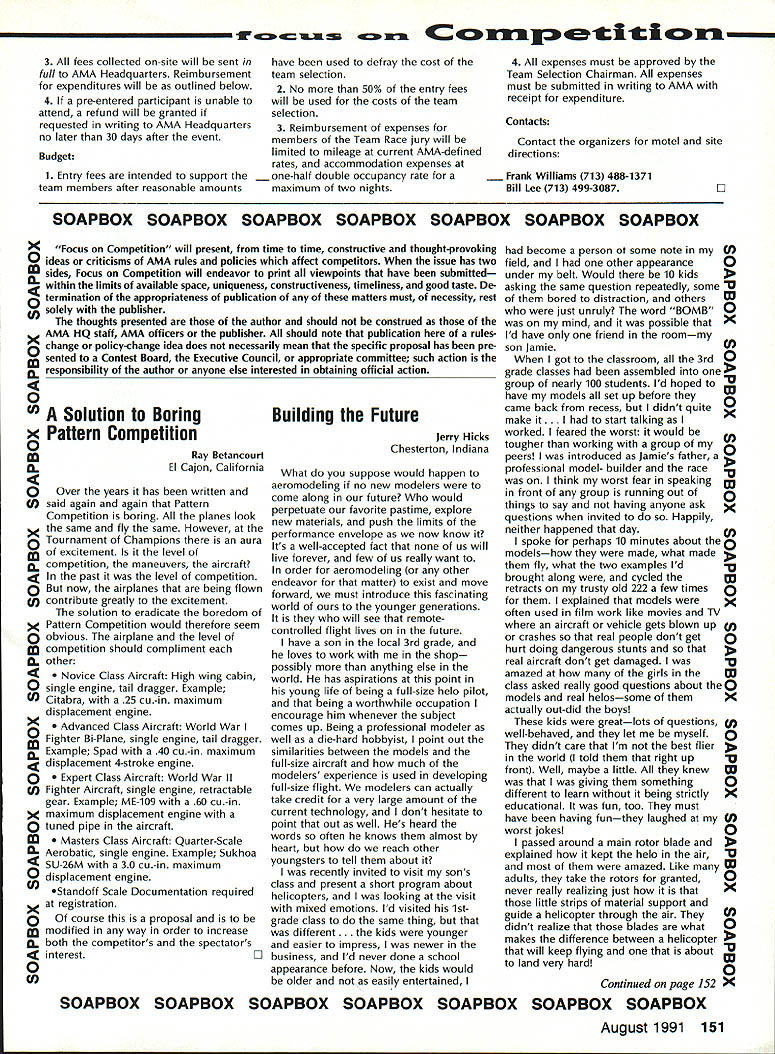
FAI Team Race — 1992 Team Selection Program
Type of contest:
- Team Race team will be selected at a single-site team selection event held over two days.
- Six rounds total (three per day).
- A participant's score is the average of his three fastest heats. In case of a tie, remaining heats are compared (next fastest, etc.) until the tie is resolved.
- The team will comprise the three teams with the top scores.
Conduct of the contest:
- The event will be conducted per the FAI Sporting Code (Section 4, Part 2 and 4a as modified).
- Section 4, Part 2 is applicable except where rules pertain to multi‑national considerations. Generally, read "Team Selection" where the Code reads "International Contest" or "World Championships."
- Paragraphs specifically defining teams for international competition are not applicable (2.3.5, 2.3.6). Several paragraphs and procedures are not applicable; FAI jury makeup will follow published AMA procedures for Team Selection.
- Paragraphs allowing for a practice day and those applicable only to Free Flight are not applicable.
Further Team Race clarifications:
- Parts 1, 2 and 4 of the FAI Code are applicable; others are not.
- A wire enclosure around the Team Race circle will not be required; normal AMA safety procedures apply.
- Due to the large number of competitive flights, an entrant may process three models rather than two.
- Marking motors is not required; sharing motors between competitors is disallowed.
- Models need not be pre-processed by the NAC.
- The organizers must appoint a panel of at least three FAI judges.
- Timekeeping: two timekeepers per entrant are required (three may be used); the average of the two times will be used after validating recorded times.
- Colored lights or other effective visual signals will be used to notify entrants of warnings.
Jury:
- The Team Race jury will be comprised of three people experienced in Team Race competition, selected by the contest organizers.
Location and Time:
- Dick Scobee Memorial Field, Houston, Texas — September 28–29, 1991.
Hosted by the Clear Lake Area Line Winders. Contest Director: Frank Williams. Discussion of procedures and model processing will occur Friday evening, September 27, 1991 (time/site to be determined).
Contacts:
- Frank Williams — (713) 488-1371
- Bill Lee — (713) 499-3087
FAI Speed — 1992 Team Selection Program
Applicable rules:
- Section 4a, Parts 1, 2 and 4 are applicable; other parts are not. Certain paragraphs are explicitly not applicable to a Team Selection. Pertinent AMA safety directives will be followed.
- No engine marking will be done; any engine sealing that would be required by the Code is disallowed.
- Part 4 paragraph 4.1.17 — only the second paragraph applies.
Event format and scoring:
- The event will last two days; two rounds will be flown each day.
- Each participant is allowed two attempts to complete one official flight per round. Failure to obtain an official flight in a round results in a zero for that round. A participant's score is the average of his two best official flights at the event. In the event of a tie, the next best official flight is compared, and so on.
- The team will be comprised of the three participants with the top scores.
Locations and dates (two sites):
- East event: Dayton, Ohio — September 7–8, 1991. Hosted by the Dayton Buzzin Buzzards.
- West event: Whittier Narrows, Los Angeles, California — September 21–22, 1991. Hosted by the Control Line Speed Fliers of Southern California.
Additional:
- Discussion of contest procedures and model processing may be required on the Friday evening preceding each event; particulars will be available from event organizers.
Entry:
- Open to all AMA and NAA members eligible to represent the United States at the 1992 Control Line World Championships. NAA membership is the official "international license" and provides the requisite FAI stamp.
- Entry fee: $50. Pre-entry should be made by sending fee to AMA Headquarters, attention Competition Dept. Late entries will be accepted on site but are strongly discouraged; they must be postmarked no later than two weeks prior to the selection event to allow Headquarters to notify contest management and forward mail.
- All entry fees collected on-site will be sent in full to AMA Headquarters. All monies will be reimbursed as noted below.
- If a pre-entered participant is unable to attend, a refund will be granted if requested in writing to AMA Headquarters no later than 30 days after the event.
Budget:
- Entry fees are intended to support team members after reasonable amounts have been used to defray Team Selection costs.
- No more than 50% of entry fees will be used for Team Selection costs.
- If judges are required, reimbursement is limited to mileage at current AMA-defined rates and accommodations at one-half double-occupancy rate for a maximum of two nights.
- All expenses must be approved by the Team Selection Chairman and submitted in writing to AMA Headquarters with receipts.
Contacts:
- Bob Heywood — (513) 890-7555
- Joe Brownlee — (213) 988-5365
---
Technical Director (continued)
Receiver narrowband identification:
- JR radio systems: narrowband receivers carry the letters "A, B, C and W" on the receiver case.
- Futaba: narrowband receivers carry a round silver seal (1/2 inch diameter) with the words "Narrowband" and "20 kHz‑1991" inside a black square in the center of the circle.
Note: Units may be manufactured by one company and sold under different names by separate importers. Equipment is only added to the AMA listing when documentation is received for the specific system named.
Robinson Engineering waiver:
- We published last month a waiver granted to Robinson Engineering to operate low-power transmitters for crane operations until June 1993. We are contacting the roughly 130 users to determine whether they might affect model operations; some have responded. We expect to publish a listing indicating frequency, power level, and location of many of these cranes.
Competition Regulations and proposed competition license:
- We are assembling the next Competition Regulations for 1992–93. Voting is complete; insertion and other changes are underway. Contest Board chairpersons, Headquarters, and the Technical Director's office are coordinating this work.
- There has been discussion about improving the rule book's quality (paper, larger print). Another proposal is issuing a special competition license for those who fly in or officiate at book events. Possible benefits of the program include:
- 1. Special license card.
- 2. AMA Competition Regulations mailed automatically (one per cycle).
- 3. FAI Sporting Code available upon request (one per cycle).
- 4. Bi-annual newsletter containing AMA and FAI updates (changes, clarifications, etc.).
- 5. Funding face-to-face Contest Board meetings when necessary at the time of initial vote (improved rule procedures).
- 6. Significantly improved readability of the AMA Competition Regulations.
- 7. Recording of contestant classification activity at Headquarters (Pattern, Helicopter, Scale).
- Incorporation of these items would likely require a modest fee (suggested $5–$10) but would increase service for competition-oriented fliers.
Other items:
- The second issue of the Cabane (a CD newsletter) has been mailed to CDs to improve communications with event managers.
- Scholarship activity: In 1990 the Academy awarded $25,000 in scholarships. This year we have over 40 applications to process; the Scholarship Committee aims to schedule awards before the next school year.
Cheers — more next month.
---
USA Junior FAI Free Flight Team
Robert W. Waterman, Co‑Chairman FFTSC
National Aero Clubs field Junior FAI Free Flight model airplane teams for the biennial Junior World Championships. The United States will participate in the 1992 (third) Junior World Championships. In 1990 the USA FAI team won first place; Mike Keller (California) became Junior World Champion FAI Power.
Internationally, some countries (notably the USSR and China) have government-sponsored programs with thousands of participants and team-built models. In the USA, we rely on dedicated individuals who volunteer time to recruit and mentor junior fliers, help them become competent builders and pilots, and rely on contributions from individuals and companies to fund the effort.
Budget and donations:
- 1992 program budget: $20,750 (includes World Championship entry fees, air fares, van rental, model box fees, contingency).
- Donations should be made payable to Academy of Model Aeronautics (tax deductible) and sent to:
AMA, 1810 Samuel Morse Dr., Reston, VA 22090, Attn: Competition Dept. Include a note indicating the contribution is for the 1992 Junior FAI Free Flight Team Fund. Deposits will earn interest until used.
Sponsorship/contact:
- To sponsor or obtain promotional material, contact:
Bob Waterman, 4480 NW Wallowa Ct., Portland, OR 97229. Telephone: (503) 645-0987 or 1-800-547-1526 (weekdays).
---
FAI Team Race (Additional Notes)
- Parts 1, 2, and 4 of the FAI Code are applicable; others are not. Part 2, paragraph 2.1 and other discipline-specific paragraphs are not applicable to Team Selection.
- Part 2, paragraph 2.2.c: wire enclosure around the circle not required; normal AMA safety applies.
- Part 2, paragraph 2.3.1: entrants may process three models.
- Part 2, paragraph 2.3.4: marking motors is not required; motor sharing disallowed.
- Part 2, paragraph 2.3.8: models need not be pre-processed by the NAC.
- Part 4, paragraphs 4.3.10a–g: redefined by other Team Selection program sections.
- Part 4, paragraph 4.3.11: international team classification is not applicable.
- Part 4, paragraph 4.3.12a: only the sentence requiring appointment of at least three FAI judges is retained.
- Part 4, paragraph 4.3.12b–c: two timekeepers per entrant required (three allowed); average of two times used after validation.
- Part 4, paragraph 4.3.13: colored lights or other visual signals will be used to notify entrants of warnings.
Jury and location:
- Jury: three experienced Team Race judges selected by organizers.
- Event: Dick Scobee Memorial Field, Houston, Texas — September 28–29, 1991. Hosted by Clear Lake Area Line Winders. Contest Director: Frank Williams. Processing discussion on Friday evening, September 27, 1991.
Entry/budget/contacts (summary):
- All fees collected on-site will be sent to AMA Headquarters; reimbursements as outlined previously. Refunds available for pre-entered non-attendees if requested in writing within 30 days after the event.
- Budget: no more than 50% of entry fees used for team selection costs. Reimbursement for Team Race jury expenses limited to mileage at AMA rates and lodging at one-half double occupancy for up to two nights; all expenses must be pre-approved and submitted with receipts.
- Contacts: Frank Williams — (713) 488-1371; Bill Lee — (713) 499-3087.
---
SOAPBOX
"Focus on Competition" will occasionally publish constructive, thought-provoking ideas or criticisms of AMA rules and policies affecting competitors. When an issue has two sides, we will try to print submitted viewpoints subject to space, uniqueness, constructiveness, timeliness, and good taste. Publication here does not imply the proposal has been presented to a Contest Board, the Executive Council, or an appropriate committee; pursuing official action is the author's responsibility. The views published are those of the author alone.
A Solution to Boring Pattern Competition
Ray Betancourt — El Cajon, California
Pattern competition is often criticized as boring because many airplanes look and fly the same. The Tournament of Champions is more exciting, partly because the airplanes contribute to the excitement. The solution is to align aircraft type with competitor classification so airplane and level of competition complement each other. A possible scheme:
- Novice Class Aircraft: High‑wing cabin, single engine, taildragger. Example: Citabria, max .25 cu. in. engine.
- Advanced Class Aircraft: World War I fighter biplane, single engine, taildragger. Example: SPAD, max .40 cu. in. 4‑stroke engine.
- Expert Class Aircraft: World War II fighter, single engine, retractable gear. Example: P‑51, max .60 cu. in. engine with tuned pipe.
- Masters Class Aircraft: Quarter‑scale aerobatic, single engine. Example: Sukhoi SU‑26M, max 3.0 cu. in. engine.
- Standard Scale: Documentation required at registration.
This is a proposal to be modified to increase competitor and spectator interest.
Building the Future
Jerry Hicks — Chesterton, Indiana
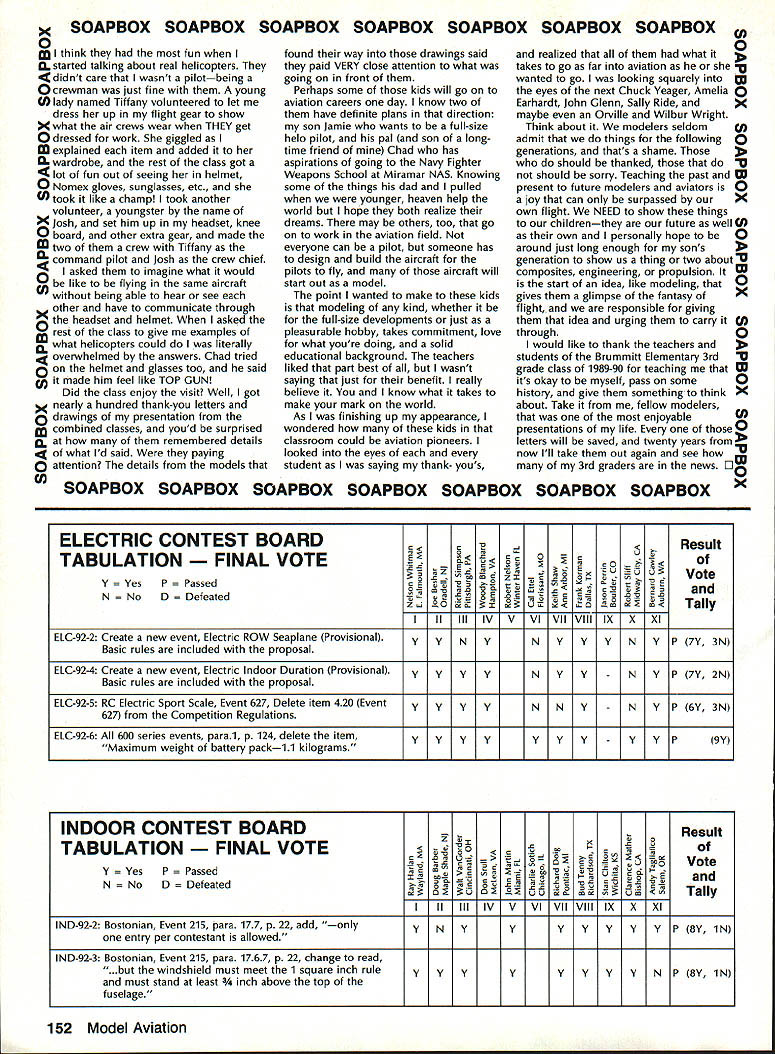
If no new modelers join, the hobby will fade. We must introduce younger generations to modeling. The author describes visiting his son's third-grade class with helicopter models and explanations about how rotors work and model construction. The visit was well received: students asked good questions, were engaged, and demonstrated that outreach to schoolchildren can attract future modelers.
---
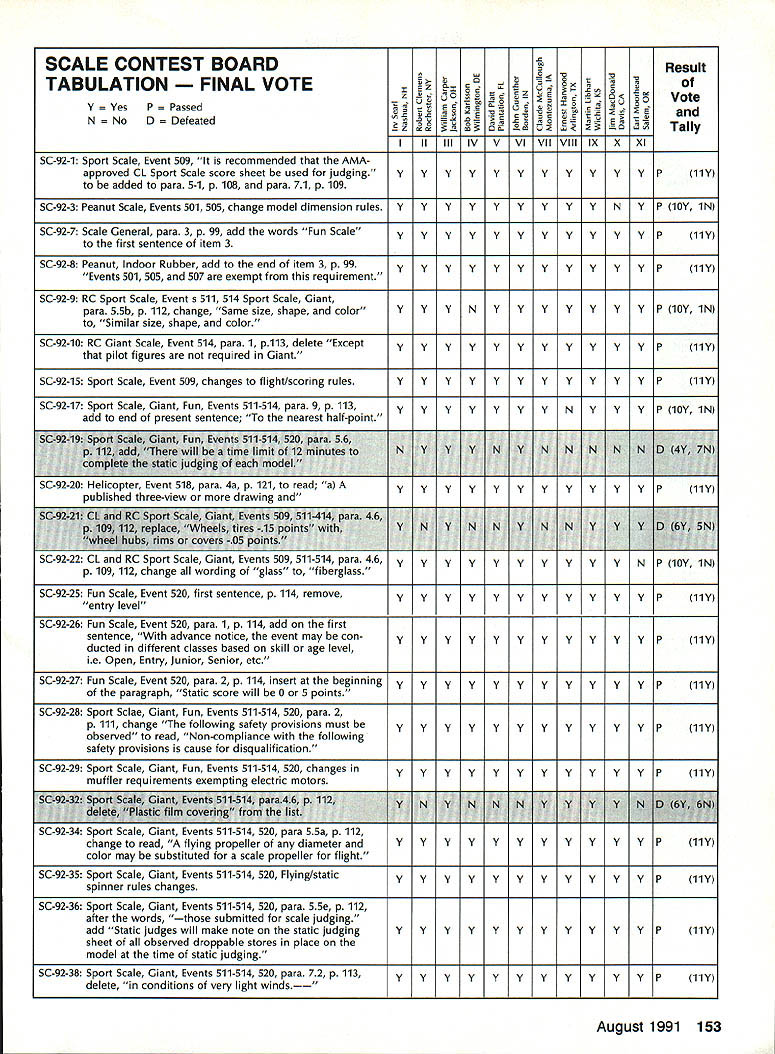
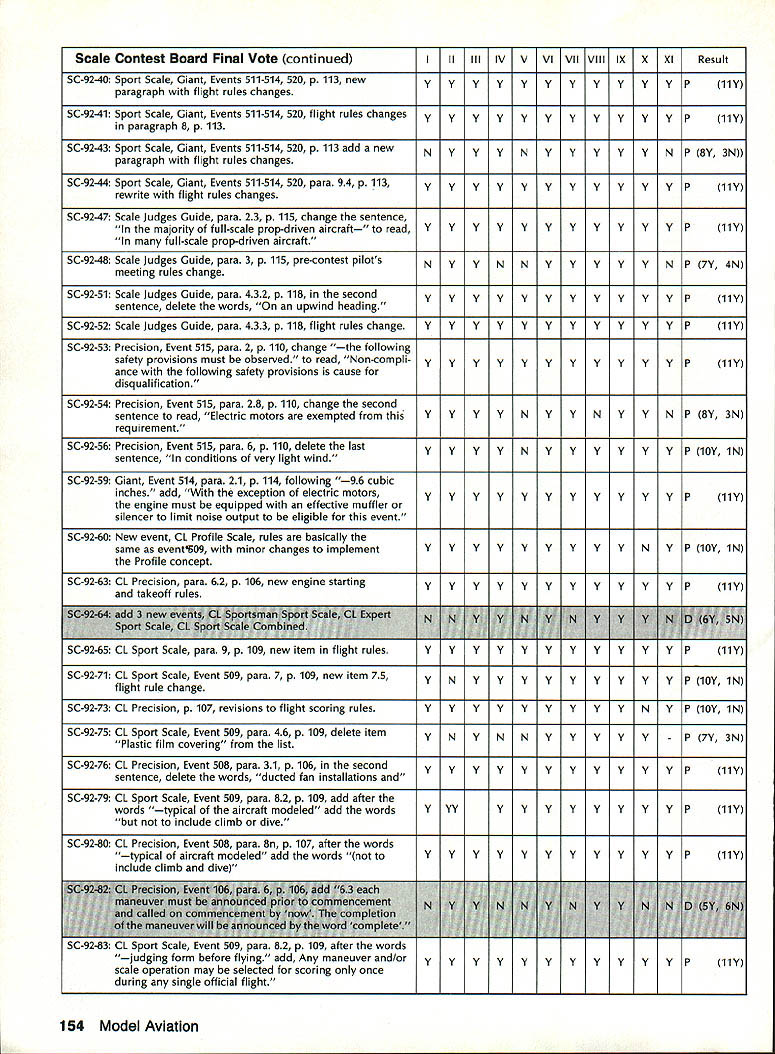
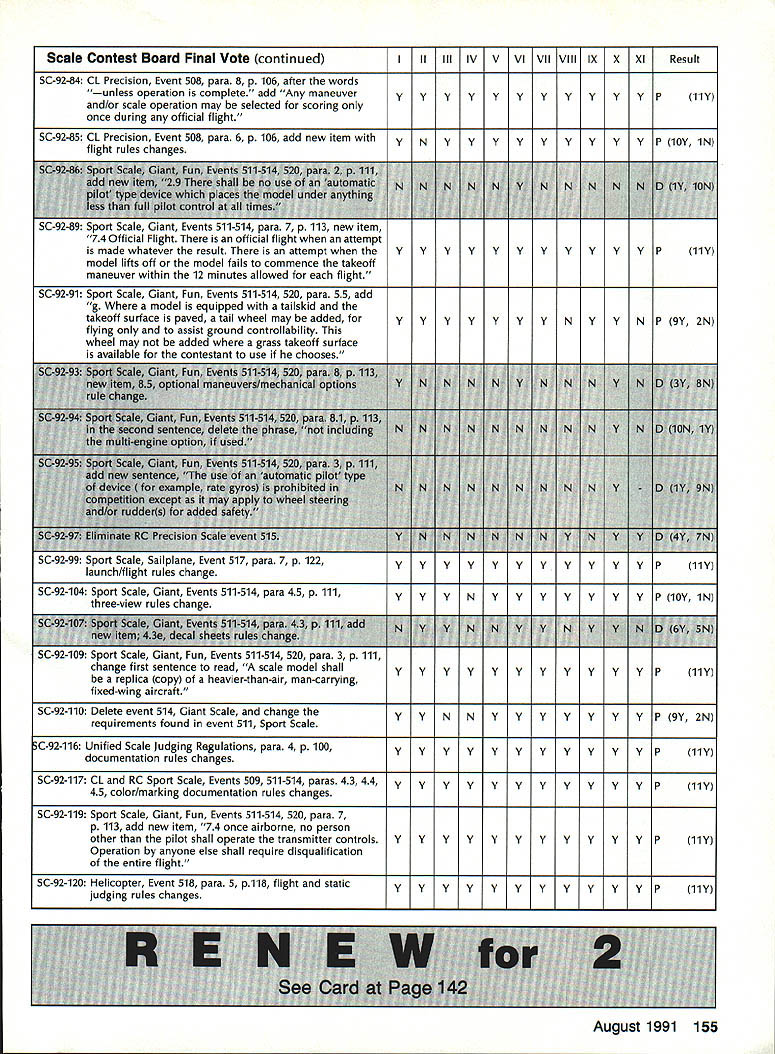
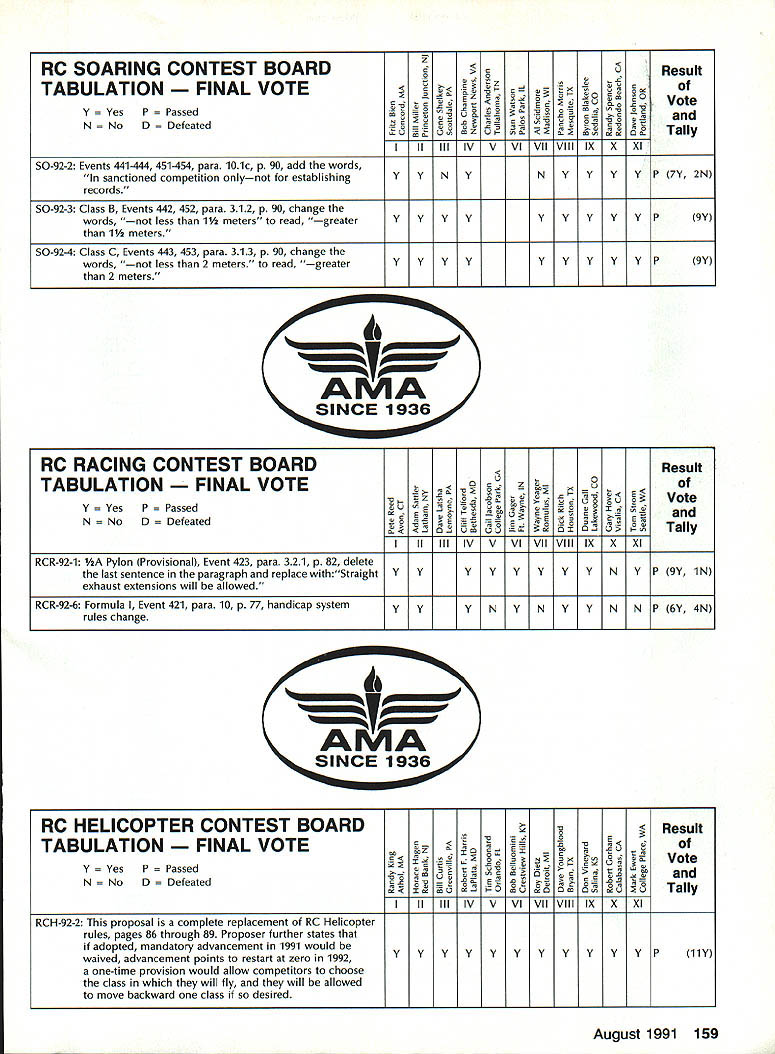
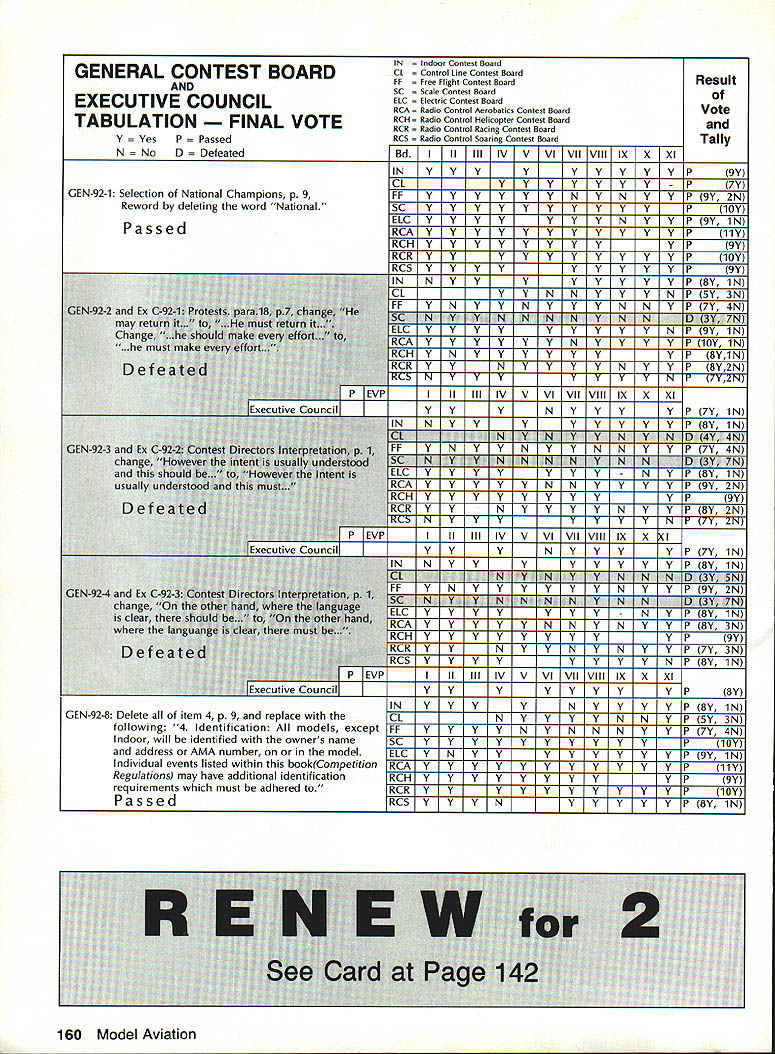
Scale Contest Board — Tabulation — Final Vote
Y = Yes P = Passed N = No D = Defeated
- SC-92-1: Sport Scale, Event 509 — Recommend that the AMA-approved CL Sport Scale score sheet be used for judging. Add to para. 5-1, p.108 and para. 7.1, p.109. (11Y)
- SC-92-3: Peanut Scale, Events 501, 505 — Change model dimension rules. (10Y, 1N)
- SC-92-7: Scale General, para. 3, p.99 — Add the words "Fun Scale" to the first sentence of item 3. (11Y)
- SC-92-8: Peanut, Indoor Rubber — Add to end of item 3, p.99: "Events 501, 505, and 507 are exempt from this requirement." (11Y)
- SC-92-9: RC Sport Scale, Event 511, 514 Sport Scale, Giant — Para. 5.5b, p.112, change "Same size, shape, and color" to "Similar size, shape, and color." (10Y, 1N)
- SC-92-10: RC Giant Scale, Event 514 — Para. 1, p.113, delete "Except that pilot figures are not required in Giant." (11Y)
- SC-92-15: Sport Scale, Event 509 — Changes to flight/scoring rules. (11Y)
- SC-92-17: Sport Scale, Giant, Fun, Events 511–514 — Para. 9, p.113, add "To the nearest half‑point." (10Y, 1N)
- SC-92-19: Sport Scale, Giant, Fun, Events 511–514, 520 — Para. 5.6, p.112, add "There will be a time limit of 12 minutes to complete the static judging of each model." (4Y, 7N)
- SC-92-20: Helicopter, Event 518 — Para. 4a, p.121, to read: "a) A published three‑view or more drawing and" (11Y)
- SC-92-21: CL and RC Sport Scale, Giant, Events 509, 511–514 — Para. 4.6, p.109,112, replace "Wheels, tires -15 points" with "wheel hubs, rims or covers -05 points." (6Y, 5N)
- SC-92-22: CL and RC Sport Scale, Giant, Events 509, 511–514 — Para. 4.6, p.109,112, change all wording of "glass" to "fiberglass." (10Y, 1N)
- SC-92-25: Fun Scale, Event 520 — First sentence, p.114, remove "entry level." (11Y)
- SC-92-26: Fun Scale, Event 520 — Para. 1, p.114, add "With advance notice, the event may be conducted in different classes based on skill or age level, i.e. Open, Entry, Junior, Senior, etc." (11Y)
- SC-92-27: Fun Scale, Event 520 — Para. 2, p.114, insert at beginning: "Static score will be 0 or 5 points." (11Y)
- SC-92-28: Sport Scale, Giant, Fun, Events 511–514, 520 — Para. 2, p.111, change "The following safety provisions must be observed" to "Non‑compliance with the following safety provisions is cause for disqualification." (11Y)
- SC-92-29: Sport Scale, Giant, Fun, Events 511–514, 520 — Changes in muffler requirements exempting electric motors. (11Y)
- SC-92-32: Sport Scale, Giant, Events 511–514 — Para. 4.6, p.112, delete "Plastic film covering" from the list. (6Y, 6N)
- SC-92-34: Sport Scale, Giant, Events 511–514, 520 — Para. 5.5a, p.112, change to: "A flying propeller of any diameter and color may be substituted for a scale propeller for flight." (11Y)
- SC-92-35: Sport Scale, Giant, Events 511–514, 520 — Flying/static spinner rules changes. (11Y)
- SC-92-36: Sport Scale, Giant, Events 511–514, 520 — Para. 5.5e, p.112, add: "Static judges will make note on the static judging sheet of observed droppable stores in place on the model at the time of static judging." (11Y)
- SC-92-38: Sport Scale, Giant, Events 511–514, 520 — Para. 7.2, p.113, delete "in conditions of very light winds." (11Y)
---
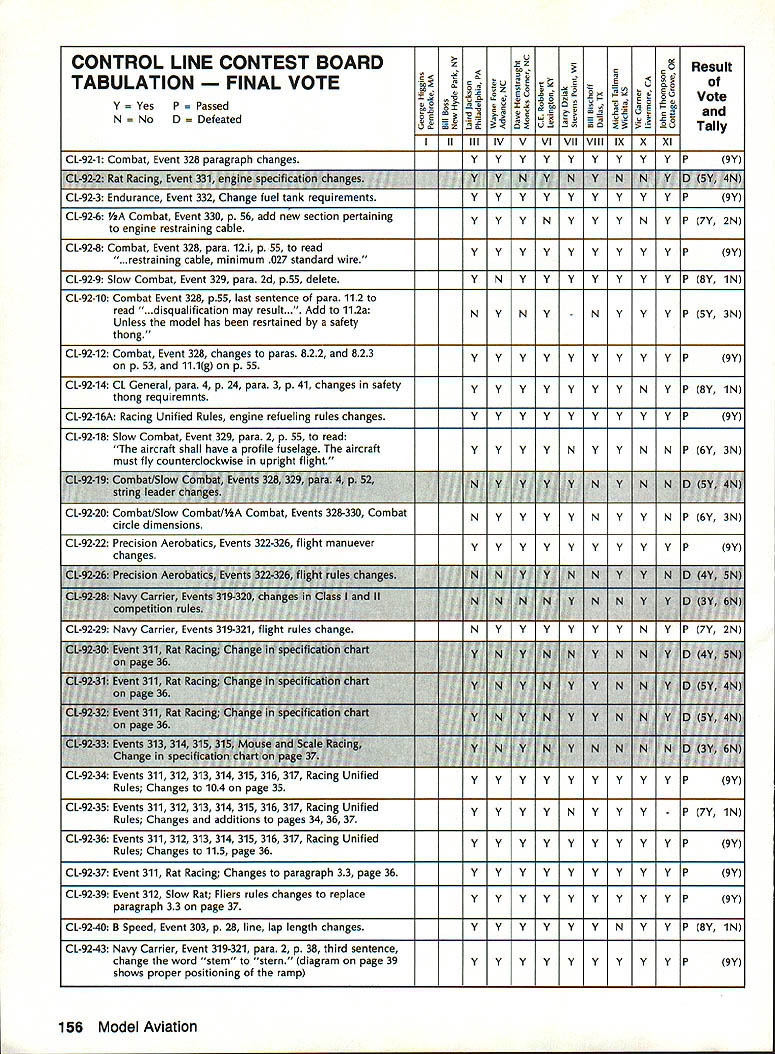
Control Line Contest Board — Tabulation — Final Vote
Y = Yes P = Passed N = No D = Defeated
- CL-92-1: Combat, Event 328 — Paragraph changes. P (9Y)
- CL-92-2: Rat Racing, Event 331 — Engine specification changes. D (5Y, 4N)
- CL-92-3: Endurance, Event 332 — Change fuel tank requirements. P (9Y)
- CL-92-6: ½A Combat, Event 330, p.56 — Add new section pertaining to engine restraining cable. P (7Y, 2N)
- CL-92-8: Combat, Event 328 — Para. 12.i, p.55, to read "...restraining cable, minimum .027 standard wire." P (8Y, 1N)
- CL-92-9: Slow Combat, Event 329 — Para. 2d, p.55, delete. P (8Y, 1N)
- CL-92-10: Combat, Event 328 — p.55, last sentence of para. 11.2 to read "...disqualification may result..." Add to 11.2a: "Unless the model has been restrained by a safety thong." P (5Y, 3N)
- CL-92-12: Combat, Event 328 — Changes to paras. 8.2.2 and 8.2.3 on p.53, and 11.1(g) on p.55. P (9Y)
- CL-92-14: CL General — Para. 4, p.24; para. 3, p.41 — Changes in safety thong requirements. P (8Y, 1N)
- CL-92-16A: Racing Unified Rules — Engine refueling rules changes. P (9Y)
- CL-92-18: Slow Combat, Event 329 — Para. 2, p.55, to read: "The aircraft shall have a profile fuselage. The aircraft must fly counterclockwise in upright flight." P (6Y, 3N)
- CL-92-19: Combat/Slow Combat, Events 328, 329 — Para. 4, p.52 — String leader changes. D (5Y, 4N)
- CL-92-20: Combat/Slow Combat/½A Combat, Events 328–330 — Combat circle dimensions. P (6Y, 3N)
- CL-92-22: Precision Aerobatics, Events 322–326 — Flight maneuver changes. P (9Y)
- CL-92-26: Precision Aerobatics, Events 322–326 — Flight rules changes. D (4Y, 5N)
- CL-92-28: Navy Carrier, Events 319–320 — Changes in Class I and II competition rules. P (6Y, 3N)
- CL-92-29: Navy Carrier, Events 319–321 — Flight rules change. P (7Y, 2N)
- CL-92-30: Event 311, Rat Racing — Change in specification chart on p.36. D (4Y, 5N)
- CL-92-31: Event 311, Rat Racing — Change in specification chart on p.36. D (5Y, 4N)
- CL-92-32: Event 311, Rat Racing — Change in specification chart on p.36. D (5Y, 4N)
- CL-92-33: Events 313–317, Mouse and Scale Racing — Change in specification chart on p.37. D (3Y, 6N)
- CL-92-34: Events 311–317, Racing Unified Rules — Changes to 10.4 on p.35. P (9Y)
- CL-92-35: Events 311–317, Racing Unified Rules — Changes and additions to pages 34, 36, 37. P (7Y, 1N)
- CL-92-36: Events 311–317, Racing Unified Rules — Changes to 11.5, p.36. P (9Y)
- CL-92-37: Event 311, Rat Racing — Changes to para. 3.3, p.36. P (9Y)
- CL-92-39: Event 312, Slow Rat — Fliers rules changes to replace para. 3.3, p.37. P (9Y)
- CL-92-40: B Speed, Event 303 — p.28, line/lap length changes. P (8Y, 1N)
- CL-92-43: Navy Carrier, Event 319–321 — Para. 2, p.38, third sentence, change "stern" to "stem" (diagram on p.39 shows proper ramp positioning). P (9Y)
---
Nitro Panic
A plant of the nation's largest supplier of nitromethane burned down about a month ago. Supplies of nitro to model fuel manufacturers have been severely curtailed. Sig Mfg. reports supply from a second source is secure and does not plan fuel price increases unless nitro costs rise drastically. Some fuel manufacturers are evaluating alternative additives. Most model engines will run on fuel containing no nitro; however, FAI Power events prohibit nitro — peak power output will be reduced, idling speeds may need to be increased, and ease of starting may decrease.
---
(End of reformatted material.)
Transcribed from original scans by AI. Minor OCR errors may remain.

