
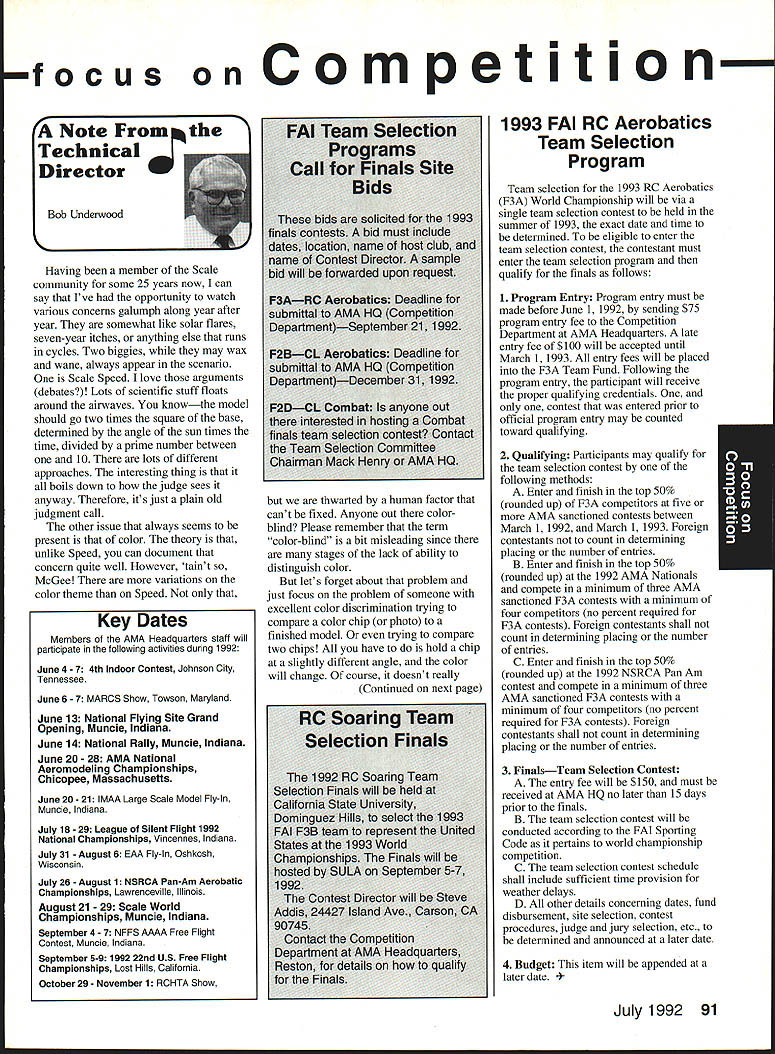
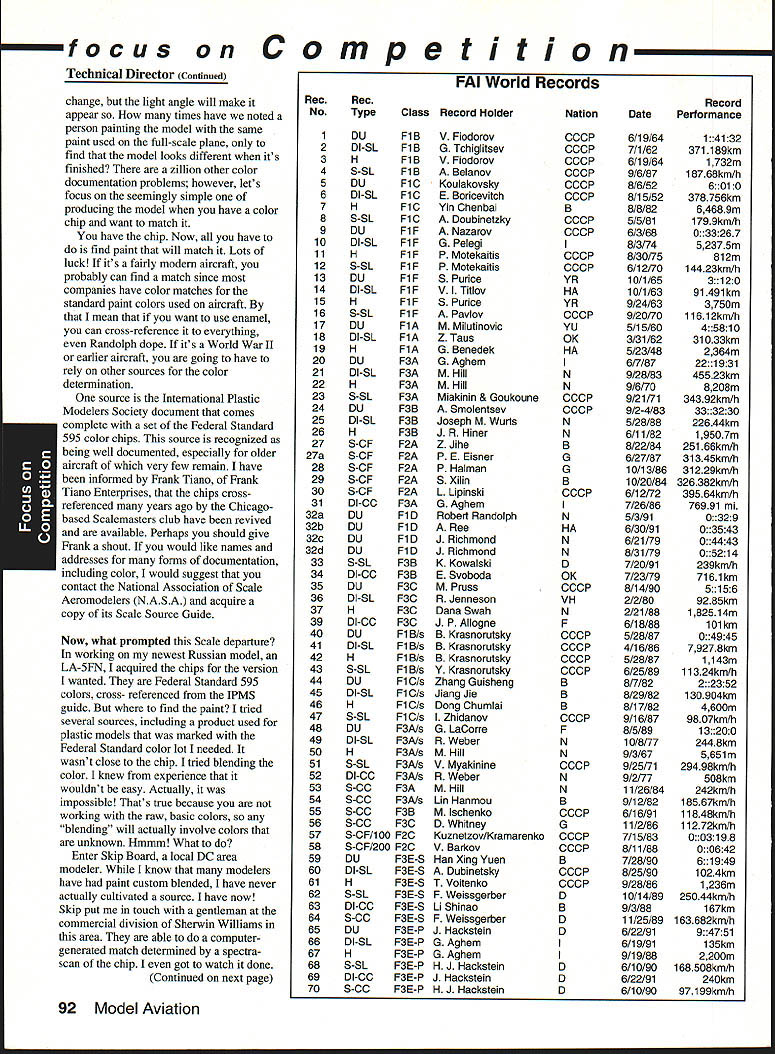
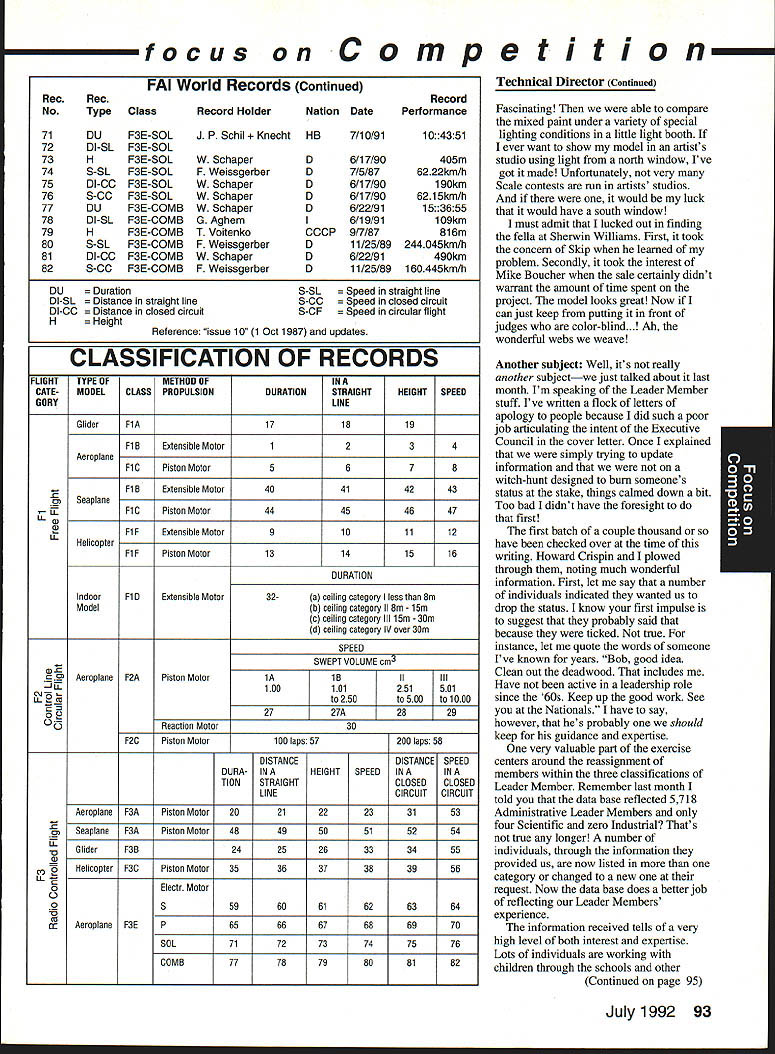
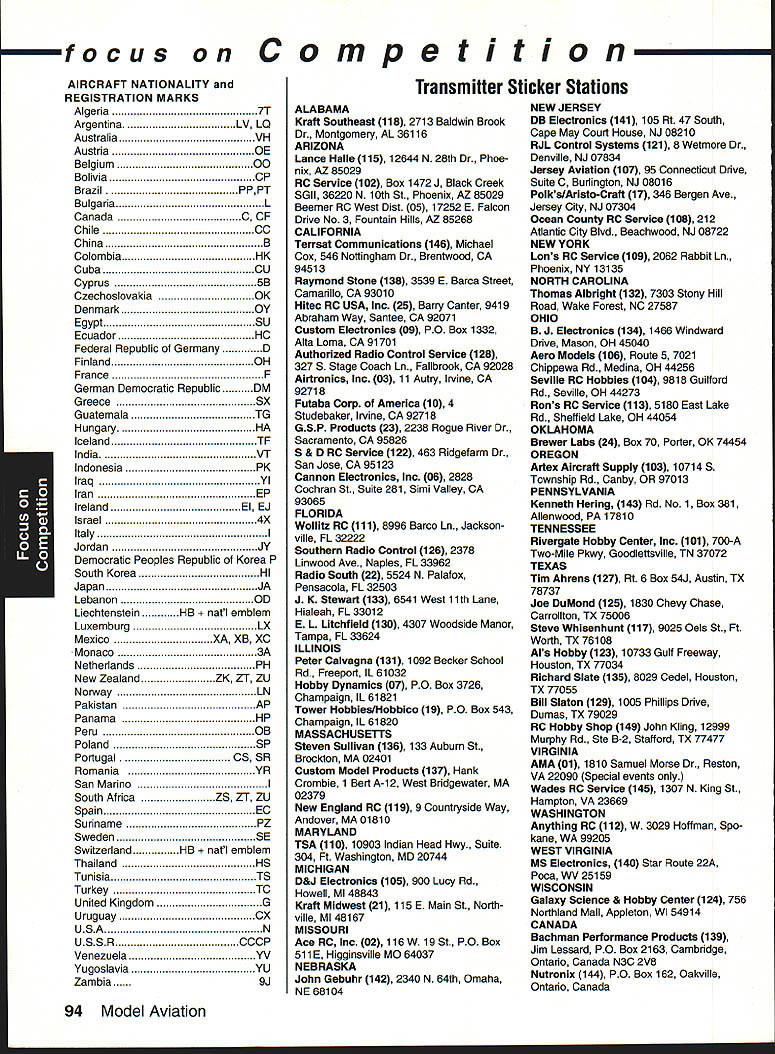
Focus on Competition
A Note From the Technical Director
Bob Underwood
Having been a member of the Scale community for some 25 years now, I can say I've had the opportunity to watch various concerns galumph along year after year. They are somewhat like solar flares, seven‑year itches, or anything else that runs in cycles. Two biggies, while they may wax and wane, always appear in the scenario.
One is scale speed. I love those arguments (debates)! Lots of scientific stuff floats around the airwaves — you know, "the model should go two times the square of the base, determined by the angle of the sun, times the time, divided by a prime number between one and ten." There are lots of different approaches. The interesting thing is that it all boils down to how the judge sees it anyway. Therefore, it's just a plain old judgment call.
The other issue that always seems to be present is color. The theory is that, unlike speed, you can document that concern quite well. However, 'tain't so, McGee! There are more variations on the color theme than on speed. Not only that, but we are thwarted by a human factor that can't be fixed. Anyone out there color‑blind? Please remember the term "color‑blind" is a bit misleading since there are many stages of the lack of ability to distinguish color.
But let's forget about that problem and focus on someone with excellent color discrimination trying to compare a color chip (or photo) to a finished model — or even trying to compare two chips. Hold a chip at a slightly different angle and the color will appear to change. Of course it doesn't really change, but the light angle will make it appear so. How many times have we noted a person painting the model with the same paint used on the full‑scale plane, only to find that the model looks different when it's finished? There are a zillion other color documentation problems; however, let's focus on the seemingly simple one of producing the model when you have a color chip and want to match it.
You have the chip. Now all you have to do is find paint that will match it. Lots of luck! If it's a fairly modern aircraft, you probably can find a match since most companies have color matches for the standard paint colors used on aircraft. By that I mean that if you want to use enamel, you can cross‑reference it to everything, even Randolph dope. If it's a World War II or earlier aircraft, you are going to have to rely on other sources for the color determination.
One source is the International Plastic Modelers Society (IPMS) document that comes complete with a set of Federal Standard 595 color chips. This source is recognized as being well documented, especially for older aircraft of which very few remain. I have been informed by Frank Tiano, of Frank Tiano Enterprises, that the chips cross‑referenced many years ago by the Chicago‑based Scalemaster club have been revived and are available. Perhaps you should give Frank a shout. If you would like names and addresses for many forms of documentation, including color, I would suggest that you contact the National Association of Scale Aeromodelers (N.A.S.A.) and acquire a copy of its Scale Source Guide.
Now, what prompted this Scale departure? In working on my newest Russian model, an LA‑5FN, I acquired the chips for the version I wanted. They are Federal Standard 595 colors, cross‑referenced from the IPMS guide. But where to find the paint? I tried several sources, including a product used for plastic models that was marked with the Federal Standard color I needed. It wasn't close to the chip. I tried blending the color. I knew from experience that it wouldn't be easy. Actually, it was impossible! That's true because you are not working with the raw, basic colors, so any "blending" will actually involve colors that are unknown.
Enter Skip Board, a local D.C. area modeler. While I know that many modelers have had paint custom‑blended, I have never actually cultivated a source. I have now! Skip put me in touch with a gentleman at the commercial division of Sherwin‑Williams in this area. They are able to do a computer‑generated match determined by a spectral scan of the chip. I even got to watch it done.
Technical Director (Continued)
Fascinating! We were able to compare mixed paint under a variety of special lighting conditions in a little light booth. If I ever want to show my model in an artist's studio, using light from a north window, I've got it made! Unfortunately, not very many scale contests are run in artists' studios. And if there were one, it would be my luck that it would have a south window!
I must admit that I lucked out in finding the fellow at Sherwin‑Williams. First, it took the concern of Skip when he learned of my problem. Secondly, it took the interest of Mike Boucher when the sale certainly didn't warrant the amount of time spent on the project. The model looks great! Now if I can just keep from putting it in front of judges who are color‑blind... Ah, the wonderful webs we weave!
Another subject — well, it's not really another subject; we just talked about it last month — is the Leader Member stuff. I've written a flock of apology letters to people because I did such a poor job articulating the intent of the Executive Council in the cover letter. Once I explained that we were simply trying to update information and that we were not on a witch‑hunt designed to burn someone's status at the stake, things calmed down a bit. Too bad I didn't have the foresight to do that first!
The first batch of a couple thousand or so forms had been checked over at the time of this writing. Howard Crispin and I plowed through them, noting much wonderful information. First, let me say that a number of individuals indicated that they wanted us to drop the status. I know your first impulse is to suggest that they probably said that because they were ticked. Not true. For instance, one person I have known for years wrote: "Bob, good idea. Clean out the deadwood. That includes me. Have not been active in a leadership role since the '60s. Keep up the good work. See you at the Nationals." I have to say, however, that he's probably the one we should keep for his guidance and expertise.
One very valuable part of the exercise centers around reassigning members within the three classifications of Leader Member. Remember last month I told you that the database reflected 5,718 Administrative Leader Members and only four Scientific and zero Industrial? That's not true any longer! A number of individuals, through the information they provided us, are now listed in more than one category or have been changed to a new one at their request. Now the database does a better job of reflecting our Leader Members' experience.
The information received tells of a very high level of both interest and expertise. Lots of individuals are working with children through the schools and other programs. We certainly should be using that resource for the Academy. One gentleman, after a huge list of activities, squeezed things at the bottom of the page and finally ended it by saying, "No more room, Darn!" Yet another individual sent along a computer disk with programs set up to help with model design. Chip Smith and I slid that little baby into a computer, punched in the parameters of my LA‑5, and — bingo — out came a bunch of good data.
Some comments were profound: "If it flies, I like it — If you need help, I'll help — If you want to learn, I'll teach — If leadership is needed, I'll lead!" Of course, another said, "I want to be a Leader Member because AMA needs watching, and I want some say when they begin messing around with my hobby." Amen!
The narrative spun by one person was interesting. He became involved with the scientific end of modeling after he discovered that he couldn't find a left‑handed boomerang. He got into airfoils, and one thing led to another.
It was a space engineer who penned the comment, "Sorry about filling in the reference section. Next time I'll read the instructions first!" Let me say that he shouldn't feel bad about that, since at least 25 percent of the returned forms contained the references. And then there were all those individual dollar bills and checks.
Another asked, "Did you leave out city?" By George, he was right! The Leader Member form didn't have a place to write the city. That's two strikes for the Technical Director on this job! Maybe the third strike will pop up. If so, no problem, because one form said, "Would consider working at AMA Headquarters (like Bob Underwood) after retiring." That man I will have to talk to! First, I'll have to find out what he perceives this job to be. Then we'll set him straight!
The last two thoughts are great. One ended his achievements with the comment, "Married with two sons who are now an asset to their community. This is by far my most important achievement." And then there was the guy who stated, "I keep my model expenses in my computer under a hidden code word so that only I know how much I spend and just hope that when I die there will be enough to bury me." I sense that there is a wife in this scenario who will see that he's buried if she ever finds the hidden code.
Enough for now — except to say that I really must wonder about the person who filled in the Date of Birth line with the word "Yes." Let's hope so!
CL Speed
Definitions and Load Formula
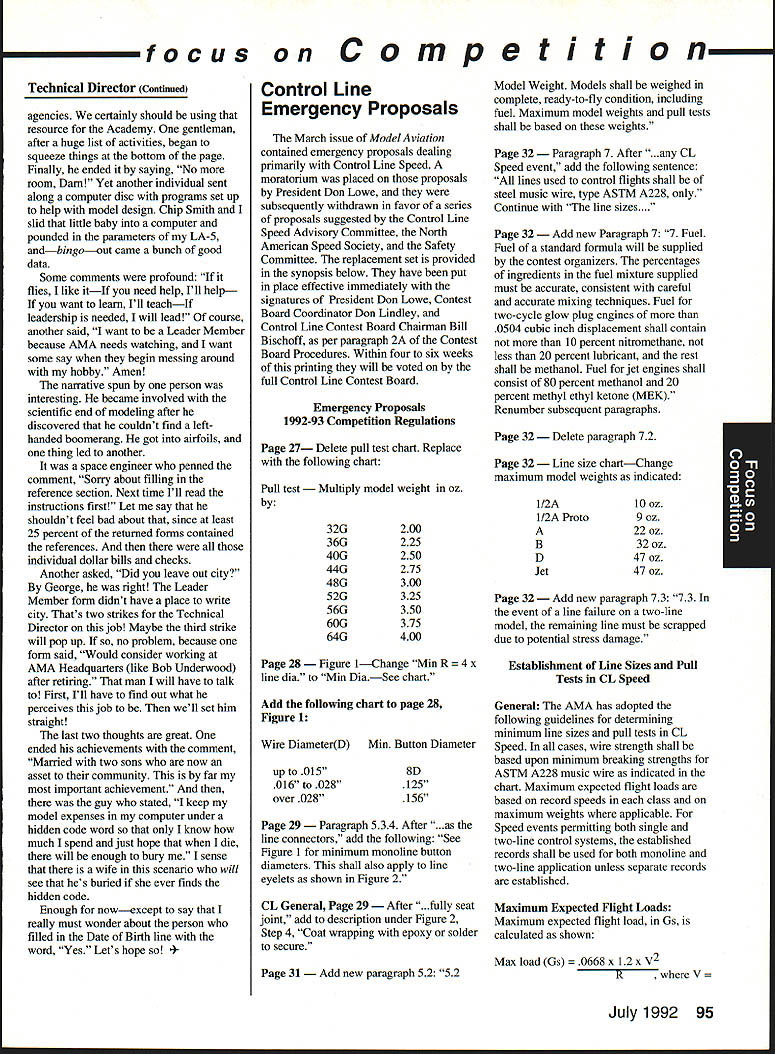
- V = record speed in mph.
- R = line length in feet.
- M = maximum model weight (pounds).
- The maximum expected flight load in pounds is equal to the maximum load in Gs times the maximum model weight in pounds.
- Max load (pounds) = 0.0668 × M × 1.2 × V^2 / R
Line Sizes
- The line sizes for single‑line applications shall be such that the maximum expected flight load in pounds shall not exceed 56 percent of the minimum breaking strength of the wire size being utilized.
- If the maximum expected flight load exceeds 56 percent, the line size shall be increased to the next standard wire size that will satisfy the above criteria.
- For two‑line control systems, the maximum expected flight load in pounds must not exceed 86 percent of the minimum breaking strength of one wire. If this number is exceeded, the line size shall be increased as described above.
Pull Tests
- The pull test, in Gs, shall be at least 1.10 times the maximum expected flight load in Gs.
- If the pull test is less than the prescribed value, the pull test shall be increased to a value where the pull test in Gs is at least 1.15 times the maximum expected flight load in Gs.
Implementation
- It is the responsibility of the Control Line Contest Board Chairman to monitor and maintain the line sizes and pull tests as described above.
- In the event a new record is established which necessitates an increase in line size, pull test, or both, any changes will be published concurrently with the announcement of the new record.
- Changes will become effective immediately upon publication in Model Aviation magazine. Changes are to be administrative only, with no action required by the Control Line Contest Board or the AMA Executive Council.
Administrative Edits (Pages 38–39)
- Page 38 — Delete Paragraph 5; renumber subsequent paragraphs.
- Page 38 — Line size charts — Change maximum model weights as indicated:
- 21 Sport Speed: 26 oz.
- Formula 40: 34 oz.
- Page 39 — Delete Paragraph 5; renumber subsequent paragraphs.
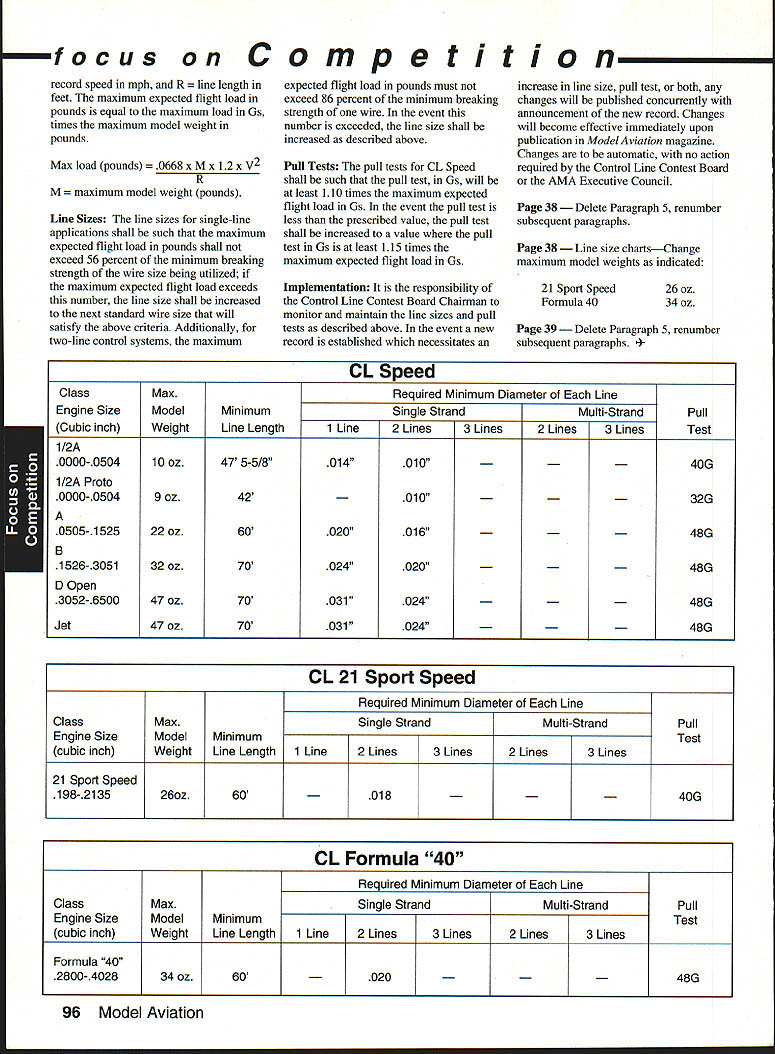
Class Requirements (CL Speed)
- 1/2A (.0000–.0504)
- Max model weight: 10 oz.
- Minimum line length: 47' 5-5/8"
- Required minimum diameter (single strand): 1 line .014", 2 lines .010"
- Pull test: 40G
- 1/2A Proto (.0000–.0504)
- Max model weight: 9 oz.
- Minimum line length: 42'
- Required minimum diameter (single strand): 2 lines .010"
- Pull test: 32G
- A (.0505–.1525)
- Max model weight: 22 oz.
- Minimum line length: 60'
- Required minimum diameter (single strand): 1 line .020", 2 lines .016"
- Pull test: 48G
- B (.1526–.3051)
- Max model weight: 32 oz.
- Minimum line length: 70'
- Required minimum diameter (single strand): 1 line .024", 2 lines .020"
- Pull test: 48G
- D Open (.3052–.6500)
- Max model weight: 47 oz.
- Minimum line length: 70'
- Required minimum diameter (single strand): 1 line .031", 2 lines .024"
- Pull test: 48G
- Jet
- Max model weight: 47 oz.
- Minimum line length: 70'
- Pull test: 48G
CL 21 Sport Speed
- 21 Sport Speed (.198–.2135)
- Max model weight: 26 oz.
- Minimum line length: 60'
- Required minimum diameter (single strand): 2 lines .018"
- Pull test: 40G
CL Formula "40"
- Formula "40" (.2800–.4028)
- Max model weight: 34 oz.
- Minimum line length: 60'
- Required minimum diameter (single strand): 2 lines .020"
- Pull test: 48G
Transcribed from original scans by AI. Minor OCR errors may remain.

