
Focus on Competition
A Note From the Technical Director
Bob Underwood
It's interesting to sit at the Headquarters end of member—AMA communications. The calls and letters galumph along in batches, kinda like bananas, with a common thread of concern for a particular issue. Radio and frequency concerns very often fall into that scenario. Lately it has been relatively quiet on that front, which is a most welcome occurrence indeed — it appears that the system is working. It should not be assumed that everyone is resting, however. The frequency arena is still a most active one.
Through the law firms that represent the Academy before the FCC, we are keeping a very careful watch on refarming (reassignment of frequencies) activities that are occurring. So far nothing has happened that threatens our frequencies directly, but the situation is monitored closely.
The Academy is also watching for any activity concerning Robinson Engineering. You may recall that Robinson has until 1993 to move the equipment that they "accidentally" placed on model frequencies in the 72 and 75 MHz bands.
Another concern developed last year within the rocket community. Because of the way the FCC's Part 95 is written — describing what the model looks like rather than what it does — questions have arisen regarding frequency use by rocket-type models. Some models are boosted aloft by a rocket and then glide back to earth while being radio-controlled; other uses in the rocket community involve radio signals to stage (ignite upper stages of) the model during flight. No clear-cut definition exists as to which band, 72 or 75 MHz, should be used. Logic suggests 72 MHz is proper, but the Academy, through its attorneys, has asked the FCC for a written interpretation after consultation with the two groups representing the rocket community: the National Association of Rocketry (NAR) and Tripoli.
Action is occurring in the six-meter world as well. The American Radio Relay League (ARRL) is polling ham members concerning use of repeaters in the 53 MHz raster of frequencies. Currently we use frequencies in both 50 and 53 MHz. Some in the Amateur community would change the separation in the 53s, which could make operation difficult for us. The Academy has addressed that issue through ARRL, requesting that the band plan remain as is.
A couple of reminders for membership concerning six‑meter operation:
- A Technician Class license is required for operation. Contest directors and club officers should note that allowing individuals to operate models without a valid FCC license violates both the AMA Safety Code and federal law. AMA insurance coverage is predicated upon modelers' adherence to the Safety Code.
- The practice of “sharing” a ham license — having the licensed amateur turn the transmitter on and off and stand by to monitor the operation — is not legal for controlling models. A section of the six‑meter rules allows unlicensed individuals to speak over the airwaves while a licensed operator is present, but this does not apply to our use. In 1980 the FCC issued Report 2143, affirming a staff ruling barring unlicensed persons from using Amateur radio stations to control model aircraft. The decision was based on the fact that our use is not the same as the two‑way communications typically employed by Amateurs in the six‑meter band. Bottom line: to operate models on six meters you must have an FCC license (Technician Class or above).
A final point about six meters: transmitters operating on 53.1 through 53.8 MHz do not have to carry a gold RCMA/AMA sticker for sanctioning contest events. The stickers were introduced to determine which transmitters could be operated at a 20 kHz frequency spacing. The 53 MHz frequencies are spaced at 100 kHz and there is no need for them to be narrow band. We have had reports of transmitters being denied entry into sanctioned events because their six‑meter transmitter did not have a gold sticker. This is unnecessary. Check the Safety Code; item four under Radio Control states “(except 27 MHz and 53 MHz).”
And speaking of stickers — the real reason for this column this month — in 1987 the Academy began checking transmitters at trade shows with a spectrum analyzer to see if they were narrow band and would work at 20 kHz spacing. This led to formation of the Radio Control Manufacturers Association (RCMA), an AMA sticker, and nearly 100 sticker stations around the country.
By recent action, upon recommendation of the Frequency Committee and Frequency Advisory Council, the AMA Executive Council has determined that the sticker requirement will cease at the end of 1994. The rationale is simple: as of March of this year, a petition submitted to the FCC a couple of years ago took effect, and all transmitters manufactured or imported must be narrow band. As of March 1993, no transmitters can be sold that are not narrow band. Thus, by law all new transmitters will have been required to be narrow band for two and one-half years prior to removing the sticker requirement. For practical purposes, all transmitters sold will have been narrow band for six years.
What about the 10-year-old transmitters still out there? We suggest you have them checked and/or updated sometime prior to the end of 1994. This year, where stickering is being done at trade shows, most radio systems appearing for checking were already gold stickered, and the numbers of transmitters being brought for checking are way down. This indicates that as more clubs move to flying all 50 channels and guard against commercial users next door to our frequencies, they are adopting all-narrowband equipment — transmitters and receivers — which helps smooth operations.
A second action will result in dropping the equipment list now printed in Model Aviation. That is slated to occur with the January 1993 issue. For over a year and a half there hasn't been anything sold that wasn't on the list; the list has become a moot point and the Academy's guidelines worked. Federal law governs transmitters, and the marketplace (and liaison between users, AMA, and RCMA) has sorted out receiver issues.
To help clubs and individuals after dropping stickers and the list, the Academy has over $50,000 worth of equipment in the field, most available to chartered clubs on loan. This includes receivers (scanners) to check for interference and a channel analyzer that can identify, in a general fashion, transmitter bandwidth. In the future we will present simple tests to determine whether receivers have problems with second-order intermodulation. While this concern has diminished to virtually zero, it can still be a factor when older equipment is used.
In closing: when do all our radio problems end? Probably never — not words of a pessimist, simply reality. We operate models in an RF environment that is increasingly polluted. Many groups within our 72 and 75 MHz world wonder whether they can use pieces or all of it. For now, what we have is working, and as of March 1998 those old, wide-band transmitters will be illegal by federal law.
Until next month!
---
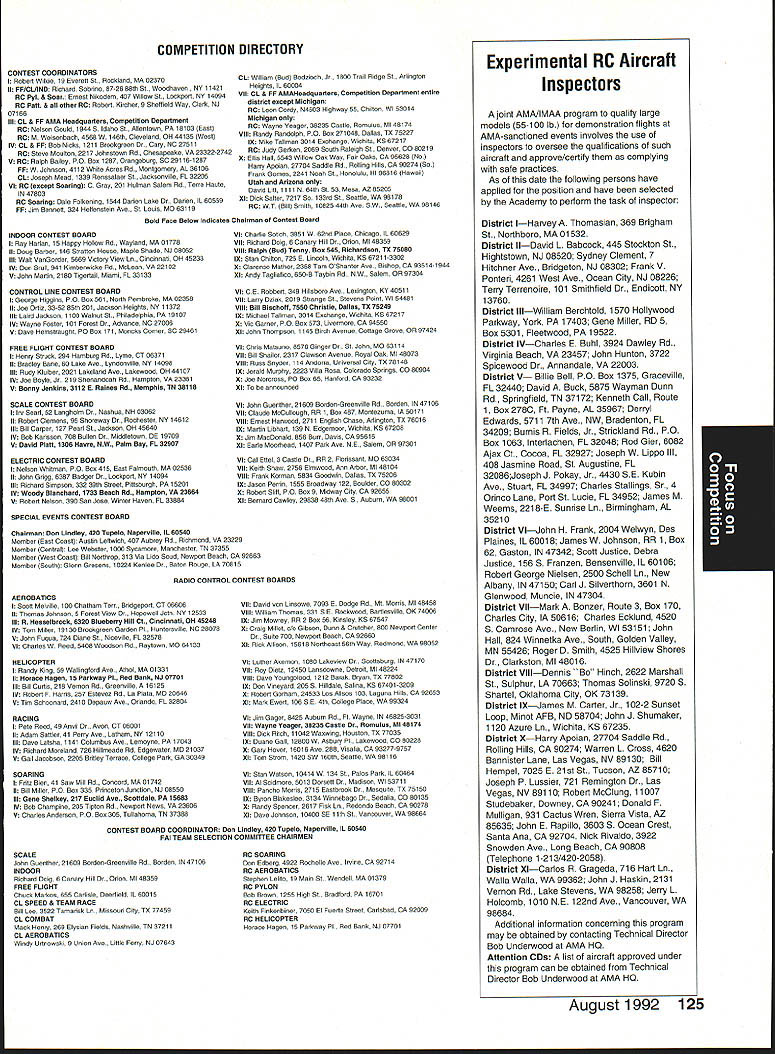
Experimental RC Aircraft Inspectors
A joint AMA/MAA program to qualify large models (55–100 lb.) for demonstration flights at AMA‑sanctioned events involves inspectors who oversee qualifications and approve/certify compliance with safe practices. The following persons have applied for and been selected by the Academy to serve as inspectors:
- District I
- Harvey A. Thomason, 369 Brigham St., Northboro, MA 01532
- District II
- David L. Babcock, 446 Stockton St., Hightstown, NJ 08520
- Sydney Clement, 7 Hitcher Ave., Bridgeton, NJ 08302
- Frank V. Potter, 4214 West A Ave., Ocean City, NJ 08226
- Terry Terrenolle, 107 Smithfield Dr., Endicott, NY 13760
- District III
- William Berchtold, 1570 Hollywood Parkway, York, PA 17403
- Gene Miller, RD 5, Box 5301, Fleetwood, PA 19522
- District IV
- Charles E. Bush, 3924 Dawley Rd., Virginia Beach, VA 23457
- John Huntoon, 3722 Spicewood Dr., Annandale, VA 22003
- District V
- Bill Beck, P.O. Box 1375, Graceville, FL 32440
- David A. Buck, 5875 Wayman Dunn Rd., Springfield, TN 37172
- Kenneth Call, Route 1, Box 278C, Ft. Payne, AL 35967
- Derryl Edwards, 5711 7th Ave., NW, Bradenton, FL 34203
- Burns R. Fields, Jr., Strickland, R.D., P.O. Box 1063, Interlachen, FL 32046
- Rod G. Boaz, Ajax Ctr., Cocoa, FL 32927
- Joseph W. Lippe III, 300 Jasmine Road, St. Augustine, FL 32086
- Joseph M. Poyak, Jr., 4430 S.E. Kubin Ave., Stuart, FL 34997
- Charles Stallings, Sr., 4 Orlone Lane, Port St. Lucie, FL 34952
- James M. Weems, 2218 E. Sunnyside Ln., Birmingham, AL 35210
- District VI
- John H. Frank, 2004 Welwyn Dr., Destin, FL 36018
- James W. Johnson, RR 1, Box 62, Gaston, IN 47342
- Scott Justice & Debra Justice, 156 S. Stratten, Bensenville, IL 60106
- Robert Georgeson, 2500 Schell Ln., New Albany, IN 47450
- Carl J. Silverthorn, 3601 N. Glenwood, Mil. 217, 2170 1st St., Butte, MT 59701
- District VII
- Mark A. Bonner, Route 3, Box 170, Charles City, IA 50616
- Charles Ecklund, 4520 S. Cross Ave., New Berlin, WI 53151
- John M. Hall, 8249 Winnetka Ave. S., Golden Valley, MN 55426
- Roger D. Smith, 4525 Hillview Shores Dr., Clarkston, MI 48010
- District VIII
- Dennis "Bo" Hinton, 2622 Marshall St., Sulphur, LA 70672
- Thomas Sonlink, 9720 S. Sharter, Oklahoma City, OK 73139
- District IX
- James M. Carver, Jr., 102-2 Sunset Loop, Muncie, ARB, ND 85704
- John N. Shumaker, 1120 Azure Ln., Wichita, KS 67235
- District X
- Harry Apodani, 27704 Saddle Rd., Rolling Hills, CA 90274
- Warren L. Cross, 4620 Bannister Lane, Las Vegas, NV 89130
- Bill Hempel, 7025 E. 21st St., Tucson, AZ 85710
- Joseph P. Lussier, 721 Remington Dr., Las Vegas, NV 89110
- Robert McClung, 11007 Studebaker, Downey, CA 90241
- Donald F. Mulligan, 331 Cactus Vern, Sierra Vista, AZ 85635
- Janet R. Kaplan, 3603 S. Ocean Crest, Santa Ana, CA 92704
- Nick Rivadva, 3922 Snowden Ave., Long Beach, CA 90808 (tel. 213/420-2058)
- District XI
- Carlos R. Grajeda, 716 Hart Ln., Walla Walla, WA 99362
- John F. Haskins, 2113 Vernon Rd., Lake Stevens, WA 98258
- Jerry L. Holcomb, 1010 N.E. 122nd Ave., Vancouver, WA 98684
Additional information about this program may be obtained by contacting Technical Director Bob Underwood at AMA HQ. Attention Contest Directors: a list of aircraft approved under this program is available from AMA HQ.
---
F3J and RC Soaring Rules
- Rule 15.6.2.5, subparagraph c) is changed:
- Delete: "This altitude is checked by an altimeter with retransmission to the ground, and set into the glider."
- Substitute: "This altitude shall be determined by an automatic altimeter carried in the tow plane."
Be aware that F3J rules will remain in the Supplement to the FAI Sporting Code documents, since official status approval procedures are not yet complete.
F3J was approved as an official class; however, a World Championships cannot be held immediately. A minimum of two years from the time of official status is required before a World Championships may be held, and within that time at least two international contests must be held with a minimum of five FAI-member nations participating. This means 1994 would be the earliest possible date for an F3J World Championship.
Several other F3J rule refinements were approved:
- New definitions of landing spots include a required spot for each competitor, allowing the pilot and helper inside the circle, and deletion of the 75 m circle. The zero-flight score for landing outside 75 m from the spot was not changed, so measurement of the 75 m may still be necessary in some cases.
- Rule 5.6.2.2:
- "The flying site shall include a number of landing spots at least 15 m apart. The spots shall be arranged crosswind, and there shall be one landing spot for each competitor in a group. A line known as the launch-line will be marked 10 m upwind of and parallel to the landing spots."
- Rule 5.6.8.2:
- "Officials (timekeepers) must remain upwind of the launch-line during the landing process, except as in 5.6.8.3. If each pilot has been allocated a separate landing spot, the pilot and one assistant are allowed inside the 15 m radius circle."
- Attempts within a slot: a proposal to allow an unlimited number of attempts met with opposition; compromise retained two attempts but deleted the 60-second time limit on the first attempt. Rule 5.6.3.1 is changed:
- "d) The official flight for a round is the last flight performed during the working time."
- Reflights: A new section added to rule 5.6.4 defines reflight rules. The competitor is entitled to a new working time in an incomplete group, or with the original group at the end of the task, if:
- a) his model in flight collides with another model in flight, or with a model in the process of being launched;
- b) the flight has not been judged by the official timekeepers;
- c) his flight has been hindered or aborted by an unexpected event not within his control.
Under circumstances a) and c), the competitor may claim authorization to use his second model if his first model has been damaged beyond repair during the attempt where he obtained the new working time.
"In the case of additional attempts during a round for reflights, the better of the two results will be the official score, except for pilots allocated the new attempt. For those, the result of the repetition flight is the official score."
There are minor ambiguities in these new F3J rules. It is hoped they can be corrected before printing the new Sporting Code.
In summary, FAI RC Soaring now has two official events with another on the verge. Two other provisional classes, F3F and F3H, have not made much recent progress. There is general resistance within CIAM against proliferation of new classes; the future will likely see survival of only popular classes.
---
FREE FLIGHT AT THE 1992 CIAM MEETING
G. Xenakis, Subcommittee Member
One anticipated aspect of the 1992 CIAM meeting was how the segmentation of some previous member countries would be handled. Actually, nothing happened: none of the CIS (Soviet) countries attended. Slovenia and Lithuania sent representatives but were not officially seated. New member countries must first apply to the parent FAI organization for membership before they can have delegates on FAI committees.
The agenda was not sent out until just before travel, so there was no time to gather input. The agenda items of interest to Free Flighters and the results of the votes at the meeting are presented below.
A revised Sporting Code, effective January 1, 1993, will be published later this year. All items below will be included and effective then. In addition, items approved at CIAM plenary meetings after the current version was printed will be included in the 1993 version. A notable one is that the 20-second attempt rule will be in effect again starting in 1993.
GENERAL ITEMS
- Local Rules for Contests: Any local rules for international or world championship contests must be published in the last bulletin from the organizer before the contest. No local rule may conflict with any item in the Sporting Code.
- Contests Calendar: To get a contest listed on the CIAM Contest Calendar, the organizer must submit a fee equal to one contestant entry fee or 40 Swiss francs (about $30), whichever is larger. Contests exclusively for Juniors are exempt.
- World Class Records: The individual claiming a world record must have built the model used for establishing the record himself. This is not a new rule; it arose when a contestant in a class without a BOM requirement attempted to change that.
- Engine Displacement: The calculation of displacement volume shall be corrected to two decimal places. Subcommittees are to recommend criteria and measurement methods. The Free Flight Technical Meeting recommended truncating the calculation at two decimal places (i.e., ignore any places beyond the first two).
FREE FLIGHT ITEMS
- Para. 2.4.4 — Jury members in international events (other than World or Continental Championships) must include at least one CIAM delegate or a person approved by that person's National Aero Club. The other two members can be delegated by the organizer's National Aero Club. Jury members must be from at least two different nations.
- Para. 2.4.4 and 2.4.7 — A contestant may serve as a jury member only on days when he is not competing. However, he does not get his expenses paid as he would if he were exclusively a jury member.
- Para. 3.1.8(b), 3.2.8(b), 3.3.8(b) — Free Flight flyoffs will start with a five-minute maximum and then increase in two-minute increments. In exceptional meteorological conditions or model recovery problems, the jury may permit a change in the maximum.
- Para. 3.3.2 — Replace sentence "No extensions, etc." with:
- "If there is an extension fitted to the exhaust opening(s) of the motor, then the maximum noise level permitted is 96 dBA at 3 meters. The noise level is to be measured over smooth ground with the motor running at full power, the model held by the competitor with fuselage and wings horizontal. The noise level is subject to checking only under General Rules 2.7.3 and 2.13.4."
Note: This change was submitted by the Free Flight subcommittee; the Technical Meeting vote was 4 in favor, 6 against, but the Plenary Meeting accepted it 12 in favor, 5 against. The U.S.A. voted against it both times. Italians presented silencer tests showing engine rpm increased from 27K to about 30K with the silencer.
- Para. 3.3.12 — The noise level at the perimeter of a field where F1C is being flown shall be no more than 6 dBA above ambient noise level at all parts of the field boundary where there is a noise sensitivity. If the noise level exceeds this limit, the launch line shall be moved away from the field boundary to a point where the level complies.
- Free Flight World Cup: In the event of a tie for any placing, competitors with that placing all receive the number of points appropriate to that placing.
- Free Flight World Cup Protests: A jury of three people, nominated by the CIAM Free Flight subcommittee, will rule on World Cup protests during the year. Any protest must be submitted to the Free Flight subcommittee chairman with a fee of 80 Swiss francs. If the protest is upheld, half the fee will be returned; the remainder will help cover administrative costs.
- Class F1J Provisional Rules: A proposal to change minimum total weight to 300 grams per cubic centimeter was rejected. The U.S. withdrew it.
- Indoor Scale Models: The Plenary Meeting voted to adopt British Peanut Scale rules rather than the Czech Peanut/Pistachio proposed rules for a provisional event.
---
CIAM SCALE COMMITTEE
Bob Wischer, Subcommittee Member
Previously, an official World Championship required five nations represented in each category (F4B Control Line and F4C Radio Control). Italy proposed modifying the number of entering nations: "If the entry is less than 10 different nations in two consecutive championships, the World Championship of that category must be canceled." The subcommittee rejected the proposal, though there is strong feeling that Control Line Scale participation has diminished, particularly in the U.K.
Two U.S. proposals would change the definition of Scale models by adding the word "actual" to describe the prototype full-scale aircraft, obligating contestants to prove that the prototype really performed chosen maneuvers. The subcommittee found this unreasonable and unanimously rejected the proposals.
Italy proposed returning to the previous system where all static judging was completed before flights begin. The proposal was rejected. Effective 1992 (or immediately), when there are more than 30 entries in a class, flights and static judging will start concurrently on the first competition day.
In static judging, color drawings from authentic sources (e.g., "Profile"-type publications, including three-views) are acceptable for proof of color and markings. A proposal to delete the words "and markings" was accepted effective 1993 — proof of markings should be taken from photographs of the actual subject aircraft as required; color drawings are artists' impressions and can differ from photos.
Noise limits: CIAM had previously adopted 96 dBA for scale models and 100 dBA for ducted-fan models. A French proposal specified measurement procedures:
- Maximum noise level: 96 dBA measured at 3 m from the model centerline with the model on the ground over concrete or macadam, motor(s) at full power. Measurement taken 90° to the flight path on the side chosen by the competitor and downwind from the model. Microphone on a stand 30 cm from the ground in line with the motor(s). No noise-reflecting objects nearer than 3 m to model or microphone.
- If concrete or macadam isn't available, measurement may be over bare earth or very short grass; maximum noise level then 94 dBA.
If a model fails the noise test, no indication shall be given to the pilot/team/judges, and both transmitter and model shall be impounded immediately following the flight. No modification or adjustment shall be permitted (other than refueling). The model shall be retested by a second noise steward with a second meter; if it fails retest, the score for the preceding flight is zero. Flight time will be interrupted for the noise check; the competitor shall not be delayed more than 30 seconds. Sound meters must be good quality and a test set system (reference noise) shall be available. Effective 1993. Note: this rule establishes a penalty.
Complexity bonuses for RC Scale models were reduced in a proposal from England. Maximum accumulation of bonuses changed from 20% to 15%.
WINGS
- Braced and/or strutted biplanes (no camber) — 3%
- Biplanes with scale undercambered wing section (prototypes with modern laminar flow undercambered wing sections not eligible) — 5%
- Three or more wings — 6%
- Monoplanes with scale undercambered wing section — 3%
ENGINES
- Two or more engines with a Thrustline/Wingspan factor of at least 0.15 — 6%
- Other multi-engined subjects — 3%
Note: Thrustline/Wingspan factor = distance between thrustlines of outermost engines divided by wingspan.
(Continued content and tables appear in the full Sporting Code.)
---
Scale Aerobatics
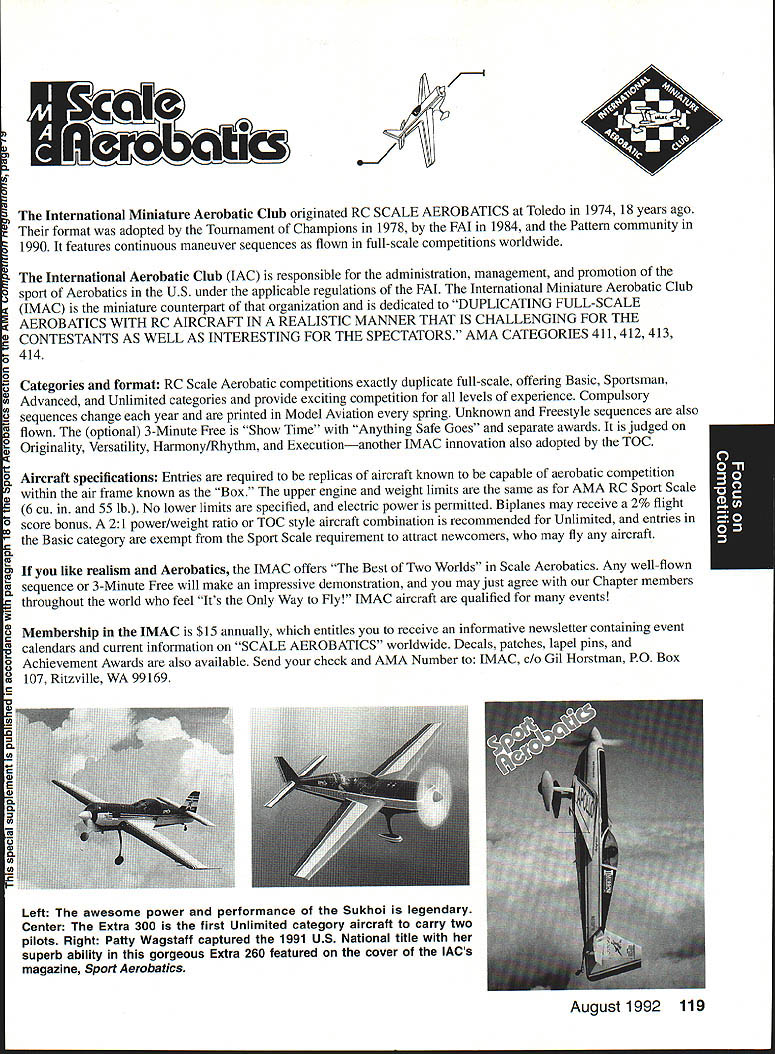
The International Miniature Aerobatic Club (IMAC) originated RC Scale Aerobatics at Toledo in 1974. The format was adopted by the Tournament of Champions in 1978, by the FAI in 1984, and by the Pattern community in 1990. It features continuous maneuver sequences as flown in full-scale competitions worldwide.
The International Aerobatic Club (IAC) administers full-scale aerobatics in the U.S.; IMAC is the miniature counterpart, dedicated to duplicating full-scale aerobatics with RC aircraft in a realistic and challenging manner. AMA categories: 411, 412, 413, 414.
Categories and format:
- Offers Basic, Sportsman, Advanced, and Unlimited categories.
- Compulsory sequences change each year and are printed in Model Aviation every spring.
- Unknown and Freestyle sequences are also flown.
- Optional 3-Minute Free ("Show Time"): anything safe goes; judged on Originality, Versatility, Harmony/Rhythm, and Execution.
Aircraft specifications:
- Entries are required to be replicas of aircraft known to be capable of aerobatic competition within the airframe known as the "Box."
- Upper engine and weight limits same as AMA RC Sport Scale (6 cu. in. and 55 lb.). No lower limits specified. Electric power permitted.
- Biplanes may receive a 2% flight score bonus.
- Recommended 2:1 power/weight ratio for Unlimited.
- Basic category entries are exempt from Sport Scale requirement to attract newcomers.
Membership in IMAC is $15 annually. Send a check and AMA number to: IMAC, c/o Gil Horstman, P.O. Box 107, Ritzville, WA 99169.
---
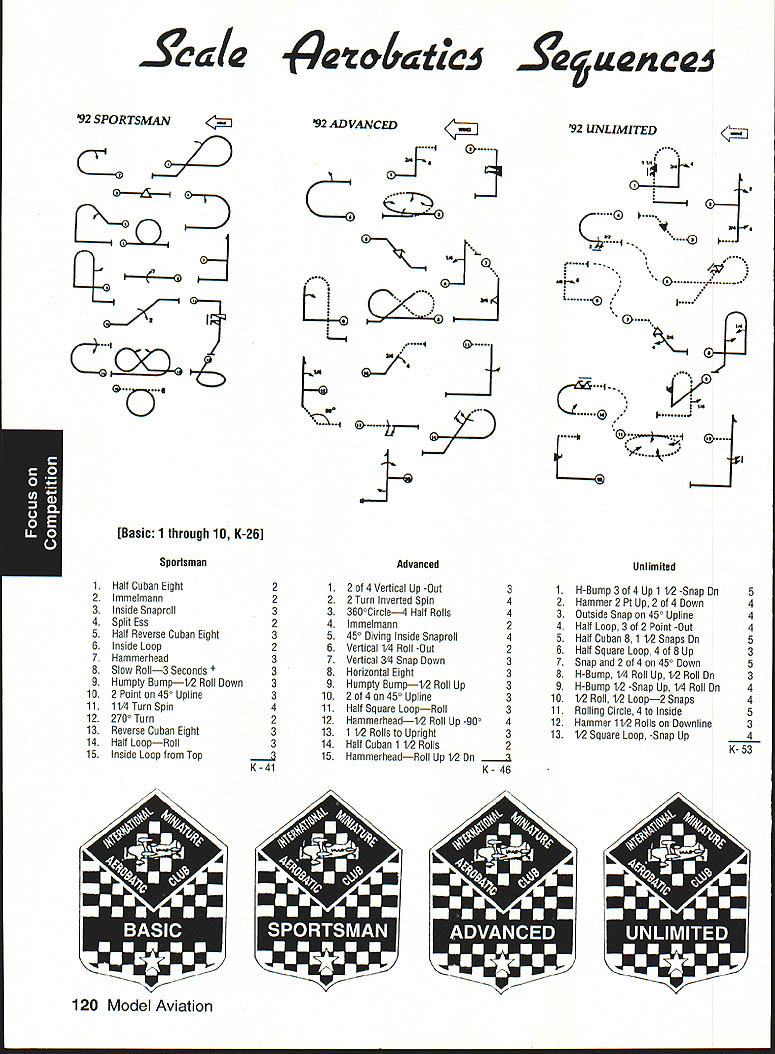
Scale Aerobatics Sequences
Sportsman
- Half Cuban Eight (2)
- Immelmann (2)
- Inside Snaproll (3)
- Split S (2)
- Half Reverse Cuban Eight (3)
- Inside Loop (2)
- Hammerhead (3)
- Slow Roll — 3 seconds (3)
- Humpty Bump — 1/2 Roll Down (3)
- 2 Point on 45° Upline (4)
- 1/4 Turn Spin (4)
- 270° Turn (2)
- Reverse Cuban Eight (3)
- Half Loop — Roll (2)
- Inside Loop from Top (3)
(K-41)
Advanced
- 2 of 4 Vertical Up-Out (3)
- 2 Turn Inverted Spin (2)
- 360° Circle — 4 Half Rolls (4)
- Immelmann (2)
- 45° Diving Inside Snaproll (2)
- Vertical 1/4 Roll-Out (2)
- Vertical 3/4 Snap Down (3)
- Horizontal Eight (3)
- Humpty Bump — 1/2 Roll Up (3)
- 2 of 4 on 45° Upline (3)
- Half Square Loop — Roll (4)
- Hammerhead — 1/2 Roll Up, -90° (3)
- 1 1/2 Rolls to Upright (3)
- Half Cuban, 1 1/2 Rolls (2)
- Hammerhead — Roll Up 1/2 Down (3)
(K-46)
Unlimited
- H‑Bump, 3 of 4 Up, 1 1/2 — Snap Down (4)
- Hammer, 2 Pt Up, 2 of 4 Down (2)
- Outside Snap on 45° Upline (5)
- Half Loop, 3 of 2 Point — Out (4)
- Half Cuban, 3 of 2 Points Out (4)
- Half Square Loop, 4 of 8 Up (5)
- Snap and 2 of 4 on 45° Down (5)
- H‑Bump, 1/4 Roll Up, 1/2 Roll Down (5)
- H‑Bump, 1/2 Snap Up, 1/4 Roll Down (5)
- 1/2 Roll, 1/2 Loop — 2 Snaps (5)
- Rolling Circle, 4 to Inside (5)
- Hammer 1/2 Rolls on Downline (5)
- 1/2 Square Loop, Snap Up (5)
(K-53)
---
CIAM Scale Subcommittee — Bonuses and Notes
LANDING GEAR
- Taildragger with tailskid — 3%
- Taildragger with tailwheel — 2%
- Tricycle — 0%
GENERAL
- Flown before the end of 1911 — 6%
- Model with wing-warping control (same as prototype) — 3%
NOTES
- To qualify for multiple-engine bonuses, the power ratio of engines must match the prototype and all engines must operate and be running at takeoff until airborne.
- Judges decide appropriate percent bonuses during static scoring.
- Complexity bonus percentages can only be awarded if the contestant reproduced the listed items on the model.
- A model may not claim more than one bonus under each heading.
- Effective 1993.
REASONS
- Original bonuses (5% increments) were justified when models were smaller and powered by high-revving two-stroke motors. Now models are larger and often powered by four-strokes; handling of "difficult types" is improved. Hence bonuses were reduced to maintain balance.
- A two-tier engine complexity bonus differentiates between conventional multi-engined subjects and those not likely to suffer badly if one engine stops.
- Retracting tricycle gear is not awarded a flight bonus; retracting gear is an optional feature (6.3.7b) and not the same as fixed gear.
- Differentiate between taildraggers with tailwheels and tailskids due to hard-surface runway issues.
- To qualify for the undercambered bonus, the wing section must be of Scale thickness; thickened sections to improve flight qualities are not intended to qualify.
- The emergence of model turbojet engines prompted discussion to delete motive power restrictions against jets; the proposal was withdrawn pending further clarification and thrust limits. Turbojets (not pulse jets) are likely in the future due to their low noise (72 dBA).
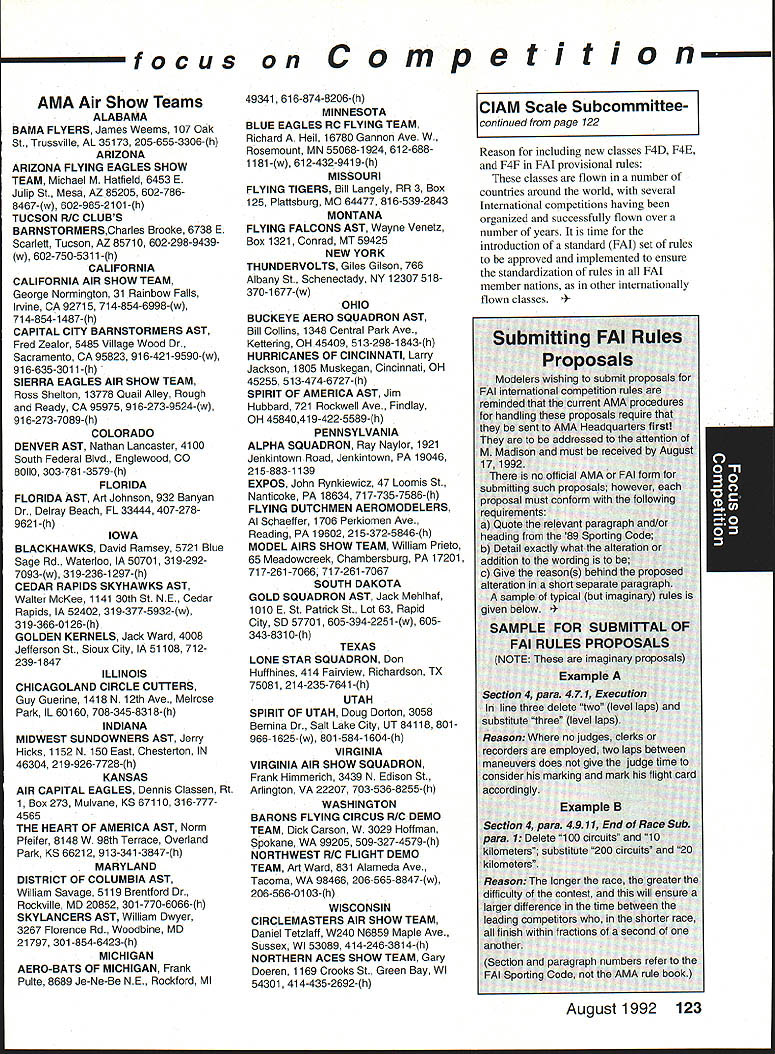
Provisional rules were proposed by the U.K. for new classes: Indoor Free Flight Scale (F4D rubber-powered), F4E electric or CO2, and F4F Peanut. The U.K. proposal was unanimously accepted. A Czechoslovakian proposal including only Peanut and Pistachio was rejected. The rationale: these classes are flown in many countries and have successful international competitions; FAI standardization is timely.
---
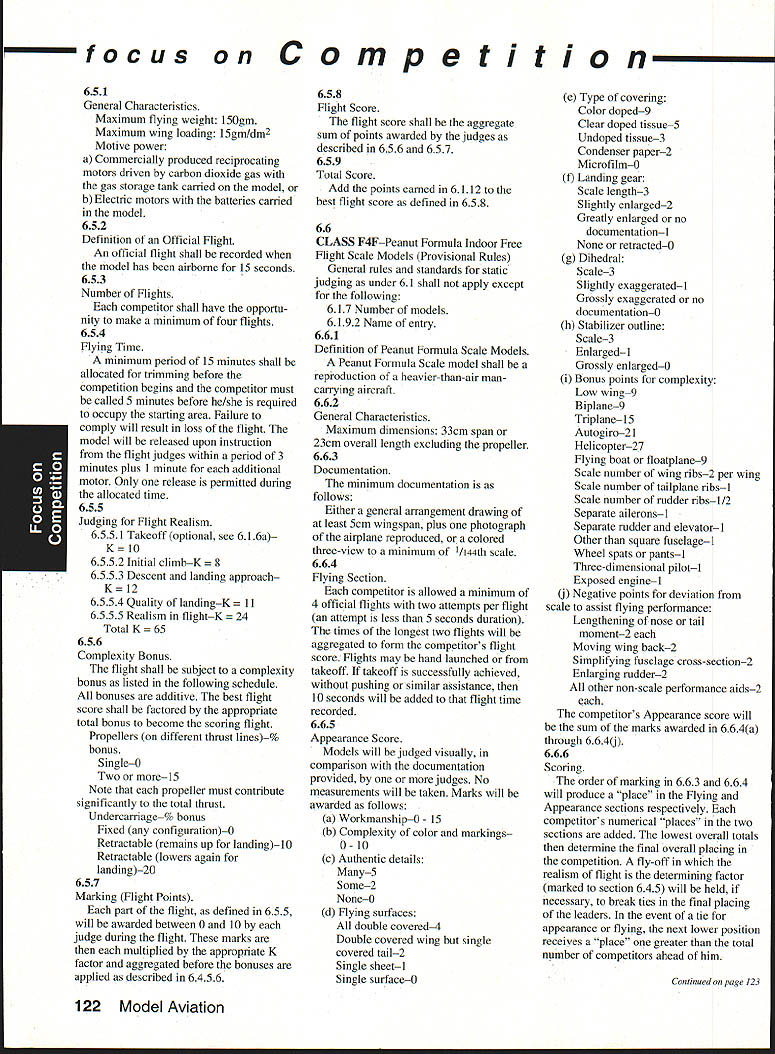
CLASS F4D — Indoor Free Flight Scale (Provisional Rules)
General rules and static judging standards under 6.1 apply with the following amendment:
- 6.1.10 Minimum judging distances to read 1.5 m and 0.5 m instead of 3 m and 1 m (6.1.6a applies).
General Characteristics
- Maximum flying weight: 150 g
- Maximum wing loading: 15 g/dm²
- Motive power: extensible motor(s) only
6.4.2 Definition of an Official Flight
- An official flight is recorded when the model has been airborne for 15 seconds.
6.4.3 Number of Flights
- Each competitor shall have the opportunity to make a minimum of four flights.
6.4.4 Flying Time
- A minimum of 15 minutes will be allocated for trimming before the competition. The competitor must be called 5 minutes before required to occupy the starting area. Failure to comply results in loss of the flight. The model will be released upon instruction from the flight judges within 3 minutes plus 1 minute for each additional motor. Only one release is permitted during the allocated time.
6.4.5 Judging for Flight Realism (K factors)
- Takeoff (optional; see 6.1.6a) K = 10
- Initial climb K = 8
- Descent and landing approach K = 12
- Quality of landing K = 11
- Realism of flight K = 24
- Total K = 65
6.4.6 Complexity Bonus (all additive; best flight factored by total bonus)
- Propellers (on different thrust lines):
- Single — 0%
- Two or more — 15% (each propeller must contribute significantly)
- Undercarriage:
- Fixed (any configuration) — 0%
- Retractable (remains up for landing) — 10%
- Retractable (lowers again for landing) — 20%
6.4.7 Marking (Flight Points)
- Each flight part in 6.4.5 is awarded marks 0–10 by each judge during the flight. These marks are multiplied by the K factor and aggregated before bonuses.
6.4.8 Flight Score
- Aggregate sum of points awarded per 6.4.6 and 6.4.7.
6.4.9 Total Score
- Add points earned in 6.1.12 to the best flight score (6.4.8).
---
CLASS F4E — Indoor Free Flight Scale (CO2 or Electric) (Provisional Rules)
- 6.5.1 Minimum judging distances to read 1.5 m and 0.5 m instead of 3 m and 1 m (6.1.6a applies).
General Characteristics
- Maximum flying weight: 150 g
- Maximum wing loading: 15 g/dm²
- Motive power: CO2 or electric motor(s) only
6.5.2 Definition of an Official Flight
- Recorded when the model has been airborne for 15 seconds.
6.5.3 Number of Flights
- Minimum of four flights per competitor.
6.5.4 Flying Time
- A minimum of 15 minutes trimming time before competition. Competitor must be called 5 minutes before occupying the starting area. Failure to comply results in loss of the flight. Model released within 3 minutes plus 1 minute per additional motor. Only one release permitted.
6.5.5 Judging for Flight Realism (K factors)
- Takeoff (optional; see 6.1.6a) K = 10
- Initial climb K = 8
- Descent and landing approach K = 12
- Quality of landing K = 11
- Realism of flight K = 24
- Total K = 65
6.5.6 Complexity Bonus (all additive)
- Propellers (on different thrust lines):
- Single — 0%
- Two or more — 15%
- Undercarriage:
- Fixed — 0%
- Retractable (remains up for landing) — 10%
- Retractable (lowers again for landing) — 20%
6.5.7 Marking (Flight Points)
- Each part of the flight (6.5.5) awarded marks 0–10 by each judge during the flight; multiplied by K factors and aggregated before bonuses.
6.5.8 Flight Score
- Aggregate sum as per 6.5.6 and 6.5.7.
6.5.9 Total Score
- Add points from 6.1.12 to the best flight score (6.5.8).
---
CLASS F4F — Peanut Formula Indoor Free Flight Scale Models (Provisional Rules)
General rules and standards for static judging under 6.1 shall not apply except for:
- 6.6.1.7 Number of models
- 6.6.1.9.2 Name of entry
6.6.1 Definition
- A Peanut Formula Scale model should be a reproduction of a heavier-than-air man-carrying aircraft.
6.6.2 General Characteristics
- Maximum dimensions: 33 cm span or 23 cm overall length excluding the propeller.
6.6.3 Documentation
- Minimum documentation: either a general arrangement drawing of at least 5 cm wingspan plus one photograph of the airplane reproduced, or a colored three-view to a minimum of 1/144 scale.
6.6.4 Flying Section
- Each competitor allowed a minimum of four official flights with two attempts per flight (an attempt is less than 5 seconds). The times of the longest two flights will be aggregated to form the competitor's flight score. Flights may be hand-launched or from takeoff. If takeoff is achieved without pushing or similar assistance, 10 seconds will be added to that recorded flight time.
6.6.5 Appearance Score Models judged visually in comparison with documentation. No measurements. Marks awarded as follows:
- (a) Workmanship — 0–15
- (b) Complexity of color and markings — 0–10
- (c) Authentic details:
- Many — 5
- Some — 2
- None — 0
- (d) Flying surfaces:
- All double covered — 4
- Double covered wing but single covered tail — 2
- Single sheet — 1
- Single surface — 0
- (e) Type of covering:
- Color doped — 9
- Clear doped tissue — 5
- Undoped tissue — 3
- Condenser paper — 2
- Microfilm — 0
- (f) Landing gear:
- Scale length — 3
- Slightly enlarged — 2
- Greatly enlarged or no documentation — 1
- None or retracted — 0
- (g) Scale?:
- Scale — 3
- Slightly exaggerated — 1
- Grossly exaggerated or no documentation — 0
- (h) Stabilizer outline:
- Scale — 3
- Enlarged — 1
- Grossly enlarged — 0
- (i) Bonus points for complexity:
- Low wing — 9
- Biplane — 9
- Triplane — 15
- Autogiro — 21
- Helicopter — 27
- Flying boat or floatplane — 9
- Scale number of wing ribs — 2 per wing
- Scale number of tailplane ribs — 1
- Scale number of rudder ribs — 1/2
- Separate ailerons — 1
- Separate rudder and elevator — 1
- Other than square fuselage — 1
- Wheel spats or pants — 1
- Three-dimensional pilot — 1
- Exposed engine — 1
- (j) Negative points for deviation from scale to assist flying performance:
- Lengthening of nose or tail — 1 each
- Moving wing back — 2
- Simplifying fuselage cross-section — 2
- Enlarging rudder — 2
- All other non-scale performance aids — 2 each
The competitor's Appearance score is the sum of marks in 6.6.5(a) through 6.6.5(j).
6.6.6 Scoring
- The order of marking in flying and appearance produces a "place" in each section. Each competitor's numerical "places" in the two sections are added. The lowest overall total determines final placing. A fly-off (realism of flight per 6.4.5) will break ties among leaders. In the event of a tie for appearance or flying, the next lower position receives a "place" one greater than the number of competitors ahead of him.
---
End of reformatted text.
Transcribed from original scans by AI. Minor OCR errors may remain.

