
Focus on Competition
A Note From the Technical Director — Bob Underwood
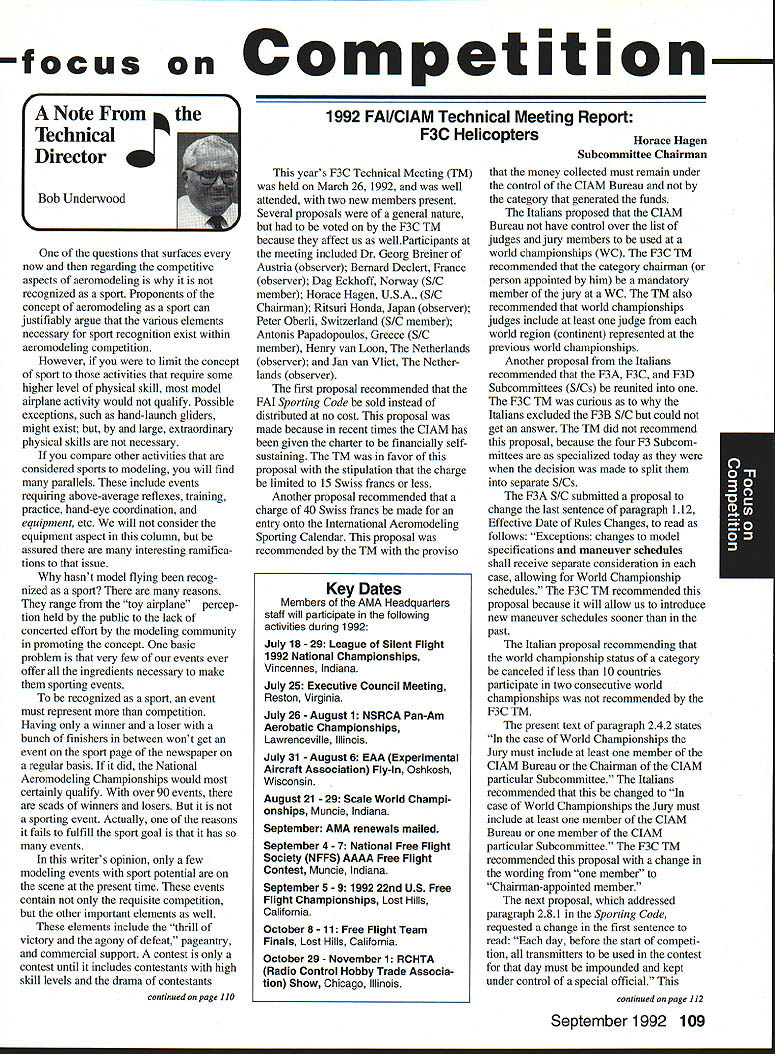
One question that surfaces periodically regarding the competitive aspects of aeromodeling is why it is not recognized as a sport. Proponents can justifiably argue that many elements necessary for sport recognition exist within aeromodeling competition. However, if one limits the concept of sport to activities requiring a high level of physical skill, most model airplane activity would not qualify. Possible exceptions, such as hand‑launch gliders, might exist, but by and large extraordinary physical skills are not necessary.
If you compare other activities considered sports to modeling, you will find many parallels: events requiring above‑average reflexes, training, practice, hand‑eye coordination, equipment, etc. One basic problem is that very few of our events ever offer all the ingredients necessary to make them sporting events.
Why hasn't model flying been recognized as a sport? Reasons range from the "toy airplane" perception held by the public to the lack of concerted effort by the modeling community in promoting the concept. To be recognized as a sport, an event must represent more than mere competition. Having only a winner and a loser with a bunch of finishers in between won't get an event on the sports page of the newspaper on a regular basis. The National Aeromodeling Championships, with over 90 events, would seem to qualify, yet its very breadth works against a clear sporting identity.
In my opinion, only a few modeling events with sport potential are on the scene. These events contain not only requisite competition but other important elements as well. These elements include:
- the thrill of victory and the agony of defeat;
- pageantry;
- commercial support;
- contestants with high skill levels and the drama of going head‑to‑head;
- spectator involvement.
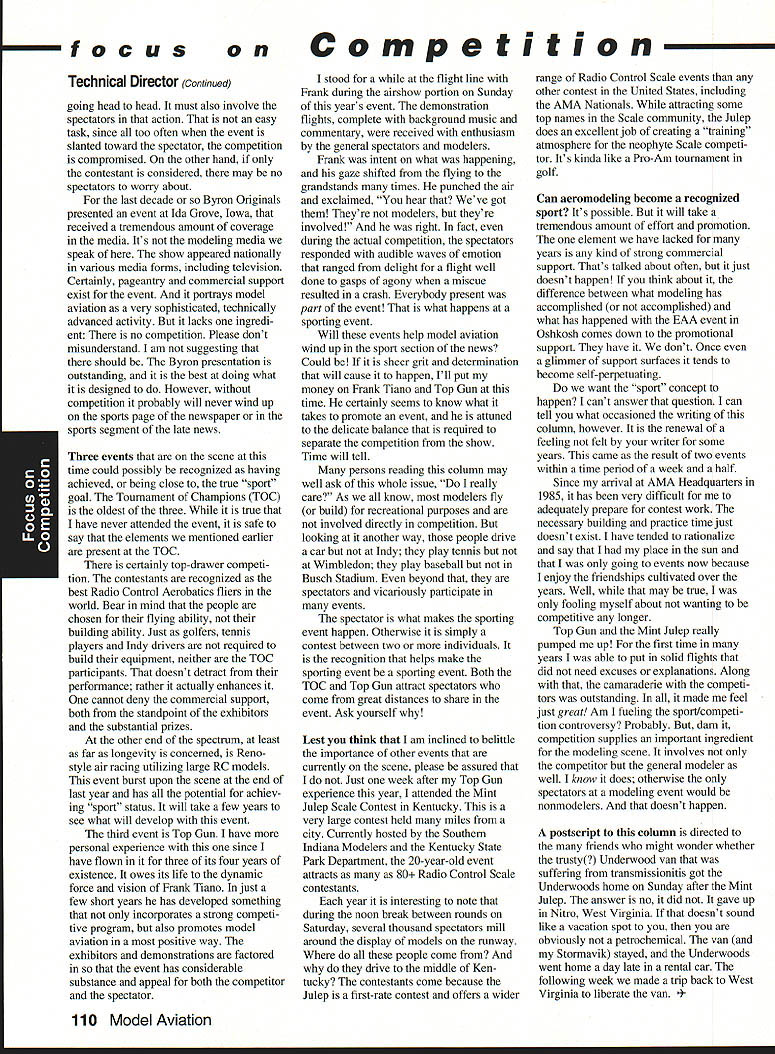
Balancing spectator appeal and uncompromised competition is difficult. When the event is slanted toward the spectator, the competition is often compromised. If only the contestant is considered, there may be no spectators at all.
Byron Originals presented an event at Ida Grove, Iowa for the last decade that received a tremendous amount of national media coverage. It had pageantry and commercial support and portrayed model aviation as a sophisticated, technically advanced activity. But it lacked one ingredient: competition. That doesn't diminish its value; it does what it sets out to do. However, without competition it probably will never land in the sports section of mainstream media.
Three events that could be recognized as achieving—or approaching—the true "sport" goal are:
- Tournament of Champions (TOC)
- Top‑drawer competition with contestants recognized as the best Radio Control or Electric Control fliers in the world.
- Competitors are chosen for flying ability (not building), similar to professional athletes.
- Strong commercial support from exhibitors and substantial prizes.
- Reno‑style RC air racing
- A newer event with potential for sport status. It will take a few years to see how it develops.
- Top Gun
- Developed by Frank Tiano, Top Gun combines a strong competitive program with positive promotion of model aviation.
- Exhibitors and demonstrations are factored in, giving appeal to both competitors and spectators.
- Demonstrations with background music and commentary drew enthusiastic responses from general spectators and modelers alike.
- The crowd reacted audibly during competition—cheers for good flights and gasps for crashes—so everyone felt part of the event, which is what happens at sporting events.
Will these events help model aviation appear in the sports pages? Possibly. If sheer grit and determination cause it to happen, I’d bet on Frank Tiano and Top Gun. He understands promotion and the delicate balance between competition and show.
Most modelers fly or build for recreational purposes and are not directly involved in competition. But consider: many people drive cars without racing at Indy, play tennis without going to Wimbledon, and play baseball without being in Busch Stadium. Spectators vicariously participate in many events. The spectator is what makes a sporting event happen; otherwise it is simply a contest between individuals. Both TOC and Top Gun attract spectators who travel great distances to share the event.
I do not belittle the importance of other events. One week after Top Gun I attended the Mint Julep Scale Contest in Kentucky, a large contest hosted by the Southern Indiana Modelers and the Kentucky State Park Department. The 20‑year‑old event attracts 80+ Radio Control Scale contestants and draws several thousand spectators during the noon break. Contestants come because the Julep is a first‑rate contest and offers a wider range of RC Scale events than any other contest in the U.S., including the AMA Nationals. It serves as a "training" atmosphere for new scale competitors—similar to a Pro‑Am tournament in golf.
Can aeromodeling become a recognized sport? It's possible, but it will take tremendous effort and promotion. One element lacking for many years is strong commercial support. The difference between what modeling has or hasn't accomplished and what the EAA event in Oshkosh has accomplished comes down to promotional support. Once even a glimmer of support surfaces, it tends to become self‑perpetuating.
Why I wrote this column: two events within a week and a half—Top Gun and the Mint Julep—renewed a feeling I hadn't felt in years. Since arriving at AMA Headquarters in 1985, I've had difficulty finding time for contest work. I had rationalized that I was content to attend events for friendships cultivated over the years. But Top Gun and the Mint Julep pumped me up. For the first time in many years I flew solid flights without excuses, and the camaraderie with competitors was outstanding. Competition supplies an important ingredient for the modeling scene. It involves not only the competitor but the general modeler as well.
Postscript: For friends wondering about the trusty Underwood van that was suffering from "transmissionitis" after the Mint Julep—the van gave up in Nitro, West Virginia. The van (and my Stormavik) stayed, and we went home a day late in a rental car. The following week we returned to West Virginia to retrieve the van.
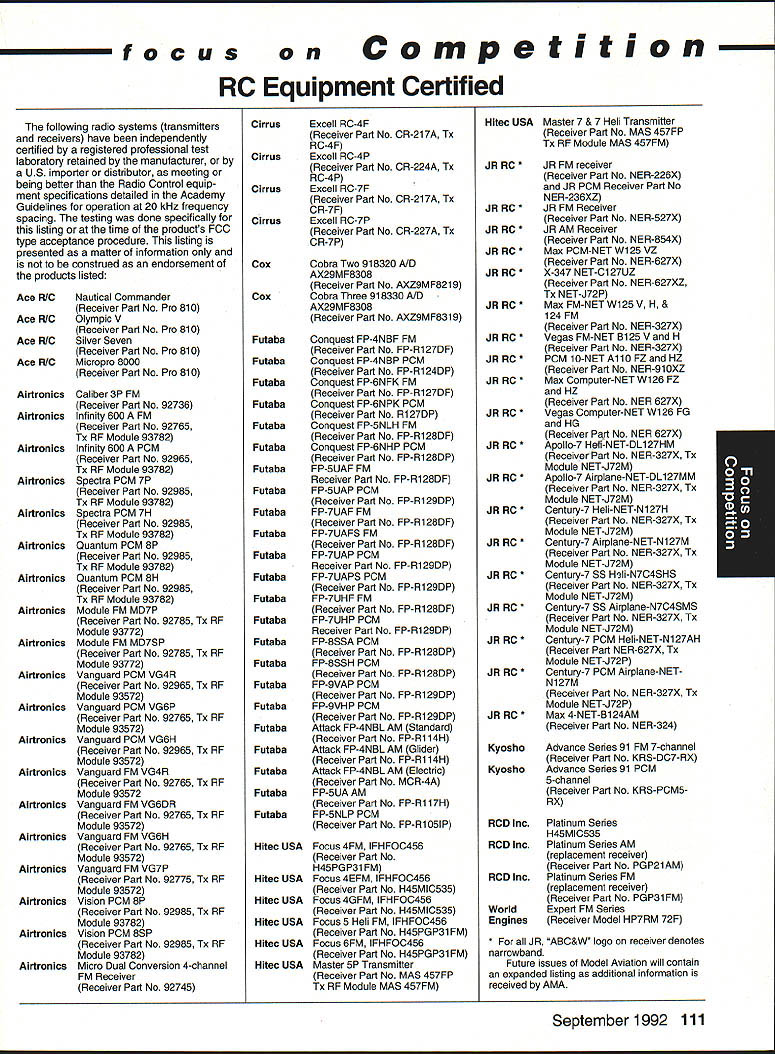
No continuation of "Focus on Competition" appears on the scanned page. The page contains only the "RC Equipment Certified" listing.
---
FAI/CIAM Meeting (Continued)
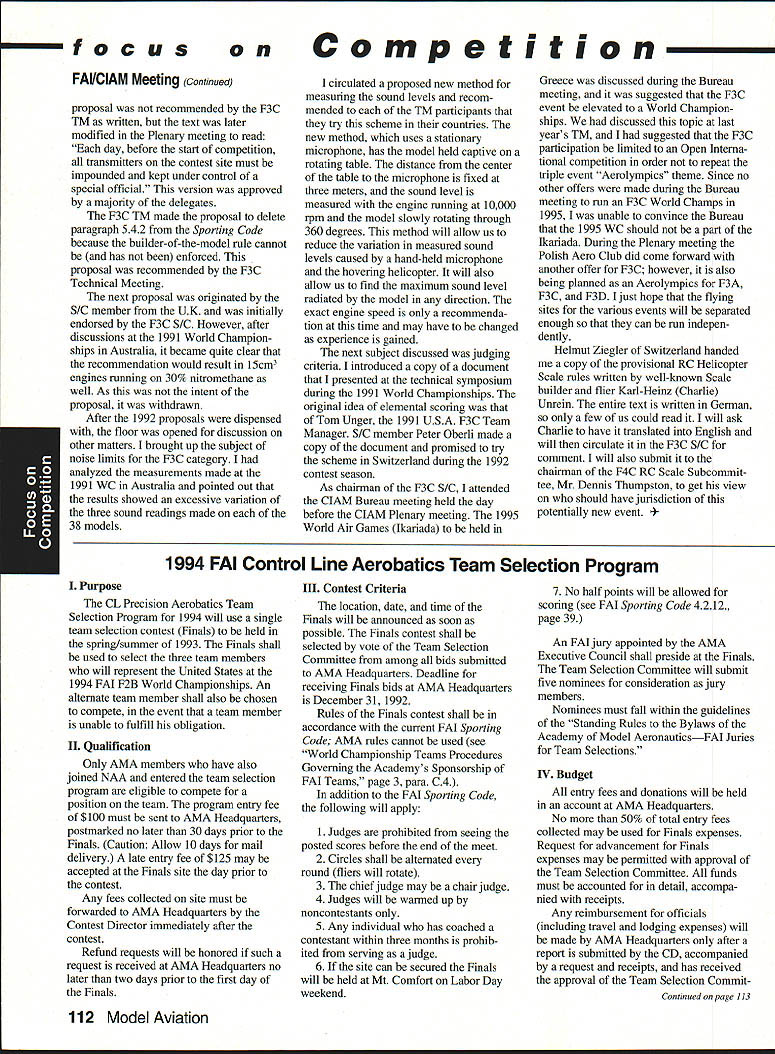
The proposal to require impounding transmitters as written was not recommended by the F3C Technical Meeting (TM), but the text was later modified in the Plenary meeting to read: "Each day, before the start of competition, all transmitters on the contest site must be impounded and kept under control of a special official." This version was approved by a majority of the delegates.
The F3C TM proposed deleting paragraph 5.4.2 from the Sporting Code because the builder‑of‑the‑model rule cannot be (and has not been) enforced. This proposal was recommended by the F3C Technical Meeting.
A proposal originated by the UK member, initially endorsed by the F3C S/C, was withdrawn after discussions at the 1991 World Championships in Australia. It became clear the recommendation would result in 15 cm3 engines running on 30% nitromethane as well, which was not the intent.
After the 1992 proposals, discussion turned to noise limits for F3C. I analyzed measurements made at the 1991 World Championships in Australia and pointed out excessive variation among the three sound readings made on each of the 38 models. I circulated a proposed new method for measuring sound levels and recommended TM participants try this scheme in their countries. The new method uses a stationary microphone with the model held captive on a rotating table: the microphone is fixed three meters from the center of the table, the engine runs at 10,000 rpm, and the model slowly rotates through 360 degrees. This should reduce variation caused by a hand‑held microphone and hovering helicopter and allow finding the maximum radiated sound level in any direction. The exact engine speed is only a recommendation and may be changed as experience is gained.
Judging criteria were also discussed. I introduced a copy of a document presented at the technical symposium during the 1991 World Championships. The original idea of elemental scoring was Tom Unger's (1991 U.S.A. F3C Team Manager). S/C member Peter Oberli promised to try the scheme in Switzerland during the 1992 contest season.
As chairman of the F3C S/C, I attended the CIAM Bureau meeting held before the CIAM Plenary. The 1995 World Air Games (Ikaria, Greece) was discussed and it was suggested the F3C event be elevated to a World Championships. I had suggested limiting F3C participation to an Open International competition to avoid repeating earlier Aerolympics. Since no other offers were made to run an F3C World Championship in 1995, I could not convince the Bureau that the 1995 World Championship should not be part of Ikaria. During the Plenary, the Polish Aero Club offered to host F3C, but it is also being planned as an Aerolympics for F3A, F3C, and F3D. I hope the flying sites for various events will be separated enough to run independently.
Helmut Ziegler of Switzerland handed me a copy of provisional RC Helicopter Scale rules written by well‑known scale builder and flier Karl‑Heinz (Charlie) Unrein. The text was in German; I will ask Charlie to translate it into English and circulate it in the F3C S/C for comment. I will also submit it to the chairman of the F4C RC Scale Subcommittee, Dennis Thumpton, to determine jurisdiction for this potentially new event.
A proposal was made to sell the FAI Sporting Code instead of distributing it for free, since CIAM charters are now financially self‑sustaining. The TM favored a stipulation limiting the charge to 15 Swiss francs or less. Another proposal recommended a charge of 40 Swiss francs for entry onto the International Aeromodeling Sporting Calendar. The TM recommended the proviso (Horace Hagen, Subcommittee Chairman) that money collected must remain under CIAM Bureau control in the category that generated the funds.
The Italians proposed that the CIAM Bureau control the list of judges and jury members used at World Championships. The F3C TM recommended that the category chairman, or his appointee, be a mandatory member of the World Championships jury. The TM also recommended that World Championship juries include at least one judge from each world region or continent represented at previous World Championships.
Another Italian proposal recommended reuniting the F3A, F3C, and F3D Subcommittees. The F3C TM questioned why F3B was excluded and received no answer. The TM did not recommend the proposal because the four F3 Subcommittees are specialized today and the decision was made to keep them separate.
The F3A S/C submitted a proposal to change the last sentence of paragraph 112, "Effective Date Rules Changes," so that exceptions to changes in model specifications and maneuver schedules would receive separate consideration for World Championship schedules. The F3C TM recommended this proposal to allow introducing new maneuver schedules sooner.
A past Italian proposal recommended canceling a World Championship category if fewer than 10 countries participate in two consecutive World Championships. Present paragraph 242 states that in the case of World Championships the Jury must include at least one member of the CIAM Bureau and the CIAM particular Subcommittee. The Italians recommended changing this to require the World Championships Jury to include at least one member of the CIAM Bureau who is also a member of the CIAM particular Subcommittee. The F3C TM recommended changing the wording from "member" to "Chairman‑appointed member."
---
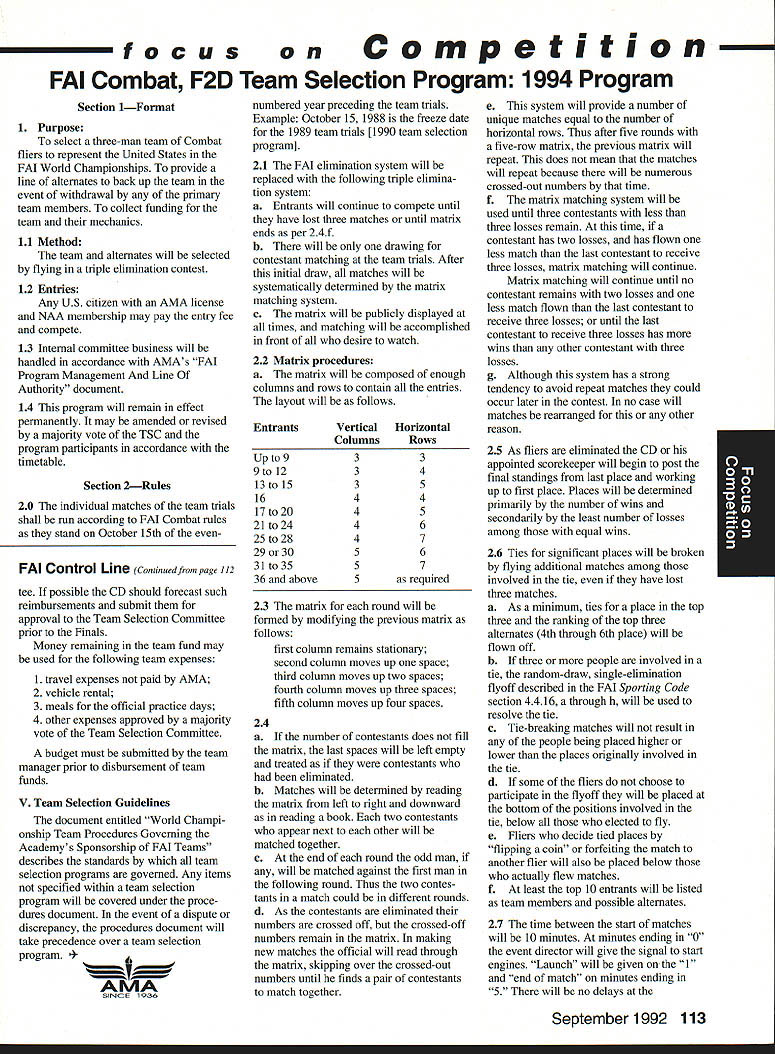
FAI Combat, F2D Team Selection Program: 1994
Section 1 — Format
- Purpose:
- To select a three‑man team of Combat fliers to represent the United States in the FAI World Championships.
- To provide a line of alternates to back up the team in case of withdrawal by any primary team member.
- To collect funding for the team and their mechanics.
1.1 Method:
- The team and alternates will be selected by flying in a triple elimination contest.
1.2 Entries:
- Any U.S. citizen with an AMA license and NAA membership may pay the entry fee and compete.
1.3 Internal committee business will be handled in accordance with AMA's "FAI Program Management and Line Of Authority" document.
1.4 Duration:
- This program will remain in effect permanently and may be amended or revised by a majority vote of the Team Selection Committee (TSC) and the program participants in accordance with the timetable.
Section 2 — Rules
2.0 The individual matches of the team trials shall be run according to FAI Combat rules as they stand on October 15 of the even‑numbered year preceding the team trials. Example: October 15, 1988 is the freeze date for the 1989 team trials (1990 team selection program).
2.1 The FAI elimination system will be replaced with the following triple elimination system: a. Entrants will continue to compete until they have lost three matches or until the matrix ends as per 2.4.f. b. There will be only one drawing for contestant matching at the team trials. After this initial draw, all matches will be systematically determined by the matrix matching system. c. The matrix will be publicly displayed at all times, and matching will be accomplished in front of any observers.
2.2 Matrix procedures:
- The matrix will be composed of enough columns and rows to contain all the entries. Layout:
- Up to 9 entrants: 3 vertical columns, 3 horizontal rows
- 9 to 12 entrants: 3 vertical columns, 4 horizontal rows
- 13 to 15 entrants: 3 vertical columns, 5 horizontal rows
- 16 to 20 entrants: 4 vertical columns, 5 horizontal rows
- 21 to 24 entrants: 4 vertical columns, 6 horizontal rows
- 25 to 28 entrants: 4 vertical columns, 7 horizontal rows
- 29 to 30 entrants: 5 vertical columns, 6 horizontal rows
- 31 to 35 entrants: 5 vertical columns, 7 horizontal rows
- 36 and above: 5 vertical columns, rows as required
2.3 The matrix for each round will be formed by modifying the previous matrix as follows:
- first column remains stationary;
- second column moves up one space;
- third column moves up two spaces;
- fourth column moves up three spaces;
- fifth column moves up four spaces.
2.4 Matrix rules and match determination: a. If the number of contestants does not fill the matrix, the last spaces will be left empty and treated as if they were contestants who had been eliminated. b. Matches will be determined by reading the matrix left to right and top to bottom. Each two contestants who appear next to each other will be matched together. c. At the end of each round the odd man, if any, will be matched against the first man in the following round; matches may involve contestants from different rounds. d. As contestants are eliminated their numbers are crossed off, but the crossed‑off numbers remain in the matrix. Officials will skip crossed‑out numbers when making new matches. e. This system will provide a number of unique matches equal to the number of horizontal rows. Thus after a number of rounds equal to the rows, the previous matrix will repeat; however, many numbers will be crossed out by then so matches will not necessarily repeat. f. Matrix matching will continue until three contestants with fewer than three losses remain. If a contestant has two losses and has flown one less match than the last contestant to receive three losses, matrix matching will continue until either no contestant remains with two losses and one less match flown, or until the last contestant to receive three losses has more wins than any other contestant with three losses. g. The system tends to avoid repeat matches, but repeats could occur later. Matches will not be rearranged for any reason.
2.5 As fliers are eliminated, the Contest Director (CD) or appointed scorekeeper will post final standings from last place up to first place. Places are determined primarily by number of wins and secondarily by the fewest losses among those with equal wins.
2.6 Ties for significant places will be broken by flying additional matches among those involved in the tie, even if they have already lost three matches. a. Minimum flyoffs: ties for top three and ranking of top three alternates (4th through 6th) will be flown off. b. If three or more are tied, the random‑draw, single‑elimination flyoff described in the FAI Sporting Code section 4.4.16 will be used. c. Tie‑breaking matches will not change positions beyond the places originally involved in the tie. d. Fliers who choose not to participate in the flyoff will be placed at the bottom of the tied positions, below all who elected to fly. e. Fliers who decide tied places by coin flip or forfeit will be placed below those who actually flew matches. f. At least the top 10 entrants will be listed as team members and alternates.
2.7 Match timing and order:
- Time between the start of matches will be 10 minutes. At minutes ending in "0" the director will signal "start engines." "Launch" will be given on the "1" and "end of match" on minutes ending in "5."
- There will be no delays at the contestant's request. Officials may skip an entire ten‑minute period if necessary. If any flier is scheduled to fly two consecutive matches, a ten‑minute period will automatically be skipped.
- Matches will be flown in the order scheduled by the matrix system. The order will not be changed at contestants' request.
2.8 Protests: a. Informal protests may be made verbally to the CD. If unsatisfied, the contestant may file a formal protest. b. Formal protests must be submitted in writing and accompanied by a $10 protest fee. Upon payment, the CD will suspend flying of any matches dependent on the protest's outcome. The written protest must be submitted within 30 minutes of posting the fee. A three‑man jury appointed by the FAI Executive Committee will decide the formal protest; this jury will exclude the CD, original judges, and persons involved in the protest. c. If the protest is rejected, the fee goes to the local organizing club. If the match outcome is changed based on the protest, the fee will be returned to the protester. d. The person against whom the protest is filed may submit a rebuttal or counterprotest without fee within 30 minutes of the decision. e. The jury's decision is final with no appeal to a higher authority.
2.9 After each match an itemized score will be publicly posted, including cuts, minutes and seconds of air time, and penalties. The score will be posted before the beginning of the next match in that circle.
2.10 Weather delays:
- If foul weather prevents completion on the scheduled days, the contest will carry over to the next day.
2.11 If a match results in a tie (per current FAI rules) it will be reflown at the end of the round.
2.12 Match scoring: 2.12.1 Matches will be scored by four pairs of cut counters stationed approximately 90 degrees around the circle. Each pair will submit a written score to the scorekeeper immediately after the match without consulting other counters. Each pair is treated as a unit and will not be mixed or matched with other pairs. Contestants may be recruited part‑time as cut counters. 2.12.2 The scorekeeper will compute match results using each of the four cut counts. If the same contestant is the winner in three or four of the scores, he will be declared the winner and the median score (middle of those reported) will be posted as the official result. Any other outcome (e.g., 2 blue/2 yellow, 2 blue/2 ties, 1 blue/3 ties) will be declared inconclusive and reflown. 2.12.3 Air time will be scored by a panel of three primary timers with no other duties, plus a pair of backup timers who may also be cut counters. Unless there is an accident or equipment failure, the three primary timers determine the score. Use of an audio tape recorder to document air time during the match is suggested. The same air time will be used for all four possible scores. 2.12.4 The center marshal may impose penalties by sole authority for certain infractions. Other penalties require agreement of two or more officials. Penalties must be submitted in writing to the scorekeeper at the end of the round before the cut count. The scorekeeper will ensure a contestant is penalized once and only once for each offense, even if multiple officials observed it. The same penalties will be used in computing all four possible scores. 2.12.5 The center marshal gives the order to start engines, counts down one minute, signals launch, and orders start and stop of combat. The four‑minute match is timed from outside the circle, beginning at the center marshal's launch signal.
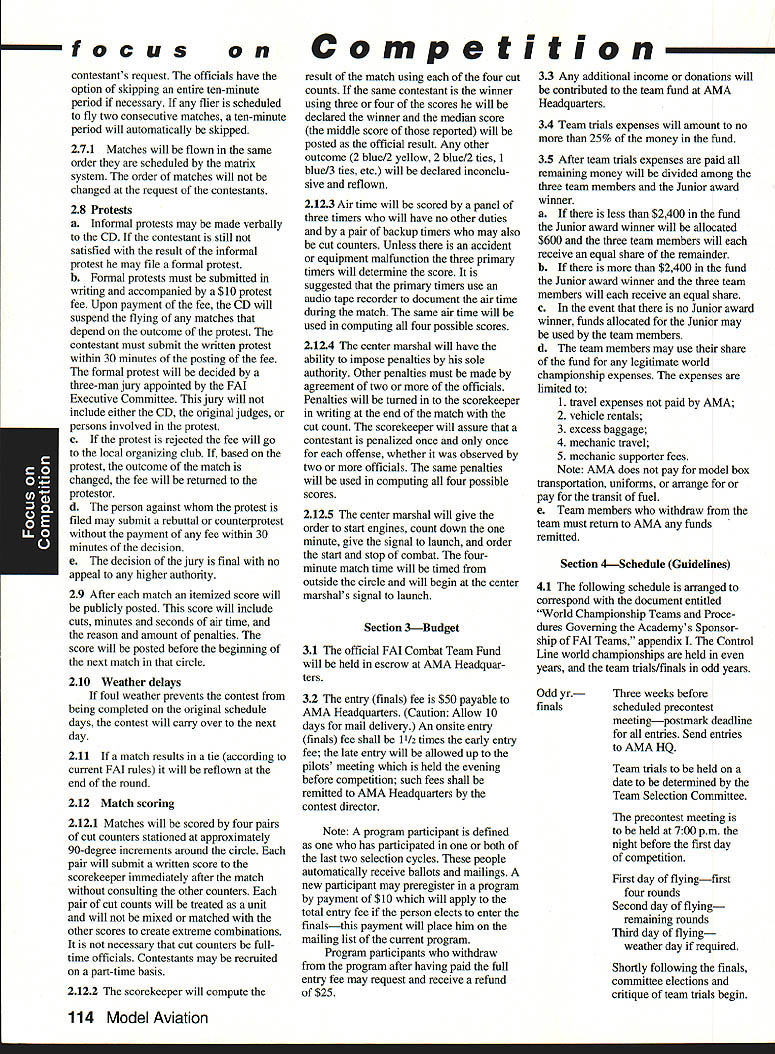
Section 3 — Budget
3.1 The official FAI Combat Team Fund will be held in escrow at AMA Headquarters.
3.2 Entry fees:
- The entry (finals) fee is $50 payable to AMA Headquarters. Allow 10 days for mail delivery.
- Onsite entry (finals) fee shall be 1.5 times the early entry fee; late entry will be allowed up to the pilots' meeting the evening before competition. Such fees shall be remitted to AMA Headquarters by the contest director.
Note:
- A program participant is defined as one who has participated in one or both of the last two selection cycles. These people automatically receive ballots and mailings.
- A new participant may preregister by paying $10, which applies to the total entry fee if the person elects to enter the finals—this payment places him on the current program mailing list.
- Program participants who withdraw after paying the full entry fee may request a refund of $25.
3.3 Any additional income or donations will be contributed to the team fund at AMA Headquarters.
3.4 Team trials expenses will amount to no more than 25% of the money in the fund.
3.5 Distribution of remaining funds after expenses: a. If there is less than $2,400 in the fund, the Junior award winner will be allocated $600 and the three team members will each receive an equal share of the remainder. b. If there is $2,400 or more in the fund, the Junior award winner and the three team members will each receive an equal share. c. If there is no Junior award winner, funds allocated for the Junior may be used by the team members. d. Team members may use their share for legitimate World Championship expenses limited to:
- travel expenses not paid by AMA;
- vehicle rental;
- excess baggage;
- mechanic travel;
- mechanic support fees.
Note: AMA does not pay for model box transportation, uniforms, or transit of fuel.
e. Team members who withdraw from the team must return to AMA any funds remitted.
Section 4 — Schedule (Guidelines)
4.1 The following schedule corresponds with the document "World Championship Team Procedures Governing the Academy's Sponsorship of FAI Teams." Control Line World Championships are held in even years; team trials/finals occur in odd years.
- Odd year — Three weeks before finals:
- Scheduled precontest meeting postmark deadline for entries (send entries to AMA HQ).
- Team trials date to be determined by the Team Selection Committee.
- Precontest meeting at 7:00 p.m. the night before first day of competition.
- Competition days:
- First day of flying — first four rounds.
- Second day of flying — remaining rounds.
- Third day — weather day if required.
- Shortly after finals, committee elections and critique of team trials begin.
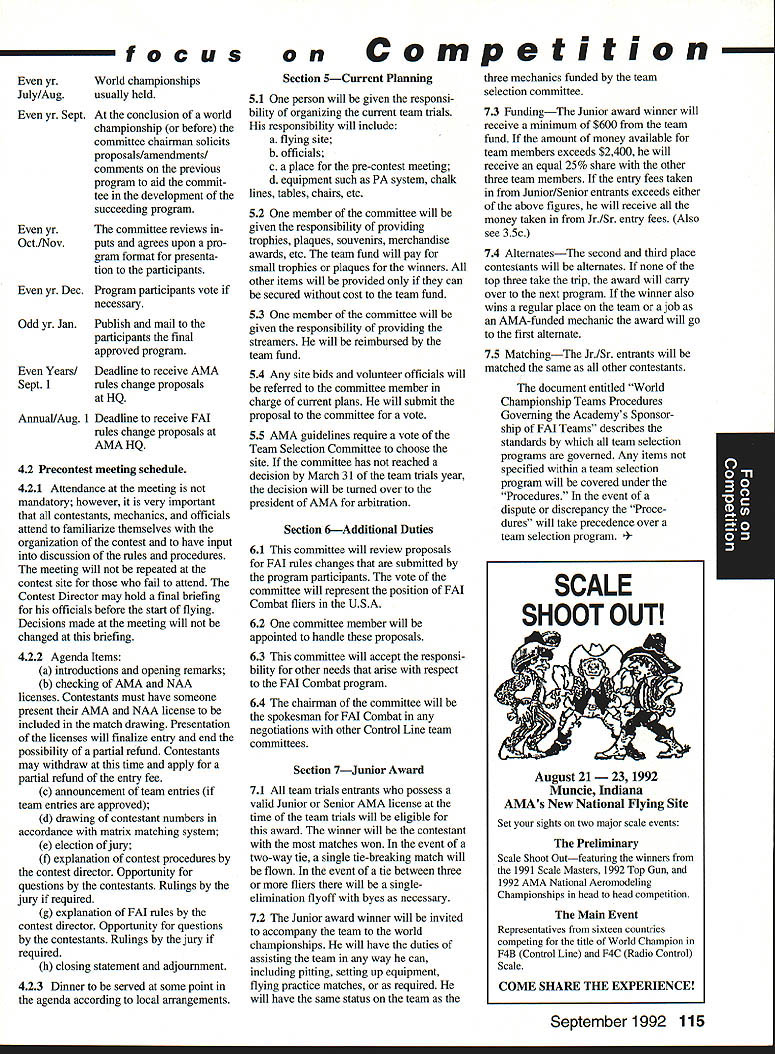
Section 5 — Current Planning
5.1 One person will be given responsibility for organizing the current team trials, including:
- flying site;
- officials;
- a place for the precontest meeting;
- equipment such as PA system, chalk lines, tables, chairs, etc.
5.2 One committee member will provide trophies, plaques, souvenirs, and merchandise awards. The team fund will pay for small trophies or plaques for winners; other items must be secured without cost to the team fund.
5.3 One committee member will provide streamers and will be reimbursed by the team fund.
5.4 Any site bids and volunteer officials will be referred to the committee member in charge of current plans, who will submit the proposal to the committee for a vote.
5.5 AMA guidelines require a vote of the Team Selection Committee to choose the site. If no decision is reached by March 31 of the team trials year, the decision will be turned over to the president of AMA for arbitration.
Section 6 — Additional Duties
6.1 The committee will review proposals for FAI rules changes submitted by program participants. The committee vote will represent the position of FAI Combat fliers in the U.S.A.
6.2 One committee member will be appointed to handle these proposals.
6.3 The committee will accept responsibility for other needs that arise with respect to the FAI Combat program.
6.4 The chairman of the committee will be the spokesman for FAI Combat in negotiations with other Control Line team committees.
Section 7 — Junior Award
7.1 Eligibility:
- All team trials entrants with a valid Junior or Senior AMA license at the time of the trials are eligible.
- The award goes to the contestant with the most matches won. A two‑way tie will be broken by a single tie‑breaking match. Ties among three or more fliers will be resolved by a single‑elimination flyoff with byes as necessary.
7.2 Role:
- The Junior award winner will be invited to accompany the team to the World Championships and assist the team (pitting, equipment setup, flying practice matches, etc.). He will have the same status on the team as the three mechanics funded by the team selection committee.
7.3 Funding:
- The Junior award winner receives a minimum of $600 from the team fund.
- If the amounts available for team members exceed $2,400, the Junior will receive an equal 25% share with the three team members.
- If entry fees from Junior/Senior entrants exceed these figures, the Junior receives all money taken from Jr./Sr. entry fees.
7.4 Alternates:
- The second and third place contestants will be alternates. If none of the top three take the trip, the award will carry over to the next program. If the winner also wins a regular team place or a funded mechanic job, the award will go to the first alternate.
7.5 Matching:
- Junior/Senior entrants will be matched the same as all other contestants.
Note: The document "World Championship Team Procedures Governing the Academy's Sponsorship of FAI Teams" describes standards by which all team selection programs are governed. Any items not specified within a team selection program will be covered under that procedures document; in event of dispute, the procedures document takes precedence.
Transcribed from original scans by AI. Minor OCR errors may remain.

