
Focus on Competition
A Note From the Technical Director — Bob Underwood
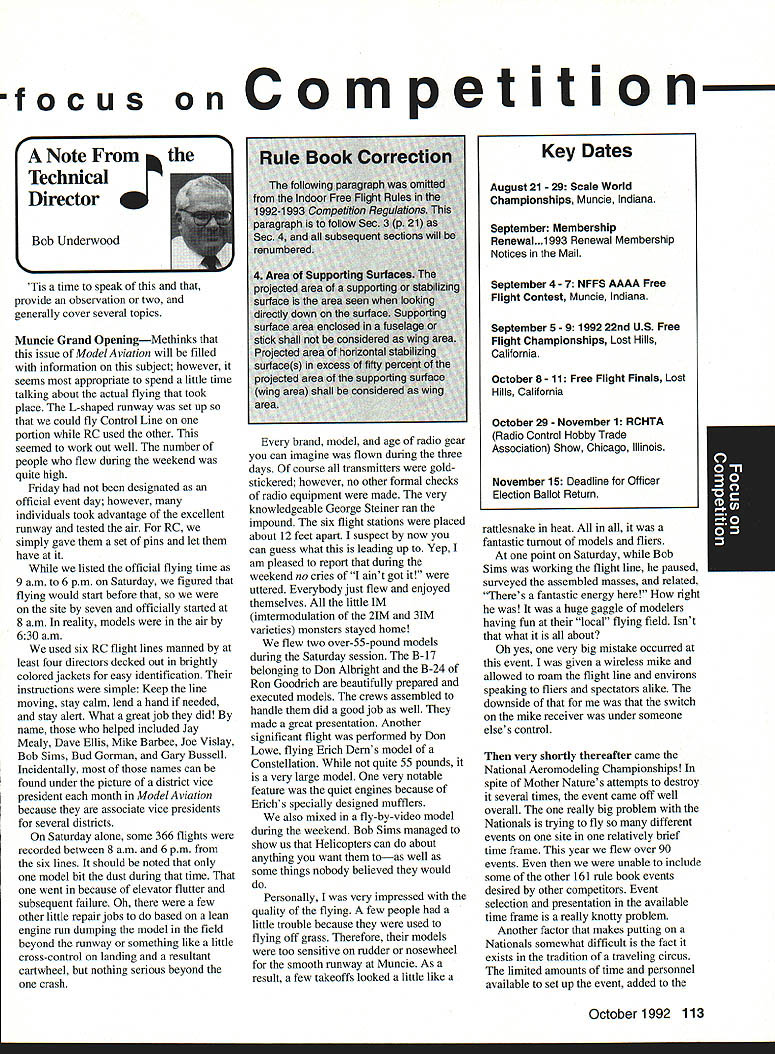
'Tis a time to speak of this and that, provide an observation or two, and generally cover several topics.
Muncie Grand Opening — This issue of Model Aviation will likely be filled with information on the subject, but it seems appropriate to spend a little time talking about the actual flying that took place. An L-shaped runway was set up so Control Line could be flown on one portion while RC used the other; this arrangement worked well. The number of people who flew during the weekend was quite high.
Friday was not an official event day, yet many individuals took advantage of the excellent runway to test their aircraft. For RC, we simply gave out pins and let people have at it. Although official flying time on Saturday was listed as 9 a.m. to 6 p.m., flying started earlier—models were in the air by 6:30 a.m. We were on site by 7 and officially started at 8 a.m.
We used six RC flight lines manned by at least four directors each, decked out in brightly colored jackets for easy identification. Their instructions were simple: keep the line moving, stay calm, lend a hand if needed, and stay alert. They did an excellent job. Those who helped included Jay Mealy, Dave Ellis, Mike Barbee, Joe Vislay, Bob Sims, Bud Gorman, and Gary Bussell — many of these names appear under the district vice president photos in Model Aviation because they serve as associate vice presidents for several districts.
On Saturday alone, some 366 flights were recorded between 8 a.m. and 6 p.m. from the six lines. Only one model was lost due to elevator flutter and subsequent failure. A few minor repair jobs were required (a lean engine run dumped one model beyond the runway; another had a cross-control landing and cartwheeled), but nothing serious beyond the single crash.
Every brand, model, and age of radio gear you can imagine was flown during the three days. Of course, all transmitters were gold-stickered; however, no other formal checks of radio equipment were performed. George Steiner ran impound. The six flight stations were placed about 12 feet apart, yet I am pleased to report that over the weekend no cries of "I ain't got it!" were uttered — everybody just flew and enjoyed themselves. The IM (intermodulation) 21M and 31M varieties stayed home.
We flew two over-55-pound models during the Saturday session: Don Albright's B-17 and Ron Goodrich's B-24. Both were beautifully prepared and executed; their crews performed well and made a great presentation. Another notable flight was Don Lowe flying Erich Dem's Constellation. While not quite 55 pounds, it is a very large model with notably quiet engines thanks to Erich's specially designed mufflers. We also featured a fly-by-video model during the weekend.
Bob Sims demonstrated that helicopters can do almost anything you want them to — and some things people didn't believe they could. The quality of the flying impressed me. A few pilots had trouble because they were used to flying off grass; their models were too sensitive on rudder or nosewheel for the smooth Muncie runway, so a few takeoffs looked like a rattlesnake. All in all, it was a fantastic turnout of models and fliers.
At one point on Saturday, while Bob Sims was working the flight line, he paused, surveyed the assembled masses, and said, "There's a fantastic energy here!" He was right — it was a huge gaggle of modelers having fun at their "local" flying field. Isn't that what it's all about?
One very big mistake occurred at the event: I was given a wireless mike to roam the flight line and speak to fliers and spectators. The downside was that the switch on the mike receiver was under someone else's control, and very shortly thereafter that caused some confusion.
Nationals — In spite of Mother Nature's attempts to disrupt it several times, the National Aeromodeling Championships came off well overall. A big problem with the Nationals is trying to fly so many different events on one site in a relatively brief time frame. This year we flew over 90 events and still could not include many of the other 161 rule-book events desired by competitors. Event selection and presentation within the available time is a knotty problem.
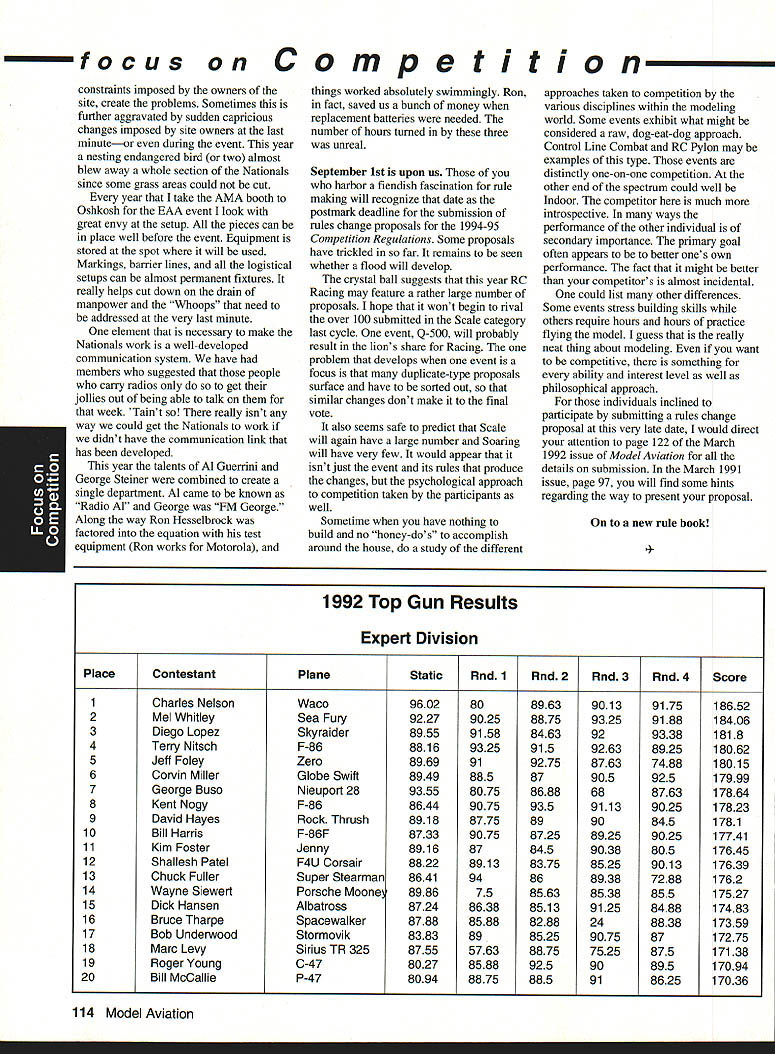
Another difficulty is the Nationals' tradition as a traveling circus. Limited time and personnel to set up, plus constraints imposed by site owners, create problems. Sometimes site owners impose capricious changes at the last minute or even during the event — this year a nesting endangered bird (or two) nearly shut down a whole section because some grass areas could not be cut.
Each year I take the AMA booth to Oshkosh for the EAA event and envy their setup: equipment stored where it will be used, markings and barriers nearly permanent, and many logistical items already in place. That arrangement reduces manpower drain and last-minute "whoops."
A well-developed communications system is essential for the Nationals to work. Some members suggested those who carry radios do so just to get their jollies talking on them for that week. Not so — there really isn't any way we could run the Nationals without the communications link that has been developed. This year Al Guerrini ("Radio Al") and George Steiner ("FM George") combined talents to create a single communications department. Ron Hesselbrock (who works for Motorola) provided test equipment and saved us money on replacement batteries. The number of hours volunteered by these three was unreal.
September 1 is the postmark deadline for submitting rules change proposals for the 1994–95 Competition Regulations. Some proposals have trickled in; it remains to be seen whether a flood will develop. The crystal ball suggests RC Racing may feature a large number of proposals this cycle, perhaps focused on Q-500. When one event becomes the focus, many duplicate proposals surface and must be sorted so similar changes don't all make the final ballot. Scale is likely to have a large number of proposals again; Soaring will probably have very few. It appears the event's culture — the psychological approach to competition by participants in different disciplines — affects how many rule changes are proposed. Some events foster a raw one-on-one, win-at-all-costs style (e.g., Control Line Combat, RC Pylon); others are more introspective (e.g., Indoor), where improving one's own performance is the primary goal and beating others is incidental.
There are many differences across events: some stress building skills; others require hours of practice flying. That's the neat thing about modeling — even if you want to be competitive, there's something for every ability, interest level, and philosophical approach.
If you intend to submit a rules change proposal at this late date, see page 122 of the March 1991 issue of Model Aviation for submission details, and page 97 of the March 1991 issue for presentation hints.
On to a new rule book!
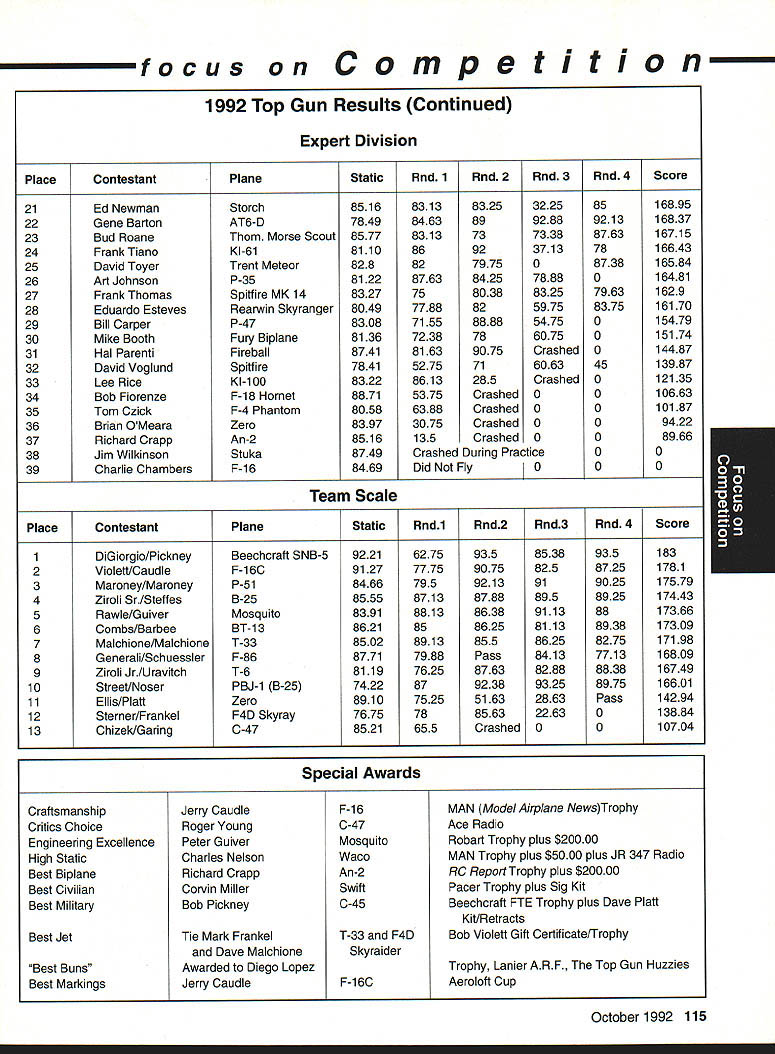
1992 Top Gun Results (Continued)
Expert Division
- 21. Ed Newman — Plane: Storch. Static: 85.16 | Rnd. 1: 83.13 | Rnd. 2: 83.25 | Rnd. 3: 32.25 | Rnd. 4: 85 | Score: 168.95
- 22. Gene Barton — Plane: AT6-D. Static: 78.49 | Rnd. 1: 84.63 | Rnd. 2: 89 | Rnd. 3: 92.88 | Rnd. 4: 92.13 | Score: 168.37
- 23. Bud Roane — Plane: Thompson Morse Scout. Static: 85.77 | Rnd. 1: 83.13 | Rnd. 2: 73 | Rnd. 3: 73.38 | Rnd. 4: 87.63 | Score: 167.15
- 24. Frank Tiano — Plane: Ki-61. Static: 81.10 | Rnd. 1: 86 | Rnd. 2: 92 | Rnd. 3: 37.13 | Rnd. 4: 78 | Score: 166.43
- 25. David Toyer — Plane: Trent Meteor. Static: 82.82 | Rnd. 1: 82 | Rnd. 2: 79.75 | Rnd. 3: 70 | Rnd. 4: 87.38 | Score: 165.84
- 26. Art Johnson — Plane: P-35. Static: 81.22 | Rnd. 1: 87.63 | Rnd. 2: 84.25 | Rnd. 3: 70.88 | Rnd. 4: 88 | Score: 164.81
- 27. Frank Thomas — Plane: Spitfire MK 14. Static: 83.27 | Rnd. 1: 75 | Rnd. 2: 80.38 | Rnd. 3: 83.25 | Rnd. 4: 79.63 | Score: 162.90
- 28. Eduardo Esteves — Plane: Rearwin Skyranger. Static: 80.49 | Rnd. 1: 77.88 | Rnd. 2: 82 | Rnd. 3: 59.75 | Rnd. 4: 83.75 | Score: 161.70
- 29. Bill Carper — Plane: P-47. Static: 83.08 | Rnd. 1: 71.55 | Rnd. 2: 88.88 | Rnd. 3: 54.75 | Rnd. 4: 0 | Score: 154.79
- 30. Mike Booth — Plane: Fury Biplane. Static: 81.36 | Rnd. 1: 72.38 | Rnd. 2: 78 | Rnd. 3: 60.75 | Rnd. 4: 0 | Score: 151.74
- 31. Hal Parenti — Plane: Fireball. Static: 87.41 | Rnd. 1: 81.63 | Rnd. 2: 90.75 | Rnd. 3: Crashed (0) | Rnd. 4: 0 | Score: 149.78
- 32. David Voglund — Plane: Spitfire. Static: 78.41 | Rnd. 1: 52.75 | Rnd. 2: 71 | Rnd. 3: 60.75 | Rnd. 4: 45 | Score: 139.87
- 33. Lee Rice — Plane: Ki-100. Static: 83.22 | Rnd. 1: 86.13 | Rnd. 2: 28.5 | Rnd. 3: Crashed (0) | Rnd. 4: 0 | Score: 121.35
- 34. Bob Fiorenze — Plane: F-18 Hornet. Static: 88.71 | Rnd. 1: 53.75 | Rnd. 2: Crashed (0) | Rnd. 3: 0 | Rnd. 4: 0 | Score: 106.63
- 35. Tom Czick — Plane: F-4 Phantom. Static: 80.58 | Rnd. 1: 63.88 | Rnd. 2: 30.88 | Rnd. 3: 0 | Rnd. 4: 0 | Score: 101.87
- 36. Brian O'Meara — Plane: Zero. Static: 83.97 | Rnd. 1: 30.75 | Rnd. 2: Crashed (0) | Rnd. 3: 0 | Rnd. 4: 0 | Score: 94.22
- 37. Richard Crapp — Plane: An-2. Static: 85.16 | Rnd. 1: 13.5 | Rnd. 2: Crashed (0) | Rnd. 3: 0 | Rnd. 4: 0 | Score: 89.66
- 38. Jim Wilkinson — Plane: Stuka. Static: 87.49 | Rnd. 1: Crashed during practice | Rnd. 2: 0 | Rnd. 3: 0 | Rnd. 4: 0 | Score: 0
- 39. Charlie Chambers — Plane: F-16. Static: 84.69 | Rnd. 1: Did not fly | Rnd. 2: 0 | Rnd. 3: 0 | Rnd. 4: 0 | Score: 0
Team Scale
- 1. DiGiorgio / Pickney — Plane: Beechcraft SNB-5. Static: 92.21 | Rnd. 1: 62.75 | Rnd. 2: 93.5 | Rnd. 3: 85.38 | Rnd. 4: 93.5 | Score: 183
- 2. Violett / Caudle — Plane: F-16C. Static: 91.27 | Rnd. 1: 77.75 | Rnd. 2: 90.75 | Rnd. 3: 82.5 | Rnd. 4: 87.25 | Score: 178.1
- 3. Maroney / Maroney — Plane: P-51. Static: 84.66 | Rnd. 1: 79.5 | Rnd. 2: 92.13 | Rnd. 3: 91 | Rnd. 4: 90.25 | Score: 175.79
- 4. Ziroli Sr. / Steffes — Plane: B-25. Static: 85.55 | Rnd. 1: 87.13 | Rnd. 2: 87.88 | Rnd. 3: 89.5 | Rnd. 4: 89.25 | Score: 174.43
- 5. Rawle / Guiver — Plane: Mosquito. Static: 83.91 | Rnd. 1: 88.13 | Rnd. 2: 86.38 | Rnd. 3: 91.13 | Rnd. 4: 88 | Score: 173.66
- 6. Combs / Barbee — Plane: BT-13. Static: 86.21 | Rnd. 1: 85 | Rnd. 2: 86.25 | Rnd. 3: 81.13 | Rnd. 4: 89.38 | Score: 173.09
- 7. Malchione / Malchione — Plane: T-33. Static: 85.02 | Rnd. 1: 89.13 | Rnd. 2: 85.5 | Rnd. 3: 86.25 | Rnd. 4: 82.75 | Score: 171.98
- 8. Generali / Schuessler — Plane: F-86. Static: 87.71 | Rnd. 1: 79.88 | Rnd. 2: Pass | Rnd. 3: 84.13 | Rnd. 4: 77.13 | Score: 168.09
- 9. Ziroli Jr. / Uravitch — Plane: T-6. Static: 81.19 | Rnd. 1: 76.25 | Rnd. 2: 87.63 | Rnd. 3: 82.88 | Rnd. 4: 73.75 | Score: 164.97
- 10. Street / Noser — Plane: PBJ-1 (B-25). Static: 74.22 | Rnd. 1: 87 | Rnd. 2: 92.38 | Rnd. 3: 93.25 | Rnd. 4: 89.75 | Score: 166.01
- 11. Ellis / Platt — Plane: Zero. Static: 89.10 | Rnd. 1: 75.25 | Rnd. 2: 65.25 | Rnd. 3: 28.63 | Rnd. 4: Pass | Score: 142.94
- 12. Sterner / Frankel — Plane: F4D Skyray. Static: 76.75 | Rnd. 1: 78 | Rnd. 2: 85.63 | Rnd. 3: 22.63 | Rnd. 4: 0 | Score: 138.84
- 13. Chizek / Garing — Plane: C-47. Static: 85.21 | Rnd. 1: 65.5 | Rnd. 2: Crashed (0) | Rnd. 3: 0 | Rnd. 4: 0 | Score: 107.04
Special Awards
- Craftsmanship: Jerry Caudle — F-16 — MAN (Model Airplane News) Trophy
- Critics Choice: Roger Young — C-47 — Ace Radio
- Engineering Excellence: Peter Guiver — Mosquito — Robart Trophy plus $200.00
- High Static: Charles Nelson — Waco — MAN Trophy plus $50.00 and JR 347 Radio
- Best Biplane: Richard Crapp — An-2 — RC Report Trophy plus $200.00
- Best Civilian: Corvin Miller — Swift — Pacer Trophy plus Sig kit
- Best Military: Bob Pickney — C-45 — Beechcraft FTE Trophy plus Dave Platt kit/retracts
- Best Jet (tie): Mark Frankel — F4D Skyray; Dave Malchione — T-33 — Bob Violett gift certificate/trophy
- "Best Buns": Diego Lopez — Trophy, Lanier A.R.F., The Top Gun Huzzies
- Best Markings: Jerry Caudle — F-16 — Aeroloft Cup
Transcribed from original scans by AI. Minor OCR errors may remain.

