

Focus on Competition
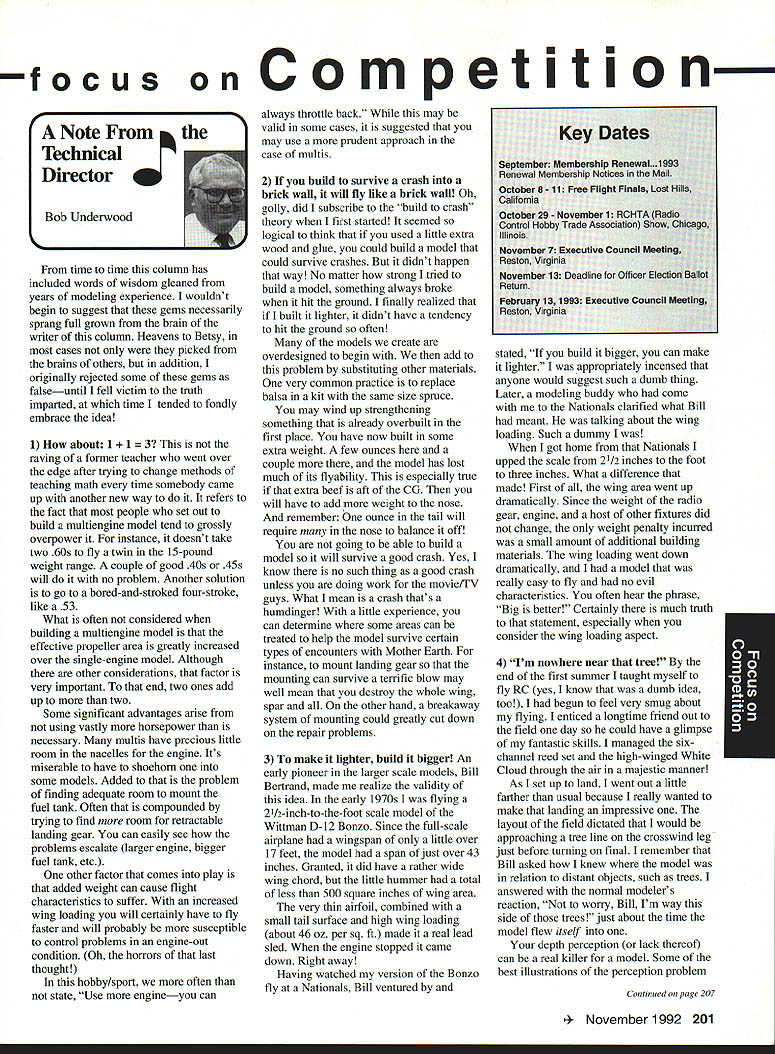
A Note From the Technical Director
Bob Underwood
From time to time this column has included words of wisdom gleaned from years of modeling experience. I wouldn't begin to suggest that these gems necessarily sprang full grown from the brain of the writer of this column. Heavens to Betsy, in most cases not only were they picked from the brains of others, but in addition, I originally rejected some of these gems as false—until I fell victim to the truth imparted, at which time I tended to fondly embrace the idea!
- About multiengine models
- People who set out to build multiengine models tend to grossly overpower them. For instance, it doesn't take two .60s to fly a twin in the 15‑pound weight range; a couple of good .40s or .45s will usually do the job. Another solution is to go to a bored‑and‑stroked four‑stroke, like a .53.
- One factor often overlooked is that the effective propeller area is greatly increased compared to a single‑engine model. Although there are other considerations, that factor is important — two small engines don't just equal twice a single engine.
- Avoid using vastly more horsepower than necessary. Many multis have precious little room in the nacelles for engines, and shoehorning larger engines creates packaging problems: finding space for fuel tanks, adding retractable gear, etc. Problems escalate (larger engine → bigger tank → more structure).
- Added weight can also hurt flight characteristics. Increased wing loading forces faster flight and increases susceptibility to control problems in an engine‑out condition. The usual advice, "use more engine—you can always throttle back," may be valid sometimes, but be more prudent with multis.
- Build to survive a crash?
- If you build to survive a crash into a brick wall, it will fly like a brick wall. Early on I subscribed to the "build to crash" theory—use extra wood and glue to make a model indestructible. It didn't work. No matter how strong you made a model, something usually broke on impact. Lighter models tended not to hit the ground so often or so hard.
- Many models are overdesigned from the start, and substituting heavier materials (for example, replacing balsa with the same‑size spruce) only adds useless weight. A few ounces here and there can ruin flyability. Extra weight aft of the C.G. is especially damaging, because adding weight to the nose to balance greatly increases total weight.
- You can't build a model to survive a catastrophic crash, but you can design for survivability in certain impacts. For example, a landing gear mount that survives a blow may require destroying the wing spar; alternatively, a breakaway mounting can reduce repair work. Think about planned weak points and breakaway systems.
- Make it lighter—build it bigger
- Bill Bertrand, an early pioneer in larger scale models, taught me that building a model at a slightly larger scale can make it fly "lighter." In the early 1970s I flew a 2½‑inch‑to‑the‑foot scale Wittman D‑12 Bonzo with less than 500 in² of wing area. Thin airfoil, small tail, and high wing loading (~46 oz/sq ft) made it a lead sled: when the engine stopped, it came down immediately.
- Increasing the scale (for example, from 2½ in/ft to 3 in/ft) increases wing area dramatically while the weights for radio gear, engine, etc., remain nearly the same. The wing‑loading drop produces a model that's easier to fly and far less likely to exhibit nasty characteristics. "Bigger is better" has much truth when you consider wing loading.
- Depth perception and concentration: "I'm nowhere near the tree!"
- Depth perception problems show up often at fun‑flys (balloon bust, limbo, dogfights). RC Combat and other spectacles can look far closer to the crowd than they actually are. Sometimes what looks like a near‑miss isn't; at other times pilots misjudge distances because of concentration or the visual background.
- It's difficult to account for all environmental factors (wind, sun, background, radio‑fade) while watching a model against cluttered backgrounds. Having a spotter or someone to call out the model's relationship to objects can prevent unnecessary damage—especially when flying near full‑scale runways or obstacles.
- Also, vision itself can be the problem. I discovered at age 41 that I needed distance glasses after a modeling incident. When was the last time you had your eyes checked?
- The fingers are not an extension of the brain!
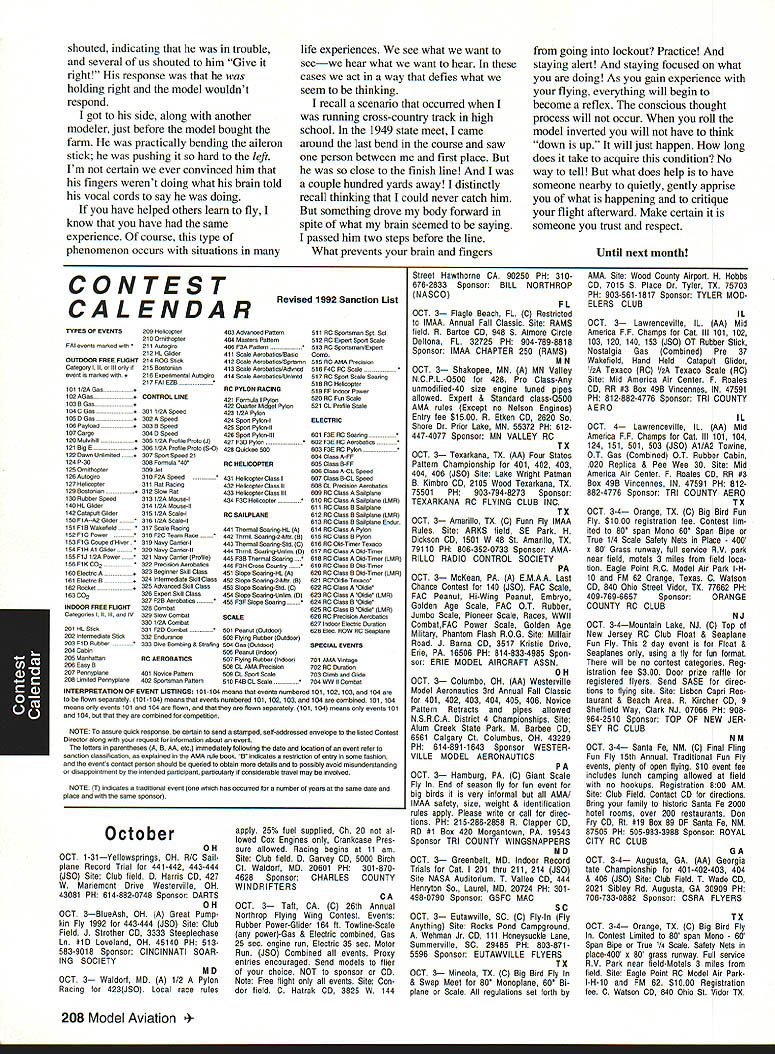
- I've seen pilots get into trouble because they tense up and "fight" the airplane with their hands. I once helped a newcomer whose model was in a steep left spiral. He insisted he was holding right, but his fingers were clamped on the stick and the model didn't respond. I told him to relax and remove his fingers from the sticks; the model straightened instantly. He put his fingers back and the spiral resumed.
- The point is simple: stop fighting the airplane with tense hands. Learn to relax, make smooth corrections, and the airplane will behave much better. With practice, many control responses become reflexive; you won't have to think "down is up" when the model is inverted.
- Practice under pressure
- Contests introduce pressure not normally found at the local field: time limits, spectators, and the knowledge that mistakes count. Simulate contest conditions in practice by putting yourself on the clock, asking friends to watch, or flying with distractions. The more you expose yourself to pressure in practice, the less it will bother you when it counts.
- Have someone nearby who can quietly and gently critique your flights afterward—someone you trust and respect.
There are dozens more little items that can make the difference between being merely competent and being a consistent competitor. Stay humble, keep learning, watch others, and above all, enjoy the flying.
Until next month!
---
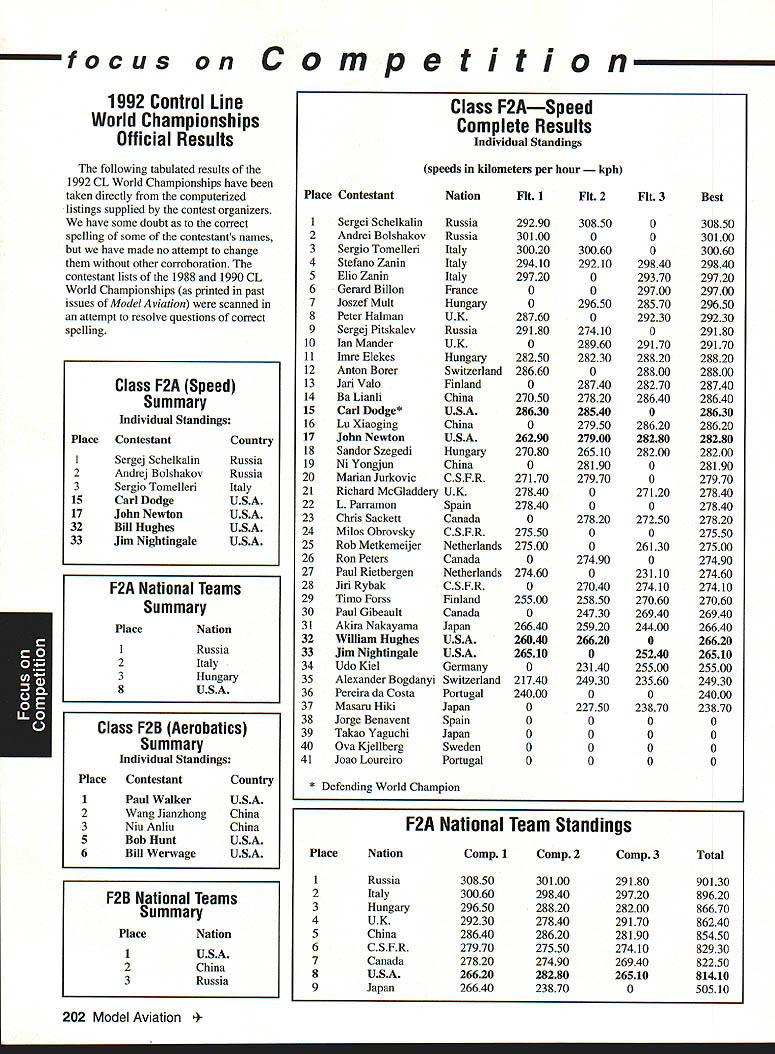
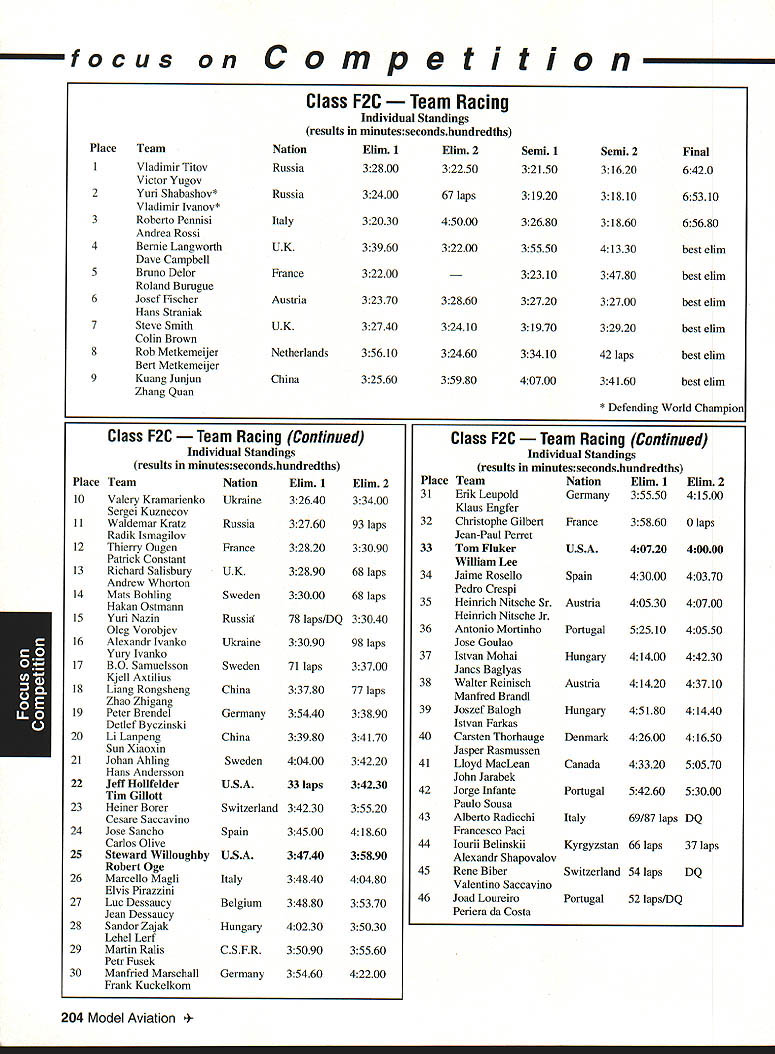
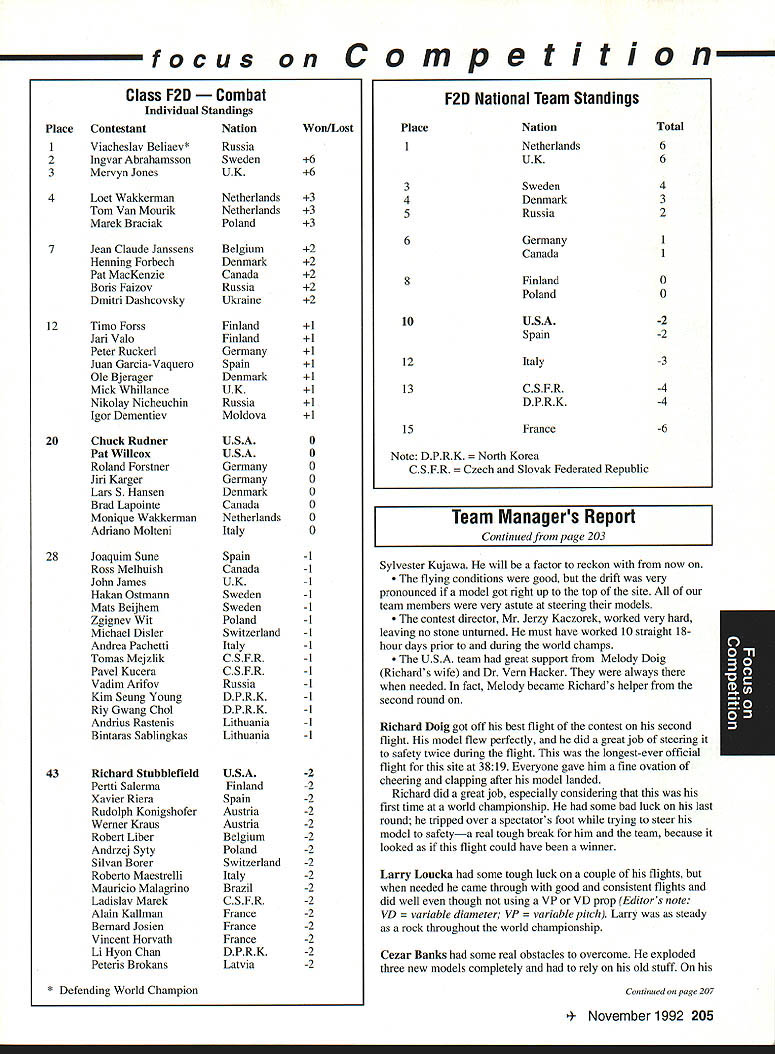
1992 Control Line World Championships Official Results
The following tabulated results of the 1992 CL World Championships have been taken directly from the computerized listings supplied by the contest organizers. We have some doubt as to the correct spelling of some contestants' names, but we have made no attempt to change them without corroboration. Contestant lists from past championships were referenced when possible.
Class F2A (Speed) Summary
Individual Standings:
- 1 Sergei Schelkalin Russia
- 2 Andrei Bolshakov Russia
- 3 Sergio Tomelleri Italy
- 15 Carl Dodge U.S.A.
- 17 John Newton U.S.A.
- 32 Bill Hughes U.S.A.
- 33 Jim Nightingale U.S.A.
F2A National Teams Summary
- 1 Russia
- 2 Italy
- 3 Hungary
- 8 U.S.A.
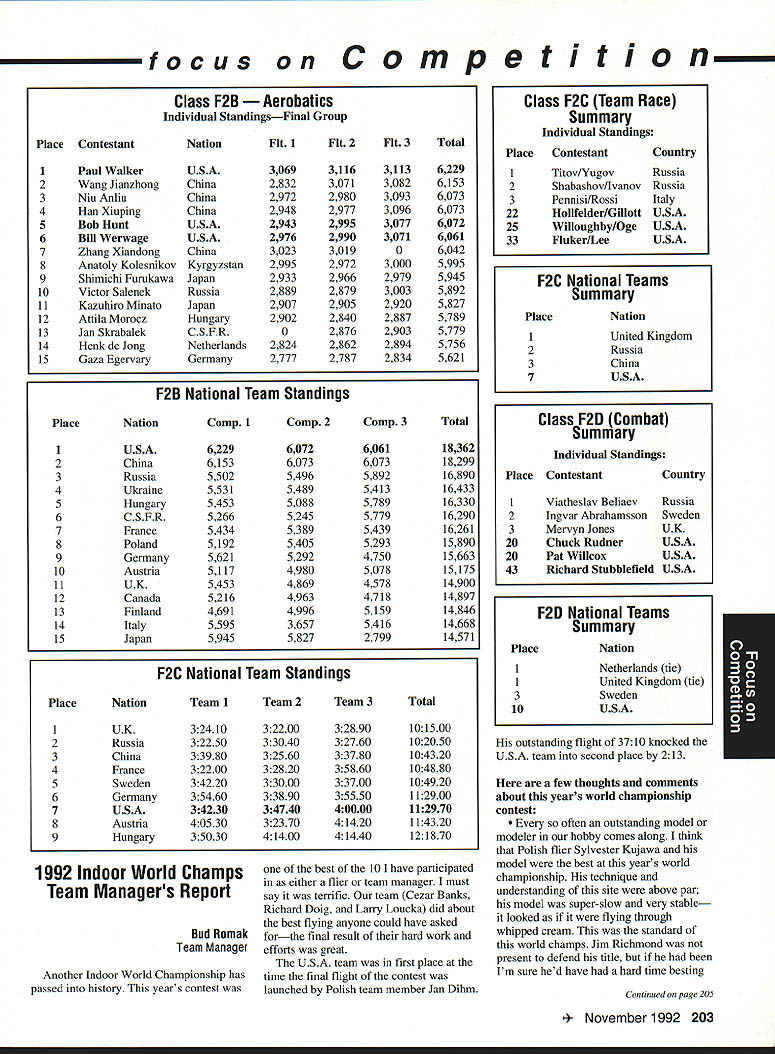
Class F2B (Aerobatics) Summary
Individual Standings:
- 1 Paul Walker U.S.A.
- 2 Wang Jianzhong China
- 3 Niu Anliu China
- 5 Bob Hunt U.S.A.
- 6 Bill Wervage U.S.A.
F2B National Teams Summary
- 1 U.S.A.
- 2 China
- 3 Russia
Class F2A — Speed
Complete Results Individual Standings (speeds in kilometers per hour — kph)
Place Contestant Nation Flt. 1 Flt. 2 Flt. 3 Best 1 Sergei Schelkalin Russia 292.90 308.50 0 308.50 2 Andrei Bolshakov Russia 301.00 0 0 301.00 3 Sergio Tomelleri Italy 300.20 300.60 0 300.60 4 Stefano Zanin Italy 294.10 292.10 298.40 298.40 5 Elio Zanin Italy 297.20 0 0 297.20 6 Gerard Billon France 0 0 297.00 297.00 7 Jozsef Mult Hungary 0 296.50 296.50 296.50 8 Peter Halman U.K. 287.60 0 0 292.30 9 Sergej Pitskalev Russia 291.80 274.10 0 291.80 10 Ian Mander U.K. 0 289.60 291.70 291.70 11 Imre Elekes Hungary 282.50 282.30 288.20 288.20 12 Anton Borer Switzerland 286.60 0 288.00 288.00 13 Jari Valo Finland 0 0 282.40 287.40 14 Ba Lianli China 270.50 278.20 286.40 286.40 15 Carl Dodge* U.S.A. 286.30 285.40 0 286.30 16 Lu Xiaoqing China 0 279.50 286.20 286.20 17 John Newton U.S.A. 262.90 270.90 282.80 282.80 18 Sandor Szegedi Hungary 270.80 265.10 282.00 282.00 19 Ni Yongjun China 0 281.90 0 281.90 20 Marian Jurkovic C.S.F.R. 271.70 279.70 0 279.70 21 Richard McGladdery U.K. 278.40 0 271.20 278.40 22 L. Parramon Spain 0 0 278.40 278.40 23 Chris Sackett Canada 0 278.20 272.50 278.20 24 Milos Obrovsky C.S.F.R. 275.50 0 0 275.50 25 Rob Metekmeijer Netherlands 275.00 0 261.30 275.00 26 Ron Peters Canada 0 274.90 0 274.90 27 Paul Rietbergen Netherlands 274.60 0 231.10 274.60 28 Jiri Rybak C.S.F.R. 0 270.40 274.10 274.10 29 Timo Forss Finland 255.00 258.50 270.60 270.60 30 Paul Gibeault Canada 0 247.30 269.40 269.40 31 Akira Nakayama Japan 266.40 0 259.20 266.40 32 William Hughes U.S.A. 260.40 266.20 0 266.20 33 Jim Nightingale U.S.A. 265.10 0 252.40 265.10 34 Udo Kiel Germany 0 231.40 255.00 255.00 35 Alexander Bogdanyi Switzerland 217.40 249.30 235.60 249.30 36 Pereira da Costa Portugal 240.00 0 0 240.00 37 Masaru Hiki Japan 0 227.50 238.70 238.70 38 Jorge Benavent Spain 0 0 0 0 39 Takao Yaguchi Japan 0 0 0 0 40 Ova Kjellberg Sweden 0 0 0 0 41 Joao Loureiro Portugal 0 0 0 0
* Defending World Champion
F2A National Team Standings
Place Nation Comp. 1 Comp. 2 Comp. 3 Total 1 Russia 308.50 301.00 291.80 901.30 2 Italy 300.60 298.40 297.20 896.20 3 Hungary 296.50 288.20 282.00 866.70 4 U.K. 292.30 278.40 291.70 862.40 5 China 286.40 286.20 281.90 854.50 6 C.S.F.R. 279.70 275.50 274.10 829.30 7 Canada 278.20 274.90 269.40 822.50 8 U.S.A. 266.20 282.80 265.10 814.10 9 Japan 266.40 238.70 0 505.10
Transcribed from original scans by AI. Minor OCR errors may remain.

