
Focus on Competition
A Note From the Technical Director
Bob Underwood
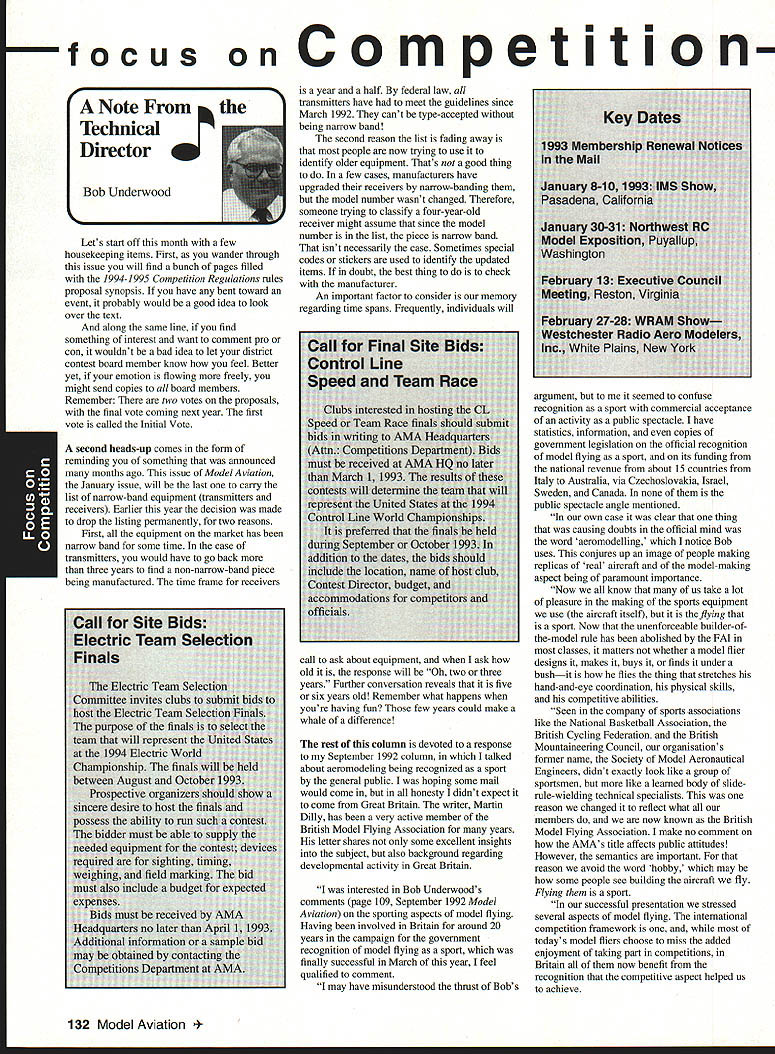
Let's start off this month with a few housekeeping items.
First, as you wander through this issue you will find a number of pages filled with the 1994–1995 Competition Regulations proposals and synopses. If you have an interest in any event, please read the text. If you find something of interest and want to comment pro or con, let your district contest board member know how you feel. Better yet, if emotion is flowing freely, send copies to all board members. Remember: there are two votes on the proposals, with the final vote coming next year. The first vote is called the Initial Vote.
A second heads-up: the January issue of Model Aviation will be the last to carry the list of narrow-band equipment (transmitters and receivers). Earlier this year the decision was made to drop the listing permanently for two reasons.
- First, all equipment on the market has been narrow band for some time. For transmitters you would have to go back more than three years to find a non–narrow-band piece being manufactured; for receivers, about a year and a half. By federal law, all transmitters have had to meet the guidelines since March 1992 and cannot be type-accepted unless narrow band.
- Second, the list is now often used to identify older equipment, which can be misleading. In some cases manufacturers have upgraded receivers to narrow band without changing the model number. Someone classifying a four-year-old receiver might assume, from a model number listed, that it is narrow band when it is not. Sometimes special codes or stickers identify updated items. If in doubt, check with the manufacturer.
An important factor to consider is our memory regarding time spans. Frequently, individuals call about equipment and say "Oh, two or three years." Further conversation reveals it is five or six years old. Remember what happens when you're having fun — those few years could make a world of difference!
The rest of this column is devoted to a response to my September 1992 column about aeromodelling being recognized as a sport by the general public. I was hoping some mail would come in, but in all honesty I didn't expect it to come from Great Britain. The writer, Martin Dilly, has been a very active member of the British Model Flying Association for many years. His letter shares excellent insights and background regarding developments in Great Britain.
Martin Dilly's letter (edited for clarity):
"I was interested in Bob Underwood's comments (page 109, September 1992 Model Aviation) on the sporting aspects of model flying. Having been involved in Britain for around 20 years in the campaign for government recognition of model flying as a sport — which was finally successful in March of this year — I feel qualified to comment.
"I may have misunderstood the thrust of Bob's argument, which seemed to confuse recognition as a sport with commercial acceptance of an activity as a public spectacle. I have statistics, information, and even copies of government legislation on the official recognition of model flying as a sport, and on its funding from national revenue in about 15 countries — Italy, Australia, Czechoslovakia, Israel, Sweden, Canada, and others. In none of them is the 'public spectacle' angle mentioned.
"In our case one thing causing doubts in the official mind was the word 'aeromodelling,' which conjures up an image of people making replicas of 'real' aircraft and of model-making being of paramount importance. We all know that many of us take a lot of pleasure in making the sports equipment we use (the aircraft itself), but it is the flying that is the sport.
"Now that the unenforceable builder-of-the-model rule has been abolished by the FAI in the model classes, it does not matter whether a model flier designs, makes, buys, or finds it under a bush — it is how he flies the thing that stretches his hand-and-eye coordination, physical skills, and competitive abilities.
"Seen in company with sports associations like the National Basketball Association, the British Cycling Federation, and the British Mountaineering Council, organizations formerly known as the Society of Model Aeronautical Engineers didn't exactly look like groups of sportsmen — more like learned bodies of slide-rule–wielding technical specialists. The reason we changed the name to reflect what members now do is that we are now known as the British Model Flying Association.
"I make no comment on how the AMA's title affects public attitudes; however, semantics are important. For many people the word 'hobby' may suggest something less serious. In our successful presentation we stressed several aspects of model flying. The international competition framework of today's model fliers was one of the things we chose to emphasize, and the added enjoyment of taking part in competitions has helped Britain obtain recognition. The competitive aspect helped us achieve our objective.
"The physical involvement is another. Control cannot be compared with flying, with similar aims to fencing; it requires highly developed reactions and hand/eye coordination. The aims in aerobatics, whether RC or CL, are akin to figure skating. In free flight the launch — whether of a towline glider, a Wakefield, or an F1C power model — is crucial to flight duration.
"Interestingly, we were helped in our presentation to the government by data from the Brazilian Aeromodelling Federation. Their government questioned the physical involvement in model flying, so an F1A flier was taken to the Army Medical Centre, fitted with radar, cameras, electromyograph, heart and lung monitors, and sent off to do typical circle towing, launches, and model recovery. The resulting medical data and graphs of cardiovascular exertion showed without a doubt that there was a sportsman in action.
"We deliberately downplayed the aspects of model flying that have little or no sporting relevance. For this reason scale was used only as an example of what model flying was not all about; judging how accurate or how well made the equipment is has no relevance to model flying, which is about how well you fly it. All the same, scale fliers in Britain also now benefit from government recognition of model flying as a sport.
"I have reservations about concentrating on aspects of our sport that have immediate commercial appeal if recognition as a sport is the objective. After all, a rock concert brings in crowds and is commercial, but it is not a sport.
"The benefits of sports recognition are numerous. Obvious ones include government funding for capital projects, financial help for national teams, training and coaching, involvement in the FAI, safety, and publicity. Less obvious ones are improved access to public sports facilities and help with site acquisition.
"Maybe one of the more nebulous benefits is the self-respect that comes from knowing model flying is no longer seen at government level as some frivolous pastime but as a sport that deserves as fair a share as football or track and field.
"Much of the preparatory work depends on local clubs' public relations people. Most important is a steady feed of stories to local papers, TV, and radio, all gently stressing the aims of model flying and spotlighting its heroes — the people who strive to fly models better and have competition results to show it.
"Always use the words 'sport' and 'model flying.' This also helps deter complaints, most of which arise from ignorance of model flying's purpose. Sometimes we are our own worst enemies.
"I know what Bob means by the problems of staying competitive when deeply involved with the national organization. As for fueling the 'sport/competition controversy,' competition flying is sport, and it's fun, the very best sort, too. If you haven't tried it yet, do. You won't be flying against other people, but with them. Whether you fly free flight, radio control, or control line, you're really competing against yourself. Doing a bit better is the point."
(End of Martin Dilly letter excerpt.)
---
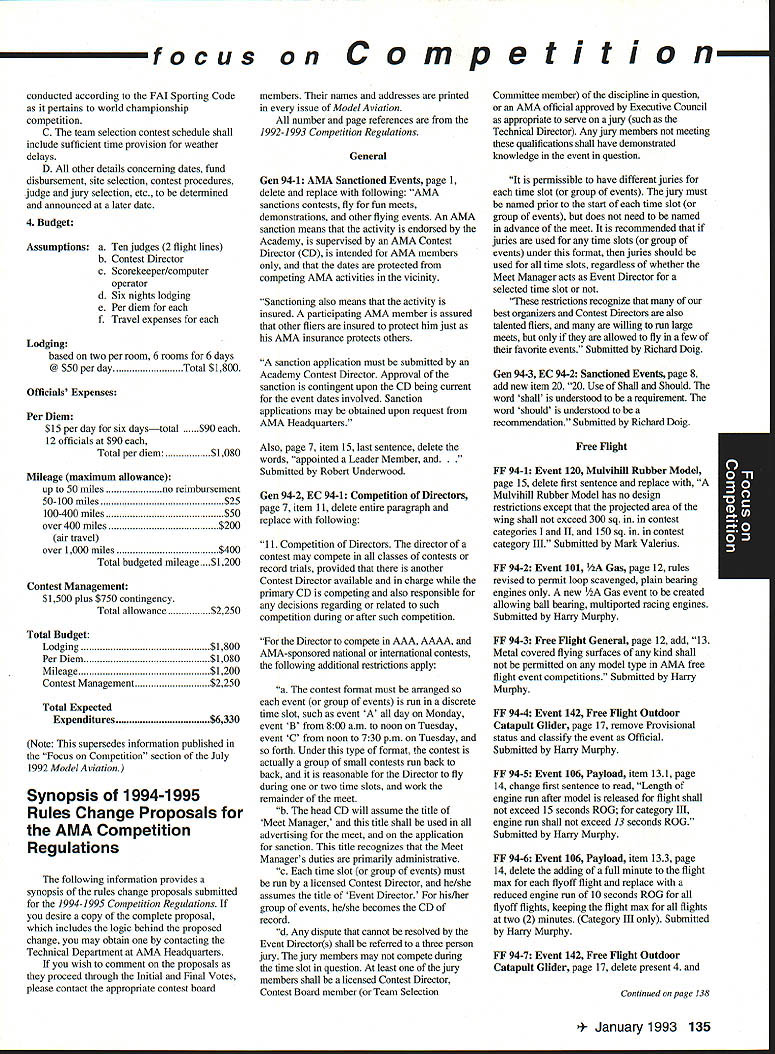
Team Selection — Budget Summary
Assumptions:
- Ten judges (2 flight lines)
- Contest Director
- Scorekeeper/computer operator
- Six nights lodging
- Per diem for each
- Travel expenses for each
Lodging:
- Based on two per room, 6 rooms for 6 days @ $50 per day (per room)
- Total: $1,800
Officials' Expenses:
- Per diem: $15 per day for six days — total $90 each
- 12 officials at $90 each — Total per diem: $1,080
Mileage (maximum allowance):
- Up to 50 miles — no reimbursement
- 50–100 miles — $25
- 100–400 miles — $50
- Over 400 miles (air travel) — $200
- Over 1,000 miles — $400
- Total budgeted mileage: $1,200
Contest Management:
- $1,500 plus $750 contingency
- Total allowance: $2,250
Total Budget:
- Lodging: $1,800
- Per Diem: $1,080
- Mileage: $1,200
- Contest Management: $2,250
Total Expected Expenditures: $6,330
(Note: This supersedes information published in the "Focus on Competition" section of the July 1992 Model Aviation.)
---
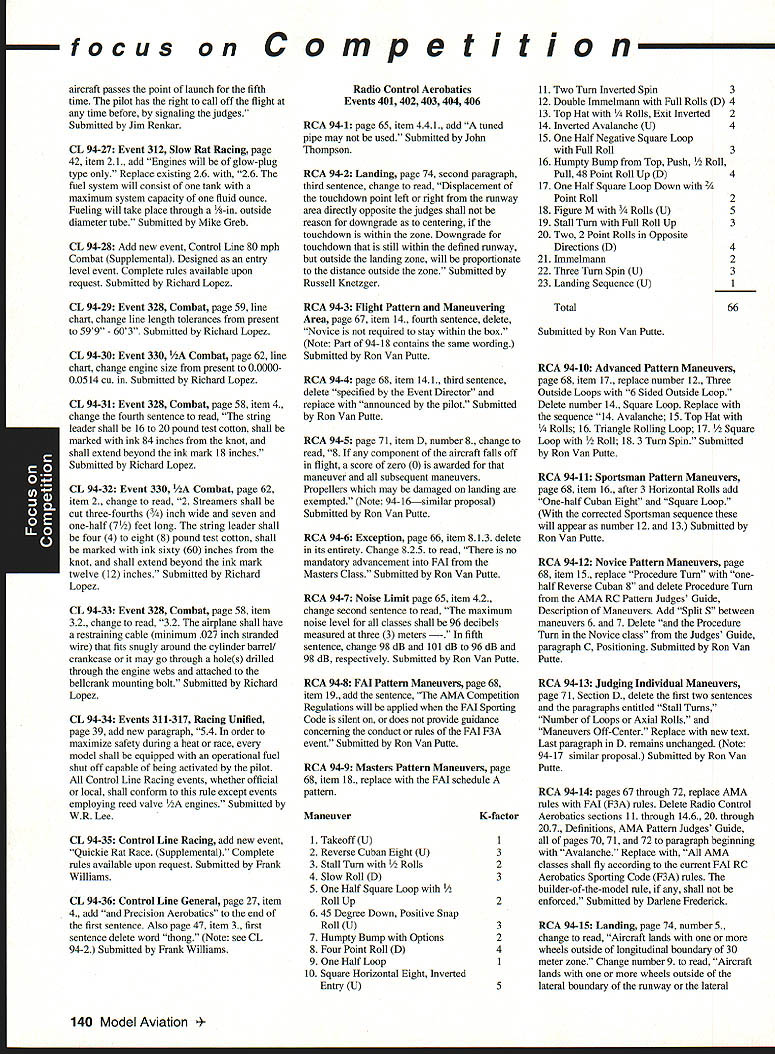
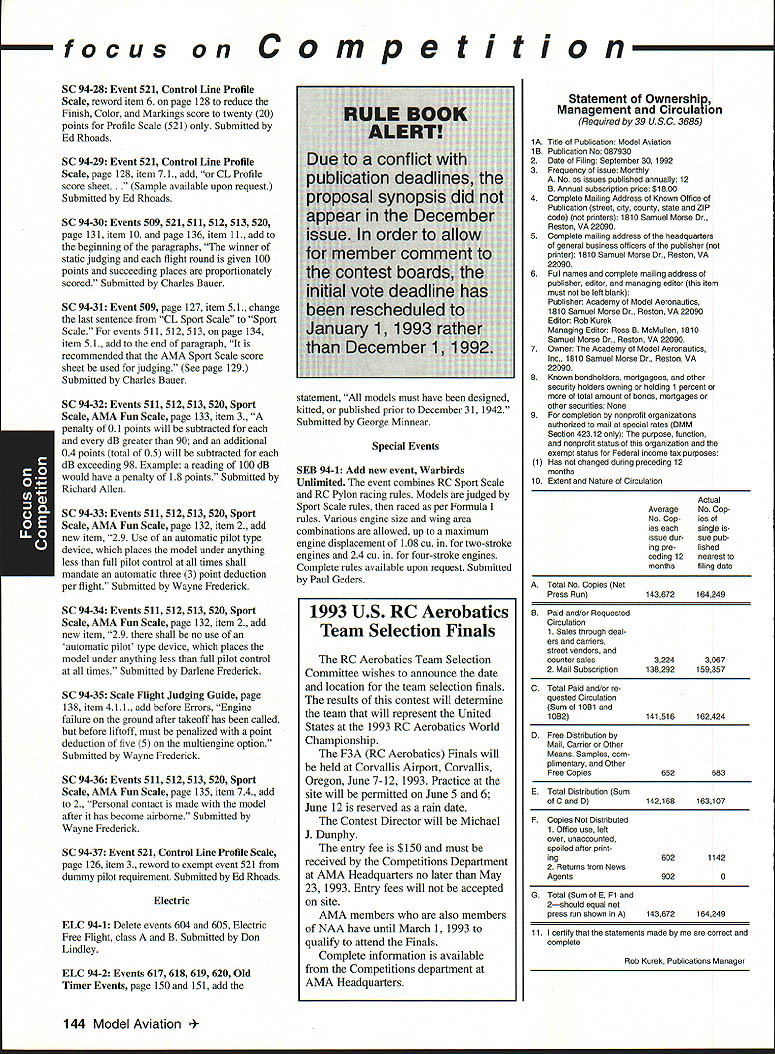
Synopsis of 1994–1995 Rules Change Proposals for the AMA Competition Regulations
The following is a synopsis of the rules change proposals submitted for the 1994–1995 Competition Regulations. If you desire a copy of a complete proposal (including rationale), contact the Technical Department at AMA Headquarters. If you wish to comment on proposals during the Initial and Final Votes, contact the appropriate contest board members (names/addresses are printed in each issue of Model Aviation).
All number and page references below are from the 1992–1993 Competition Regulations.
#### General
- Gen 94-1: AMA Sanctioned Events, page 1. Delete and replace with a new definition stating AMA sanctions contests, fly-for-fun meets, demonstrations, and other flying events; an AMA sanction means the activity is endorsed by the Academy, supervised by an AMA Contest Director (CD), intended for AMA members only, dates protected from competing AMA activities, and is insured. A sanction application must be submitted by an Academy Contest Director; approval contingent upon the CD being current for the event dates. Sanction applications available from AMA Headquarters. Also, page 7, item 15, last sentence: delete the words "appointed a Leader Member, and." Submitted by Robert Underwood.
- Gen 94-2 / EC 94-1: Competition of Directors, page 7, item 1. Delete the paragraph and replace with a new item (11. Competition of Directors) allowing contest directors to compete provided another Contest Director is available and in charge while the primary CD competes. Additional restrictions apply for AAA, AAAA, and AMA-sponsored national or international contests: discrete time slots for events, Head CD titled Meet Manager, each time slot run by a licensed Contest Director titled Event Director, unresolved disputes referred to a three-person jury with specified qualifications, recommended juries for all time slots. Submitted by Richard Doig.
#### Free Flight
- FF 94-1: Event 120, Mulvihill Rubber Model, page 15. Replace first sentence: "A Mulvihill Rubber Model has no design restrictions except that the projected area of the wing shall not exceed 300 sq. in. in contest categories II and III, and 150 sq. in. in contest category I." Submitted by Mark Valerius.
- FF 94-2: Event 101, 1/2A Gas, page 12. Rules revised to permit loop-scavenged, plain-bearing engines only. A new 1/2A Gas event to be created allowing ball-bearing, multiported racing engines. Submitted by Harry Murphy.
- FF 94-3: Free Flight General, page 12. Add: "13. Metal covered flying surfaces of any kind shall not be permitted on any model type in AMA free flight event competitions." Submitted by Harry Murphy.
- FF 94-4: Event 142, Free Flight Outdoor Catapult Glider, page 17. Remove Provisional status and classify as Official. Submitted by Harry Murphy.
- FF 94-5: Event 106, Payload, item 13.1, page 14. Change first sentence to read: "Length of engine run after model is released for flight shall not exceed 15 seconds ROG; for category III, engine run shall not exceed 13 seconds ROG." Submitted by Harry Murphy.
- FF 94-6: Event 106, Payload, item 13.3, page 14. Delete the addition of a full minute to the flight timer for each flyoff flight and replace with a reduced engine run of 10 seconds ROG for all flyoff flights, keeping the flight max for all flights at two minutes. (Category III only.) Submitted by Harry Murphy.
- FF 94-7: Event 142, Free Flight Outdoor Catapult Glider, page 17. Delete present 4 and 5 minute flight times for categories and replace with standardized flight times as proposed. Submitted by Harry Murphy.
- FF 94-8: Event 146, Rubber Scale, page 16. Revise rules to clarify towing and launch procedures and to specify scoring changes. Submitted by Harry Murphy.
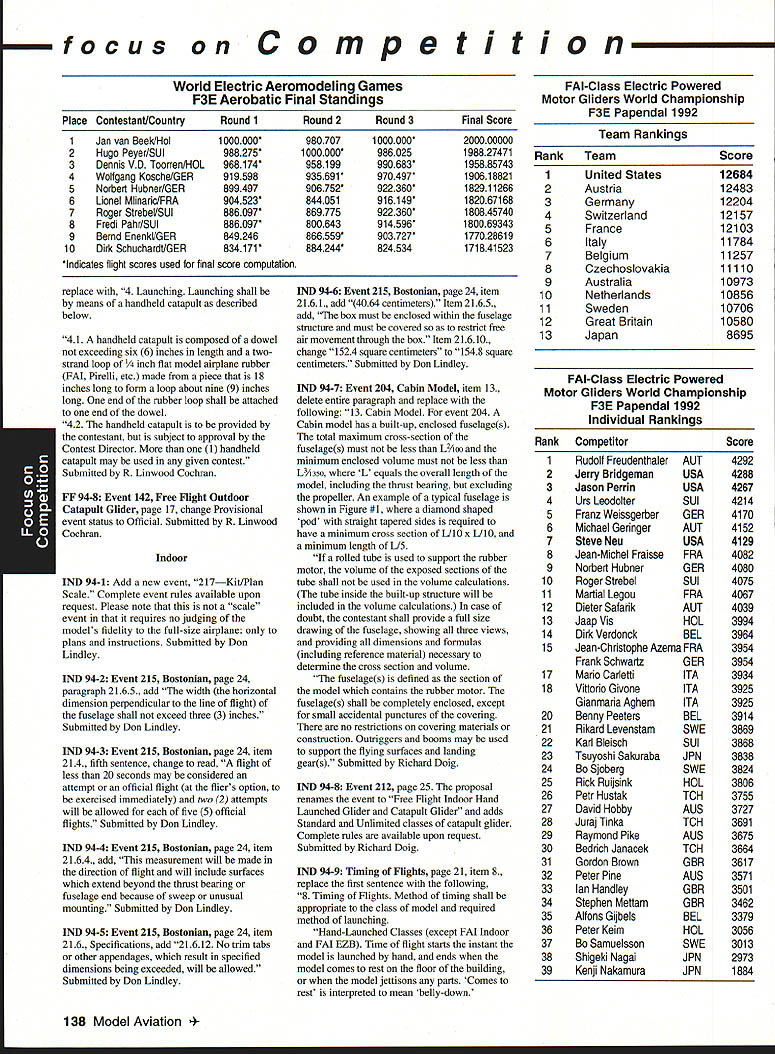
- FF 94-8 (alternate submission): Event 142, change Provisional event status to Official. Submitted by R. Linwood Cochran.
- Additional FF 94-? (Catapult glider launching text proposed by R. Linwood Cochran): Replace current launch rules with:
- "4. Launching. Launching shall be by means of a handheld catapult as described below.
- 4.1. A handheld catapult is composed of a dowel not exceeding six (6) inches in length and a two-strand loop of 1/4 inch flat model airplane rubber (FAI, Pirelli, etc.) made from a piece that is 18 inches long to form a loop about nine (9) inches long. One end of the rubber loop shall be attached to one end of the dowel.
- 4.2. The handheld catapult is to be provided by the contestant, but is subject to approval by the Contest Director. More than one (1) handheld catapult may be used in any given contest."
#### Indoor
- IND 94-1: Add a new event, "217 — Kit/Plan Scale." Complete event rules available upon request. Note: This is not a traditional "scale" event; it requires no judging of fidelity to the full-size airplane, only to plans and instructions. Submitted by Don Lindley.
- IND 94-2: Event 215, Bostonian, page 24, paragraph 21.6.5. Add: "The width (the horizontal dimension perpendicular to the line of flight) of the fuselage shall not exceed three (3) inches." Submitted by Don Lindley.
- IND 94-3: Event 215, Bostonian, page 24, item 21.4, fifth sentence. Change to: "A flight of less than twenty (20) seconds may be considered an attempt or an official flight (at the flier's option, to be exercised immediately) and two (2) attempts will be allowed for each of five (5) official flights." Submitted by Don Lindley.
- IND 94-4: Event 215, Bostonian, page 24, item 21.6.4. Add: "This measurement will be made in the direction of flight and will include surfaces which extend beyond the thrust bearing or fuselage end because of sweep or unusual mounting." Submitted by Don Lindley.
- IND 94-5: Event 215, Bostonian, page 24, item 21.6.5 (Specifications). Add: "21.6.12. No trim tabs or other appendages, which result in specified dimensions being exceeded, will be allowed." Submitted by Don Lindley.
- IND 94-6: Event 215, Bostonian, page 24, item 21.6.5. Add "(40.64 centimeters)." Also: "The box must be enclosed within the fuselage structure and must be covered so as to restrict free air movement through the box." Item 21.6.10: change "152.4 square centimeters" to "154.8 square centimeters." Submitted by Don Lindley.
- IND 94-7: Event 204, Cabin Model, item 13. Replace paragraph with a clarified definition and volume/cross-section requirements; includes instructions on calculating enclosed volume, rolled tube exceptions, and requirement that the fuselage(s) contain the rubber motor. Submitted by Richard Doig.
- IND 94-8: Event 212, page 25. Rename event to "Free Flight Indoor Hand-Launched Glider and Catapult Glider" and add Standard and Unlimited classes of catapult glider. Complete rules available upon request. Submitted by Richard Doig.
- IND 94-9: Timing of Flights, page 21, item 8. Replace first sentence with: "Timing of flights shall commence at the release of the model and end when the model comes to rest." Clarify timing for Hand-Launched Classes, Rise-Off-Ground Classes, and All Classes; include delayed flight period (60 seconds unless otherwise specified) and rules for obstructions. Submitted by Richard Doig.
#### Control Line (CL)
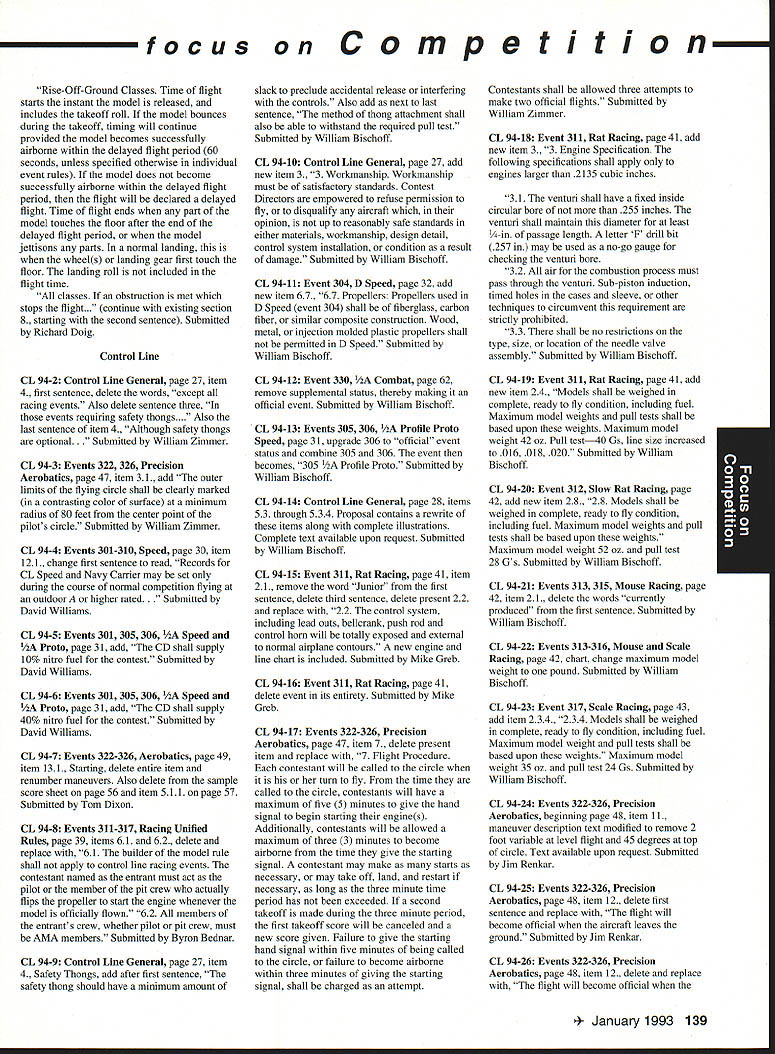
- CL 94-2: Control Line General, page 27, item 4. Delete the words "except all racing events." Also delete sentences about safety thongs and optional nature. Submitted by William Zimmer.
- CL 94-3: Events 322, 326, Precision Aerobatics, page 47, item 3.1. Add: "The outer limits of the flying circle shall be clearly marked (in a contrasting color of surface) at a minimum radius of 80 feet from the center point of the pilot's circle." Submitted by William Zimmer.
- CL 94-4: Events 301–310, Speed, page 30, item 12.1. Change first sentence: "Records for CL Speed and Navy Carrier may be set only during the course of normal competition flying at an outdoor A or higher rated..." Submitted by David Williams.
- CL 94-5: Events 301, 305, 306, 1/2A Speed and 1/2A Proto, page 31. Add: "The CD shall supply 10% nitro fuel for the contest." Submitted by David Williams.
- CL 94-6: Events 301, 305, 306, 1/2A Speed and 1/2A Proto, page 31. Add: "The CD shall supply 40% nitro fuel for the contest." Submitted by David Williams. (Note: These two submissions appear to conflict — both propose specific fuel nitro contents.)
- CL 94-7: Events 322–326, Aerobatics, page 49, item 13.1. Starting. Delete entire item and renumber maneuvers; also delete related sample score sheet sections. Submitted by Tom Dixon.
- CL 94-8: Events 311–317, Racing Unified Rules, page 39, items 6.1 and 6.2. Delete and replace with: "6.1. The builder-of-the-model rule shall not apply to control line racing events. The contestant named as the entrant must act as the pilot or the member of the pit crew who actually flips the propeller to start the engine whenever the model is officially flown. 6.2. All members of the entrant's crew, whether pilot or pit crew, must be AMA members." Submitted by Byron Bednar.
- CL 94-9: Control Line General, page 27, item 4., Safety Thongs. Add: "The safety thong should have a minimum amount of slack to preclude accidental release or interfering with the controls." Also add: "The method of thong attachment shall also be able to withstand the required pull test." Submitted by William Bischoff.
- CL 94-10: Control Line General, page 27. Add new item 3., "Workmanship. Workmanship must be of satisfactory standards. Contest Directors are empowered to refuse permission to fly, or to disqualify any aircraft which, in their opinion, is not up to reasonably safe standards in materials, workmanship, design detail, control system installation, or condition as a result of damage." Submitted by William Bischoff.
- CL 94-11: Event 304, D Speed, page 32. Add new item 6.7.2: "Propellers used in D Speed (event 304) shall be of fiberglass, carbon fiber, or similar composite construction. Wood, metal, or injection molded plastic propellers shall not be permitted in D Speed." Submitted by William Bischoff.
- CL 94-12: Event 330, 1/2A Combat, page 62. Remove supplemental status, making it an official event. Submitted by William Bischoff.
- CL 94-13: Events 305, 306, 1/2A Profile Proto Speed, page 31. Upgrade 306 to "official" and combine 305 and 306 into "305/1/2A Profile Proto." Submitted by William Bischoff.
- CL 94-14: Control Line General, page 28, items 5.3–5.3.4. Proposal rewrites these items and includes illustrations. Complete text available upon request. Submitted by William Bischoff.
- CL 94-15: Event 311, Rat Racing, page 41, item 2.1. Remove the word "Junior" from the first sentence; revise control system wording; include new engine and line chart. Submitted by Mike Greb.
- CL 94-16: Event 311, Rat Racing, page 41. Delete the event in its entirety. Submitted by Mike Greb.
- CL 94-17: Events 322–326, Precision Aerobatics, page 47, item 7. Flight Procedure. Replace existing text with a new time-of-start and takeoff procedure, including a five-minute limit to begin starting engines after being called to the circle, and a three-minute limit to become airborne after signaling. Contestants may make many starts within the three minutes; multiple starts allowed, with conditions described. Contestants allowed three attempts to make two official flights. Submitted by William Zimmer.
- CL 94-18: Event 311, Rat Racing, page 41. Add new item 3., "Engine Specification." For engines larger than .2135 cu in:
- 3.1. Venturi fixed inside circular bore not more than .225 inches, maintain diameter for at least 1/4 in. of passage. A 'letter F' drill bit (.257 in.) may be used as no-go gauge.
- 3.2. All air for combustion must pass through the venturi; sub-piston induction, timed holes in cases and sleeves, or other circumventing techniques prohibited.
- 3.3. No restrictions on size or location of the needle valve assembly.
Submitted by William Bischoff.
- CL 94-19: Event 311, Rat Racing, page 41. Add new item 2.4: Models weighed ready to fly including fuel; maximum model weight 42 oz; pull test 40 Gs; line size increased to .016, .018, .020. Submitted by William Bischoff.
- CL 94-20: Event 312, Slow Rat Racing, page 42. Add new item 2.8: Models weighed ready to fly including fuel; maximum model weight 52 oz; pull test 28 Gs. Submitted by William Bischoff.
- CL 94-21: Events 313, 315, Mouse Racing, page 42, item 2.1. Delete the words "currently produced" from the first sentence. Submitted by William Bischoff.
- CL 94-22: Events 313–316, Mouse and Scale Racing, page 42. Change maximum model weight to one pound. Submitted by William Bischoff.
- CL 94-23: Event 317, Scale Racing, page 43. Add new 2.3.4: Models weighed ready to fly including fuel; maximum model weight 35 oz; pull test 24 Gs. Submitted by William Bischoff.
- CL 94-24: Events 322–326, Precision Aerobatics, page 48, item 11. Remove description text modified to remove 2-foot variable at level flight and 45 degrees at top of circle. Text available upon request. Submitted by Jim Renkar.
- CL 94-25: Events 322–326, Precision Aerobatics, page 48, item 12. Delete first sentence and replace with: "The flight will become official when the aircraft passes the point of launch for the fifth time. The pilot has the right to call off the flight at any time before, by signaling the judges." Submitted by Jim Renkar.
- CL 94-27: Event 312, Slow Rat Racing, page 42, item 2.1. Add: "Engines will be of glow-plug type only." Replace existing 2.6 with fuel system specification: one tank, maximum capacity one fluid ounce; fueling through a 9/16-in. outside diameter tube. Submitted by Mike Greb.
- CL 94-28: Add new event, Control Line 80 mph Combat (Supplemental). Entry-level event. Complete rules available upon request. Submitted by Richard Lopez.
- CL 94-29: Event 328, Combat, page 59, chart. Change line length tolerances to 59'9"–60'3". Submitted by Richard Lopez.
- CL 94-30: Event 330, 1/2A Combat, page 62, chart. Change engine size to 0.000–0.0514 cu. in. Submitted by Richard Lopez.
- CL 94-31: Event 328, Combat, page 58, item 4. Change fourth sentence to: "The string leader shall be 16 to 20 pound test cotton, shall be marked with 8 in. knots from the knot, and shall extend beyond the knot mark 18 inches." Submitted by Richard Lopez.
- CL 94-32: Event 330, 1/2A Combat, page 62, item 2. Change to: "2. Streamers shall be one-fourth (1/4) inch wide and seven and one-half (7 1/2) feet long. The string leader shall be four (4) to eight (8) pound test cotton, shall be marked with sixty (60) inches from the knot, and shall extend beyond the mark twelve (12) inches." Submitted by Richard Lopez.
- CL 94-33: Event 328, Combat, page 58, item 3. Change to: "3. The airplane shall have a restraining cable (minimum .027 inch stranded wire) that fits snugly around the cylinder barrel/crankcase or it may go through a hole(s) drilled through the engine web and attached to the bellcrank mounting bolt." Submitted by Richard Lopez.
- CL 94-34: Events 311–317, Racing Unified, page 39. Add new paragraph 5-4: All models shall be equipped with an operational fuel shutoff capable of being activated by the pilot. All Control Line Racing events, whether official or local, shall conform to this rule except events employing two-valve 1/2A engines. Submitted by W.R. Lee.
- CL 94-35: Control Line Racing. Add new event "Quickie Rat Race" (Supplemental). Complete rules available upon request. Submitted by Frank Williams.
- CL 94-36: Control Line General, page 27, item 4. Add "Precision Aerobatics" to the end of the first sentence. Also page 47, item 3., first sentence: delete the word "thong." (Note: see CL 94-2.) Submitted by Frank Williams.
#### Radio Control Aerobatics (Events 401, 402, 403, 404, 406)
- RCA 94-1: Page 65, item 4.4.1. Add: "A tuned pipe may not be used." Submitted by John Thompson.
- RCA 94-2: Landing, page 74, second paragraph, third sentence. Change to clarify touchdown displacements and proportional downgrades. Submitted by Russell Kneziger.
- RCA 94-3: Flight Pattern and Maneuvering Area, page 67, item 14. Delete the sentence: "Novice is not required to stay within the box." Submitted by Ron Van Putte.
- RCA 94-4: Page 68, item 14.1, third sentence. Delete "specified by the Event Director" and replace with "announced by the pilot." Submitted by Ron Van Putte.
- RCA 94-5: Page 71, item D, number 8. Change to: "If any component of the aircraft fails in flight, a score of zero (0) is awarded for that maneuver and all subsequent maneuvers. Propellers that may be damaged on landing are exempted." Submitted by Ron Van Putte.
- RCA 94-6: Exception, page 66, item 8.1.3. Delete in its entirety. Change 8.2.5 to read: "There is no mandatory advancement into FAI from the Masters Class." Submitted by Ron Van Putte.
- RCA 94-7: Noise Limit, page 65, item 4.2. Change second sentence: "The maximum noise level for all classes shall be 96 decibels measured at three (3) meters." Change related dB figures accordingly. Submitted by Ron Van Putte.
- RCA 94-8: FAI Pattern Maneuvers, page 68, item 19. Add: "The AMA Competition Regulations will be applied when the FAI Sporting Code is silent on a maneuver and scoring guidance concerning the conduct or rules of the FAI/FAI event." Submitted by Ron Van Putte.
- RCA 94-9: Masters Pattern Maneuvers, page 68, item 8. Replace with the FAI schedule A pattern. (Maneuver list with K-factors provided.) Submitted by Ron Van Putte.
- RCA 94-10: Advanced Pattern Maneuvers, page 68, item 17. Replace number 12 (Three Outside Loops) with "6 Sided Outside Loop." Delete number 14 (Square Loop). Replace with sequence changes including Avalanche, Top Hat with 1/4 Rolls, Triangle Roll Loop, and others. Submitted by Ron Van Putte.
- RCA 94-11: Sportsman Pattern Maneuvers, page 68, item 16. After 3 Horizontal Rolls add "One-half Cuban Eight" and "Square Loop." Submitted by Ron Van Putte.
- RCA 94-12: Novice Pattern Maneuvers, page 68, item 15. Replace "Procedure Turn" with "one-half Reverse Cuban 8" and delete Procedure Turn from the AMA R/C Pattern Judges' Guide. Add "Split S" between names. Submitted by Ron Van Putte.
- RCA 94-13: Judging Individual Maneuvers, page 71, second paragraph. Replace several paragraphs (Stall Turns, Number of Loops or Axial Rolls, Maneuvers Off-Center) with new text. (Note: 94-17 similar.) Submitted by Ron Van Putte.
- RCA 94-14: Pages 67–72. Replace AMA rules with FAI (F3A) rules. Delete large sections of the Radio Control Aerobatics rules and replace with a statement that all AMA classes shall fly according to current FAI RC Aerobatic Sporting Code (F3A) rules. The builder-of-the-model rule, if any, shall not be enforced. Submitted by Darlene Frederick.
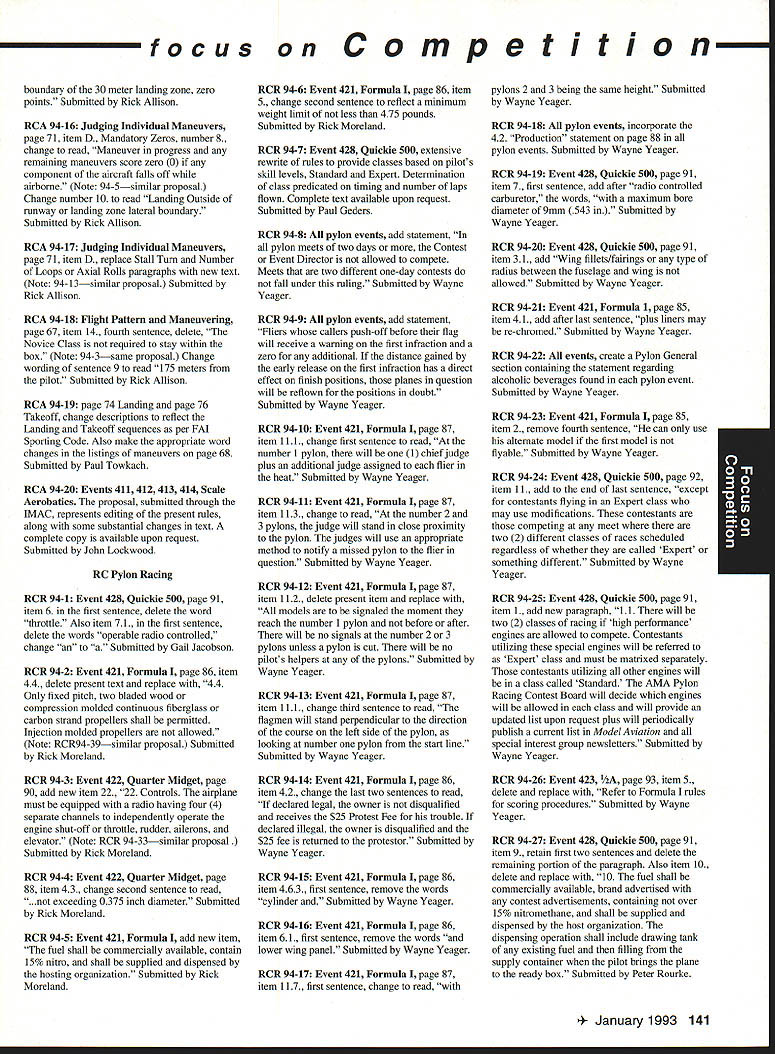
- RCA 94-15: Landing, page 74, numbers 7 and 9. Change wording regarding landing with wheels outside runway boundaries and lateral boundaries. Submitted by Ron Van Putte / Rick Allison (notes indicate related edits).
- RCA 94-16: Judging Individual Maneuvers, page 71, item D, Mandatory Zeros. Number 8: change to read: "Maneuver in progress and any remaining maneuvers score zero (0) if any component of the aircraft falls off while airborne." Also change number 10 to read "Landing Outside of runway or landing zone lateral boundary." Submitted by Rick Allison.
- RCA 94-17: Judging Individual Maneuvers, page 71, item D. Replace Stall Turn and Number of Loops or Axial Rolls paragraphs with new text. (Note: Similar proposals exist.) Submitted by Rick Allison.
- RCA 94-18: Flight Pattern and Maneuvering, page 67, item 14. Delete "Novice Class is not required to stay within the box." Also change a distance wording to "175 meters from the pilot." Submitted by Rick Allison.
- RCA 94-19: Page 74 Landing and page 76 Takeoff. Change descriptions to reflect FAI Sporting Code Landing and Takeoff sequences; update maneuver listings. Submitted by Paul Towchak.
- RCA 94-20: Events 411–414, Scale Aerobatics. Proposal submitted through IMAC represents editorial changes and substantial text changes; complete copy available upon request. Submitted by John Lockwood.
#### RC Pylon Racing
- RCR 94-1: Event 428, Quickie 500, page 88, item 6. Delete the word "throttle." Item 7.1: delete "operable radio controlled," change "fan" to "a." Submitted by Gail Jacobson.
- RCR 94-2: Event 421, Formula I, page 86, item 4.4. Replace with: "Only fixed pitch, two-bladed wood or carbon propellers molded continuous fiberglass or carbon strand propellers shall be permitted. Injection molded propellers are not allowed." Submitted by Rick Moreland.
- RCR 94-3: Event 422, Quarter Midget, page 90, add new item 22: "Controls. The airplane must be equipped with a radio having four (4) separate channels to independently operate the engine shut-off or throttle, rudder, ailerons, and elevator." Submitted by Rick Moreland.
- RCR 94-4: Event 422, Quarter Midget, page 88, item 4.3. Change second sentence to read "...not exceeding 0.375 inch diameter." Submitted by Rick Moreland.
- RCR 94-5: Event 421, Formula I. Add new item: "The fuel shall be commercially available, contain 15% nitromethane, and shall be supplied and dispensed by the hosting organization." Submitted by Rick Moreland.
- RCR 94-6: Event 421, Formula I, page 86, item 5. Change second sentence to reflect a minimum weight limit of not less than 4.75 pounds. Submitted by Rick Moreland.
- RCR 94-7: Event 428, Quickie 500. Extensive rewrite to provide classes Standard and Expert, determination based on timing and number of laps. Complete text available upon request. Submitted by Paul Gedes.
- RCR 94-8: All pylon events. Add statement: "In all pylon meets of two days or more, the Contest or Event Director is not allowed to compete. Meets that are two different one-day contests do not fall under this ruling." Submitted by Wayne Yeager.
- RCR 94-9: All pylon events. Add statement regarding collars pushing off before line release: first infraction warning, additional zeros thereafter; re-flights if early release affected finish positions. Submitted by Wayne Yeager.
- RCR 94-10: Event 421, Formula I, page 87, item 11. Change: "At the number 1 pylon, there will be one (1) chief judge plus an additional judge assigned to each flier in the heat." Submitted by Wayne Yeager.
- RCR 94-11: Event 421, Formula I, page 87, item 11. Change: "At numbers 2 and 3 pylons, judge will stand in close proximity to the pylon. Judges will use an appropriate method to notify a missed pylon to the flier in question." Submitted by Wayne Yeager.
- RCR 94-12: Event 421, item 11.2. Replace with: "All models are to be signaled the moment they reach number 1 pylon and not before or after. There will be no signals at the number 2 or 3 pylons unless a pylon is cut. There will be no pilot's helpers at any pylons." Submitted by Wayne Yeager.
- RCR 94-13: Event 421, item 11.1. Change: "The flier's model shall not be considered to be on course on the left side of the pylon, as looking at number one pylon from the start line." Submitted by Wayne Yeager.
- RCR 94-14: Event 421, page 86, item 4.2. Change the last two sentences about protests and protest fee disposition. Submitted by Wayne Yeager.
- RCR 94-15: Event 421, page 86, item 4.6.3. Remove words "cylinder and." Submitted by Wayne Yeager.
- RCR 94-16: Event 421, page 86, item 6.1. Remove words "and lower wing panel." Submitted by Wayne Yeager.
- RCR 94-17: Event 421, item 11.7. Change to: "with pylons 2 and 3 being the same height." Submitted by Wayne Yeager.
- RCR 94-18: All pylon events. Incorporate the 4.2 "Production" statement on page 88 into all pylon events. Submitted by Wayne Yeager.
- RCR 94-19: Event 428, Quickie 500, page 91, item 7. Add a maximum carburetor bore diameter of 9mm (.543 in.). Submitted by Wayne Yeager.
- RCR 94-20: Event 428, Quickie 500, page 91, item 3.1. Add: "Wing fillets/fairings or any type of radius between the fuselage and wing is not allowed." Submitted by Wayne Yeager.
- RCR 94-21: Event 421, page 85, item 4.1. Add: "plus liners may be re-chromed." Submitted by Wayne Yeager.
- RCR 94-22: All events. Create a Pylon General section containing the alcoholic beverages statement currently found in each pylon event. Submitted by Wayne Yeager.
- RCR 94-23: Event 421, page 85, item 2. Remove fourth sentence: "He can only use his alternate model if the first model is not flyable." Submitted by Wayne Yeager.
- RCR 94-24: Event 428, Quickie 500, page 92, item 11. Add: exceptions for Expert class modifications when there are two classes. Submitted by Wayne Yeager.
- RCR 94-25: Event 428, Quickie 500, page 91, item 1.1. Add paragraph establishing two classes (Standard and Expert), requirement to mark Expert models, AMA Pylon Racing Contest Board will publish allowed engines list. Submitted by Wayne Yeager.
- RCR 94-26: Events 423, 423A, page 93, item 5. Delete and replace with "Refer to Formula I rules for scoring procedures." Submitted by Wayne Yeager.
- RCR 94-27: Event 428, Quickie 500, page 91, item 9. Retain first two sentences, delete remaining paragraph. Replace item 10 with fuel supply and dispensing procedure specifying commercially available fuel containing not over 15% nitromethane, supplied and dispensed by host organization. Submitted by Peter Rourke.
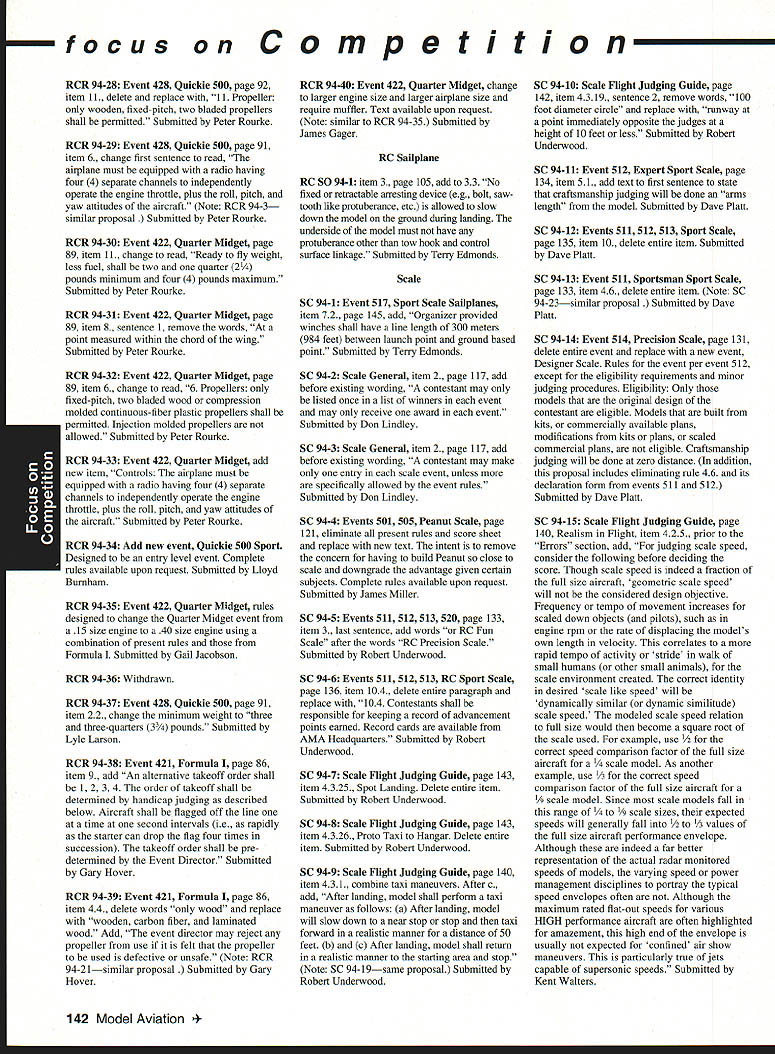
- RCR 94-28: Event 428, Quickie 500, page 92, item 11. Delete and replace with: "11. Propeller: only wooden, fixed-pitch, two-bladed propellers shall be permitted." Submitted by Peter Rourke.
- RCR 94-29: Event 428, Quickie 500, page 91, item 6. Change first sentence to require radio with four separate channels to operate engine throttle plus roll, pitch, and yaw. Submitted by Peter Rourke.
- RCR 94-30: Event 422, Quarter Midget, page 89, item 11. Change ready-to-fly weight less fuel to be 2.25 pounds minimum and 4 pounds maximum. Submitted by Peter Rourke.
- RCR 94-31: Event 422, Quarter Midget, page 89, item 8. Remove clause "At a point measured within the chord of the wing." Submitted by Peter Rourke.
- RCR 94-32: Event 422, Quarter Midget, page 89, item 6. Propellers: only fixed-pitch two-bladed wood or compression-molded continuous-fiber plastic propellers; injection molded propellers not allowed. Submitted by Peter Rourke.
- RCR 94-33: Event 422, Quarter Midget. Add new "Controls" item requiring radio with four separate channels to operate engine throttle plus roll, pitch, and yaw. Submitted by Peter Rourke.
- RCR 94-34: Add new event, Quickie 500 Sport (entry-level). Complete rules available upon request. Submitted by Lloyd Burnham.
- RCR 94-35: Event 422, Quarter Midget. Change event to larger engine size (.40) and larger airplane size and require muffler; text available upon request. Submitted by Gail Jacobson.
- RCR 94-36: Withdrawn.
- RCR 94-37: Event 428, Quickie 500, page 91, item 2. Change minimum weight to 3.75 pounds. Submitted by Lyle Larson.
- RCR 94-38: Event 421, Formula I, page 86, item 9. Add an alternative takeoff order and description of one-second flag releases, takeoff order determined by handicap. Submitted by Gary Hoyer.
- RCR 94-39: Event 421, Formula I, page 86, item 4. Delete "only wood" and replace with "wooden, carbon fiber, and laminated wood." Allow Event Director to reject unsafe propellers. Submitted by Gary Hoyer.
- RCR 94-40: Event 422, Quarter Midget. Change to larger engine and airplane size and require muffler. Submitted by James Gager.
#### RC Sailplane
- RC SO 94-1: Item 3., page 105, add to 3.3: "No fixed or retractable arresting device (e.g., bolt, saw-tooth like protuberance, etc.) is allowed to slow the model on the ground during landing. The underside of the model must not have any protuberance other than tow hook and control surface linkage." Submitted by Terry Edmonds.
#### Scale
- SC 94-1: Event 517, Sport Scale Sailplanes, item 7., page 145. Add: "Organizer provided winches shall have a line length of 300 meters (984 feet) between launch point and ground base point." Submitted by Terry Edmonds.
- SC 94-2: Scale General, item 2., page 117. Add: "A contestant may only be listed once in a list of winners in each event and may only receive one award in each event." Submitted by Don Lindley.
- SC 94-3: Scale General, item 2., page 117. Add: "A contestant may make only one entry in each scale event, unless more are specifically allowed by the event rules." Submitted by Don Lindley.
- SC 94-4: Events 501, 505, Peanut Scale, page 121. Eliminate present rules and score sheet and replace with new text intended to reduce the advantage given certain subjects and remove pressure to build Peanut very close to scale. Complete rules available upon request. Submitted by James Miller.
- SC 94-5: Events 511, 512, 513, 520, page 133, item 3. Add words "or RC Fun Scale" after "RC Precision Scale." Submitted by Robert Underwood.
- SC 94-6: Events 511, 512, 513, RC Sport Scale, page 136, item 10.4. Delete entire paragraph and replace with: "10.4. Contestants shall be responsible for keeping a record of advancement points earned. Record cards are available from AMA Headquarters." Submitted by Robert Underwood.
- SC 94-7: Scale Flight Judging Guide, page 143, item 4.3.25, Spot Landing. Delete entire item. Submitted by Robert Underwood.
- SC 94-8: Scale Flight Judging Guide, page 143, item 4.3.26, Proto Taxi to Hangar. Delete entire item. Submitted by Robert Underwood.
- SC 94-9: Scale Flight Judging Guide, page 140, item 4.3.1. Combine taxi maneuvers and define three taxi options after landing. (See text for specific sequence.) Submitted by Robert Underwood.
- SC 94-10: Scale Flight Judging Guide, page 142, item 4.3.19. Replace "100-foot diameter circle" with "runway at a point immediately opposite the judges at a height of 10 feet or less." Submitted by Robert Underwood.
- SC 94-11: Event 512, Expert Sport Scale, page 134, item 5.1. Add that craftsmanship judging will be done at an "arms length" from the model. Submitted by Dave Platt.
- SC 94-12: Events 511, 512, 513, Sport Scale, page 135, item 10. Delete entire item. Submitted by Dave Platt.
- SC 94-13: Event 511, Sportsman Sport Scale, page 133, item 4.6. Delete entire item. Submitted by Dave Platt.
- SC 94-14: Event 514, Precision Scale, page 131. Delete entire event and replace with a new event, Designer Scale (eligibility: original designs or one-of-a-kind only). Craftsmanship judging at arms length. Submitted by Dave Platt.
- SC 94-15: Scale Flight Judging Guide, page 138, item 4.2.5. Add guidance on judging scale speed, emphasizing dynamic similarity and not strictly geometric speed. Submitted by Kent Walters.
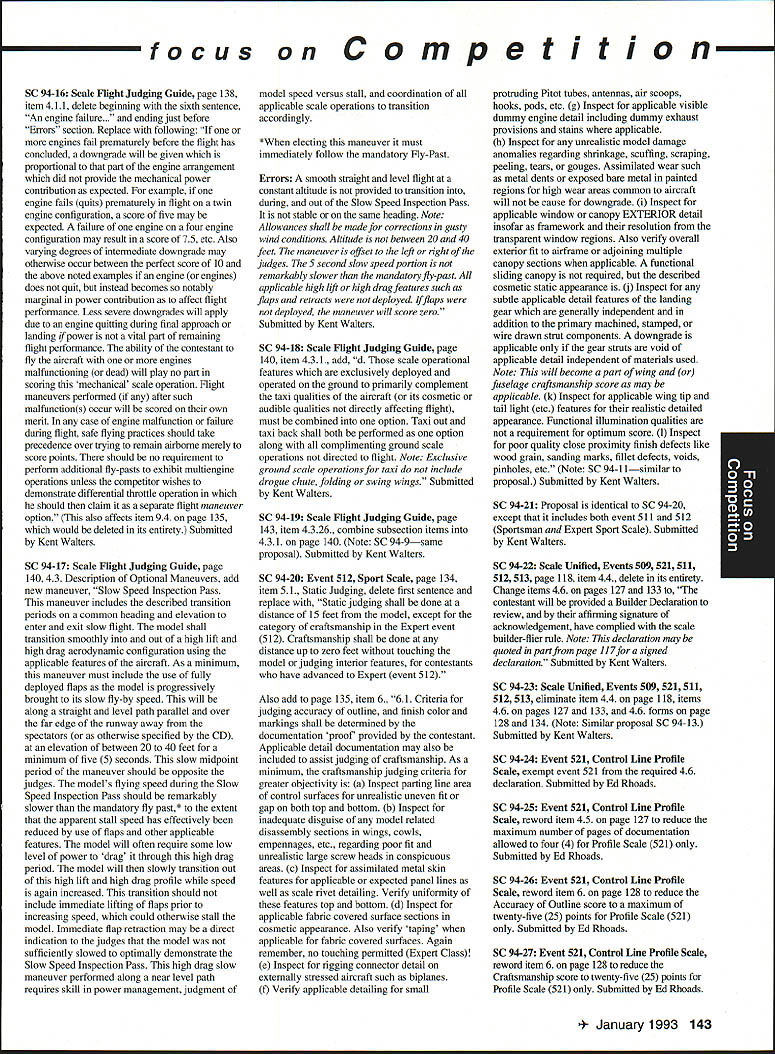
- SC 94-16: Scale Flight Judging Guide, page 138, item 4.1.1. Replace text regarding engine failure with detailed guidance on proportional downgrades for engine failure in multi-engine models and safety considerations; delete related item 9.4 on page 135. Submitted by Kent Walters.
- SC 94-17: Scale Flight Judging Guide, page 140, 4.3. Add new optional maneuver "Slow Speed Inspection Pass" with detailed entry, execution, and error descriptions. Submitted by Kent Walters.
- SC 94-18: Scale Flight Judging Guide, page 140, item 4.3.1. Add clarifying text about taxi operations and what constitutes exclusive ground scale operations. Submitted by Kent Walters.
- SC 94-19: Scale Flight Judging Guide, page 143, item 4.3.26. Combine subsection items into 4.3.1 on page 140. (Same as SC 94-9.) Submitted by Kent Walters.
- SC 94-20: Event 512, Sport Scale, page 134, item 5.1. Change static judging distance to 15 feet, with craftsmanship judged at any distance up to zero feet (without touching) for Expert contestants; add expanded criteria for craftsmanship judging. Submitted by Kent Walters.
- SC 94-21: Proposal identical to SC 94-20 but includes both events 511 and 512 (Sportsman and Expert Scale). Submitted by Kent Walters.
- SC 94-22: Scale Unified, Events 509, 521, 511, 512, 513, page 118, item 4.4. Delete in its entirety. Change items 4.6 on pages 127 and 133 to provide a Builder Declaration for contestants to sign. Submitted by Kent Walters.
- SC 94-23: Scale Unified, Events 509, 521, 511, 512, 513. Eliminate item 4.4 on page 118 and other related items; remove requirement or adjust builder declaration rules. Submitted by Kent Walters.
- SC 94-24: Event 521, Control Line Profile Scale. Exempt event 521 from required 4.6 declaration. Submitted by Ed Rhoads.
- SC 94-25: Event 521, Control Line Profile Scale. Reduce maximum number of pages of documentation to four (4) for Profile Scale only. Submitted by Ed Rhoads.
- SC 94-26: Event 521, Control Line Profile Scale. Reduce Accuracy of Outline score to 25 points for Profile Scale only. Submitted by Ed Rhoads.
- SC 94-27: Event 521, Control Line Profile Scale. Reduce Craftsmanship score to 25 points for Profile Scale only. Submitted by Ed Rhoads.
- SC 94-28: Event 521, Control Line Profile Scale. Reword item 6 on page 128 to reduce Finish, Color, and Markings score to 20 points for Profile Scale only. Submitted by Ed Rhoads.
- SC 94-29: Event 521, Control Line Profile Scale, page 128, item 7.1. Add "or CL Profile score sheet." Sample available upon request. Submitted by Ed Rhoads.
- SC 94-30: Events 509, 521, 511, 512, 513, 520, page 131, item 10 and page 136, item 11. Add: "The winner of static judging and each flight round is given 100 points and succeeding places are proportionately scored." Submitted by Charles Bauer.
- SC 94-31: Event 509, page 127, item 5.1. Change last sentence from "CL Sport Scale" to "Sport Scale." For events 511–513, page 133, item 5.1. Recommend using AMA Sport Scale score sheet for judging. Submitted by Charles Bauer.
- SC 94-32: Events 511–513, 520. Add noise penalty wording: 0.1 points subtracted for each dB over 90; additional 0.4 points (total 0.5) for each dB exceeding 98. Example: 100 dB penalty = 1.8 points. Submitted by Richard Allen.
- SC 94-33: Events 511–513, 520. Add new item: Use of an autopilot-type device that places the model under less than full pilot control mandates an automatic three (3) point deduction per flight. Submitted by Wayne Frederick.
- SC 94-34: Events 511–513, 520. Add new item: There shall be no use of an autopilot-type device that places the model under less than full pilot control at all times. Submitted by Darlene Frederick.
- SC 94-35: Scale Flight Judging Guide, page 138, item 4.1. Add: "Engine failure on the ground after takeoff has been called, but before liftoff, must be penalized with a point deduction of five (5) on the multiline option." Submitted by Wayne Frederick.
- SC 94-36: Events 511–513, 520. Page 135, item 7.4. Add: "Personal contact is made with the model after it has become airborne." Submitted by Wayne Frederick.
- SC 94-37: Event 521, Control Line Profile Scale, page 126, item 3. Reword to exempt event 521 from dummy pilot requirement. Submitted by Ed Rhoads.
#### Electric
- ELC 94-1: Delete events 604 and 605, Electric Free Flight, class A and B. Submitted by Don Lindley.
- ELC 94-2: Events 617–620, Old Timer Events, pages 150–151. Add: "All models must have been designed, kitted, or published prior to December 31, 1942." Submitted by George Minnear.
RULE BOOK ALERT: Due to a conflict with publication deadlines, the proposal synopsis did not appear in the December issue. To allow member comment to contest boards, the initial vote deadline has been rescheduled to January 1, 1993 (rather than December 1, 1992).
#### Special Events
- SEB 94-1: Add new event, Warbirds Unlimited. The event combines R/C Sport Scale and R/C Pylon racing rules. Models judged by Sport Scale rules then raced per Formula 1 rules. Various engine size and wing area limits up to a maximum engine displacement of 1.08 cu. in. (two-stroke) and 2.4 cu. in. (four-stroke). Complete rules available upon request. Submitted by Paul Geders.
---
1993 U.S. RC Aerobatics Team Selection Finals
The RC Aerobatics Team Selection Committee announces the date and location for the team selection finals. The results will determine the team representing the United States at the 1993 RC Aerobatics World Championship.
- Dates: June 7–12, 1993 (practice permitted June 5–6; June 12 reserved as rain date)
- Location: Corvallis Airport, Corvallis, Oregon
- Contest Director: Michael J. Dunphy
- Entry fee: $150; must be received by the Competitions Department at AMA Headquarters no later than May 23, 1993. Entry fees will not be accepted on site.
- AMA members who are also NAA members have until March 1, 1993 to qualify to attend the Finals.
- Complete information available from the Competitions Department at AMA Headquarters.
---
Results, Technical Surveys, and Championship Summaries (Excerpts)
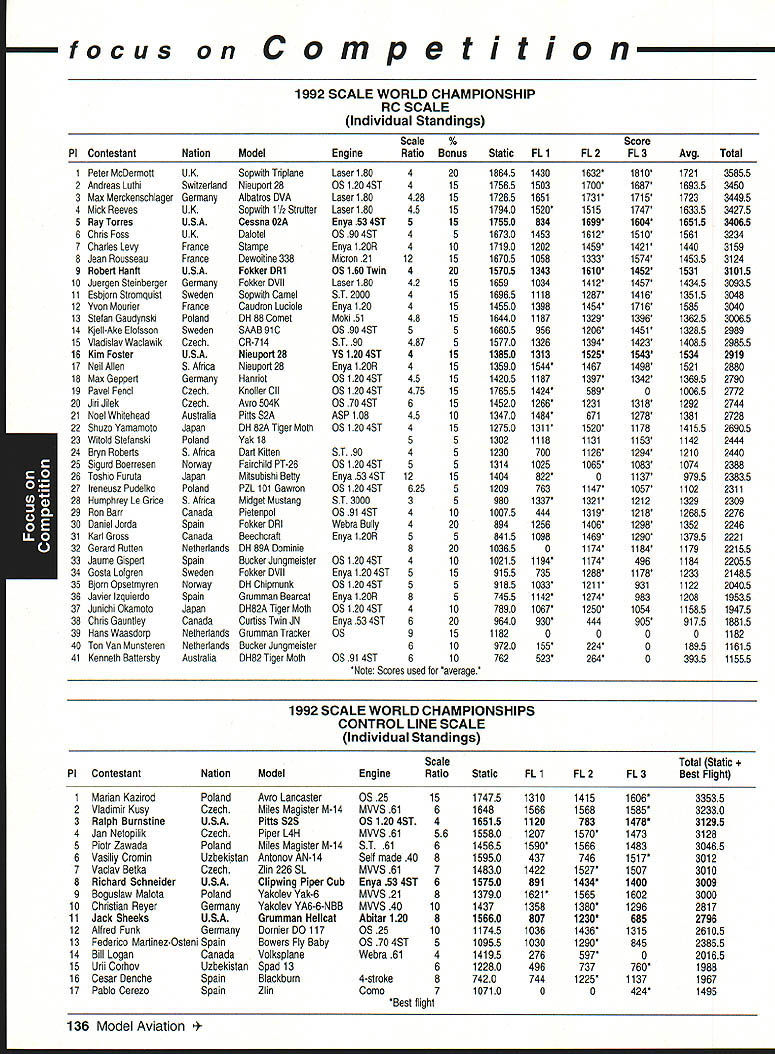
#### 1992 Scale World Championship — RC Scale (Individual Standings) — Top Placings (excerpt)
- Peter McDermott — U.K. — Sopwith Triplane — Engine: Laser 1.80 — Score Avg. Total: 3585.5
- Andreas Luthi — Switzerland — Neupor 28 — Engine: OS 1.20 4ST — Total: 3495.5
- Max Kerenschaefer — Germany — Albatros DVA — Engine: Laser 1.80 — Total: 3494.5
- Rick Reeves — U.K. — Sopwith 1½ Strutter — Engine: Laser 1.80 — Total: 3422.5
- Ray Torres — U.S.A. — Cessna 02A — Engine: Enya .53 4ST — Total: 3405
(Additional individual standings and scoring details were provided in the original results; consult full championship report for the complete list.)
#### 1992 Scale World Championships — Control Line Scale (Individual Standings) — Top Placings (excerpt)
- Marian Kazirod — Poland — Avro Lancaster — Engine: OS .25 — Total: 3535.5
- Vladimir Kusy — Czechoslovakia — Miles Magister M-14 — Engine: MWS .61 — Total: 3235.0
- Ralph Burnstine — U.S.A. — Pits S2S — Engine: OS 1.20 4ST — Total: 3129.5
(Additional results included full flight scores and static scores.)
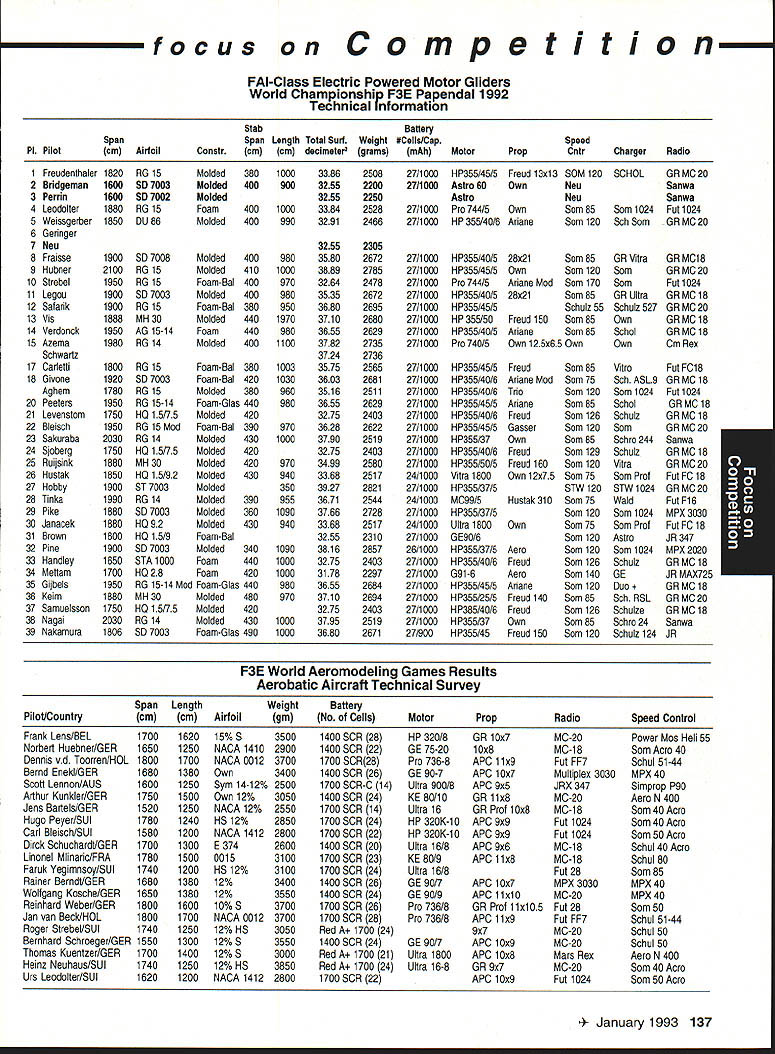
#### FAI-Class Electric Powered Motor Gliders — World Championship F3E, Papendal 1992 — Technical Summary (excerpt) Top entries included span, airfoil, construction, stabilizer span, length, total surface area, weight, battery configuration, motor, prop, speed control, charger, and radio details. Examples:
- Freudenthaler — Span 1820 cm — Airfoil RG 15 — Molded — Stabilizer 380 cm — Length 1000 cm — Total Surf. 33.86 dm^2 — Weight 2508 g — Battery 27 cells / 1000 mAh — Motor HP355/4/5 — Prop Freud 13x13 — Speed control Som 120 — Radio SCHOL GR MC 20
- Bridgeman — Span 1600 cm — Airfoil SD 7003 — Molded — Stabilizer 400 cm — Length 980 cm — Total Surf. 32.55 dm^2 — Weight 2200 g — Battery Astro 60 — Radio Neu — etc.
(Complete technical information for the full field is available in the event technical report.)
#### F3E World Aeromodelling Games — Aerobatic Aircraft Technical Survey (excerpt) Pilot/Country — Span (cm) — Length (cm) — Airfoil — Weight (g) — Battery — Motor — Prop — Radio — Speed Control
- Frank Lens / BEL — 1700 — 1620 — 15% S — 3500 g — 1400 SCR (28) — HP 320/8 — GR 10x7 — MC-20 — Power Mos Heil 55
- Norbert Hubacher / GER — 1650 — 1250 — NACA 1410 — 2900 g — 1400 SCR (22) — GE 75-20 — 10x8 — MC-18 — Som Acro 40
- Dennis v.d. Tooren / NED — 1800 — 1700 — NACA 0012 — 3400 g — 1400 SCR (28) — Pro 736-8 — APC 11x8 — Fut — Schulz 51-44
(See full technical survey for complete participant data.)
---
End of reformatted material.
Transcribed from original scans by AI. Minor OCR errors may remain.

