
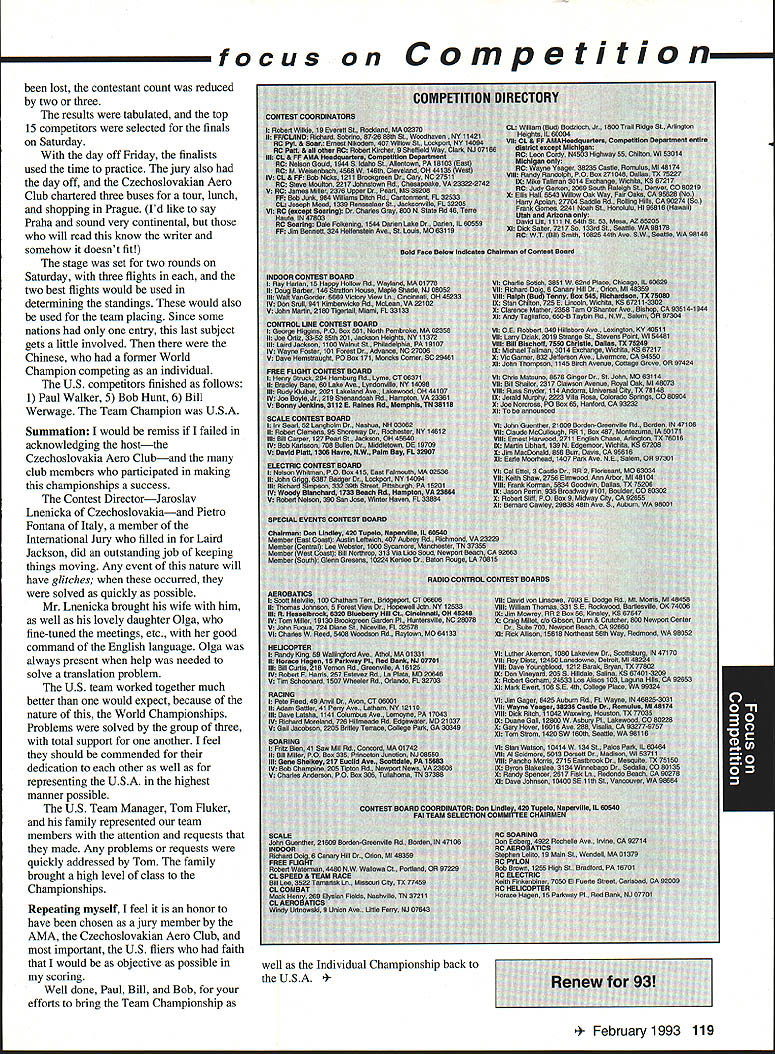
Focus on Competition
A Note From the Technical Director
Bob Underwood
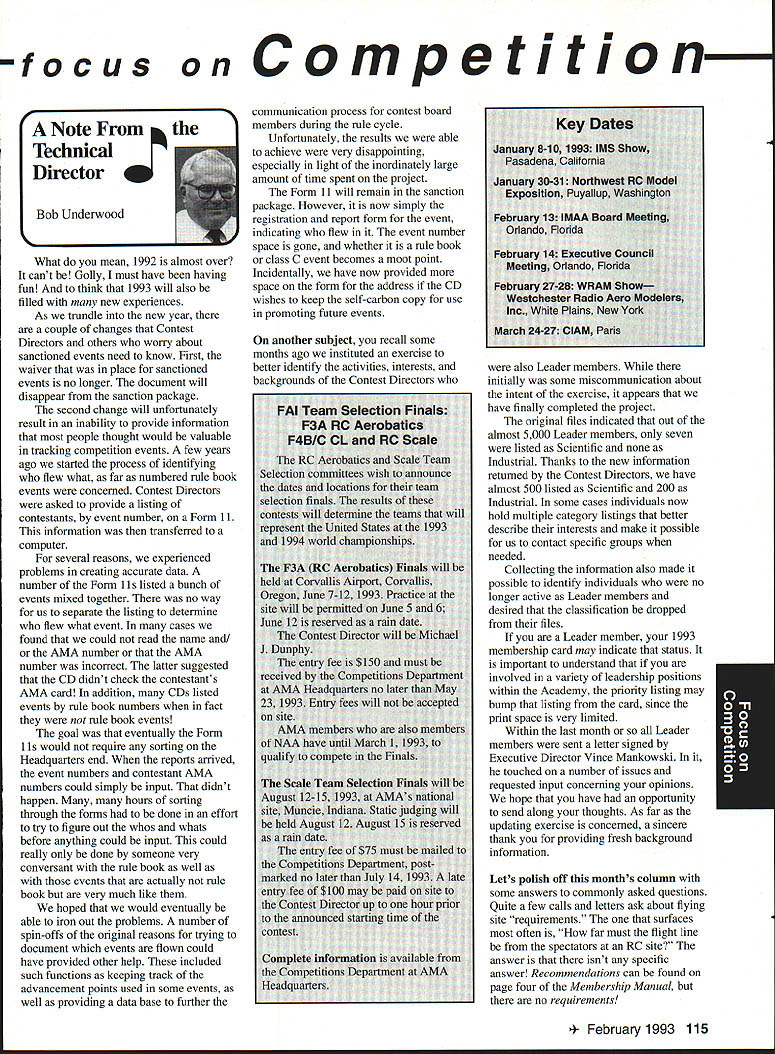
What do you mean, 1992 is almost over? Isn't it? Golly — I must have been having fun! And to think that 1993 will also be filled with many new experiences.
As we trundle into the new year, there are a couple of changes that Contest Directors and others who worry about sanctioned events need to know.
First, the waiver that was in the sanction package is no longer. That document will disappear from the sanction package.
Second, we will unfortunately be unable to provide some of the information many thought valuable for tracking competition events. A few years ago we began identifying who flew what in numbered rule-book events. Contest Directors were asked to provide a listing of contestants by event number on a Form 11; this information was transferred to a computer.
For several reasons we experienced problems creating accurate data. Many Form 11s mixed a bunch of events together so there was no way to separate listings to determine who flew what event. In many cases the name and/or AMA number could not be read or the AMA number was incorrect (suggesting the CD didn't check the contestant's AMA card). In addition, many CDs listed events by rule-book numbers when in fact they were not rule-book events.
Our goal was that eventually Form 11s would not require any sorting on the Headquarters end — that when reports arrived the event numbers and contestant AMA numbers could simply be input. That didn't happen. Many, many hours were required to sort through forms and figure out the whos and whats before anything could be input. This work could really only be done by someone very conversant with the rule book and with events that are not rule-book but are very similar.
We had hoped to iron out these problems. The original reasons for trying to document which events are flown could have provided other help — for example, keeping track of advancement points used in some events and providing a database to aid communication with contest board members during the rule cycle. Unfortunately, the results were very disappointing given the inordinately large amount of time spent on the project.
The Form 11 will remain in the sanction package, but it is now simply the registration and report form for the event, indicating who flew in it. The event-number space is gone, and whether it is a rule-book or Class C event becomes a moot point. Incidentally, we have provided more space on the form for the address if the CD wishes to keep the self-carbon copy for promoting future events.
Some months ago we instituted an exercise to better identify the activities, interests, and backgrounds of Contest Directors who are also Leader members. Initially some miscommunication about the intent delayed completion, but the project has now been finished.
Original files indicated that out of almost 5,000 Leader members, only seven were listed as Scientific and none as Industrial. Thanks to the new information returned by the Contest Directors, we now have almost 500 listed as Scientific and 200 as Industrial. In some cases individuals now hold multiple category listings that better describe their interests and make it possible for us to contact specific groups when needed.
Collecting the information also made it possible to identify individuals who were no longer active as Leader members and who desired that a classification be dropped from their files.
If you are a Leader member, your 1993 membership card may indicate that status. It is important to understand that if you are involved in a variety of leadership positions within the Academy, a priority listing may bump other listings from the card since print space is limited. Within the last month or so all Leader members were sent a letter signed by Executive Director Vince Mankowski. In it he touched on a number of issues and requested input concerning your opinions. We hope you have had an opportunity to send along your thoughts. As far as the updating exercise is concerned, a sincere thank you for providing fresh background information.
Common Questions — Flying Sites and Radio
Let's polish off this month's column with answers to commonly asked questions.
- How far must the flight line be from the spectators at an R/C site?
There is no specific answer. Recommendations can be found on page 4 of the Membership Manual, but there are no fixed requirements.
- What about rule-book event requirements?
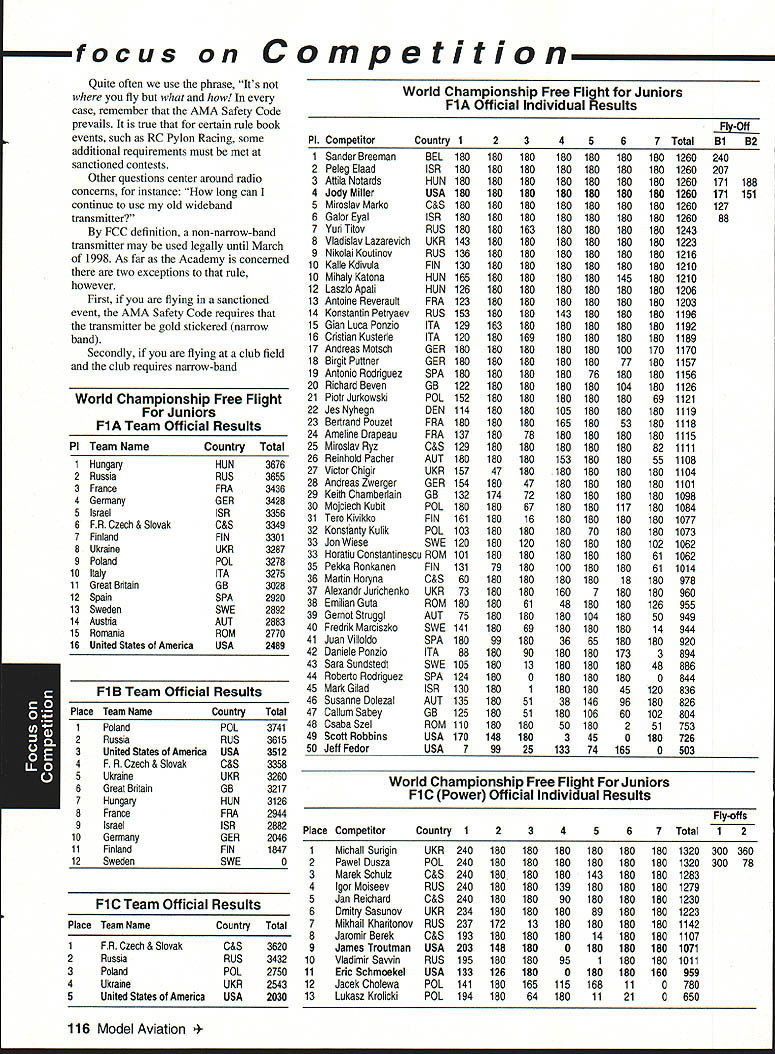
The AMA Safety Code prevails. Certain rule-book events (for example, R/C Pylon Racing) may have additional requirements for sanctioned contests.
- How long can one continue to use old wide-band transmitters?
By FCC definition, a non-narrow-band transmitter may be used legally until March 1998. However, the Academy has two exceptions:
- If you are flying at a sanctioned event, the AMA Safety Code requires that the transmitter be gold-stickered (narrow band).
- If you are flying at a club field that requires narrow-band transmitters, you must comply with the club's rules; otherwise you are violating the AMA Safety Code (see item three in the general section of the Safety Code).
- Must my receivers be narrow band?
Legally (FCC regulation), the answer is no: the FCC is concerned with what you put into the air, not what you receive. Practically, however, narrow-band receivers are important. Commercial users may operate very close to model frequencies and at high power; older broad-band receivers can be easily overwhelmed. If your club uses many frequencies you are at further risk. Using narrow-band equipment reduces interference risk and helps maintain the reputation of modelers as responsible operators — which reduces the likelihood of outside regulation by agencies such as the FAA.
The AMA Safety Code is intentionally general, designed to prompt common-sense guidelines. Individuals and clubs have the autonomy to impose additional requirements to fit their specific safety and operational situations.
'Nuff for now.
---
FAI Team Selection Finals
F3A RC Aerobatics / F4B/C CL and RC Scale
- F3A (RC Aerobatics) Finals
- Location: Corvallis Airport, Corvallis, Oregon
- Dates: June 7–12, 1993 (practice permitted June 5–6; June 12 reserved as rain date)
- Contest Director: Michael J. Dunphy
- Entry fee: $150 — must be received by the Competitions Department at AMA Headquarters no later than May 23, 1993. Entries received after that date will not be accepted on site.
- Note: AMA members who are also members of NAA have until March 1, 1993, to qualify to compete in the Finals.
- Scale Team Selection Finals (F4B/C)
- Location: AMA national site, Muncie, Indiana
- Dates: August 12–15, 1993 (static judging August 12; August 15 reserved as rain date)
- Entry fee: $75 — must be mailed to the Competitions Department, postmarked no later than July 14, 1993.
- Late entry: $100 may be paid on site to the Contest Director up to one hour prior to the announced starting time of the contest.
Complete information is available from the Competitions Department at AMA Headquarters.
Key Dates
- January 8–10, 1993: IMS Show, Pasadena, California
- January 30–31, 1993: Northwest RC Model Exposition, Puyallup, Washington
- February 13, 1993: IMAA Board Meeting, Orlando, Florida
- February 14, 1993: Executive Council Meeting, Orlando, Florida
- February 27–28, 1993: WRAM Show — Westchester Radio Aero Modelers, Inc., White Plains, New York
- March 24–27, 1993: CIAM, Paris
---
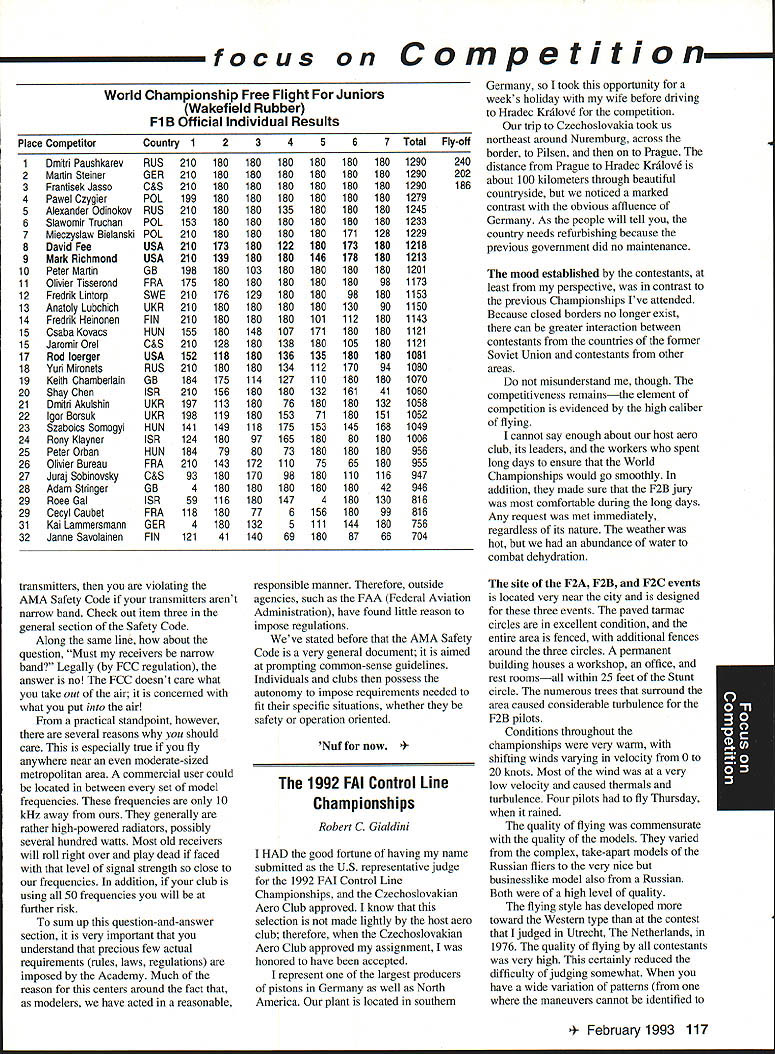
World Championships — Jury Report (summary)
The jury for the championships included:
- Robert C. Gialdini (U.S.A.)
- Zdenek Liska (Czechoslovakia)
- Stefan Kraszewski (Poland)
- Christian Gafner (Switzerland)
- Antoine Charles (France)
I was sensitive to problems seen at previous championships. One especially — that of big maneuvers — did not seem evident, and flights were downgraded accordingly. The jury was not aware of the standings until the 15 finalists were announced, and scores were not posted until each round was completed. Contestants did not welcome this, but it reduced the possibility of favoritism.
During the preflight jury meeting we discussed whether judges would move before a flight to allow for changes in wind direction. The initial poll indicated there would be no movement unless changes were severe. I appealed to the panel that every pilot should have the benefit of judging from the best perspective. Liska, a judge since 1958, concurred and the panel agreed. The Italian competitor Luciano Compestelli used a small puff of talcum powder from a hand-held dispenser during his flight to assure him of the correct wind direction; he says without it he cannot remember the pattern.
The wind shifted more often than anticipated, but the jury was able to move immediately during a flight and also at the request of a pilot before his flight. The changes of location sometimes encompassed the entire 360° of the circle, especially during the finals.
Each judge had an assigned assistant to record maneuver scores, but all — except Liska — opted to list his own, reducing the chance of overhearing other scores. Liska called his scores to his assistant in Czech, so there was no problem.
A random method was used to assign initial flight order, with the order reversed in following rounds. This has merit but does not affect those flying in the middle of the round; this topic should be addressed by FAI officials.
Eliminations began on Wednesday at 7:00 a.m.; the first round of 62 contestants was completed at approximately 7:30 p.m. That schedule continued Thursday, with repairs extending into Friday. Friday's flying was shortened because of high winds and rain; the contest resumed in the afternoon and the round was finished. The finals began Saturday and concluded Sunday afternoon.
With Friday off for the qualifiers, the finalists used the time to practice and the jury had the day off. The Czechoslovakian Aero Club charte red buses for a tour, lunch, and shopping in Prague.
Finals format: two rounds on Saturday with three flights each; the two best flights were used for standings and team placing. Some nations had only one entry; China had a former World Champion competing as an individual.
U.S. results:
- Individual: 1) Paul Walker, 5) Bob Hurt, 6) Bill Werwage
- Team Champion: U.S.A.
Acknowledgments: The Czechoslovakian Aero Club and its members did an outstanding job. Contest Director Jaroslav Leninecka and International Jury member Pietro Fontana (who filled in for Laird Jackson) kept things moving. Mr. Leninecka's daughter Olga provided valuable translation help. The U.S. Team worked together and were well supported by Team Manager Tom Fluker and his family.
Well done, Paul, Bill, and Bob, for bringing the Team Championship as well as the Individual Championship back to the U.S.A.
---
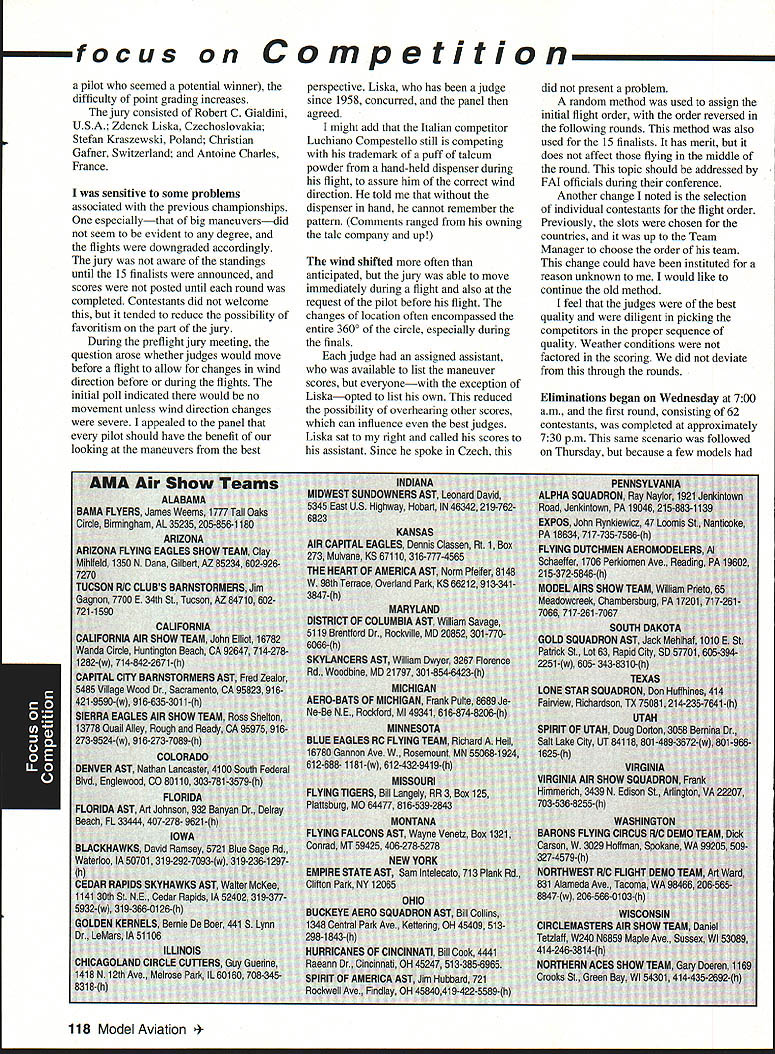
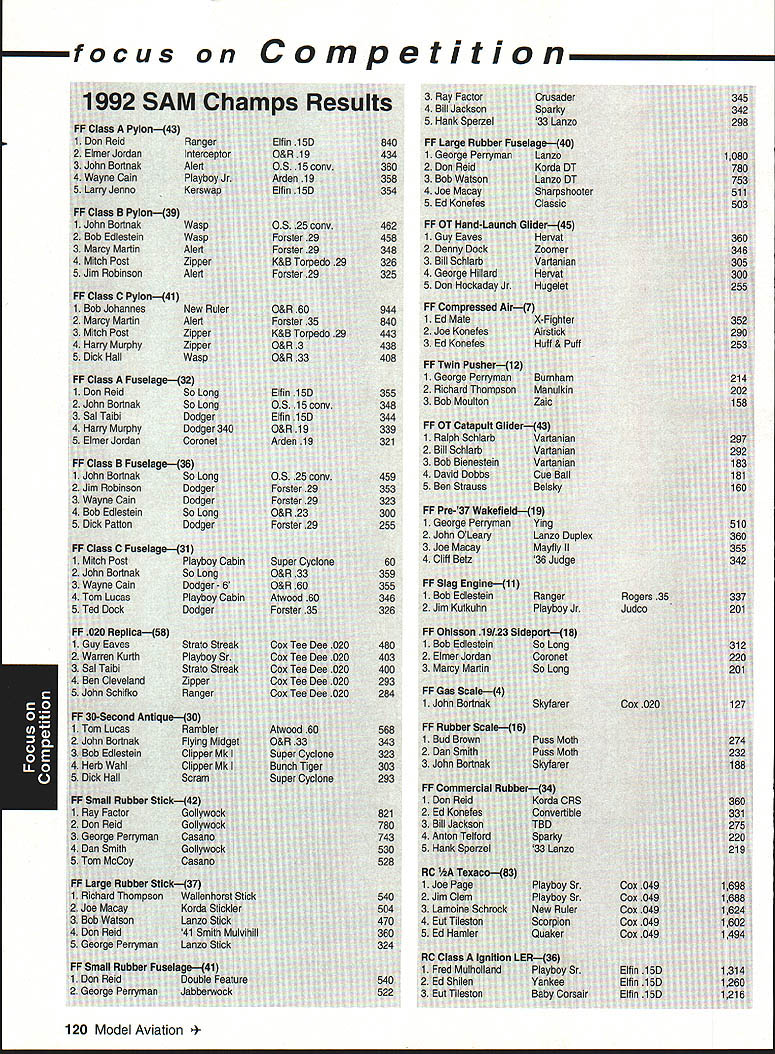
Competition Results
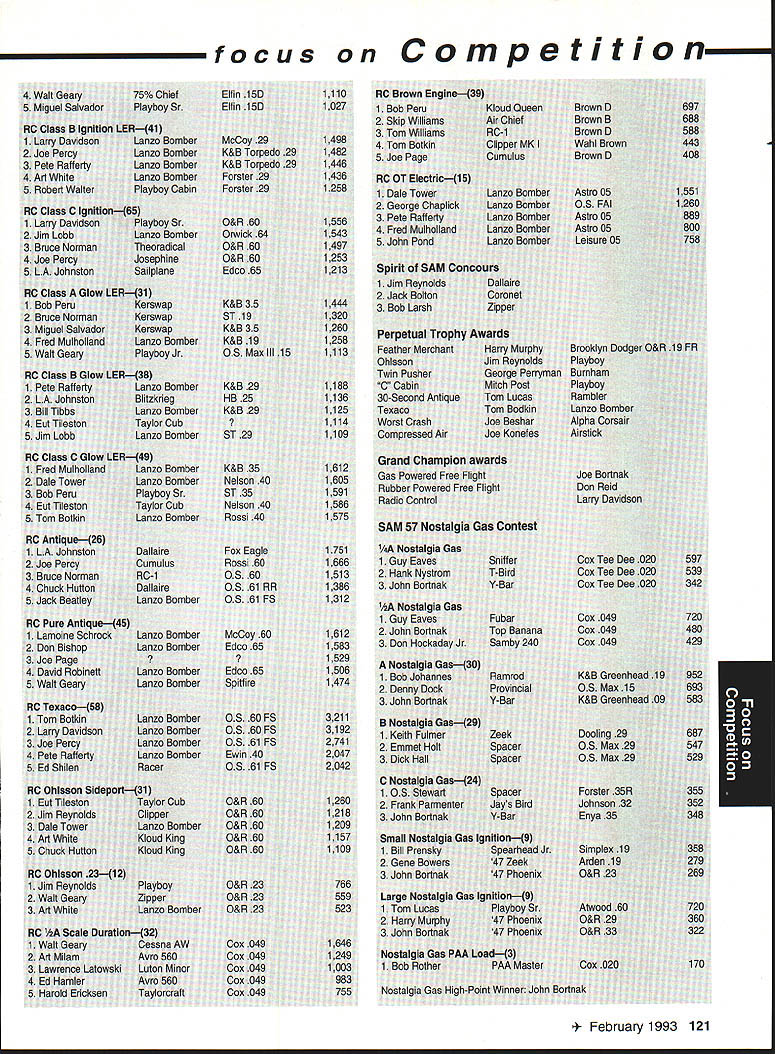
RC Class B Ignition LER (41)
- Larry Davidson — Lanzo Bomber — McCoy .29 — 1,498
- Joe Percy — Lanzo Bomber — K&B Torpedo .29 — 1,482
- Pete Rafferty — Lanzo Bomber — K&B Torpedo .29 — 1,446
- Art White — Lanzo Bomber — Forster .29 — 1,436
- Robert Walter — Playboy Cabin — Forster .29 — 1,258
RC Class C Ignition (65)
- Larry Davidson — Playboy Sr. — O&R .60 — 1,556
- Jim Lobb — Lanzo Bomber — Orwick .64 — 1,543
- Bruce Norman — Theoradical — O&R .60 — 1,497
- Joe Percy — Josephine — O&R .60 — 1,253
- L.A. Johnston — Sailplane — Edco .65 — 1,213
RC Class A Glow LER (31)
- Bob Peru — Kerswap — K&B 3.5 — 1,444
- Bruce Norman — Kerswap — ST .19 — 1,320
- Miguel Salvador — Kerswap — K&B 3.5 — 1,260
- Fred Mulholland — Lanzo Bomber — K&B .19 — 1,258
- Walt Geary — Playboy Jr. — O.S. Max III .15 — 1,113
RC Class B Glow LER (38)
- Pete Rafferty — Lanzo Bomber — K&B .29 — 1,188
- L.A. Johnston — Blitzkrieg — HB .25 — 1,136
- Bill Tibbs — Lanzo Bomber — K&B .29 — 1,125
- Eut Tileston — Taylor Cub — ? — 1,114
- Jim Lobb — Lanzo Bomber — ST .29 — 1,109
RC Class C Glow LER (49)
- Fred Mulholland — Lanzo Bomber — K&B .35 — 1,612
- Dale Tower — Lanzo Bomber — Nelson .40 — 1,605
- Bob Peru — Playboy Sr. — ST .35 — 1,591
- Eut Tileston — Taylor Cub — Nelson .40 — 1,586
- Tom Botkin — Lanzo Bomber — Rossi .40 — 1,575
RC Antique (26)
- L.A. Johnston — Dallaire — Fox Eagle — 1,751
- Joe Percy — Cumulus — Rossi .60 — 1,666
- Bruce Norman — RC-11F — O.S. .60 — 1,513
- Chuck Hutton — Dallaire — O.S. .61 FR — 1,386
- Jack Beasley — Lanzo Bomber — O.S. .61 FS — 1,312
RC Pure Antique (45)
- Lamoine Schrock — Lanzo Bomber — McCoy .60 — 1,612
- Don Bishop — Lanzo Bomber — Edco .65 — 1,583
- Joe Page — Lanzo Bomber — ? — 1,529
- David Robinett — Lanzo Bomber — Edco .65 — 1,506
- Walt Geary — Spitfire — ? — 1,474
RC Texaco (58)
- Tom Botkin — ? — O.S. .60 FS — 3,211
- Larry Davidson — Lanzo Bomber — O.S. .60 FS — 3,192
- Joe Percy — Lanzo Bomber — O.S. .61 FS — 2,741
- Pete Rafferty — Lanzo Bomber — Enya .40 — 2,071
- Ed Shillen — Racer — O.S. .61 FS — 2,042
RC Ohlsson Sidesport (31)
- Eut Tileston — Taylor Cub — O&R .60 — 1,280
- Jim Reynolds — Clipper — C&R .60 — 1,218
- Dale Tower — Lanzo Bomber — O&R .60 — 1,209
- Art White — Kloud King — O&R .60 — 1,157
- Chuck Hutton — Kloud King — O&R .60 — 1,109
RC Ohlsson .23 (12)
- Jim Reynolds — Playboy — O&R .23 — 766
- Walt Geary — Zipper — O&R .23 — 559
- Art White — Lanzo Bomber — O&R .23 — 523
RC 1/2 Scale Duration (32)
- Walt Geary — Cessna AW — Cox .049 — 1,646
- Art Milam — Avro 560 — Cox .049 — 1,249
- Lawrence Latoswski — Luton Minor — Cox .049 — 1,003
- Ed Hambler — Avro 560 — Cox .049 — 983
- Harold Ericksen — Taylorcraft — Cox .049 — 755
RC Brown Engine (39)
- Bob Peru — Kloud Queen — Brown D — 697
- Skip Williams — Air Chief — Brown B — 688
- Tom Williams — RC-1 — Brown D — 588
- Tom Botkin — Clipper MK I — Wahl Brown — 443
- Joe Page — Cumulus — Brown D — 408
RC OT Electric (15)
- Dale Tower — Lanzo Bomber — Astro 05 — 1,551
- George Chaplick — Lanzo Bomber — O.S. FAI — 1,260
- Pete Rafferty — Lanzo Bomber — Astro 05 — 889
- Fred Mulholland — Lanzo Bomber — Astro 05 — 800
- John Pond — Lanzo Bomber — Leisure 05 — 758
Spirit of SAM Concours
- Jim Reynolds — Playboy
- Jack Bolton — Coronet
- Bob Larson — Zipper
Perpetual Trophy Awards
- Feather Merchant — Harry Murphy — Brooklyn Dodger — O&R .19 FR
- Ohlsson — Jim Reynolds — Playboy
- Twin Pusher — George Perryman — Burnham
- "C" Cabin — Mitch Post — Playboy
- 30-Second Antique — Tom Lucas — ?
- Texaco — Tom Bodin — Lanzo Bomber
- Worst Crash — Joe Beshar — Alpha Corsair
- Compressed Air — Joe Koniefes — Airstick
Grand Champion Awards
- Gas Powered Free Flight — Joe Bortnak
- Rubber Powered Free Flight — Don Reid
- Radio Control — Larry Davidson
---
SAM 57 Nostalgia Gas Contest
1/4A Nostalgia Gas
- Guy Eaves — Sniffer — Cox Tee Dee .020 — 597
- Hank Nystrom — T-Bird — Cox Tee Dee .020 — 539
- John Bortnak — Y-Bar — Cox Tee Dee .020 — 342
1/2A Nostalgia Gas
- Guy Eaves — Fubar — Cox .049 — 720
- John Bortnak — Top Banana — Cox .049 — 480
- Don Hockaday Jr. — Samby 240 — Cox .049 — 429
A Nostalgia Gas (30)
- Bob Johannes — Ramrod — K&B Greenhead .19 — 952
- Denny Dock — Provincial — O.S. Max .15 — 693
- John Bortnak — ? — K&B Greenhead .09 — 583
B Nostalgia Gas (29)
- Keith Fulmer — Zeek — Dooling .29 — 607
- Emmet Holt — Spacer — O.S. Max .29 — 547
- Dick Hall — Spacer — O.S. Max .29 — 529
C Nostalgia Gas (24)
- O.S. Stewart — Spacer — Forster .35R — 355
- Frank Parmenter — Jay’s Bird — Johnson .32 — 352
- John Bortnak — Y-Bar — Enya .35 — 348
Small Nostalgia Gas Ignition (9)
- Bill Prensky — Spearhead Jr. — Simplex .19 — 358
- Gene Bowers — .47 Zeek — Arden .19 — 279
- John Bortnak — ’47 Phoenix — O&R .23 — 269
Large Nostalgia Gas Ignition (9)
- Tom Lucas — Playboy Sr. — Atwood .60 — 720
- Harry Murphy — ’47 Phoenix — O&R .29 — 360
- John Bortnak — ’47 Phoenix — O&R .33 — 322
Nostalgia Gas PAA Load (3)
- Bob Rother — PAA Master — Cox .020 — 170
Nostalgia Gas High-Point Winner: John Bortnak
Transcribed from original scans by AI. Minor OCR errors may remain.

