
Focus on Competition
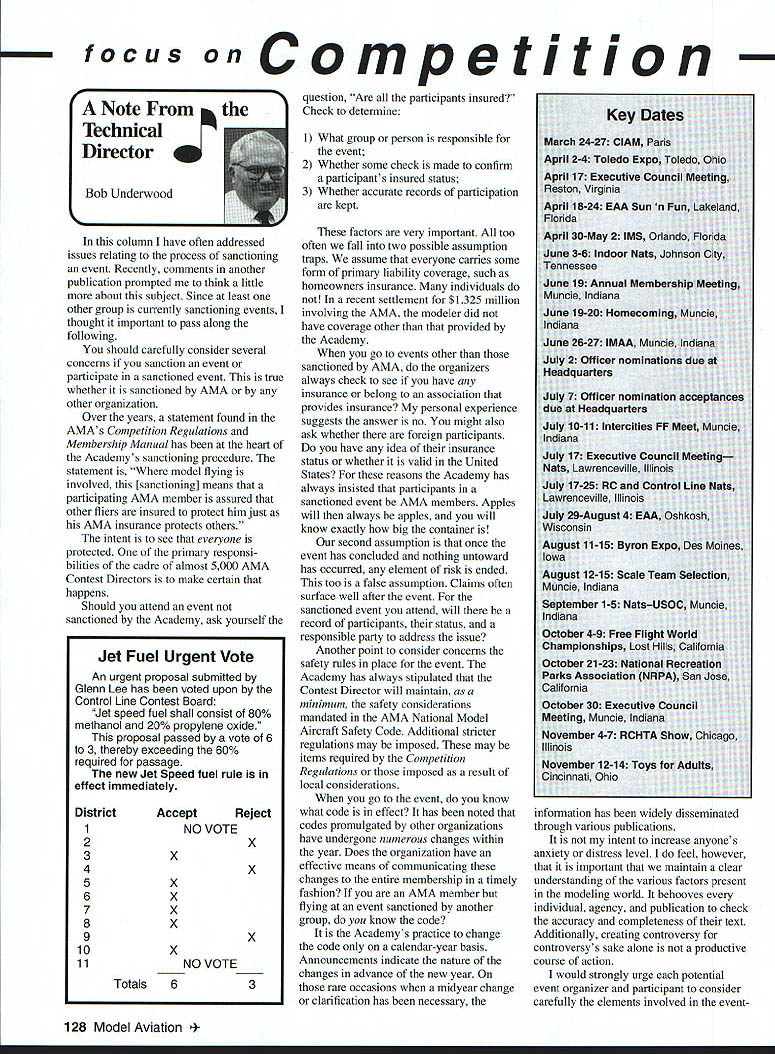
A Note From the Technical Director — Bob Underwood
In this column I have often addressed issues relating to the process of sanctioning an event. Recently, comments in another publication prompted me to think a little more about this subject. Since at least one other group is currently sanctioning events, I thought it important to pass along the following.
You should carefully consider several concerns if you sanction an event or participate in a sanctioned event. This is true whether it is sanctioned by AMA or by any other organization.
Over the years, a statement found in the AMA's Competition Regulations and Membership Manual has been at the heart of the Academy's sanctioning procedure. The statement is, "Sanctioning means that a participating AMA member is assured that other fliers are insured to protect him just as his AMA insurance protects others." The intent is to see that everyone is protected. One of the primary responsibilities of the cadre of almost 5,000 AMA Contest Directors is to make certain that happens.
Should you attend an event not sanctioned by the Academy, ask yourself the question: Are all the participants insured? Check to determine:
- What group or person is responsible for the event;
- Whether some check is made to confirm a participant's insured status;
- Whether accurate records of participation are kept.
These factors are very important. All too often we fall into two possible assumption traps. We assume that everyone carries some form of primary liability coverage, such as homeowners insurance. Many individuals do not. In a recent settlement for $1.325 million involving the AMA, the modeler did not have coverage other than that provided by the Academy.
When you go to events other than those sanctioned by AMA, do the organizers always check to see if you have any insurance or belong to an association that provides insurance? My personal experience suggests the answer is no. You might also ask whether there are foreign participants. Do you have any idea of their insurance status or whether it is valid in the United States? For these reasons the Academy has always insisted that participants in a sanctioned event be AMA members. Apples will then always be apples, and you will know exactly how big the container is!
Our second assumption is that once the event has concluded and nothing untoward has occurred, any element of risk is ended. This too is a false assumption. Claims often surface well after the event. For the sanctioned event you attend, will there be a record of participants, their status, and a responsible party to address the issue?
Another point to consider concerns the safety rules in place for the event. The Academy has always stipulated that the Contest Director will maintain, as a minimum, the safety considerations mandated in the AMA National Model Aircraft Safety Code. Additional, stricter regulations may be imposed. These may be items required by the Competition Regulations or those imposed as a result of local considerations.
When you go to the event, do you know what code is in effect? It has been noted that codes promulgated by other organizations have undergone numerous changes within a year. Does the organization have an effective means of communicating these changes to the entire membership in a timely fashion? If you are an AMA member but are flying at an event sanctioned by another group, do you know the code?
It is the Academy's practice to change the code only on a calendar-year basis. Announcements indicate the nature of the changes in advance of the new year. On those rare occasions when a midyear change or clarification has been necessary, the information has been widely disseminated through various publications.
It is not my intent to increase anyone's anxiety or distress level. I do feel, however, that it is important that we maintain a clear understanding of the various factors present in the modeling world. It behooves every individual, agency, and publication to check the accuracy and completeness of their text. Additionally, creating controversy for controversy's sake alone is not a productive course of action.
I would strongly urge each potential event organizer and participant to consider carefully the elements involved in the event-sanctioning procedures. The structure designed over the years for the Academy provides a high level of liability protection for all involved. This is because the sanctioning program is monitored by a cadre of hardworking, dedicated individuals who do their level best to assure that all participants are adequately insured and fly safely, according to known regulations. Records are maintained and available if needed in the event of a problem.
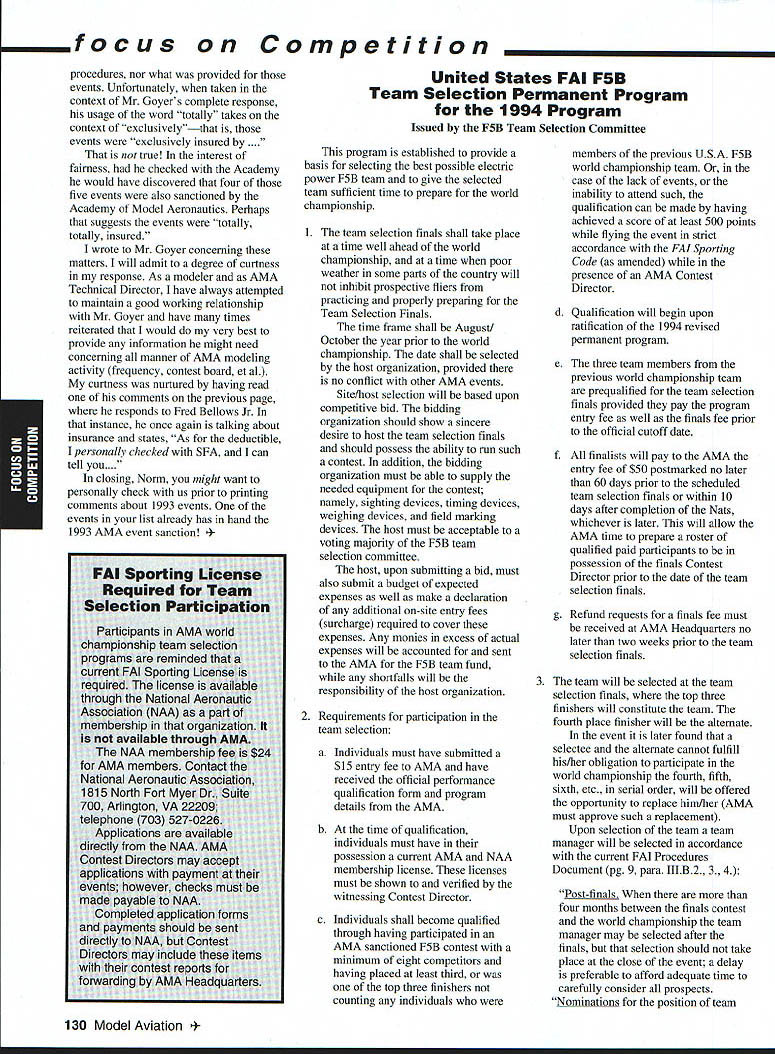
Now, a few remarks on a specific matter that prompted these thoughts. I read many letters, newsletters, magazines, rule books, and surveys as part of my job. Recently, Norm Goyer wrote in the December 1992 issue of Scale R/C Modeler. On page 55 he replied to a letter by Randolph M. Getchell and addressed the sanctioning of major events. He wrote, "This year, (1992—Ed.) the Scale Masters Championships, Top Gun, QSAA, Schneider Cup Re-Enactment, and the Tucson Reno Style races have all been totally insured by Sport Flyers Association."
The most commonly used definition of "totally" would suggest "completely." I can't comment on whether that is true because I am not familiar with the details of what is involved with their sanctioning procedures nor what was provided for those events. However, I have obtained enough information to state that, if what he meant was that the Sport Flyers Association provided insurance for the participants, it is not equivalent to AMA insurance and does not provide the same protections. The Academy's sanctioning procedure has been developed to provide the maximum protection possible. The insurance provided through the Academy is a group policy designed to protect the organization, its officers, and its members; it requires certain record keeping and affiliation responsibilities that simply are not present in many other sanctioning schemes.
When taken in the context of Mr. Goyer's complete response, his usage of the word "totally" takes on the context of "exclusively"—that is, those events were "exclusively insured by" the Sport Flyers Association. That is not true. In the interest of fairness, had he checked with the Academy he would have discovered that four of those five events were also sanctioned by the Academy of Model Aeronautics.
I wrote to Mr. Goyer concerning these matters. I will admit to a degree of curtness in my response. As a modeler and as AMA Technical Director, I have always attempted to maintain a good working relationship with Mr. Goyer and have many times reiterated that I would do my very best to provide any information he might need concerning all manner of AMA modeling activity. In closing, Norm, you might want to personally check with us prior to printing comments about 1993 events. One of the events in your list already has in hand the 1993 AMA event sanction.
Again, I reiterate: check the accuracy and completeness of your information; avoid creating controversy for its own sake; and consider carefully the elements involved in event sanctioning and participation.
---
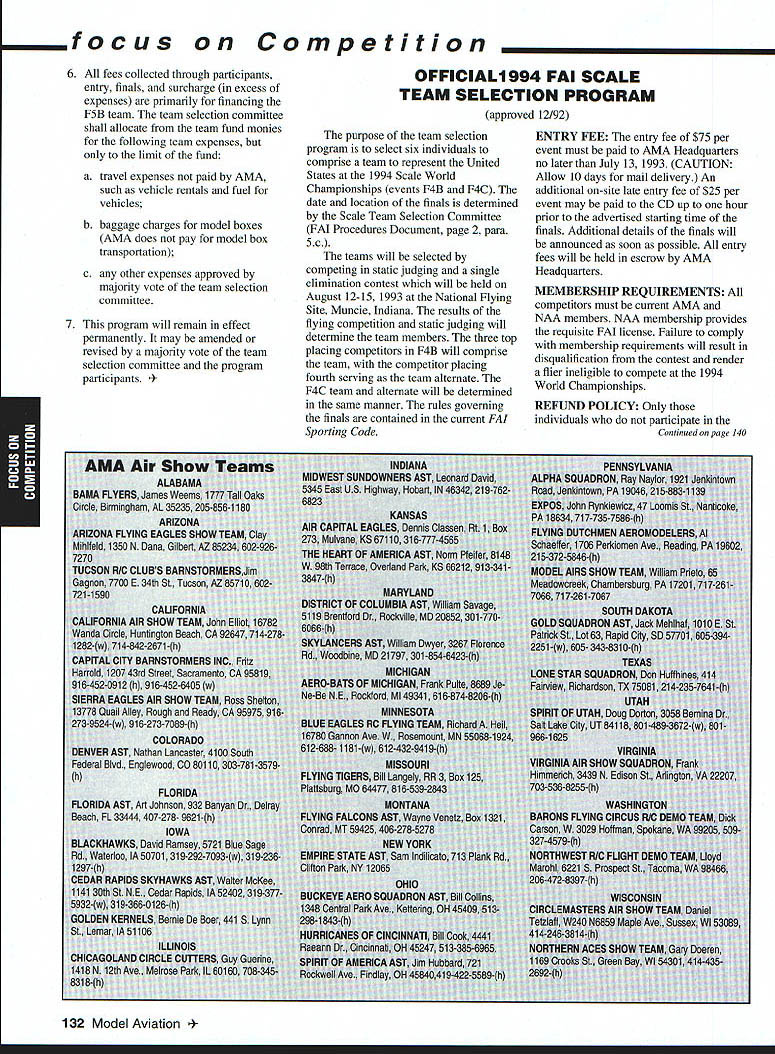
Team Manager and Team Selection Rules
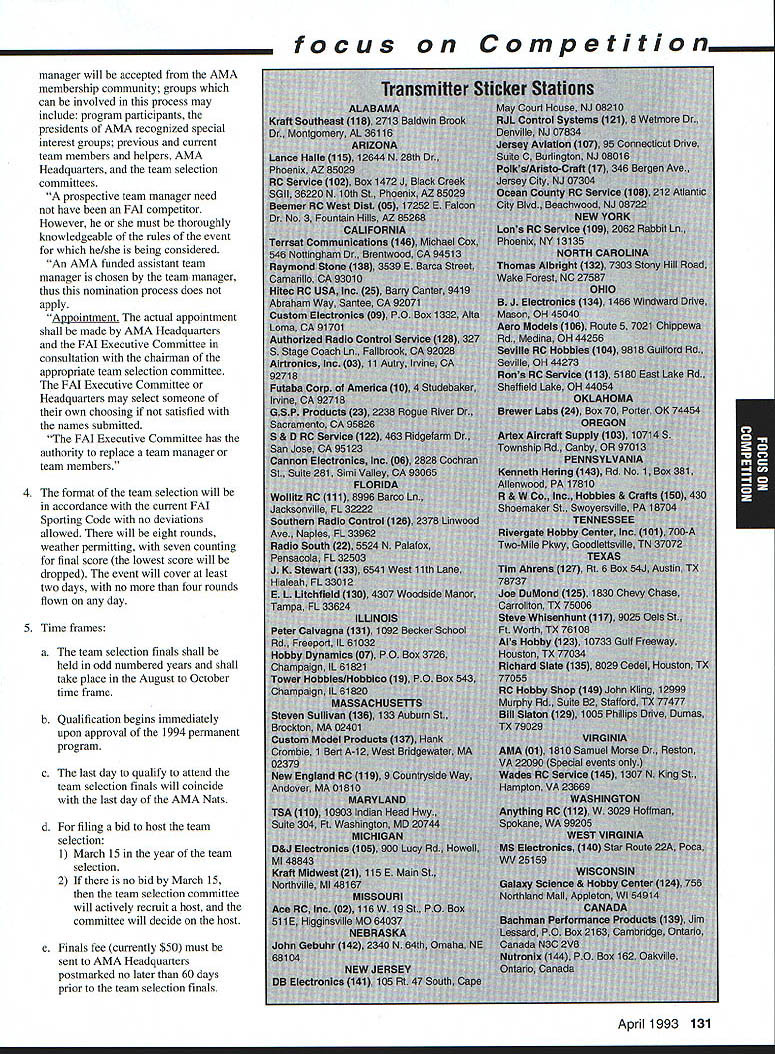
- A team manager will be accepted from the AMA membership community. Groups which may be involved in this process include program participants, presidents of AMA-recognized special interest groups, previous and current team members and helpers, AMA Headquarters, and the team selection committees.
- "A prospective team manager need not have been an FAI competitor. However, he or she must be thoroughly knowledgeable of the rules of the event for which he/she is being considered."
- "An AMA-funded assistant team manager is chosen by the team manager; thus this nomination process does not apply."
- Appointment: The actual appointment shall be made by AMA Headquarters and the FAI Executive Committee in consultation with the chairman of the appropriate team selection committee. The FAI Executive Committee or Headquarters may select someone of their own choosing if not satisfied with the names submitted. The FAI Executive Committee has the authority to replace a team manager or team members.
- The format of the team selection will be in accordance with the current FAI Sporting Code with no deviations allowed. There will be eight rounds, weather permitting, with seven counting for the final score (the lowest score will be dropped). The event will cover at least two days, with no more than four rounds flown on any day.
- Time frames:
- The team selection finals shall be held in odd-numbered years and shall take place in the August to October time frame.
- Qualification begins immediately upon approval of the 1994 permanent program.
- The last day to qualify to attend the team selection finals will coincide with the last day of the AMA Nats.
- For filing a bid to host the team selection:
- March 15 in the year of the team selection.
- If there is no bid by March 15, then the team selection committee will actively recruit a host, and the committee will decide on the host.
- Finals fee (currently $50) must be sent to AMA Headquarters postmarked no later than 60 days prior to the team selection finals.
- All fees collected through participants, entry, finals, and surcharge (in excess of expenses) are primarily for financing the F5B team. The team selection committee shall allocate from the team fund monies for the following team expenses, but only to the limit of the fund:
- Travel expenses not paid by AMA, such as vehicle rentals and fuel for vehicles;
- Baggage charges for model boxes (AMA does not pay for model box transportation);
- Any other expenses approved by majority vote of the team selection committee.
- This program will remain in effect permanently. It may be amended or revised by a majority vote of the team selection committee and the program participants.
---
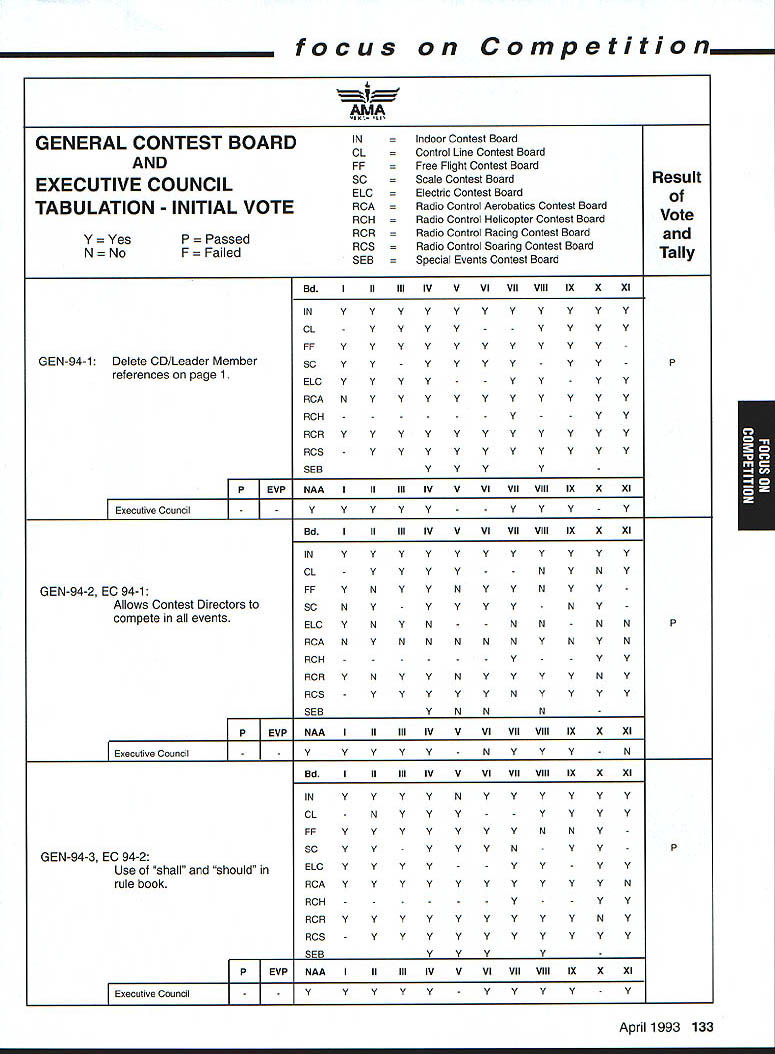
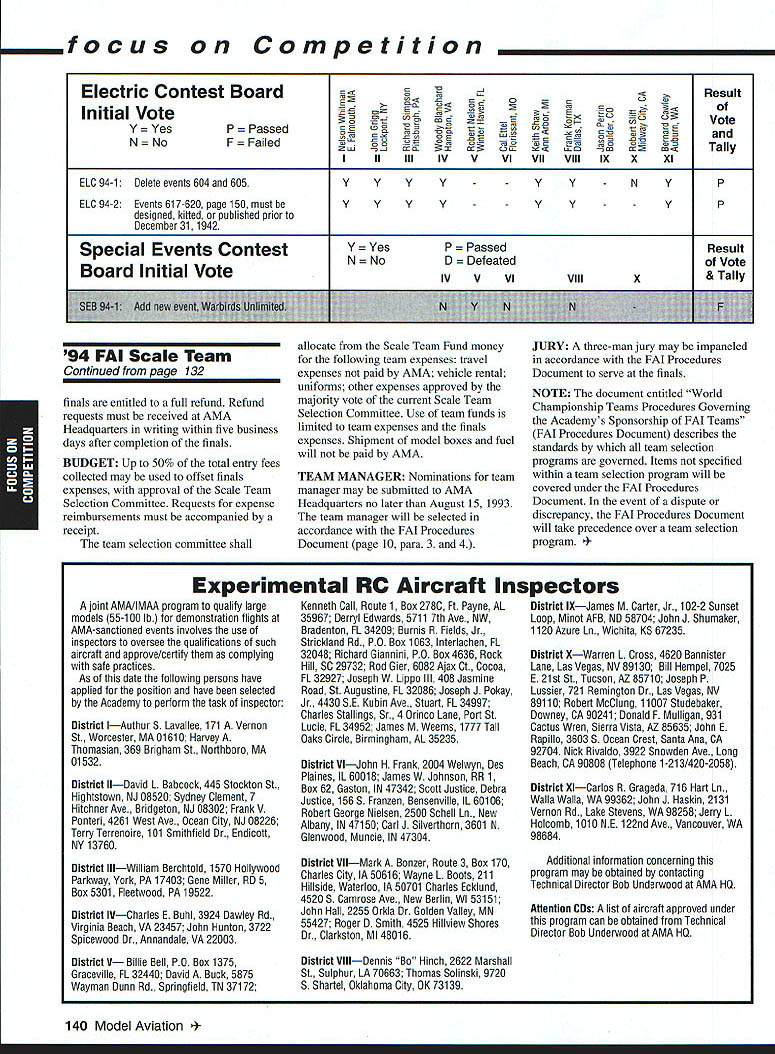
General Contest Board and Executive Council Tabulation — Initial Vote
Y = Yes P = Passed N = No F = Failed
IN = Indoor Contest Board CL = Control Line Contest Board FF = Free Flight Contest Board SC = Scale Contest Board ELC = Electric Contest Board RCA = Radio Control Aerobatics Contest Board RCH = Radio Control Helicopter Contest Board RCR = Radio Control Racing Contest Board RCS = Radio Control Soaring Contest Board SEB = Special Events Contest Board
Result of Vote and Tally:
- GEN-94-1: Delete CD/Leader Member references on page 1. — P
- GEN-94-2, EC 94-1: Allows Contest Directors to compete in all events. — P
- GEN-94-3, EC 94-2: Use of "shall" and "should" in rule book. — P
---
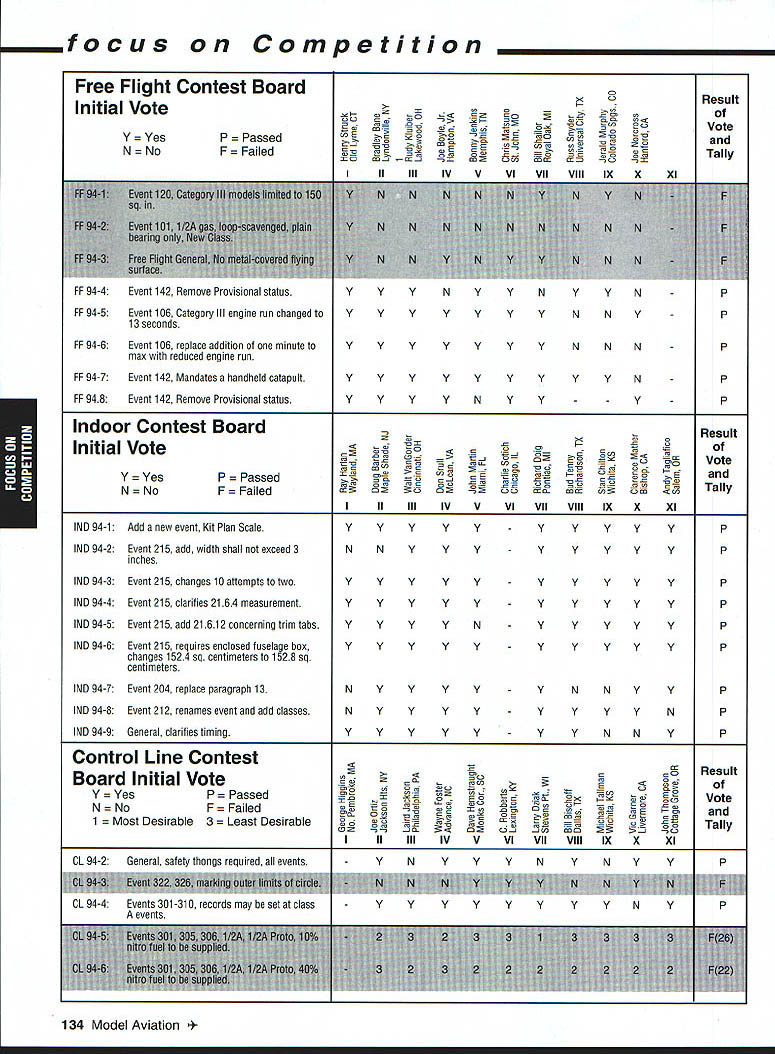
Free Flight Contest Board — Initial Vote
Y = Yes N = No P = Passed F = Failed
- FF 94-1: Event 120, Category III models limited to 150 sq. in. — F
- FF 94-2: Event 101, 1/2A gas, loop-scavenged, plain bearing only, New Class. — F
- FF 94-3: Free Flight General, No metal-covered flying surface. — F
- FF 94-4: Event 142, Remove Provisional status. — P
- FF 94-5: Event 106, Category III engine run changed to 13 seconds. — P
- FF 94-6: Event 106, replace addition of one minute to max with reduced engine run. — P
- FF 94-7: Event 142, Mandates a handheld catapult. — P
- FF 94-8: Event 142, Remove Provisional status. — P
---
Indoor Contest Board — Initial Vote
Y = Yes N = No P = Passed F = Failed
- IND 94-1: Add a new event, Kit Plan Scale. — P
- IND 94-2: Event 215, add, width shall not exceed 3 inches. — P
- IND 94-3: Event 215, changes 10 attempts to two. — P
- IND 94-4: Event 215, clarifies 21.6.4 measurement. — P
- IND 94-5: Event 215, add 21.6.12 concerning trim tabs. — P
- IND 94-6: Event 215, requires enclosed fuselage box, changes 152.4 sq. centimeters to 152.8 sq. centimeters. — P
- IND 94-7: Event 204, replace paragraph 13. — P
- IND 94-8: Event 212, renames event and add classes. — P
- IND 94-9: General, clarifies timing. — P
---
Control Line Contest Board — Initial Vote
Y = Yes N = No P = Passed F = Failed 1 = Most Desirable 3 = Least Desirable
- CL 94-2: General, safety thongs required at all events. — P
- CL 94-3: Event 322, 326, marking outer limits of circle. — F
- CL 94-4: Events 301-310, records may be set at Class A events. — P
- CL 94-5: Events 301, 305, 306, 1/2A, 1/2A Proto, 10% nitro fuel to be supplied. — F (26)
- CL 94-6: Events 301, 305, 306, 1/2A, 1/2A Proto, 40% nitro fuel to be supplied. — F (22)
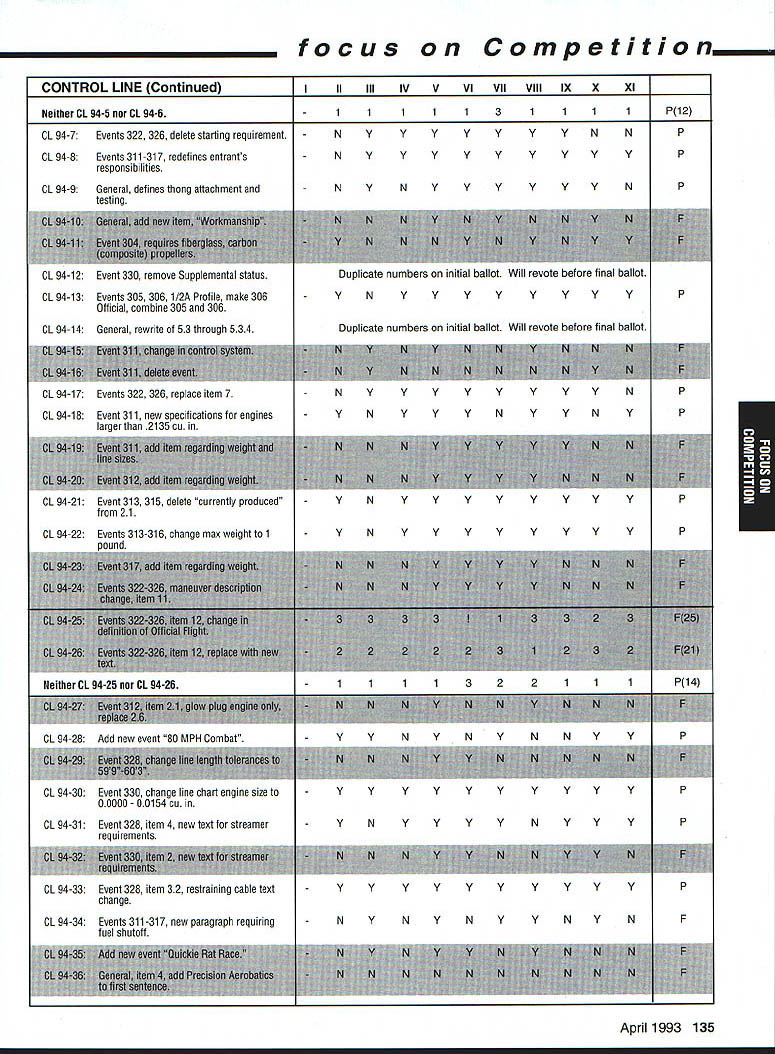
Control Line (continued)
- Neither CL 94-5 nor CL 94-6 passed.
- CL 94-7: Events 322, 326, delete starting requirement.
- CL 94-8: Events 311-317, redefines entrant's responsibilities.
- CL 94-9: General, defines thong attachment and testing.
- CL 94-10: General, add new item "Workmanship".
- CL 94-11: Event 304, requires fiberglass, carbon (composite) propellers.
- CL 94-12: Event 330, remove Supplemental status.
- CL 94-13: Events 305, 306, 1/2A Profile, make 306 Official, combine 305 and 306.
- CL 94-14: General, rewrite of 5.3 through 5.3.4.
- CL 94-15: Event 311, change in control system.
- CL 94-16: Event 311, delete event.
- CL 94-17: Events 322, 326, replace item 7.
- CL 94-18: Event 311, new specifications for engines larger than .2135 cu. in.
- CL 94-19: Event 311, add item regarding weight and line sizes.
- CL 94-20: Event 312, add item regarding weight.
- CL 94-21: Events 313, 315, delete "currently produced" from 2.1.
- CL 94-22: Events 313-316, change max weight to 1 pound.
- CL 94-23: Event 317, add item regarding weight.
- CL 94-24: Events 322-326, maneuver description change, item 11.
- CL 94-25: Events 322-326, item 12, change in definition of Official Flight.
- CL 94-26: Events 322-326, item 12, replace with new text.
- Neither CL 94-25 nor CL 94-26 passed.
- CL 94-27: Event 312, item 2.1, glow plug engine only, replace 2.6.
- CL 94-28: Add new event "80 MPH Combat".
- CL 94-29: Event 328, change line length tolerances to 59" - 60".
- CL 94-30: Event 330, change line chart engine size to 0.0000 - 0.0154 cu. in.
- CL 94-31: Event 328, item 4, new text for streamer requirements.
- CL 94-32: Event 330, item 2, new text for streamer requirements.
- CL 94-33: Event 328, item 3.2, restraining cable text change.
- CL 94-34: Events 311-317, new paragraph requiring fuel shutoff.
- CL 94-35: Add new event "Quickie Rat Race".
- CL 94-36: General, item 4, add Precision Aerobatics to first sentence.
---
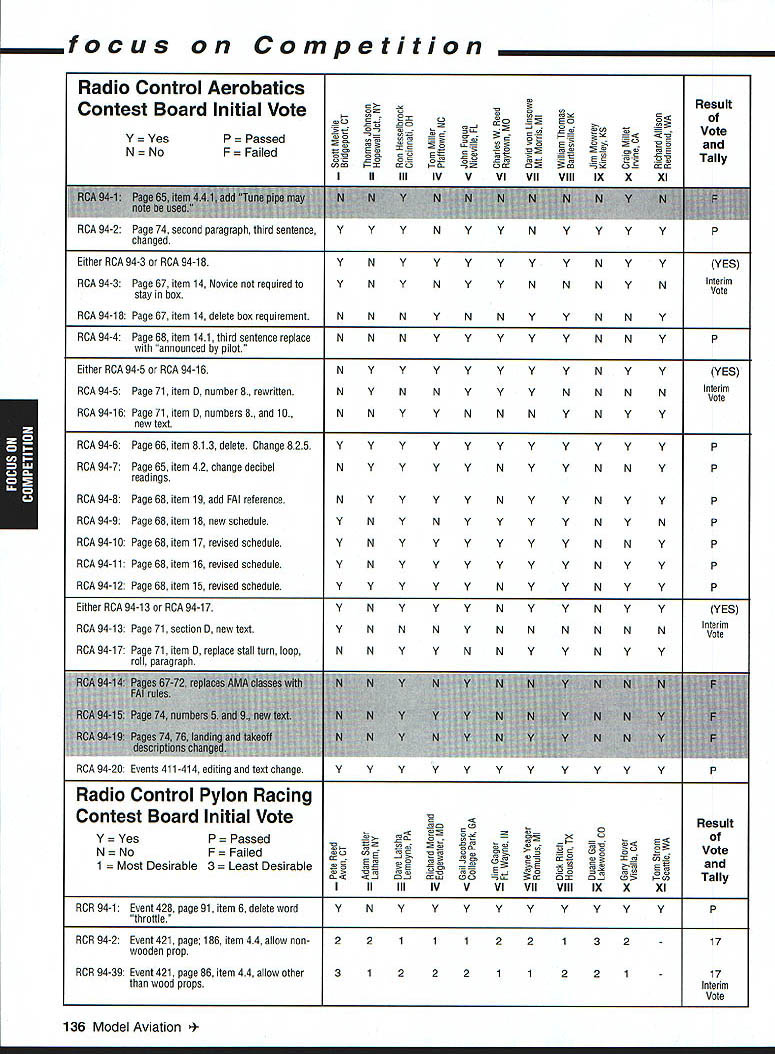
Radio Control Aerobatics Contest Board — Initial Vote
Y = Yes P = Passed N = No F = Failed I = Interim Vote
- RCA 94-1: Page 65, item 4.4.1, add "Tune pipe may not be used." — F
- RCA 94-2: Page 74, second paragraph, third sentence, changed. — P
- Either RCA 94-3 or RCA 94-18 passed: (YES)
- RCA 94-3: Page 67, item 14, Novice not required to stay in box. — Interim Vote
- RCA 94-18: Page 67, item 14, delete box requirement. — P
- RCA 94-4: Page 68, item 14.1, third sentence replace with "announced by pilot." — P
- Either RCA 94-5 or RCA 94-16: both Interim Vote
- RCA 94-5: Page 71, item D, number 8, rewritten. — Interim Vote
- RCA 94-16: Page 71, item D, numbers 8 and 10, new text. — Interim Vote
- RCA 94-6: Page 66, item 8.13, delete. Change 8.2.5. — P
- RCA 94-7: Page 65, item 4.2, change decibel readings. — P
- RCA 94-8: Page 68, item 19, add FAI reference. — P
- RCA 94-9: Page 68, item 18, new schedule. — P
- RCA 94-10: Page 68, item 17, revised schedule. — P
- RCA 94-11: Page 68, item 16, revised schedule. — P
- RCA 94-12: Page 68, item 15, revised schedule. — P
- Either RCA 94-13 or RCA 94-17: (YES)
- RCA 94-13: Page 71, section D, new text. — Interim Vote
- RCA 94-17: Page 71, item D, replace stall turn, loop, roll paragraph. — Interim Vote
- RCA 94-14: Pages 67-72, replaces AMA classes with FAI rules. — F
- RCA 94-15: Page 74, numbers 5 and 9, new text. — F
- RCA 94-19: Pages 74, 76, landing and takeoff descriptions changed. — F
- RCA 94-20: Events 411-414, editing and text change. — P
---
Radio Control Pylon Racing Contest Board — Initial Vote
Y = Yes P = Passed N = No F = Failed I = Interim Vote 1 = Most Desirable 3 = Least Desirable
- RCR 94-1: Event 428, page 91, item 6, delete word "throttle." — P
- RCR 94-2: Event 421, page 86, item 4.4, allow non-wooden prop. — 17 (Interim)
- RCR 94-39: Event 421, page 86, item 4.4, allow other than wood props. — 17 (Interim)
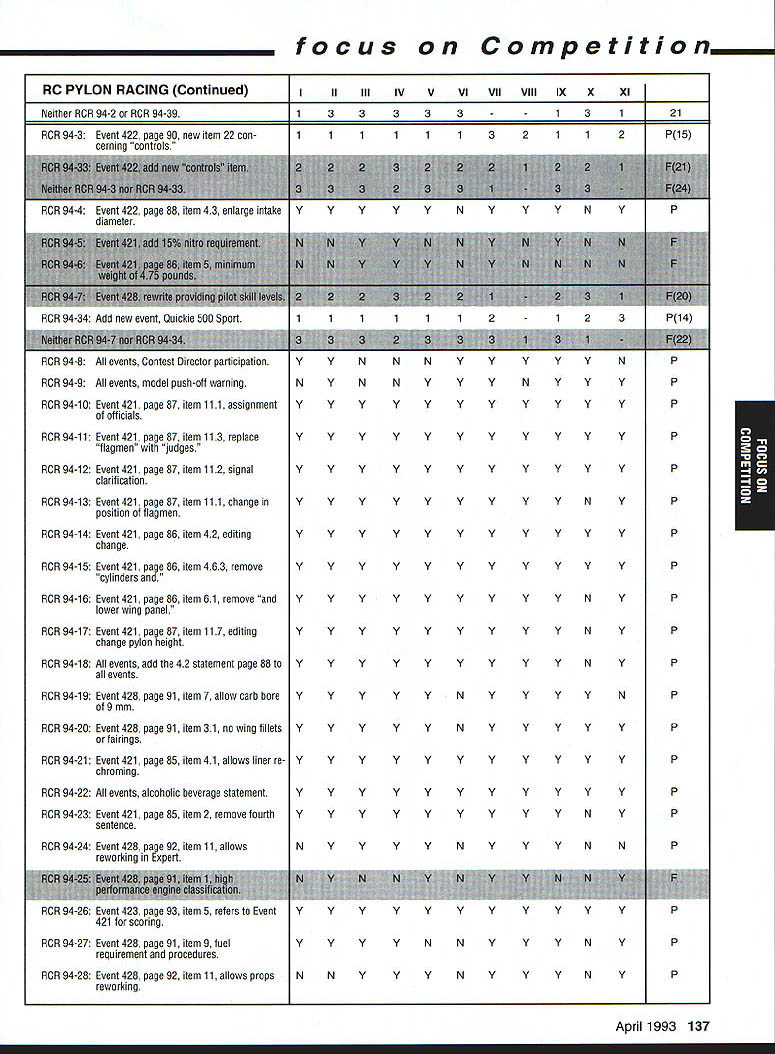
- Neither RCR 94-2 nor RCR 94-39 passed.
- RCR 94-3: Event 422, page 90, new item 22 concerning "controls."
- RCR 94-33: Event 422, add new "controls" item.
- Neither RCR 94-3 nor RCR 94-33 passed.
- RCR 94-4: Event 422, page 88, item 4.3, enlarge intake diameter.
- RCR 94-5: Event 421, add 15% nitro requirement.
- RCR 94-6: Event 421, page 86, item 5, minimum weight of 4.75 pounds.
- RCR 94-7: Event 428, rewrite providing pilot skill levels.
- RCR 94-34: Add new event, Quickie 500 Sport.
- Neither RCR 94-7 nor RCR 94-34 passed.
- RCR 94-8: All events, Contest Director participation.
- RCR 94-9: All events, medal push-off warning.
- RCR 94-10: Event 421, page 87, item 11.1, assignment of officials.
- RCR 94-11: Event 421, page 87, item 11.3, replace "flagmen" with "judges."
- RCR 94-12: Event 421, page 87, item 11.2, signal clarification.
- RCR 94-13: Event 421, page 87, item 11.1, change in position of flagmen.
- RCR 94-14: Event 421, page 86, item 4.2, editing change.
- RCR 94-15: Event 421, page 86, item 4.6.3, remove cylinders and ...
- RCR 94-16: Event 421, page 86, item 6.1, remove "and lower wing panel."
- RCR 94-17: Event 421, page 87, item 11.7, editing change pylon height.
- RCR 94-18: All events, add the 4.2 statement page 88 to all events.
- RCR 94-19: Event 428, page 91, item 7, allow carb bore of 9 mm.
- RCR 94-20: Event 428, page 91, item 3.1, no wing fillets or fairings.
- RCR 94-21: Event 421, page 85, item 4.1, allows liner re-chroming.
- RCR 94-22: All events, alcoholic beverage statement.
- RCR 94-23: Event 421, page 85, item 2, remove fourth sentence.
- RCR 94-24: Event 428, page 92, item 11, allows reworking in Expert.
- RCR 94-25: Event 428, page 91, item 1, high performance engine classification.
- RCR 94-26: Event 423, page 93, item 5, refers to Event 421 for scoring.
- RCR 94-27: Event 428, page 91, item 9, fuel requirement and procedures.
- RCR 94-28: Event 428, page 92, item 11, allows props reworking.
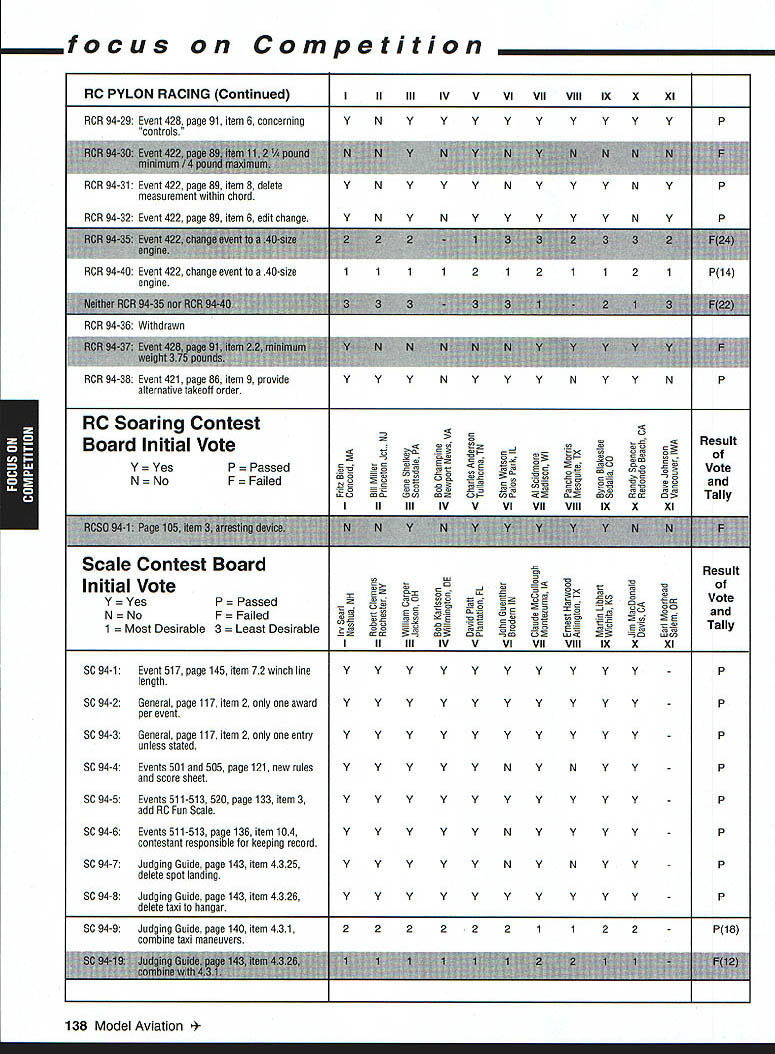
- RCR 94-29: Event 428, page 91, item 6, concerning "controls."
- RCR 94-30: Event 422, page 89, item 11, 2 1/4 pound minimum / 4 pound maximum.
- RCR 94-31: Event 422, page 89, item 8, delete measurement within chord.
- RCR 94-32: Event 422, page 89, item 6, edit change.
- RCR 94-35: Event 422, change event to a .40-size engine.
- RCR 94-40: Event 422, change event to a .40-size engine.
- Neither RCR 94-35 nor RCR 94-40 passed.
- RCR 94-36: Withdrawn.
- RCR 94-37: Event 428, page 91, item 2.2, minimum weight 3.75 pounds.
- RCR 94-38: Event 421, page 86, item 9, provide alternative takeoff order.
---
Radio Control Soaring Contest Board — Initial Vote
Y = Yes P = Passed N = No F = Failed
- RCSO 94-1: Page 105, item 3, arresting device. — (Result recorded)
---
Scale Contest Board — Initial Vote
Y = Yes P = Passed N = No F = Failed 1 = Most Desirable 3 = Least Desirable
- SC 94-1: Event 517, page 145, item 7.2 winch line length.
- SC 94-2: General, page 117, item 2, only one award per event.
- SC 94-3: General, page 117, item 2, only one entry unless stated.
- SC 94-4: Events 501 and 505, page 121, new rules and score sheet.
- SC 94-5: Events 511-513, 520, page 133, item 3, add RC Fun Scale.
- SC 94-6: Events 511-513, page 136, item 10.4, contestant responsible for keeping record.
- SC 94-7: Judging Guide, page 143, item 4.3.25, delete spot landing.
- SC 94-8: Judging Guide, page 143, item 4.3.26, delete taxi to hangar.
- SC 94-9: Judging Guide, page 140, item 4.3.1, combine taxi maneuvers.
- SC 94-19: Judging Guide, page 143, item 4.3.26, combine with 4.3.1.
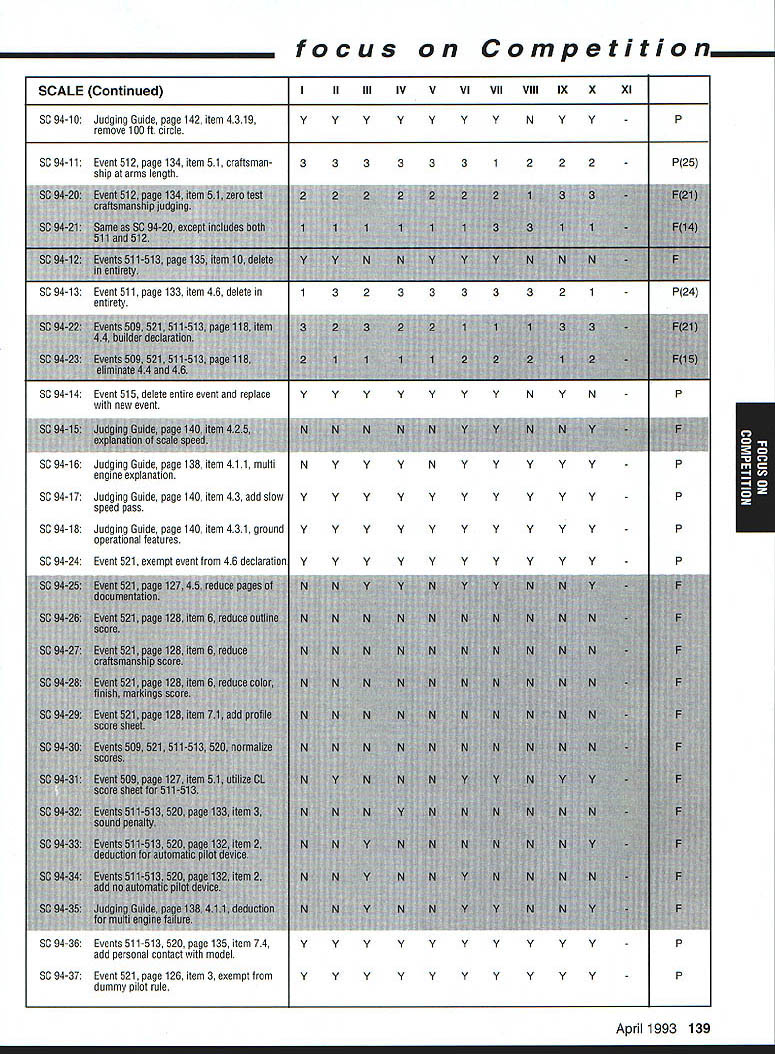
Scale (continued)
- SC 94-10: Judging Guide, page 142, item 4.3.19, remove 100 ft. circle. — Result: P
- SC 94-11: Event 512, page 134, item 5.1, craftsmanship at arms length. — Result: P (25)
- SC 94-20: Event 512, page 134, item 5.1, zero test craftsmanship judging. — Result: F (21)
- SC 94-21: Same as SC 94-20, except includes both 511 and 512. — Result: F (14)
- SC 94-12: Events 511-513, page 135, item 10, delete in entirety. — Result: F
- SC 94-13: Event 511, page 133, item 4.6, delete in entirety. — Result: P (24)
- SC 94-22: Events 509, 521, 511-513, page 118, item 4.4, builder declaration. — Result: F (21)
- SC 94-23: Events 509, 521, 511-513, page 118, eliminate 4.4 and 4.6. — Result: F (15)
- SC 94-14: Event 515, delete entire event and replace with new event. — Result: P
- SC 94-15: Judging Guide, page 140, item 4.2.5, explanation of scale speed. — Result: F
- SC 94-16: Judging Guide, page 138, item 4.1.1, multi-engine explanation. — Result: P
- SC 94-17: Judging Guide, page 140, item 4.3, add slow speed pass. — Result: P
- SC 94-18: Judging Guide, page 140, item 4.3.1, ground operational features. — Result: P
- SC 94-24: Event 521, exempt event from 4.6 declaration. — Result: P
- SC 94-25: Event 521, page 127, 4.5, reduce pages of documentation. — Result: F
- SC 94-26: Event 521, page 128, item 6, reduce outline score. — Result: F
- SC 94-27: Event 521, page 128, item 6, reduce craftsmanship score. — Result: F
- SC 94-28: Event 521, page 128, item 6, reduce color, finish, markings score. — Result: F
- SC 94-29: Event 521, page 128, item 7.1, add profile score sheet. — Result: F
- SC 94-30: Events 509, 521, 511-513, 520, normalize scores. — Result: F
- SC 94-31: Event 509, page 127, item 5.1, utilize CL score sheet for 511-513. — Result: F
- SC 94-32: Events 511-513, 520, page 133, item 3, sound penalty. — Result: F
- SC 94-33: Events 511-513, 520, page 132, item 2, deduction for automatic pilot device. — Result: F
- SC 94-34: Events 511-513, 520, page 132, item 2, add no automatic pilot device. — Result: F
- SC 94-35: Judging Guide, page 138, 4.1.1, deduction for multi-engine failure. — Result: F
- SC 94-36: Events 511-513, 520, page 135, item 7.4, add personal contact with model. — Result: P
- SC 94-37: Event 521, page 126, item 3, exempt from dummy pilot rule. — Result: P
---
Note From the Technical Director — Closing
Columns have often addressed issues relating to event sanctioning and safety. Recently, comments in another publication prompted me to think a little about the subject. Since other groups are currently sanctioning events, I thought it important to repeat the following items you should carefully consider when sanctioning an event or participating in one — true whether sanctioned by AMA or another organization.
Over the years the statement found in AMA's Competition Regulations and Membership Manual has been at the heart of the Academy's sanctioning procedure: "Sanctioning means that a participating AMA member is assured that other fliers are insured to protect him just as AMA insurance protects others." The intent was to see everyone protected; primary responsibilities lie with a cadre of almost 5,000 AMA Contest Directors to make certain this happens.
Should you attend an event not sanctioned by the Academy, ask yourself: Are participants insured? Check to determine:
These factors are very important. Too often people fall into two possible assumption traps. One is to assume everyone carries some form of primary liability coverage (such as homeowners insurance). In a recent settlement (approximately $1.325 million) involving an AMA modeler, an individual did not have such coverage. When you go to events not sanctioned by AMA, organizers should check whether entrants have insurance or belong to an association that provides insurance. Personal experience suggests the answer is often no. You might also ask whether foreign participants have any idea of their insurance status or whether their coverage is valid in the United States.
The second assumption is that once an event has concluded nothing untoward will surface and the element of risk has ended. That, too, is false. Claims often surface well after an event. Whoever attends a sanctioned event should make a record of participants' status so the responsible party can address any later issues.
Another point to consider concerns the safety rules in place at the event. The Academy has always stipulated the Contest Director will maintain minimum safety considerations mandated by the AMA National Model Aircraft Safety Code. Additional, stricter regulations may be imposed, and items required in the Competition Regulations may be added as a result of local considerations. When you go to an event, know what code is in effect. Codes promulgated by other organizations have undergone numerous changes within a year. Does the organization have effective means of communicating changes to the entire membership in a timely fashion? An AMA member flying at an event sanctioned by another group may not know which code applies. The Academy's practice is to change the code on a calendar-year basis; announcements indicate the nature of changes in advance of the new year. On rare occasions a midyear change or clarification has been necessary.
Creating controversy for controversy's sake is not productive. I strongly urge potential event organizers and participants to consider carefully the elements involved in any event.
Transcribed from original scans by AI. Minor OCR errors may remain.

