
Focus on Competition - 2001/01
Technical Director
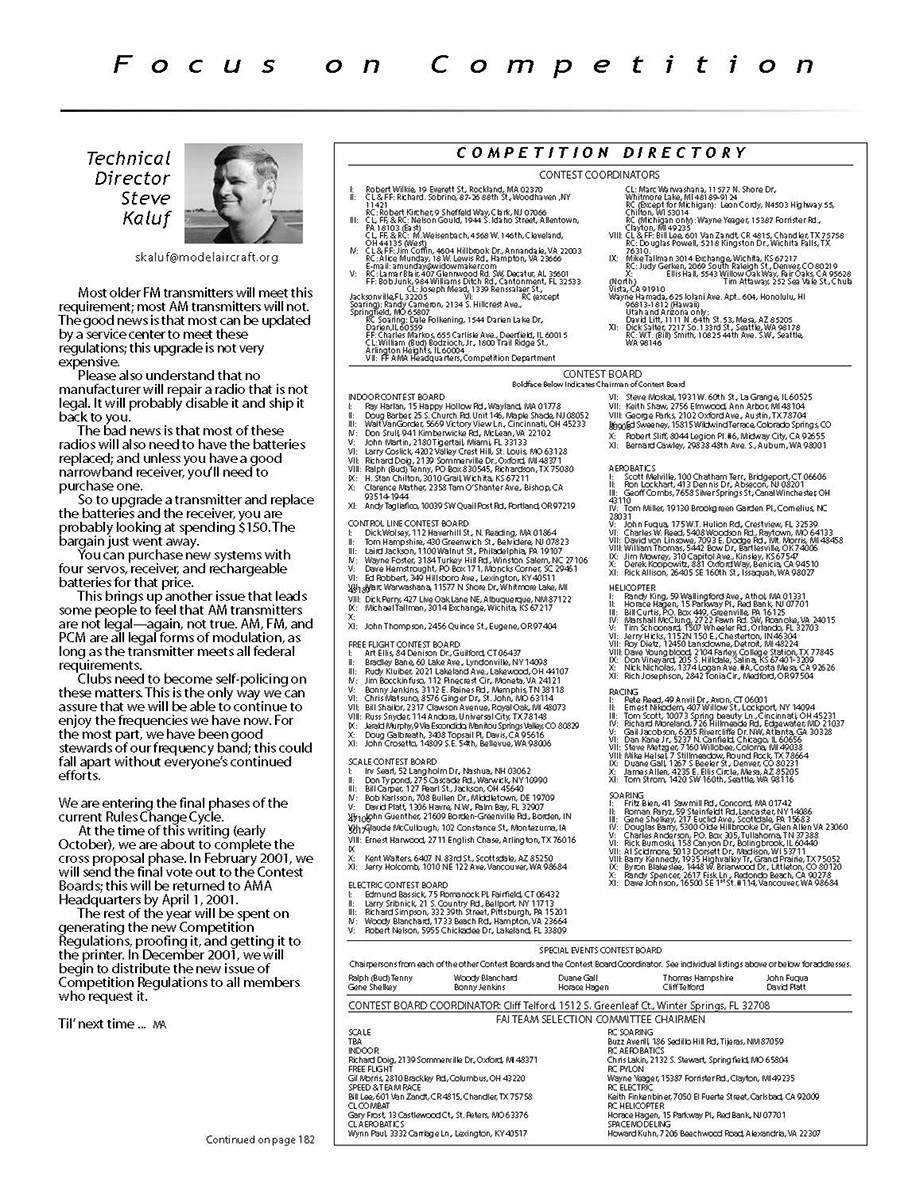
Steve Kaluf skaluf@modelaircraft.org
Continued from page 179
HAPPY NEW YEAR! I hope this finds you in good health and ready for a great 2001 flying season.
I'd love to report that I did loads of flying in 2000, but sadly that is not the case. I just don't seem to have the time I want to spend at the flying field. I'm sure my story is not unlike many of yours; I have two very active school-age kids that manage to keep me and my wife very busy. Couple that with our own meetings, serving on boards, other activities, etc., and there is little time left in the day.
I did get to fly Hand-Launch Golf during the Nationals. This is always great fun! For the last two years, my partner has been League of Silent Flight president Jack Strother and his wife Karen. They are great people. This year, Daryl Perkins (F3B World Champion) joined our group. Talk about being outclassed! I made three to four throws to each one that Daryl made. I did have the longest drive on one hole—of course that was only until Daryl launched.
My daughter has driven the golf cart for me on these outings for as long as I can remember; coupled with serving as a Nats runner (also driving golf carts), she is probably the most experienced golf-cart driver around!
Interference and Narrowband Receivers
We continue to receive calls from members who are having problems with interference at their flying sites. In many cases, I can help them trace this problem back to aircraft that have not had narrowband receivers installed. Although law does not require this, narrowband receivers are essential at almost all flying sites. This is the only way we can help ensure that our aircraft and those around them are as protected as possible. This is a serious safety issue.
Clubs may want to consider checking aircraft to make sure they have narrowband receivers installed.
If the interference problem cannot be traced to receivers, some monitoring of your field should be done. Clubs may borrow scanning and receiving equipment from AMA districts. Others may wish to purchase their own equipment. If you do, give me a call and I'll let you know what we have found to work and from whom to get the equipment.
Transmitter Regulations and Legal Issues
I also continue to get many calls and e-mail regarding transmitters. These range from "I'm looking at buying a used transmitter; is it legal?" to "I understand AM radios are no longer legal?" One member even accused AMA of making these rules and causing people to replace old equipment. Let's look at some of these issues and try to clear them up a bit.
Several months ago (in two columns), I brought up the issues of transmitter-crystal swapping and using frequency modules from one manufacturer in another manufacturer's transmitter. To say that the issue caused a stir would be an understatement.
We reported that these practices are illegal according to Federal Communications Commission (FCC) regulations. Since that time, we asked our attorney who deals with FCC issues to interpret this rule for us. (This is a firm dedicated to dealing with FCC issues daily.) They have looked at the rule and inquired to the FCC, and they agree with our interpretation.
This rule is found in the Code of Federal Regulations, Title 47, Part 95, paragraph 95.645(b). It states:
"95.645 TYPE ACCEPTANCE REQUIREMENTS
(b) An R/C transmitter which incorporates plug-in frequency determining modules which are changed by the user must be type accepted with the modules. Each module must contain all of the frequency determining circuitry including the oscillator. Plug-in crystals are not considered modules and must not be accessible to the user."
Although this is not what many of our members were hoping for, it is a federal regulation and must be abided by.
Most older FM transmitters will meet the narrowband requirement; most AM transmitters will not. The good news is that many transmitters can be updated by a service center to meet these regulations; this upgrade is not very expensive. Please also understand that no manufacturer will repair a radio that is not legal. It will probably disable it and ship it back to you.
The bad news is that many of these radios will also need to have the batteries replaced; and unless you have a good narrowband receiver, you'll need to purchase one. So to upgrade a transmitter and replace the batteries and the receiver, you are probably looking at spending about $150. The bargain just went away. You can purchase new systems with four servos, receiver, and rechargeable batteries for that price.
This brings up another issue that leads some people to feel that AM transmitters are not legal—again, not true. AM, FM, and PCM are all legal forms of modulation, as long as the transmitter meets all federal requirements.
The onslaught of used transmitters on the market continues to plague radio control fliers. Many of these transmitters are being sold at very low prices that make them attractive to beginners. Don't misunderstand me; I'm not saying that no one should purchase an older transmitter. I am saying that you must be very careful when doing so.
Older transmitters may or may not meet the narrowband regulations. In most cases, unless they display a gold RCMA/AMA RF Check sticker, they will have to be checked to assure they meet these regulations.
Clubs need to become self-policing on these matters. This is the only way we can assure that we will be able to continue to enjoy the frequencies we have now. For the most part, we have been good stewards of our frequency band; this could fall apart without everyone's continued efforts.
Rules Change Cycle
We are entering the final phases of the current Rules Change Cycle. At the time of this writing (early October), we were about to complete the cross-proposal phase.
In February 2001, we will send the final vote out to the Contest Boards; this will be returned to AMA Headquarters by April 1, 2001. The rest of the year will be spent on generating the new Competition Regulations, proofing it, and getting it to the printer. In December 2001, we will begin to distribute the new issue of Competition Regulations to all members who request it.
'Til next time... SK
Transcribed from original scans by AI. Minor OCR errors may remain.

