
Focus on Competition
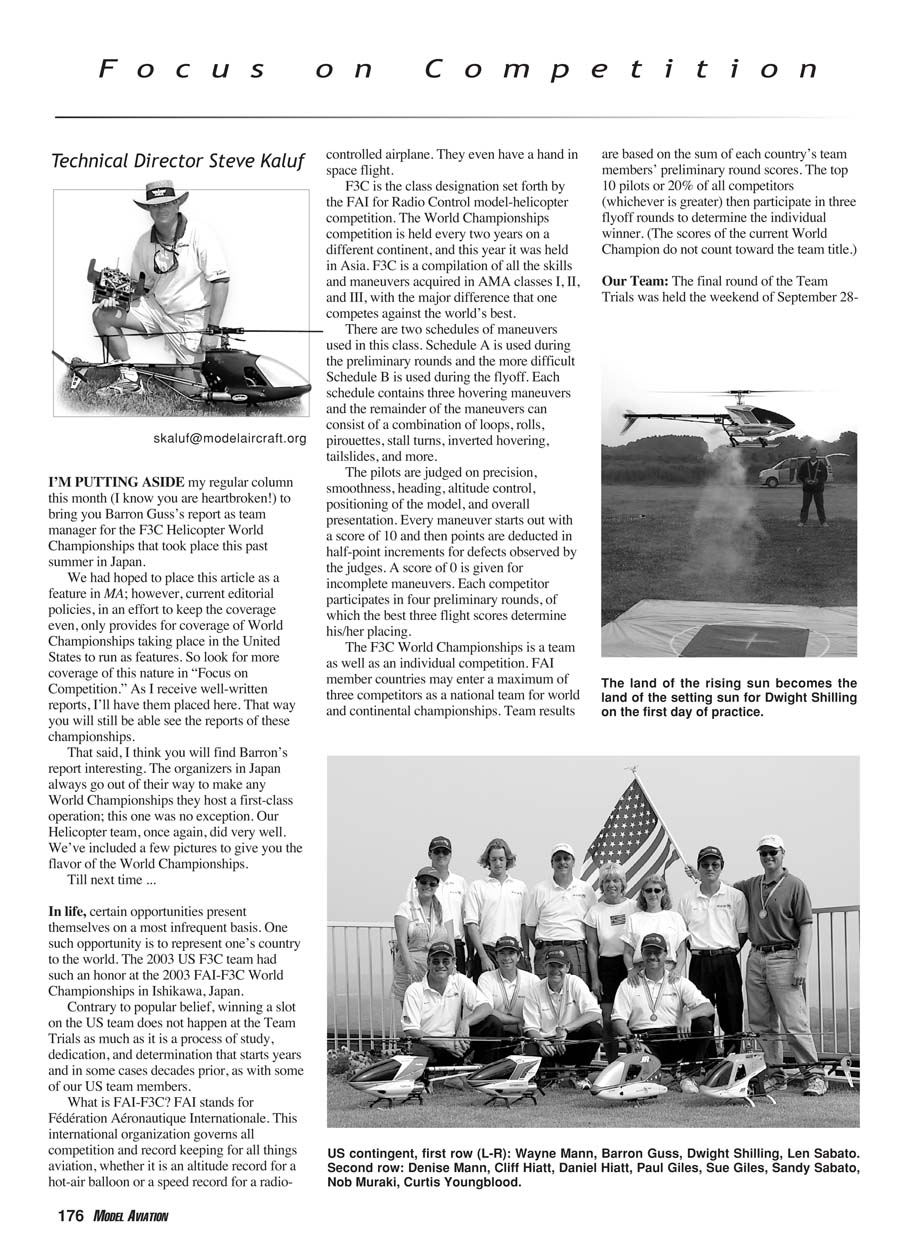
Technical Director Steve Kaluf
I'm putting aside my regular column this month (I know you are heartbroken!) to bring you Barron Guss's report as team manager for the F3C Helicopter World Championships that took place this past summer in Japan.
We had hoped to place this article as a feature in MA; however, current editorial policies, in an effort to keep the coverage even, only provide for coverage of World Championships taking place in the United States to run as features. So look for more coverage of this nature in "Focus on Competition." As I receive well-written reports, I'll have them placed here. That way you will still be able to see the reports of these championships.
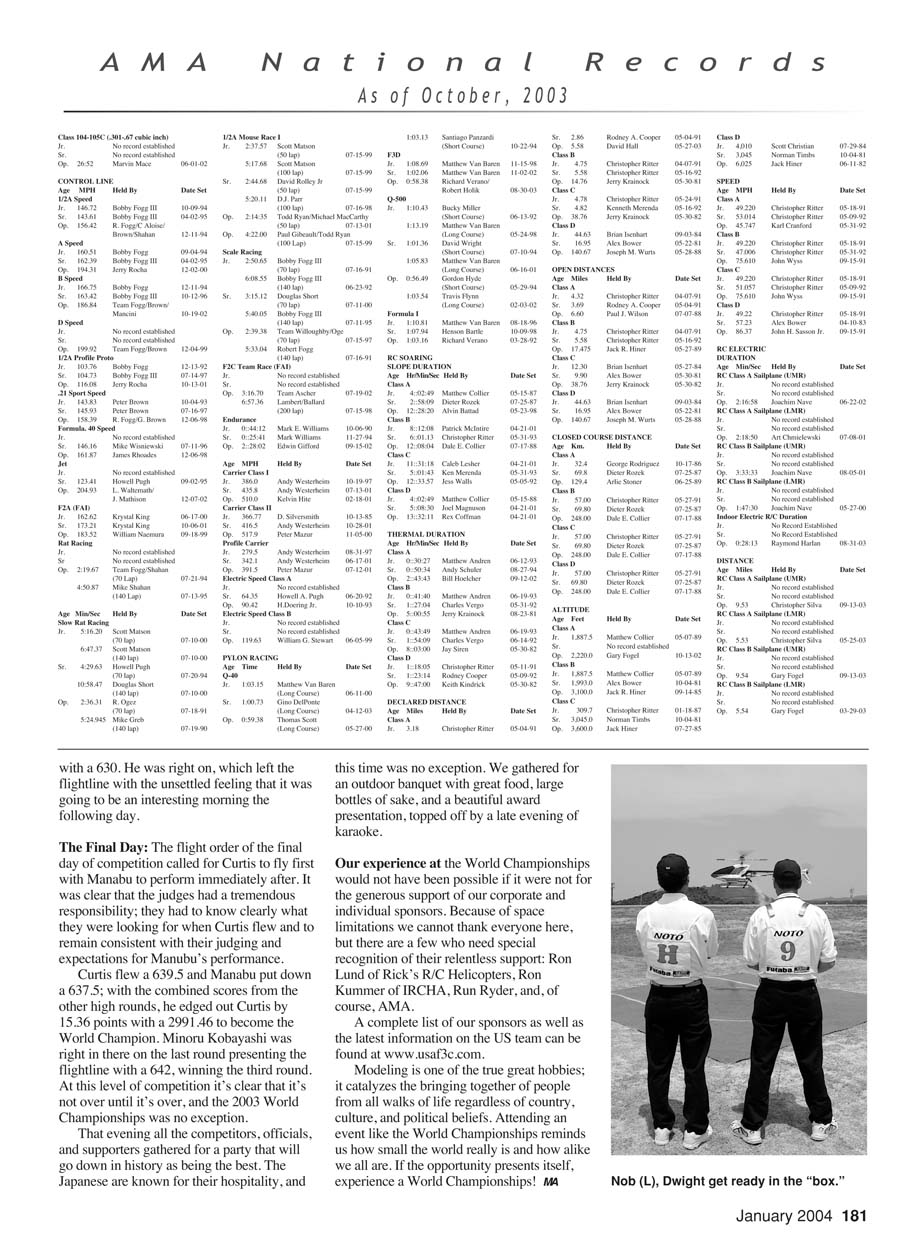
That said, I think you will find Barron's report interesting. The organizers in Japan always go out of their way to make any World Championships they host a first-class operation; this one was no exception. Our helicopter team, once again, did very well. We've included a few pictures to give you the flavor of the World Championships.
Till next time ...
In life, certain opportunities present themselves on a most infrequent basis. One such opportunity is to represent one's country to the world. The 2003 US F3C team had such an honor at the 2003 FAI-F3C World Championships in Ishikawa, Japan.
Contrary to popular belief, winning a slot on the US team does not happen at the Team Trials as much as it is a process of study, dedication, and determination that starts years and, in some cases, decades prior — as with some of our US team members.
What is FAI-F3C? FAI stands for Fédération Aéronautique Internationale. This international organization governs all competition and record keeping for all things aviation, whether it is an altitude record for a hot-air balloon or a speed record for a radio-controlled airplane. They even have a hand in space flight.
F3C is the class designation set forth by the FAI for radio-control model-helicopter competition. The World Championships competition is held every two years on a different continent; this year it was held in Asia. F3C is a compilation of all the skills and maneuvers acquired in AMA Classes I, II, and III, with the major difference that one competes against the world's best.
There are two schedules of maneuvers used in this class. Schedule A is used during the preliminary rounds and the more difficult Schedule B is used during the flyoff. Each schedule contains three hovering maneuvers and the remainder can consist of a combination of loops, rolls, pirouettes, stall turns, inverted hovering, tailslides, and more.
The pilots are judged on precision, smoothness, heading, altitude control, positioning of the model, and overall presentation. Every maneuver starts out with a score of 10 and then points are deducted in half-point increments for defects observed by the judges. A score of 0 is given for incomplete maneuvers. Each competitor participates in four preliminary rounds, of which the best three flight scores determine his or her placing.
The F3C World Championships is a team as well as an individual competition. FAI member countries may enter a maximum of three competitors as a national team for world and continental championships. Team results are based on the sum of each country's team members' preliminary round scores. The top 10 pilots or 20% of all competitors (whichever is greater) then participate in three flyoff rounds to determine the individual winner. (The scores of the current World Champion do not count toward the team title.)
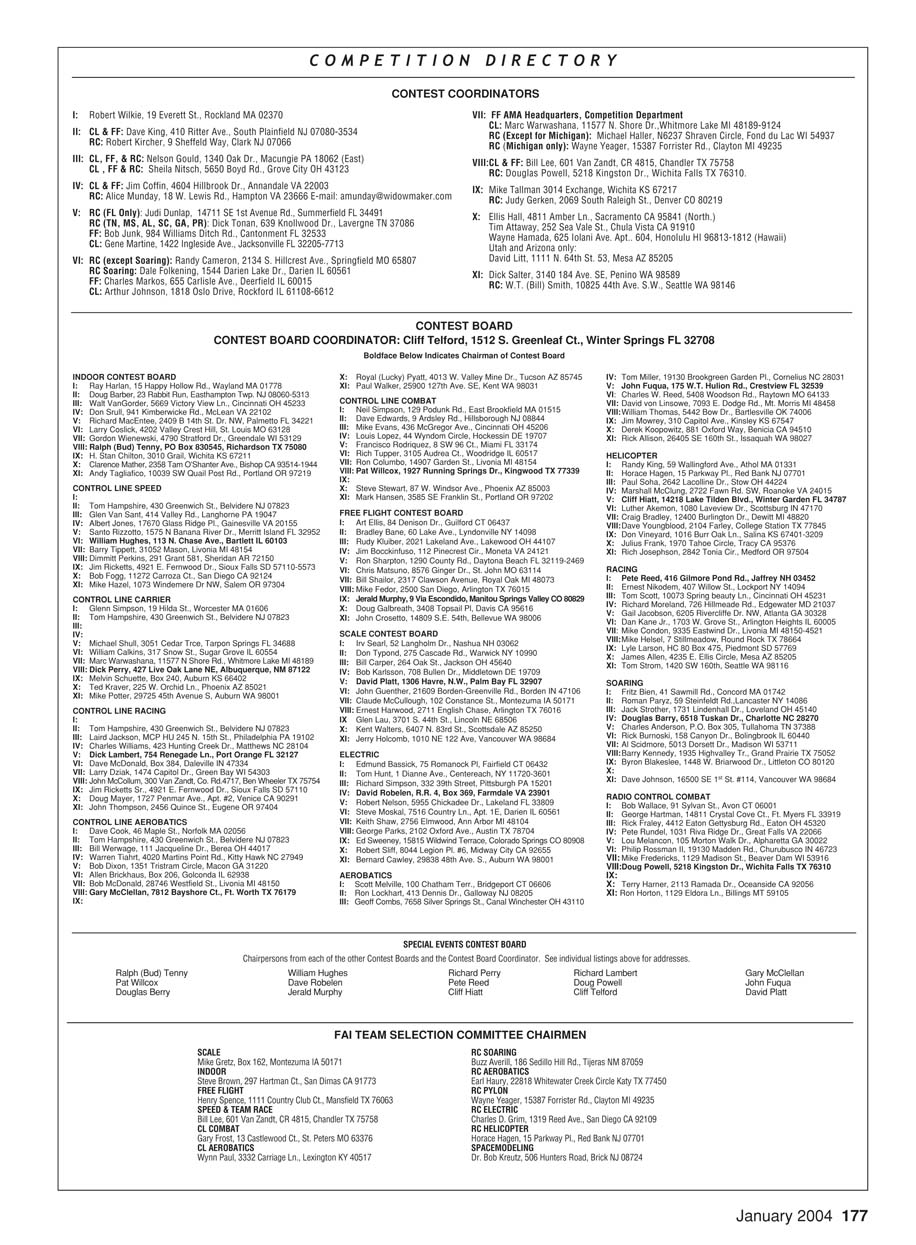
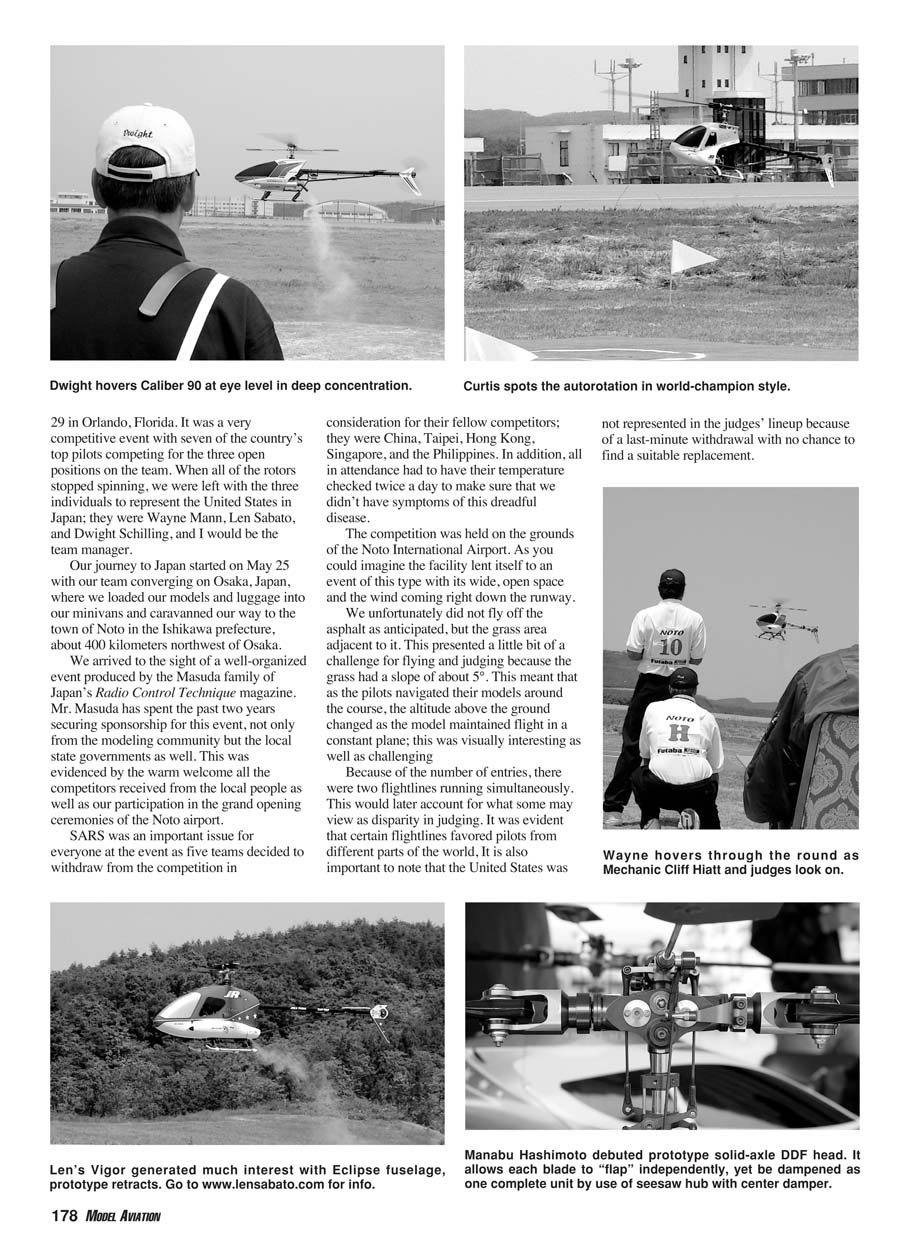
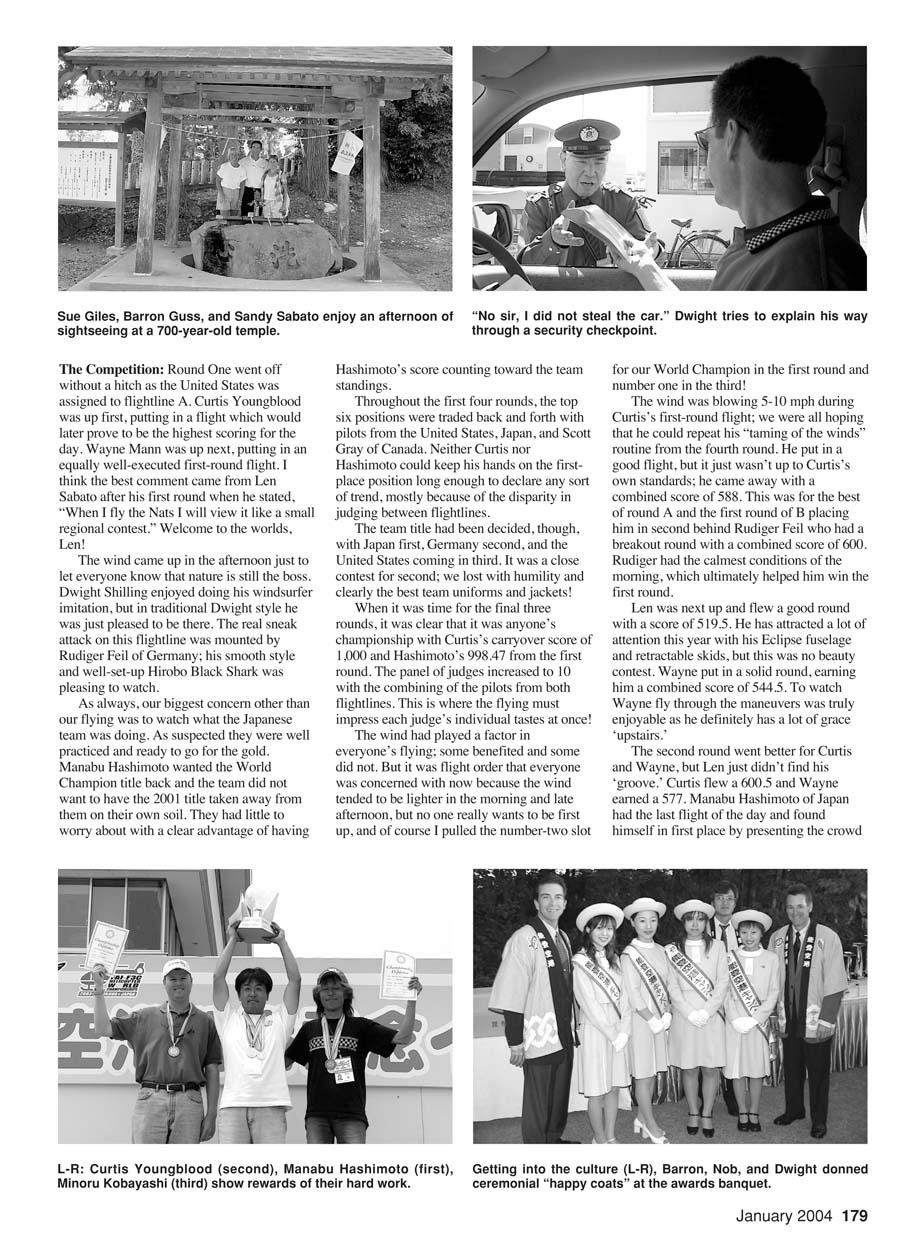
Our team: The final round of the Team Trials was held the weekend of September 28–29 in Orlando, Florida. It was a very competitive event with seven of the country's top pilots competing for the three open positions on the team. When all of the rotors stopped spinning, we were left with the three individuals to represent the United States in Japan: Wayne Mann, Len Sabato, and Dwight Schilling. I served as the team manager.
Our journey to Japan started on May 25 with our team converging on Osaka, where we loaded our models and luggage into minivans and caravanned our way to the town of Noto in the Ishikawa prefecture, about 400 kilometers northwest of Osaka.
We arrived to the sight of a well-organized event produced by the Masuda family of Japan's Radio Control Technique magazine. Mr. Masuda spent the past two years securing sponsorship for this event, not only from the modeling community but from local and prefectural governments as well. This was evidenced by the warm welcome all the competitors received from the local people as well as our participation in the grand opening ceremonies of the Noto airport.
SARS was an important issue for everyone at the event as five teams decided to withdraw from the competition in consideration for their fellow competitors: China, Taipei, Hong Kong, Singapore, and the Philippines. In addition, all in attendance had to have their temperature checked twice a day to make sure that we didn't have symptoms of this dreadful disease.
The competition was held on the grounds of the Noto International Airport. As you could imagine, the facility lent itself to an event of this type with its wide, open space and the wind coming right down the runway.
We unfortunately did not fly off the asphalt as anticipated, but from the grass area adjacent to it. This presented a bit of a challenge for flying and judging because the grass had a slope of about 5°. As the pilots navigated their models around the course, the altitude above the ground changed as the model maintained flight in a constant plane; this was visually interesting as well as challenging.
Because of the number of entries, there were two flightlines running simultaneously. This would later account for what some may view as disparity in judging. It was evident that certain flightlines favored pilots from different parts of the world. It is also important to note that the United States was not represented in the judges' lineup because of a last-minute withdrawal with no chance to find a suitable replacement.
The Competition
Round One went off without a hitch as the United States was assigned to flightline A. Curtis Youngblood was up first, putting in a flight which would later prove to be the highest scoring for the day. Wayne Mann followed with an equally well-executed first-round flight. I think the best comment came from Len Sabato after his first round when he said, "When I fly the Nats I will view it like a small regional contest." Welcome to the worlds, Len!
The wind came up in the afternoon just to let everyone know that nature is still the boss. Dwight Schilling enjoyed doing his windsurfer imitation, but in traditional Dwight style he was just pleased to be there. The real sneak attack on this flightline was mounted by Rudiger Reil of Germany; his smooth style and well-set-up Hirobo Black Shark was a pleasure to watch.
As always, our biggest concern other than our flying was to watch what the Japanese team was doing. As suspected, they were well practiced and ready to go for the gold. Manabu Hashimoto wanted the World Champion title back and the team did not want to have the 2001 title taken away from them on their own soil. They had little to worry about with Hashimoto's score counting toward the team standings.
Throughout the first four rounds, the top six positions were traded back and forth among pilots from the United States, Japan, and Scott Gray of Canada. Neither Curtis nor Hashimoto could hold first place long enough to declare any sort of trend, mostly because of the disparity in judging between flightlines.
The team title had been decided, though, with Japan first, Germany second, and the United States third. It was a close contest for second; we lost with humidity — and clearly the best team uniforms and jackets!
When it was time for the final three rounds, it was clear that it was anyone's championship. Curtis carried over a score of 1,000 and Hashimoto had 998.47 from the first round. The panel of judges increased to 10 with the combining of the pilots from both flightlines. This is where the flying must impress each judge's individual tastes at once!
The wind had affected everyone's flying; some benefited and some did not. But flight order was the big concern because the wind tended to be lighter in the morning and late afternoon. No one really wants to be first up, and of course I pulled the number-two slot for our World Champion in the first round and number one in the third!
The wind was blowing 5–10 mph during Curtis's first flyoff flight; we were all hoping that he could repeat his "taming of the winds" routine from earlier. He put in a good flight, but it just wasn't up to his own standards; he came away with a combined score of 588 (best of Round A and the first round of B), placing him in second behind Rudiger Reil, who had a breakout round with a combined score of 600. Rudiger had the calmest conditions of the morning, which ultimately helped him win the first flyoff round.
Len flew a good round and scored 519.5. He has attracted a lot of attention this year with his Eclipse fuselage and retractable skids, but this was no beauty contest. Wayne put in a solid round, earning a combined score of 544.5 — to watch Wayne fly through the maneuvers was truly enjoyable as he definitely has a lot of grace "upstairs."
The second round went better for Curtis and Wayne, but Len just didn't find his "groove." Curtis flew a 600.5 and Wayne earned a 577. Manabu Hashimoto had the last flight of the day and found himself in first place by presenting the crowd with a 630. He was right on, which left the flightline with the unsettled feeling that it was going to be an interesting morning the following day.
The Final Day
The flight order on the final day called for Curtis to fly first with Manabu immediately after. It was clear that the judges had a tremendous responsibility; they had to know clearly what they were looking for when Curtis flew and remain consistent with their judging and expectations for Manabu’s performance.
Curtis flew a 639.5 and Manabu put down a 637.5; with the combined scores from the other high rounds, Manabu edged out Curtis by 15.36 points with a 2991.46 to become the World Champion. Minoru Kobayashi was right in there on the last round, presenting the flightline with a 642 and winning the third round. At this level of competition it’s clear that it’s not over until it’s over, and the 2003 World Championships was no exception.
That evening all the competitors, officials, and supporters gathered for a party that will go down in history as being the best. The Japanese are known for their hospitality, and this time was no exception. We gathered for an outdoor banquet with great food, large bottles of sake, and a beautiful award presentation, topped off by a late evening of karaoke.
Our experience at the World Championships
Our experience at the World Championships would not have been possible if it were not for the generous support of our corporate and individual sponsors. Because of space limitations we cannot thank everyone here, but there are a few who need special recognition for their relentless support:
- Ron Lund of Rick’s R/C Helicopters
- Ron Kummer of IRCHA
- RunRyder
- AMA
A complete list of our sponsors as well as the latest information on the US team can be found at www.usaf3c.com.
Modeling is one of the true great hobbies; it brings together people from all walks of life regardless of country, culture, and political beliefs. Attending an event like the World Championships reminds us how small the world really is and how alike we all are. If the opportunity presents itself, experience a World Championships!
Transcribed from original scans by AI. Minor OCR errors may remain.

