
Focus on Competition - 2004/02
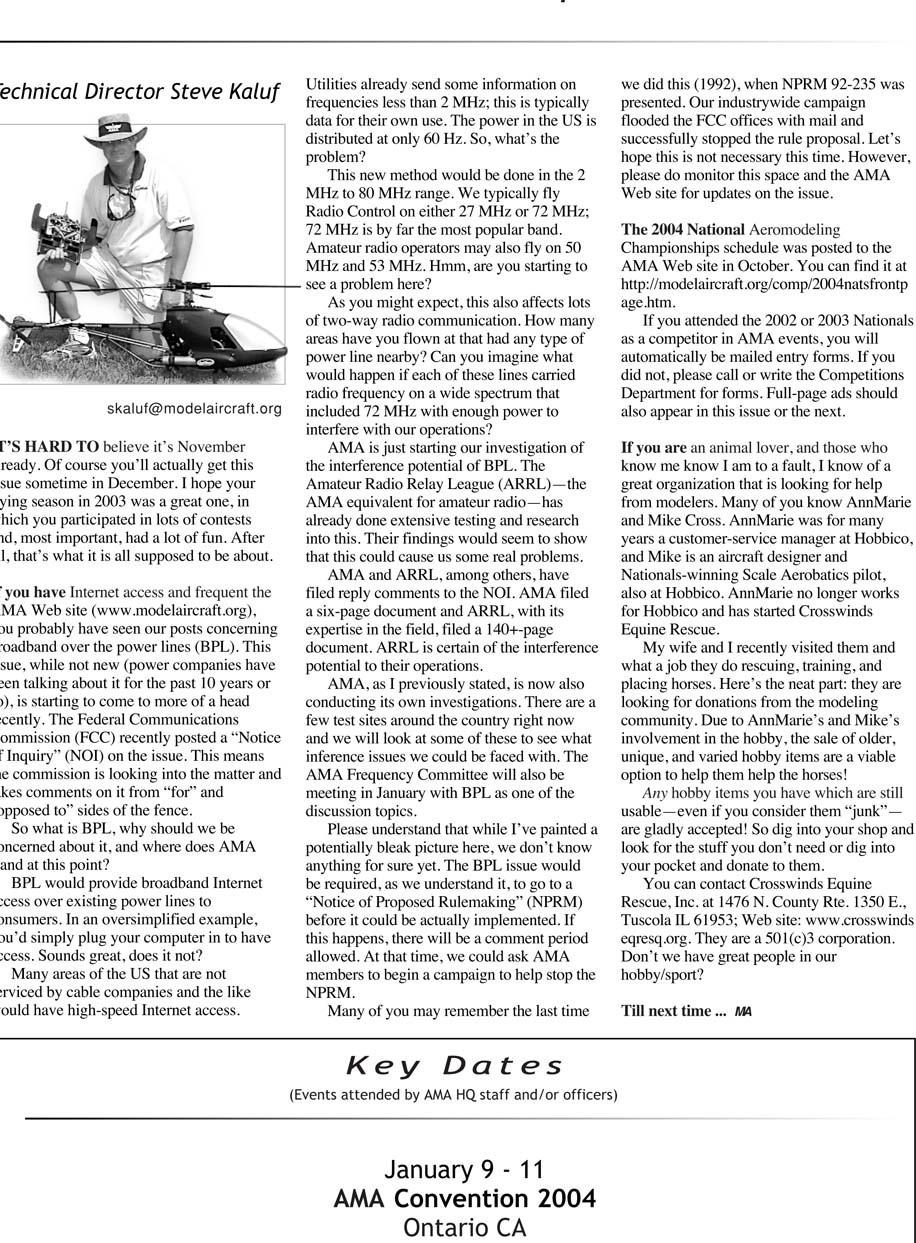
Technical Director
Steve Kaluf skaluf@modelaircraft.org
It's hard to believe it's November already. Of course you'll actually get this issue sometime in December. I hope your flying season in 2003 was a great one, in which you participated in lots of contests and, most important, had a lot of fun. After all, that is what it is all supposed to be about.
If you have Internet access and frequent the AMA website (www.modelaircraft.org), you probably have seen our posts concerning broadband over the power lines (BPL). This issue, while not new (power companies have been talking about it for the past 10 years or so), is starting to come to more of a head recently. The Federal Communications Commission (FCC) recently posted a "Notice of Inquiry" (NOI) on the issue. This means the commission is looking into the matter and takes comments from both sides of the fence.
So what is BPL, why should we be concerned about it, and where does AMA stand at this point? BPL would provide broadband Internet access over existing power lines to consumers. In an oversimplified example, you'd simply plug your computer in to have access. Sounds great, does it not? Many areas of the U.S. that are not serviced by cable companies and the like would have high-speed Internet access.
Utilities already send some information on frequencies less than 2 MHz; this is typically data for their own use. The power in the U.S. is distributed at only 60 Hz. So, what's the problem?
This new method would be done in the 2 MHz to 80 MHz range. We typically fly radio control on either 27 MHz or 72 MHz; 72 MHz is by far the most popular band. Amateur radio operators may also fly on 50 MHz and 53 MHz. Hmm — are you starting to see a problem here? As you might expect, this also affects lots of two-way radio communication. How many areas have you flown at that had any type of power line nearby? Can you imagine what would happen if each of these lines carried radio frequency on a wide spectrum that included 72 MHz with enough power to interfere with our operations?
AMA is just starting our investigation of the interference potential of BPL. The Amateur Radio Relay League (ARRL)—the AMA equivalent for amateur radio—has already done extensive testing and research into this. Their findings would seem to show that this could cause us some real problems. AMA and ARRL, among others, have filed reply comments to the NOI. AMA filed a six-page document and ARRL filed a document of more than 140 pages. ARRL is certain of the interference potential to their operations.
AMA, as I previously stated, is now also conducting its own investigations. There are a few test sites around the country right now and we will look at some of these to see what interference issues we could be faced with. The AMA Frequency Committee will also be meeting in January with BPL as one of the discussion topics.
Please understand that while I've painted a potentially bleak picture here, we don't know anything for sure yet. The BPL issue would be required, as we understand it, to go to a "Notice of Proposed Rulemaking" (NPRM) before it could be actually implemented. If this happens, there will be a comment period allowed. At that time, we could ask AMA members to begin a campaign to help stop the NPRM.
Many of you may remember the last time we did this (1992), when NPRM 92-235 was presented. Our industrywide campaign flooded the FCC offices with mail and successfully stopped the rule proposal. Let's hope this is not necessary this time. However, please monitor this space and the AMA website for updates on the issue.
The 2004 National Aeromodeling Championships schedule was posted to the AMA website in October. You can find it at: http://modelaircraft.org/comp/2004natsfrontpage.htm
If you attended the 2002 or 2003 Nationals as a competitor in AMA events, you will automatically be mailed entry forms. If you did not, please call or write the Competitions Department for forms. Full-page ads should also appear in this issue or the next.
If you are an animal lover (and those who know me know I am to a fault), I know of a great organization that is looking for help from modelers. Many of you know AnnMarie and Mike Cross. AnnMarie was for many years a customer-service manager at Hobbico, and Mike is an aircraft designer and Nationals-winning Scale Aerobatics pilot, also at Hobbico. AnnMarie no longer works for Hobbico and has started Crosswinds Equine Rescue.
My wife and I recently visited them and saw what a job they do rescuing, training, and placing horses. Here's the neat part: they are looking for donations from the modeling community. Due to AnnMarie's and Mike's involvement in the hobby, the sale of older, unique, and varied hobby items are a viable option to help them help the horses!
Any hobby items you have which are still usable — even if you consider them "junk" — are gladly accepted. So dig into your shop and look for the stuff you don't need or dig into your pocket and donate to them.
You can contact Crosswinds Equine Rescue, Inc. at: 1476 N. County Rte. 1350 E., Tuscola, IL 61953 Website: www.crosswindseqresq.org They are a 501(c)(3) corporation.
Till next time... MA
Focus on Competition
The U.S. sends 12 teams to their respective World Championships (WC) every other year. There are even more team selections because CL and FF have several events and teams for each event, and team selections are held for each event.
Featuring all of the team selections would be impossible to do in the magazine, and covering a WC is difficult. We cannot ask any of the contestants to cover one of these events; they are far too busy competing, and we want their focus on the job at hand. Spectators and supporters may or may not be qualified to prepare a WC report, so we run a chance of getting uneven coverage.
The team manager is supposed to write a report on the contest as part of his duties, and it is supposed to be included in the "Focus on Competition" section of Model Aviation. Sometimes we get good coverage and sometimes we don't. We've decided to let the team manager's report suffice for WC events that are held in other countries.
Model Aviation will strive to feature the WC events held on U.S. soil because we can more closely control coverage. That's not an ideal situation, but it is how we are going to do it for at least a year.
Perhaps the most difficult obstacle to overcome in contest/event coverage is the fact that few of our members (less than 10%) compete, and they have indicated little interest in reading about any type of competition. In fact, we receive a number of complaints each year when we present our Nationals issue. Many cannot fathom why we spend so much of the magazine space on competition when so few compete.
Being a competitor myself, I try to present them with the logic that much of AMA's heritage was built on competition. I further explain that dedicated competitors developed much of the technology inherent in the products we use, and often take for granted, in sport flying today during many years of competition flying. Many see that logic and understand the need, and many still prefer not to read such content.
In summary, Model Aviation is going to work with the SIGs to try to promote and publicize coverage on their websites in any given month, and we'll try to present as much coverage as we can in the magazine in a fair and balanced manner. We'll also try to be as timely as we can with the articles we choose to present.
The preceding is probably not what many of you wanted to read in respect to our coverage articles. It is, however, an honest look at just one of the many problems we face on a regular basis when trying to bring as many facets of our sport to as many members as possible in a finite format.
We are all going to have to try to work together and use the resources that are available to us to increase all aspects of reporting on all modeling subjects. The Internet is now, and will continue to be, a big part of the solution to getting out the maximum amount of information.
Transcribed from original scans by AI. Minor OCR errors may remain.

