
Focus on Competition - 2004/12
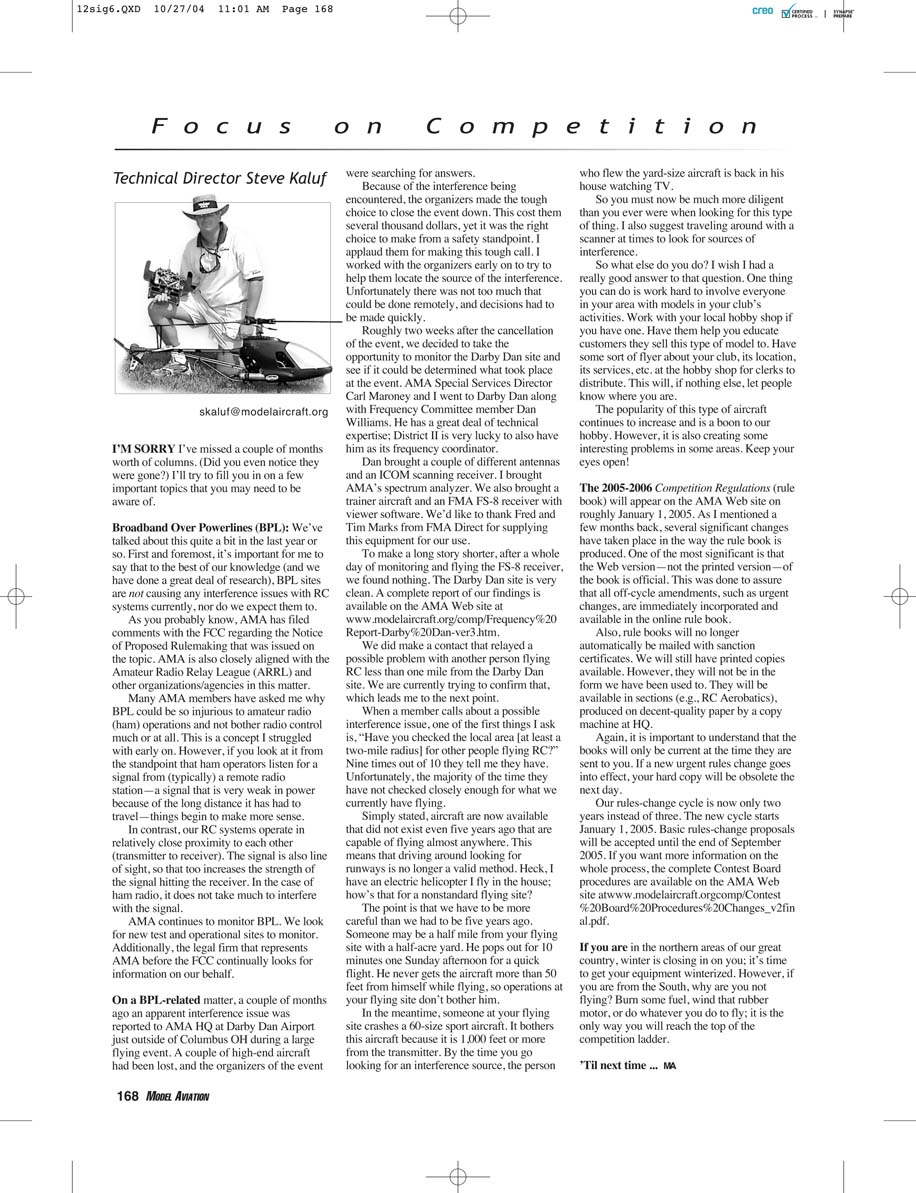
Technical Director
Steve Kaluf skaluf@modelaircraft.org
I'M SORRY I've missed a couple of months' worth of columns. (Did you even notice they were gone?) I'll try to fill you in on a few important topics that you may need to be aware of.
Broadband Over Powerlines (BPL): We've talked about this quite a bit in the last year or so. First and foremost, it's important for me to say that to the best of our knowledge (and we have done a great deal of research), BPL sites are not causing any interference issues with RC systems currently, nor do we expect them to in the near future. That said, AMA has filed comments with the FCC regarding the Notice of Proposed Rulemaking that was issued on the topic. AMA is also closely aligned with the Amateur Radio Relay League (ARRL) and other organizations/agencies in this matter.
Many AMA members have asked me why BPL could be so injurious to amateur radio (ham) operations and not bother radio control much or at all. That's a logical question when first heard. However, if you look at it from the standpoint that ham operators listen for a signal from (typically) a remote radio station — a signal that is very weak in power because of the long distance it has had to travel — things begin to make more sense. In contrast, our RC systems operate in relatively close proximity to each other (transmitter to receiver). The signal is also line of sight, so that increases the strength of the signal hitting the receiver. In the case of ham radio, it does not take much to interfere with the signal.
AMA continues to monitor BPL. We look for new test and operational sites to monitor. Additionally, the legal firm that represents AMA before the FCC continually looks for information on our behalf.
On a BPL-related matter, a couple of months ago an apparent interference issue was reported to AMA HQ at Darby Dan Airport just outside of Columbus, OH during a large flying event. A couple of high-end aircraft had been lost, and the organizers of the event were searching for answers. Because of the interference being encountered, the organizers made the tough choice to close the event down. This cost them several thousand dollars, yet it was the right choice to make from a safety standpoint. I applaud them for making this tough call. I worked with the organizers early on to try to help them locate the source of the interference. Unfortunately there was not too much that could be done remotely, and decisions had to be made quickly.
Roughly two weeks after the cancellation of the event, we decided to take the opportunity to monitor the Darby Dan site and see if it could be determined what took place at the event. AMA Special Services Director Carl Maroney and I went to Darby Dan along with Frequency Committee member Dan Williams. Dan has a great deal of technical expertise; District II is very lucky to also have him as its frequency coordinator. Dan brought a couple of different antennas and an ICOM scanning receiver. I brought AMA's spectrum analyzer. We also brought a trainer aircraft and an FMA FS-8 receiver with viewer software. We'd like to thank Fred and Tim Marks from FMA Direct for supplying this equipment for our use.
To make a long story shorter, after a whole day of monitoring and flying the FS-8 receiver, we found nothing. The Darby Dan site is very clean. A complete report of our findings is available on the AMA Web site at www.modelaircraft.org/comp/Frequency%20Report-Darby%20Dan-ver3.htm.
We did make a contact that relayed a possible problem with another person flying RC less than one mile from the Darby Dan site. We are currently trying to confirm that, which leads me to the next point. When a member calls about a possible interference issue, one of the first things I ask is, "Have you checked the local area (at least a two-mile radius) for other people flying RC?" Nine times out of 10 they tell me they have. Unfortunately, the majority of the time they have not checked closely enough for what we currently have flying. Simply stated, aircraft are now available that did not exist even five years ago and are capable of flying almost anywhere. This means that driving around looking for runways is no longer a valid method. Heck, I have an electric helicopter I fly in the house; how's that for a nonstandard flying site? The point is that we have to be more careful than we had to be five years ago. Someone may be a half mile from your flying site with a half-acre yard. He pops out for 10 minutes one Sunday afternoon for a quick flight. He never gets the aircraft more than 50 feet from himself while flying, so operations at your flying site don't bother him. In the meantime, someone at your flying site crashes a 60-size sport aircraft. It bothers this aircraft because it is 1,000 feet or more from the transmitter. By the time you go looking for an interference source, the person who flew the yard-size aircraft is back in his house watching TV. So you must now be much more diligent than you ever were when looking for this type of thing. I also suggest traveling around with a scanner at times to look for sources of interference.
So what else do you do? I wish I had a really good answer to that question. One thing you can do is work hard to involve everyone in your area with models in your club's activities. Work with your local hobby shop if you have one. Have them help you educate customers they sell this type of model to. Have some sort of flyer about your club, its location, its services, etc., at the hobby shop for clerks to distribute. This will, if nothing else, let people know where you are.
The popularity of this type of aircraft continues to increase and is a boon to our hobby. However, it is also creating some interesting problems in some areas. Keep your eyes open!
The 2005–2006 Competition Regulations (rule book) will appear on the AMA Web site on roughly January 1, 2005. As I mentioned a few months back, several significant changes have taken place in the rules that govern competition. The Web version — not the printed version — of the book is official. This was done to assure that all off-cycle changes, such as urgent changes, are immediately incorporated and available in the online rule book.
Also, rule books will no longer automatically be mailed with sanction certificates. We will still have printed copies available; however, they will not be in the form we have been used to. They will be available in sections (e.g., RC Aerobatics), produced on decent-quality paper by a copy machine.
Again, it is important to understand that the books will not be current at the time they are sent to you. If a new rule is changed after they are printed, that hard copy will be obsolete the next day.
Our rules-change cycle is now only two years instead of three. The new cycle starts January 1, 2005. Basic rules-change proposals will be accepted until the end of September 2005. If you want more information on the whole process, the complete Contest Board procedures are available on the AMA Web site.
If you are in the northern areas of our great country, winter is closing in on you; it's time to get your equipment winterized. However, if you are from the South, why are you still flying? Burn some fuel, wind that rubber motor, or do whatever you do to fly; it's the only way you will reach the top of the competition ladder.
'Til next time ... MA
Focus on Competition
The following Nationals results were inadvertently omitted from the 2004 Special Issue. MA apologizes for any inconvenience this may have caused.
CL 311 RAT RACING
Open
- James Holland — Merced, CA
- Les Akre — Canada
- Michael MacCarthy — Santa Rosa, CA
- Tim Stone — McHenry, IL
- Steve Eichenberger — Chandler, AZ
Junior/Senior
- Jason Stone — McHenry, IL
CL 312 SLOW RAT
Open
- Tim Stone — McHenry, IL
- Bill Bischoff — Garland, TX
- Mike Greb — Sulphur Springs, TX
- William Cave — Burson, CA
- John Green — Branbury, TX
Junior/Senior
- Jason Stone — McHenry, IL
CL 313 1/2A MOUSE-1
Open
- William Lee — Chandler, TX
- David Hallas — Largo, FL
- Derek Heaton — United Kingdom
- Paul Gibeault — Canada
- Robert Whitney — Palm Bay, FL
Junior/Senior
- James Vansant — Langhorne, PA
OUTDOOR FF 102A GAS
Open
- Marvin Mace — Seguin, TX
- Greg Hinrichs — Monona, WI
- Robert Harford — Broken Arrow, OK
- Guy Scott Jr. — Albany, IN
- Ronnie Thompson — Athens, AL
National Records Update
September/October 2004
#### INDOOR AMA CEILING CATEGORY I
- F1D (FAI): Op. Mark Bennett — 24:09 (06/30/04)
#### INDOOR AMA CEILING CATEGORY II
- F1D (FAI): Op. Mark Bennett — 25:16 (06/30/04)
#### INDOOR AMA CEILING CATEGORY IV
- Helicopter: Sr. Doug Schaefer — 8:48 (05/29/04)
- Ministick: Op. Robert Romash — 16:39 (07/03/04)
#### INDOOR ELECTRIC RC DURATION
- Op. Henry Pasquet — 30:40 (05/29/04)
#### OUTDOOR FREE FLIGHT
- Catapult Glider: Jr. Taylor Boe — 06:38 (05/01/04)
#### RADIO CONTROL SAILPLANE
- Class B (UMR): Op. Gary Fogel — 40:00 (05/23/04)
- Class B (LMR): Op. Gary Fogel — 37:00 (05/23/04)
#### CONTROL LINE
- 21 Sport Speed: Jr. Erik Olson — 149.44 mph (08/07/04)
Transcribed from original scans by AI. Minor OCR errors may remain.

