
Focus on Competition
A Note From the Technical Director
Bob Underwood
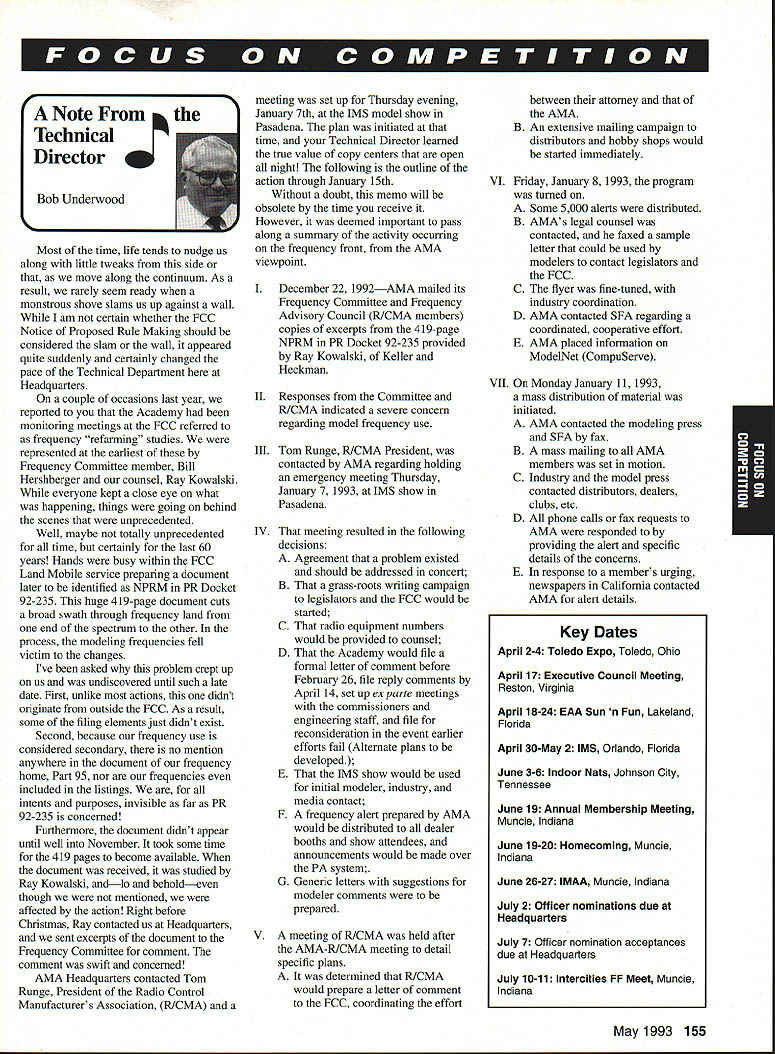
Most of the time life tends to nudge us along with little tweaks from one side or the other, and we move along a continuum. As a result, we rarely seem ready when a monstrous shove slams us up against a wall. I am not certain whether the FCC Notice of Proposed Rule Making should be considered the slam, but it appeared quite suddenly and certainly changed the pace of the Technical Department here at Headquarters.
On a couple of occasions last year we reported that the Academy had been monitoring FCC meetings referred to as frequency "refarming" studies. We were represented at the earliest of these by Frequency Committee member Bill Hershberger and our counsel, Ray Kowalski. While everyone kept a close eye on what was happening, things were going on behind the scenes that were unprecedented—well, maybe not totally unprecedented for all time, but certainly for the last 60 years. Hands were busy within the FCC Land Mobile Service preparing a document later identified as NPRM in PR Docket 92-235.
This huge, 419-page document cuts a broad swath through frequency land from one end of the spectrum to the other. In the process, modeling frequencies fell victim to the changes. I've been asked why this problem crept up on us and was undiscovered until such a late date. First, unlike most actions, this one didn't originate from outside the FCC; as a result, some of the filing elements just didn't exist. Second, because our frequency use is considered secondary, there is no mention anywhere in the document of our frequency home, Part 95, nor are our frequencies included in the listings. For all intents and purposes, we were invisible as far as PR Docket 92-235 was concerned.
Furthermore, the document didn't appear until well into November, and it took some time for the 419 pages to become available. When the document was received and studied by Ray Kowalski, it became clear—even though we were not mentioned explicitly—that we were affected by the action. Right before Christmas, Ray contacted Headquarters and sent excerpts of the document to the Frequency Committee for comment. The comment was swift and concerned.
AMA Headquarters contacted Tom Runge, President of the Radio Control Manufacturers Association (R/CMA), and a meeting was set up for Thursday evening, January 7, at the IMS model show in Pasadena. The plan was initiated at that time, and your Technical Director learned the true value of copy centers that are open all night. The following is an outline of the action through January 15.
- December 22, 1992
- AMA mailed its Frequency Committee and Frequency Advisory Council (and R/CMA members) copies of excerpts from the 419-page NPRM in PR Docket 92-235, provided by Ray Kowalski of Keller & Heckman.
- Responses
- Responses from the Committee and R/CMA indicated severe concern regarding model frequency use.
- January 7, 1993
- Tom Runge, R/CMA President, was contacted by AMA regarding holding an emergency meeting on Thursday, January 7, 1993, at the IMS show in Pasadena.
- Decisions from the January 7 meeting
- A. Agreement that a problem existed and should be addressed in concert.
- B. That a grass-roots writing campaign to legislators and the FCC would be started.
- C. That radio equipment numbers would be provided to counsel.
- D. That the Academy would file a formal letter of comment before February 26, file reply comments by April 14, set up ex parte meetings with the commissioners and engineering staff, and file for reconsideration if earlier efforts failed (alternate plans to be developed).
- E. That the IMS show would be used for initial modeler, industry, and media contact.
- F. A frequency alert prepared by AMA would be distributed to all dealer booths and show attendees, and announcements would be made over the PA system.
- G. Generic letters with suggestions for modeler comments would be prepared.
- R/CMA follow-up
- A. R/CMA determined it would prepare a letter of comment to the FCC, coordinating the effort between its attorney and the AMA's counsel.
- B. An extensive mailing campaign to distributors and hobby shops would be started immediately.
- Friday, January 8, 1993 — Program activated
- A. Some 5,000 alerts were distributed.
- B. AMA's legal counsel faxed a sample letter that modelers could use to contact legislators and the FCC.
- C. The flyer was fine-tuned with industry coordination.
- D. AMA contacted SFA regarding a coordinated, cooperative effort.
- E. AMA placed information on ModelNet (CompuServe).
- Monday, January 11, 1993 — Mass distribution
- A. AMA contacted the modeling press and SFA by fax.
- B. A mass mailing to all AMA members was set in motion.
- C. Industry and the model press contacted distributors, dealers, clubs, etc.
- D. All phone and fax requests to AMA were responded to by providing the alert and specific details of the concerns.
- E. Newspapers in California contacted AMA for alert details in response to members' urging.
- Further actions under counsel
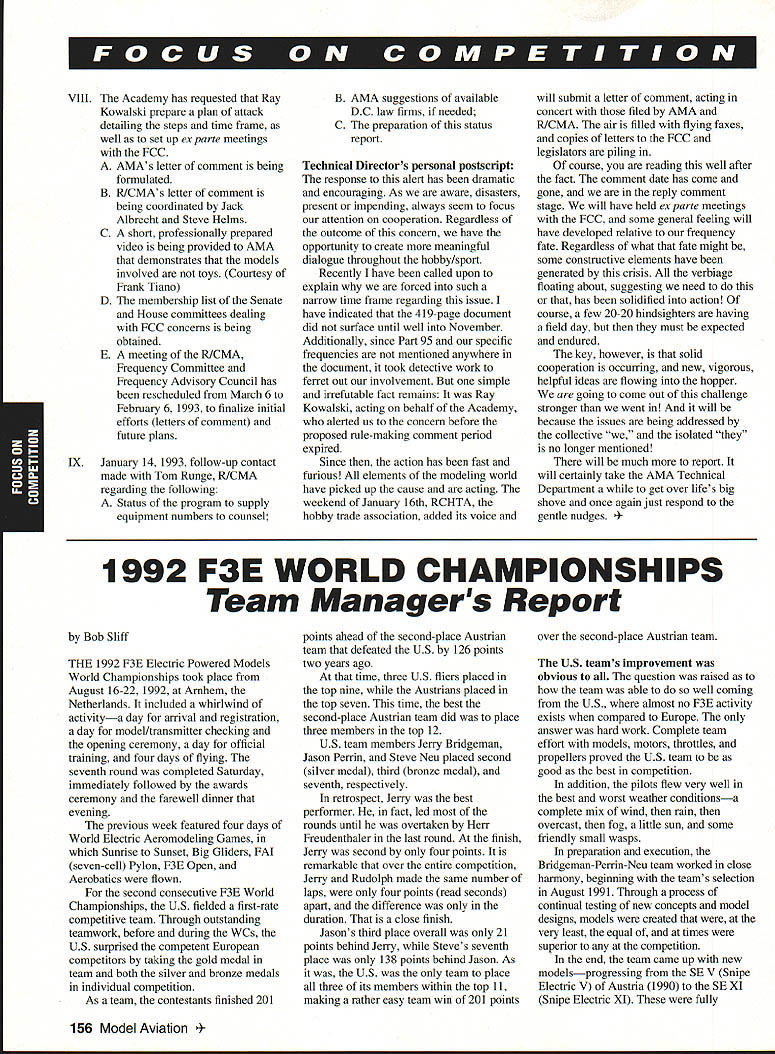
- A. AMA requested that Ray Kowalski prepare a plan of attack detailing steps and time frame, and to set up ex parte meetings with the FCC.
- B. AMA's letter of comment is being formulated.
- C. R/CMA's letter of comment is being coordinated by Jack Albrecht and Steve Helms.
- D. A short, professionally prepared video demonstrating that the models involved are not toys is being provided to AMA (courtesy of Frank Tiano).
- E. The membership lists of the Senate and House committees dealing with FCC concerns are being obtained.
- F. A meeting of R/CMA, the Frequency Committee, and the Frequency Advisory Council was rescheduled from March 6 to February 6, 1993, to finalize initial efforts and future plans.
- January 14, 1993 — Follow-up with R/CMA
- A. Status of the program to supply equipment numbers to counsel.
- B. AMA suggestions of available D.C. law firms, if needed.
- C. Preparation of this status report.
Technical Director's personal postscript
The response to this alert has been dramatic and encouraging. Disasters, present or impending, always seem to focus our attention on cooperation. Regardless of the outcome, we have the opportunity to create more meaningful dialogue throughout the hobby and sport.
I have been asked why we were forced into such a narrow time frame. The 419-page document did not surface until well into November. Additionally, since Part 95 and our specific frequencies were not mentioned anywhere in the document, it took detective work to ferret out our involvement. One simple and irrefutable fact remains: it was Ray Kowalski, acting on behalf of the Academy, who alerted us to the concern before the proposed rule-making comment period expired.
Since then, the action has been fast and furious. All elements of the modeling world have picked up the cause and are acting. The weekend of January 16, RCHTA, the hobby trade association, added its voice and submitted a letter of comment, acting in concert with those filed by AMA and R/CMA. The air was filled with flying faxes, and copies of letters to the FCC and legislators were piling in.
Of course you are reading this after the initial dates. The comment date has come and gone, and we are in the reply-comment stage. We will have held ex parte meetings with the FCC, and some general feeling will have developed relative to our frequency fate. Regardless of what that fate might be, constructive elements have been generated by this crisis. Verbiage suggesting we need to do this or that has been solidified into action. A few 20–20 hindsighters may be critical, but they must be expected and endured.
The key is that solid cooperation is occurring, and new, vigorous, helpful ideas are flowing into the hopper. We are going to come out of this challenge stronger than we went in, and it will be because the issues are being addressed by the collective "we" rather than by isolated "they."
There will be much more to report. It will certainly take the AMA Technical Department a while to get over life's big shove and once again respond to the gentle nudges.
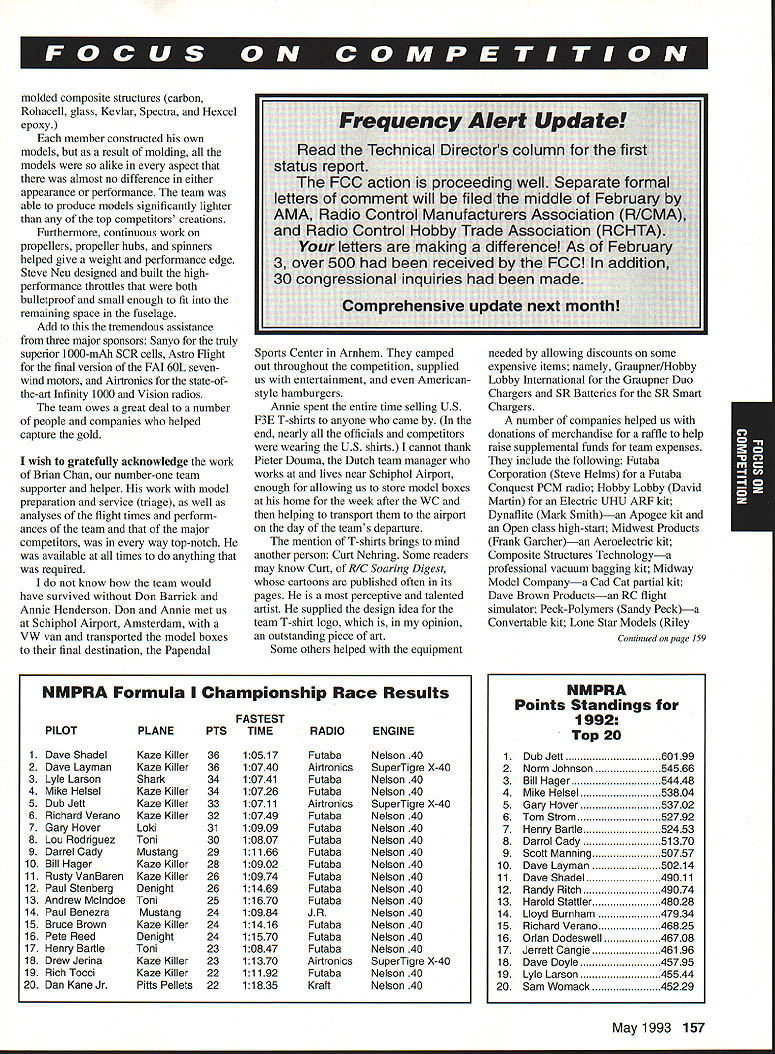
Frequency Alert Update
- Read the Technical Director's column for the first status report.
- The FCC action is proceeding. Separate formal letters of comment were to be filed in mid-February by AMA, R/CMA, and RCHTA.
- Your letters are making a difference: as of February 3, over 500 had been received by the FCC, and 30 congressional inquiries had been made.
- Comprehensive update next month.
---
F3E Team Report
Team sponsors and equipment
The team's success was supported by molded composite structures (carbon, Rohacell, glass, Kevlar, Spectra, and Hexcel epoxy). Each member constructed his own models, but because of molding all the models were so alike in appearance and performance that there was almost no difference among them. The team produced models significantly lighter than many top competitors.
Continuous work on propellers, propeller hubs, and spinners helped provide a weight and performance edge. Steve Neu designed and built high-performance throttles that were both reliable and compact enough to fit into the remaining fuselage space.
Major sponsors:
- Sanyo — 1000-mAh SCR cells.
- Astro Flight — final version of the FAI 60L seven-wind motors.
- Airtronics — Infinity 1000 and Vision radios.
Key team contributors
- Brian Chan — number-one team supporter and helper; model preparation, service (triage), and flight-time/performance analyses.
- Don Barrick and Annie Henderson — met the team at Schiphol Airport with transport, camped at the competition, provided assistance and hospitality; Annie sold U.S. F3E T-shirts to many attendees.
- Pieter Douma — Dutch team manager; allowed storage of model boxes and assisted with transport.
- Curt Nehring — supplied the team T-shirt logo design.
- Several companies provided discounts on equipment:
- Graupner/Hobby Lobby International — Graupner Duo Chargers.
- SR Batteries — SR Smart Chargers.
Raffle donors and merchandise contributions
Companies donating merchandise or raffle items included:
- Futaba Corporation (Steve Helms) — Futaba Compact PCM radio.
- Hobby Lobby (David Martin) — Electric UHU ARF kit.
- Dynaflite (Mark Smith) — Apogee kit and Open class high-start.
- Midwest Products (Frank Gardner) — Aerotech kit.
- Composite Structures Technology — professional vacuum bagging kit.
- Midway Model Company — Cad Cat partial kit.
- Dave Brown Products — RC flight simulator.
- Peck-Polymers (Sandy Peck) — Convertable kit.
- Ace R/C (Tom Runge) — AT 200 RC dual charger.
- Badger — model #400 airbrush.
- Rocket City — assorted R/C hardware.
- Sullivan Products — assorted R/C hardware.
- Hayes Products (Mike Pesak) — assorted R/C hardware.
- Gates Energy Company — 1200-mAh battery packs.
- TREK — certificates for free electronic speed controls.
- LJM — certificate for Mac/Soar or PC Soar computer program.
- RC Soaring Digest (Jerry and Judy Slates) — three subscriptions.
- JARMAK — universal servos.
- CB/Tatone — 2-1/2-inch spinner.
- Master Airscrew — two 1/2 x 8 folding props.
- Eastern Tool Supply — Magic Chuck and catalogs.
- Additional discount certificates and catalogs from: Future Flight, Coverite, RAM Products, Vinylwrite, Tekin, Cox Hobbies, B2 Streamlines, TREK, RC Buyers Guide, Carl Goldberg Models, Tower Hobbies, and Hot Stuff.
Several people and clubs donated time and money:
- Keystone R/C Club and Contest Director John Hickey — club donation of $200.
- Bill and Jean Shive (Penn Valley Hobby Center) — donated a radio for raffle proceeds.
- Bob Kopsik — generous support.
- Many friends and supporters purchased raffle tickets or T-shirts.
Travel, logistics, and AMA support
- Nino DiRonza (AMA travel agent) handled flight arrangements and minimized extra charges for model boxes; his advice helped avoid additional baggage problems.
- Micheline Madison and Penny Hudson (AMA) ensured model forms were in order, event fees were paid, and team funds were available on time.
Competition organization and hospitality
A number of officials and volunteers provided excellent organization and support:
- Organizing committee chairman — Thomas Schleppers.
- Committee secretary — John Gardener.
- Treasurer and business manager — Ruud Bakker.
- Contest Director — Harry Sanders.
- Contest manager — Mr. F. Koot.
- Facilities manager — Ron van Renens.
- Facilities staff — Messrs. Koot, Van Rossum, Schiphoven, and Meertens.
- International Jury — Werner Groth (Germany), Cal Eftel (U.S.), and Jacky Jongers (Belgium).
Post-competition visits and impressions
After the competition the team visited several model airplane people in Germany:
- Herr Keller — entertained the team with a history of electric flight and motors, and hosted a traditional German dinner.
- Herr Graupner — gave a tour of his facility in Kirchheim-Teck and a lunchtime trip into the historic city center.
- Franz Weinsberger — gave a tour of his shop (including a CNC machine used to make F3E wing molds) and hosted a traditional Bavarian dinner.
General impressions: The team was warmly welcomed and accepted by contestants and officials from the other 12 countries. The Papendal–Arnhem F3E World Championships were marked by hospitality, excellent organization, and great camaraderie. It was an episode the team will cherish for a long time.
Transcribed from original scans by AI. Minor OCR errors may remain.

