
Focus on Competition
A Note From the Technical Director
Bob Underwood
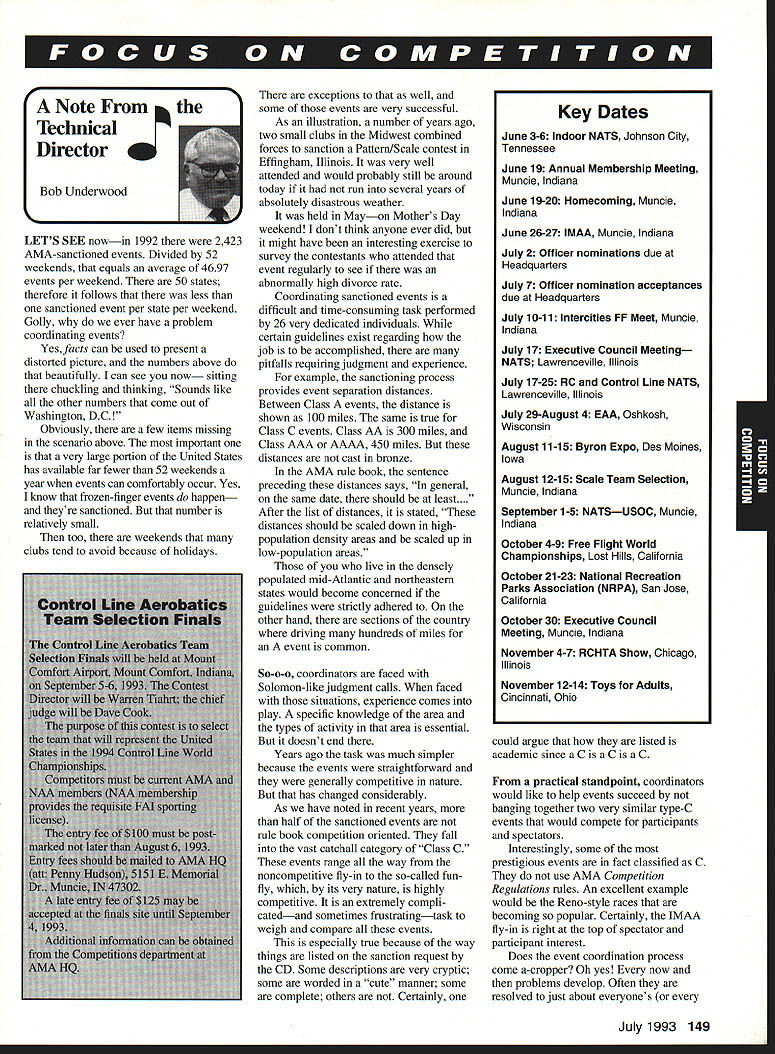
Let's see now — in 1992 there were 2,423 AMA‑sanctioned events. Divided by 52 weekends, that equals an average of about 46.6 events per weekend. With 50 states, that averages less than one sanctioned event per state per weekend. Golly — ever have a problem coordinating events? Yes: facts can be used to present a distorted picture.
Obviously, a few items are missing from the scenario above. A very large portion of the United States has far fewer than 52 weekends a year when events can comfortably occur. Yes, frozen‑finger events do happen — and they're sanctioned — but that number is relatively small. Many clubs also tend to avoid certain weekends because of holidays, although there are exceptions and some holiday‑weekend events are very successful.
As an illustration: a number of years ago two small clubs in the Midwest combined forces to sanction a Pattern/Scale contest in Effingham, Illinois. It was very well attended and would probably still be around today if it had not run into several years of absolutely disastrous weather. It was held in May — on Mother's Day weekend! It might have been an interesting exercise to survey the regular contestants to see whether the divorce rate was abnormally high.
Coordinating sanctioned events is a difficult and time‑consuming task performed by 26 very dedicated individuals. While guidelines exist regarding how the job is to be accomplished, there are many pitfalls requiring judgment and experience.
For example, the sanctioning process provides event separation distances:
- Between Class A events: 100 miles.
- Between Class C events: 100 miles.
- Between Class AA events: 300 miles.
- Between Class AAA and AAAA events: 450 miles.
These distances are not set in stone. The AMA rule book precedes them with the sentence, "In general, on the same date, there should be at least...." and follows the list with, "These distances should be scaled down in high‑population density areas and scaled up in low‑population areas." Those who live in the densely populated mid‑Atlantic and northeastern states would become concerned if the guidelines were strictly adhered to; on the other hand, in parts of the country where driving many hundreds of miles to an A event is common, the distances make more sense.
So coordinators are faced with Solomon‑like judgment calls. Experience comes into play: specific knowledge of the area and the types of activity in that area is essential.
Years ago the task was much simpler because events were straightforward and generally competitive. That has changed considerably. Today, more than half of the sanctioned events are not rule‑book competition oriented; they fall into the catchall category of "Class C." These range from noncompetitive fly‑ins to so‑called fun‑flys — which, by their nature, can be highly competitive. It is an extremely complicated — and sometimes frustrating — task to weigh and compare all these events.
This difficulty is compounded by the way events are described on the sanction request by the CD. Some descriptions are very cryptic; some are written in a "cute" manner; some are complete; others are not. One could argue that a C is a C is a C, but from a practical standpoint coordinators would like to help events succeed by not scheduling two very similar Type C events that would compete for participants and spectators.
Interestingly, some of the most prestigious events are classified as C and do not use AMA Competition Regulations rules. An excellent example is the Reno‑style races that have become popular. Certainly the IMAA fly‑in ranks at the top for spectator and participant interest.
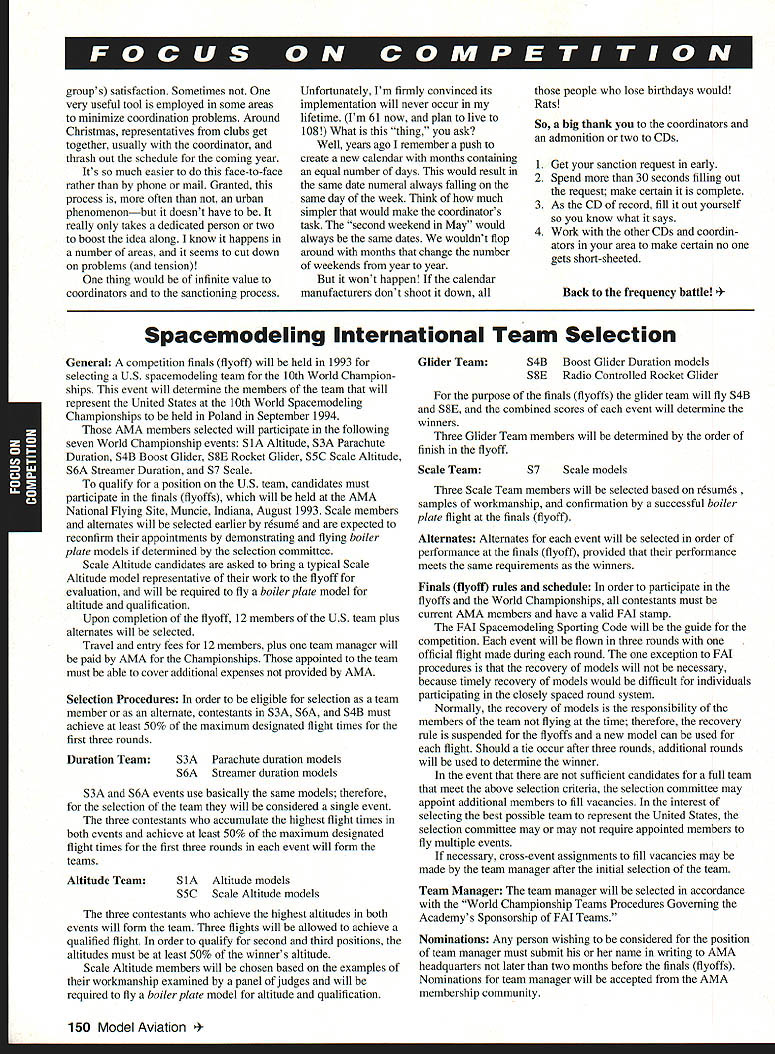
Does the event coordination process come a‑cropper? Oh yes. Problems develop from time to time. Often they are resolved to just about everyone's satisfaction, sometimes not.
One very useful tool employed in some areas to minimize coordination problems is a face‑to‑face scheduling meeting: around Christmas, representatives from clubs get together, usually with the coordinator, and thrash out the schedule for the coming year. It's so much easier to do this in person rather than by phone or mail. This process is more common in urban areas, but it only takes a dedicated person or two to start it elsewhere, and it seems to cut down on problems (and tension).
One idea that would be of infinite value to coordinators — though I am convinced it will never happen in my lifetime — is a reformatted calendar with months containing an equal number of days so the same date numeral always falls on the same day of the week. The "second weekend in May" would always be the same dates, and we wouldn't flip around with months that change the number of weekends from year to year. But it won't happen.
So, a big thank you to the coordinators and an admonition or two to CDs:
- Get your sanction request in early.
- Spend more than 30 seconds filling out the request; make certain it is complete.
- As the CD of record, fill it out yourself so you know what it says.
- Work with the other CDs and coordinators in your area to make certain no one gets short‑sheeted.
Back to the frequency battle!
---
Key Dates
- June 3–6: Indoor NATS, Johnson City, Tennessee
- June 19: Annual Membership Meeting, Muncie, Indiana
- June 19–20: Homecoming, Muncie, Indiana
- June 26–27: IMAA, Muncie, Indiana
- July 2: Officer nominations due, Headquarters
- July 7: Officer nomination acceptances due, Headquarters
- July 10–11: Intercities FF Meet, Muncie, Indiana
- July 17: Executive Council Meeting, NATS, Lawrenceville, Illinois
- July 17–25: RC Control Line NATS, Lawrenceville, Illinois
- July 29–August 4: EAA, Oshkosh, Wisconsin
- August 11–15: Byron Expo, Des Moines, Iowa
- August 12–15: Scale Team Selection, Muncie, Indiana
- September 1–5: NATS/USOC, Muncie, Indiana
- October 4–9: Free Flight World Championships, Lost Hills, California
- October 21–23: National Recreation Parks Association (NRPA), San Jose, California
- October 30: Executive Council Meeting, Muncie, Indiana
- November 4–7: RCHTA Show, Chicago, Illinois
- November 12–14: Toys for Adults, Cincinnati, Ohio
---
Space Modeling Teams
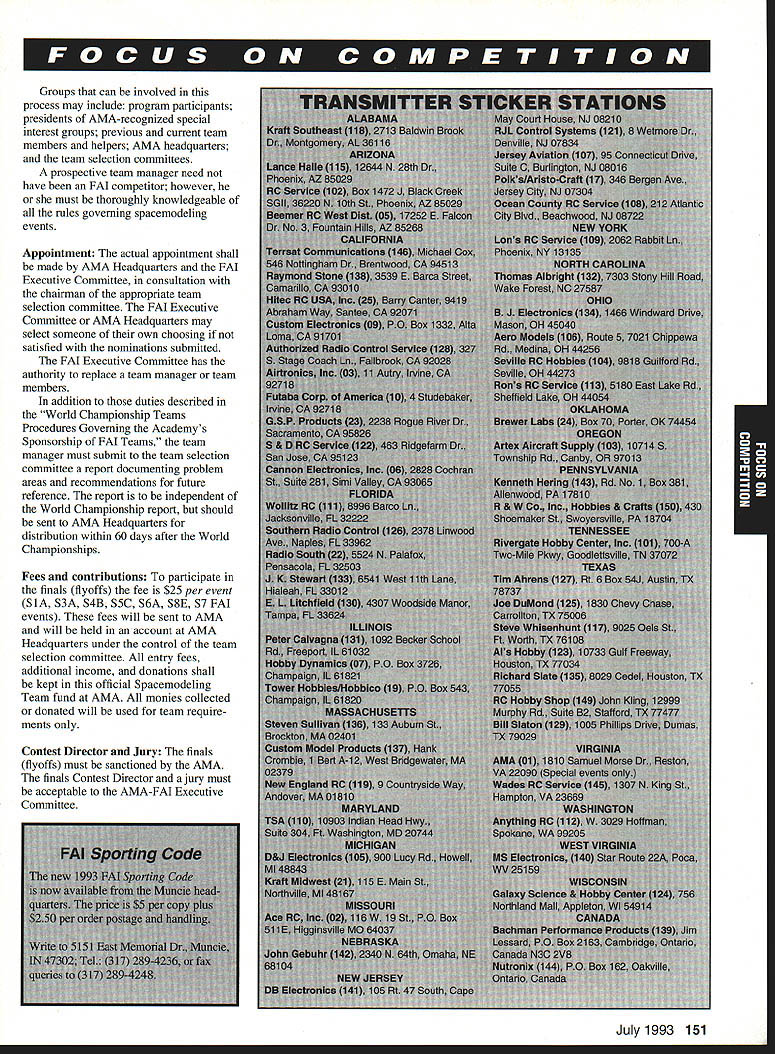
Groups that can be involved in the team selection process may include:
- Program participants
- Presidents of AMA‑recognized special interest groups
- Previous and current team members and helpers
- AMA Headquarters
- Team selection committees
Appointment
- The actual appointment of a team manager shall be made by AMA Headquarters and the FAI Executive Committee, in consultation with the chairman of the appropriate team selection committee.
- The FAI Executive Committee or AMA Headquarters may select someone other than the one nominated if not satisfied with the nominations submitted.
- The FAI Executive Committee has the authority to replace a team manager or team members.
Team Manager Duties
- A prospective team manager need not have been an FAI competitor, but must be thoroughly knowledgeable of all rules governing space/scale modeling events.
- In addition to duties described in the "World Championships Teams Procedures Governing the Academy's Sponsorship of FAI Teams," the team manager must submit to the team selection committee a report documenting problem areas and recommendations for future reference.
- This report is to be independent of the World Championships report and should be sent to AMA Headquarters for distribution within 60 days after the World Championships.
Fees and Contributions
- To participate in the finals (flyoffs), the fee is $25 per event (S1A, S3A, S4B, S5C, S6A, S8E, S7 FAI events).
- These fees will be sent to AMA and held in an account at AMA Headquarters under the control of the team selection committee.
- All entry fees, additional income, and donations shall be kept in this official Space Modeling Team fund at AMA, and all monies collected or donated will be used for team requirements only.
Contest Director and Jury
- The finals (flyoffs) must be sanctioned by the AMA.
- The finals Contest Director and a jury must be acceptable to the AMA‑FAI Executive Committee.
FAI Sporting Code
- The new 1993 FAI Sporting Code is available from AMA Headquarters.
- Price: $5 per copy plus $2.50 per order postage and handling.
- Write to: AMA, 5151 East Memorial Dr., Muncie, IN 47302; Tel. (317) 289‑4256; fax: (317) 289‑4248.
---
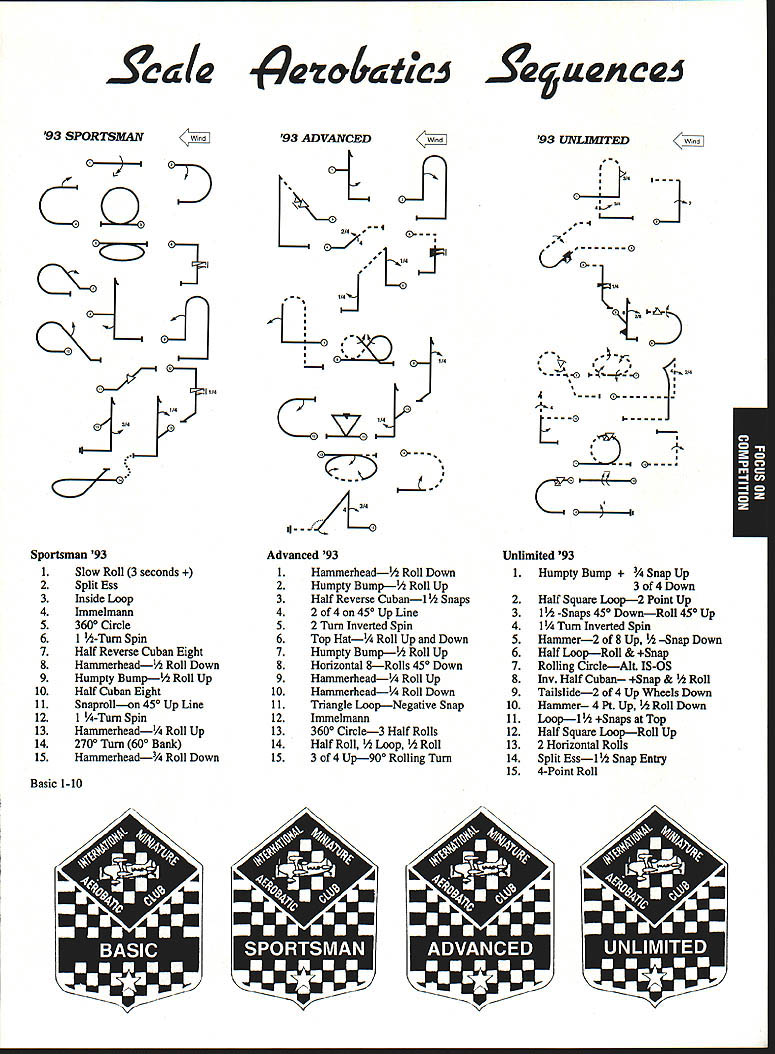
Scale Aerobatics Sequences
'93 SPORTSMAN
- Slow Roll (3 seconds+)
- Split Ess
- Inside Loop
- Immelmann
- 360° Circle
- 1 1/2 Turn Spin
- Half Reverse Cuban Eight
- Hammerhead — 1/2 Roll Down
- Humpty Bump — 1/2 Roll Up
- Half Cuban Eight
- Snaproll — one 45° Up Line
- 1 1/4‑Turn Spin
- Hammerhead — 1/4 Roll Up
- 270° Turn (60° Bank)
- Hammerhead — 3/4 Roll Down
'93 ADVANCED
- Hammerhead — 1/2 Roll Down
- Humpty Bump — 1/2 Roll Up
- Half Reverse Cuban — 1 1/2 Snaps
- 2 of 4 on 45° Up Line
- 2‑Turn Inverted Spin
- Top Hat — 1/4 Roll Up and Down
- Humpty Bump — 1/2 Roll Up
- Horizontal 8 — Rolls 45° Down
- Hammerhead — 1/4 Roll Up
- Hammerhead — 1/4 Roll Down
- Triangle Loop — Negative Snap
- Immelmann
- 360° Circle — 3 Half Rolls
- Half Roll, 1/2 Loop, 1/2 Roll
- 3 of 4 Up — 90° Rolling Turn
'93 UNLIMITED
- Humpty Bump + 3/4 Snap Up, 3 of 4 Down
- Half Square Loop — 2 Point Up
- 1 1/2‑Snaps 45° Down — Roll 45° Up
- 1 1/4 Turn Inverted Spin
- Hammer — 2 of 8 Up, 1/4 Snap Down
- Half Loop — Roll & Snap
- Rolling Circle — Alt. IS‑OS
- Inverted Half Cuban — Snap & 1/2 Roll
- Tailslide — 2 of 4 Up, Wheels Down
- Hammer — 2 of Up, 1/2 Roll Down
- Loop — 1 1/2 Snaps at Top
- Half Square Loop — Roll Up
- 2 Horizontal Rolls
- Split Ess — 1 1/2 Snap Entry
- 4‑Point Roll
---
Scale Aerobatics
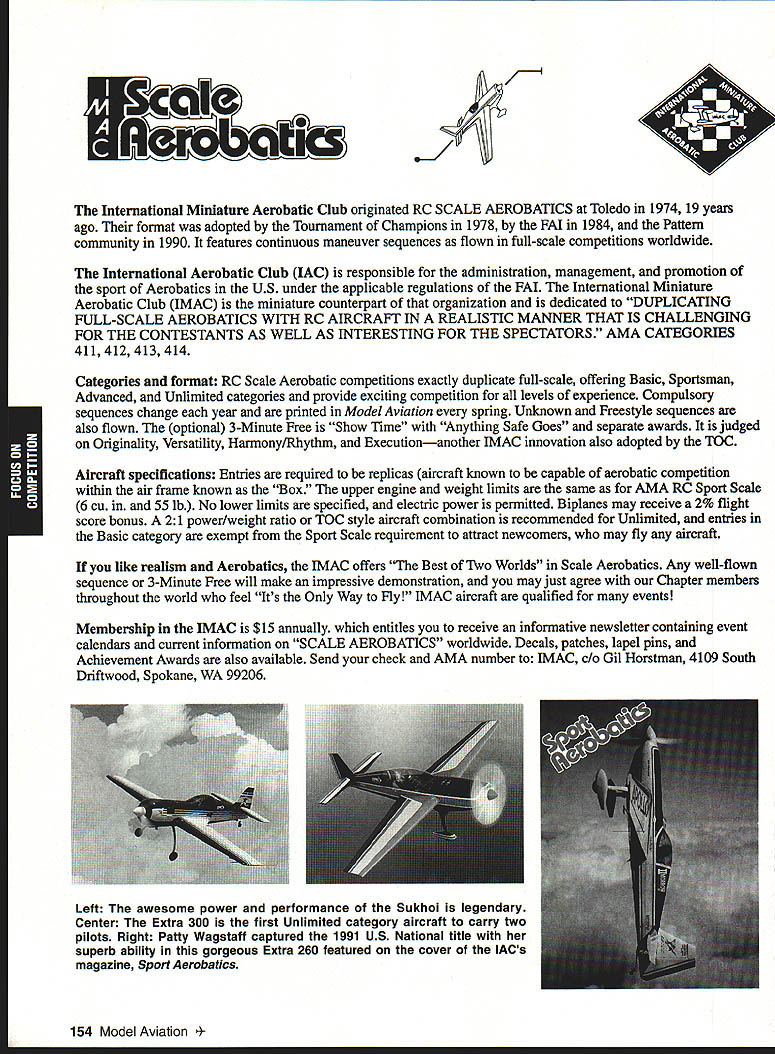
The International Miniature Aerobatic Club (IMAC) originated RC scale aerobatics at Toledo in 1974. Their format was adopted by the Tournament of Champions in 1978, by the FAI in 1984, and by the Pattern community in 1990. It features continuous maneuver sequences as flown in full‑scale competitions worldwide.
The International Aerobatic Club (IAC) administers full‑scale aerobatics in the U.S. under FAI regulations; IMAC is the miniature counterpart, dedicated to "duplicating full‑scale aerobatics with RC aircraft in a realistic manner that is challenging for the contestants as well as interesting for the spectators." (AMA Categories 411, 412, 413, 414.)
Categories and Format
- RC scale aerobatic competitions duplicate full‑scale competition with Basic, Sportsman, Advanced, and Unlimited categories.
- Compulsory sequences change each year and are printed in Model Aviation every spring.
- Unknown and Freestyle sequences are also flown.
- The optional 3‑Minute Free ("Show Time") is judged on Originality, Versatility, Harmony/Rhythm, and Execution. Anything safe goes, and separate awards are given.
Aircraft Specifications
- Entries are required to be replicas — aircraft known to be capable of aerobatic competition within the airframe known as the "Box."
- Upper limits: 6 cu. in. engine and 55 lb. weight (same as AMA R/C Sport Scale).
- No lower limits specified; electric power is permitted.
- Biplanes may receive a 2% flight score bonus.
- A 2:1 power/weight ratio or TOC‑style aircraft combination is recommended for Unlimited.
- Entries in the Basic category are exempt from the Sport Scale requirement to attract newcomers.
If you like realism and aerobatics, IMAC offers "the best of two worlds" in scale aerobatics. Any well‑flown sequence or 3‑Minute Free will make an impressive demonstration. IMAC aircraft are qualified for many events.
Membership
- Annual dues: $15 (includes an informative newsletter with event calendars and current information on scale aerobatics worldwide).
- Decals, patches, lapel pins, and achievement awards are also available.
- Send your check and AMA number to: IMAC, c/o Gil Horstman, 4109 South Driftwood, Spokane, WA 99206.
Images (captions):
- Left: The awesome power and performance of the Sukhoi is legendary.
- Center: The Extra 300 is the first Unlimited category aircraft to carry two pilots.
- Right: Patty Wagstaff captured the 1991 U.S. National title in the Extra 260 featured on the cover of IAC's magazine, Sport Aerobatics.
---
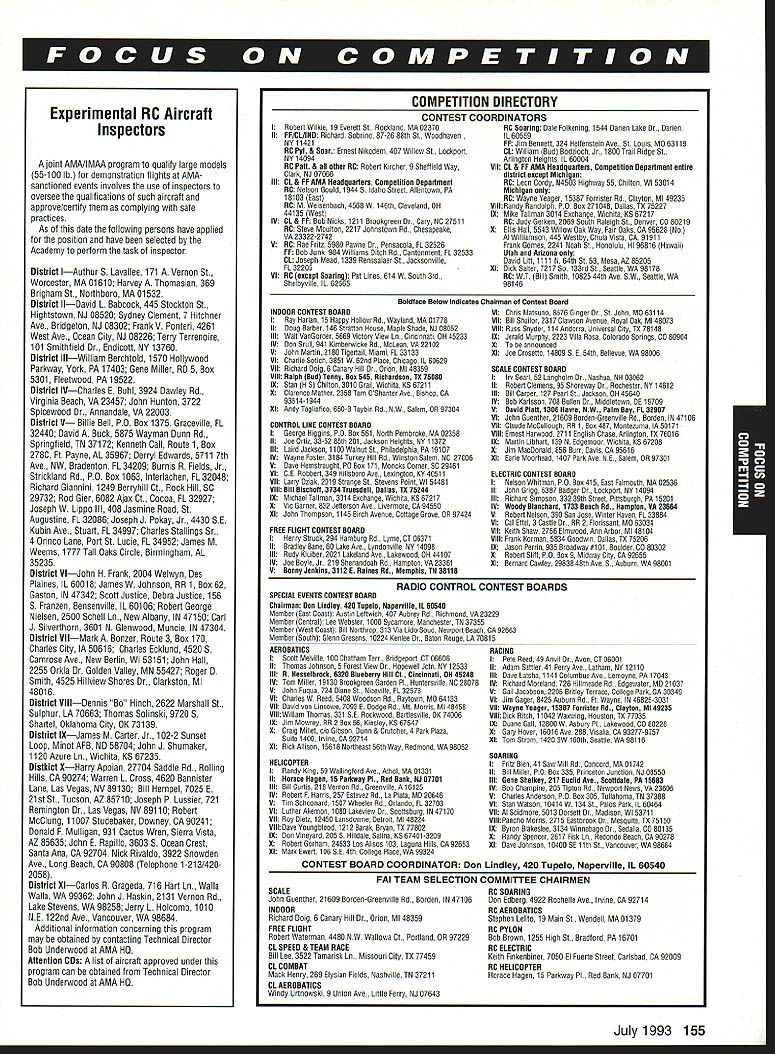
Competition Directory — Request for Better Scan
I am unable to reliably read and accurately correct the small, dense text in the competition directory box from this scan. To make a correct transcription I need a higher‑resolution crop of the main article area (the competition directory box) or a clearer scan of this page.
Please either:
- Upload a higher‑resolution image of this page, or
- Crop and upload the central box labeled “COMPETITION DIRECTORY” (and any adjoining columns that contain the contest‑board lists).
Once I have a clearer image I will extract and correct the competition directory text.
Transcribed from original scans by AI. Minor OCR errors may remain.

