
FOCUS ON COMPETITION
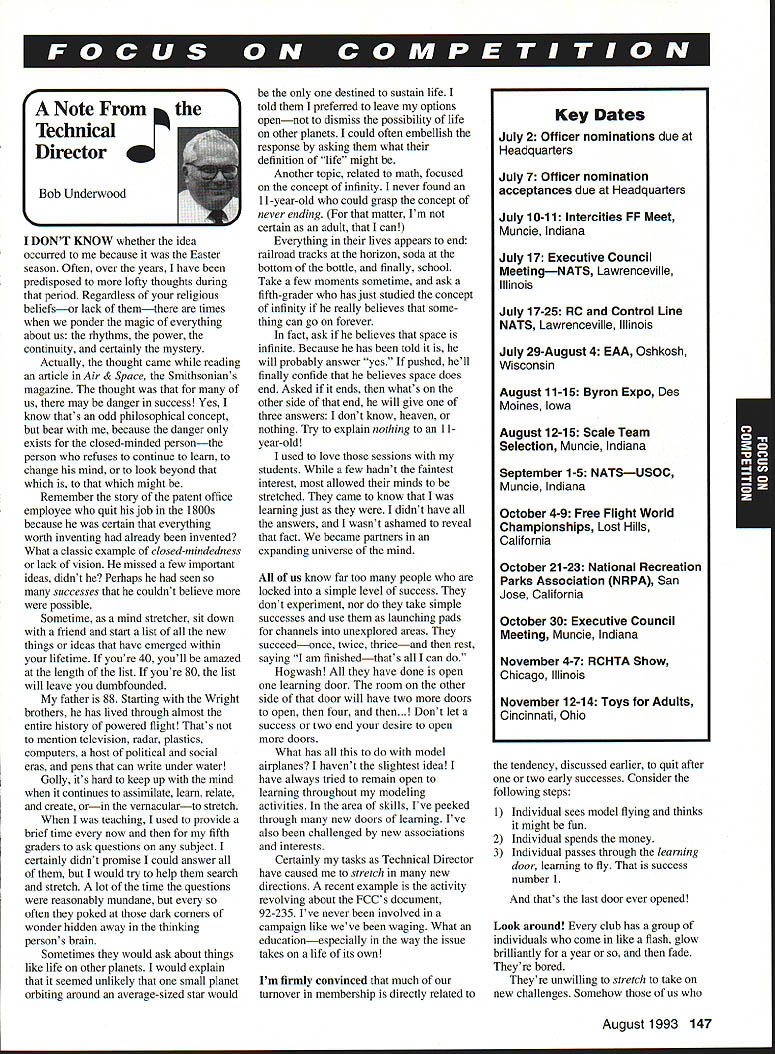
A Note From the Technical Director
Bob Underwood
I don't know whether the idea occurred to me because it was the Easter season. Often over the years I have been predisposed to loftier thoughts during that period. Regardless of your religious beliefs—or lack of them—there are times when we ponder the magic of everything about us: the rhythms, the power, the continuity, and certainly the mystery.
Actually, the thought came while reading an article in Air & Space, the Smithsonian's magazine. The thought was that for many of us there may be danger in success. Yes, I know that's an odd philosophical concept, but bear with me: the danger only exists for the closed-minded person—the person who refuses to continue to learn, to change his mind, or to look beyond that which is, to that which might be.
Remember the story of the patent office employee who quit his job in the 1800s because he was certain that everything worth inventing had already been invented? What a classic example of closed-mindedness, or lack of vision. He missed a few important ideas, didn't he? Perhaps he had seen so many successes that he couldn't believe more were possible.
Sometime, as a mind stretcher, sit down with a friend and start a list of all the new things or ideas that have emerged within your lifetime. If you're 40 you'll be amazed at the length of the list. If you're 80, the list will leave you dumbfounded.
My father is 88. Starting with the Wright brothers, he has lived through almost the entire history of powered flight! That's not to mention television, radar, plastics, computers, a host of political and social eras, and pens that can write under water.
Golly, it's hard to keep up with the mind when it continues to assimilate, learn, relate, and create, or—in the vernacular—to stretch.
When I was teaching, I used to provide a brief time every now and then for my fifth graders to ask questions on any subject. I certainly didn't promise I could answer all of them, but I would try to help them search and stretch. A lot of the time the questions were reasonably mundane, but every so often they poked at those dark corners of wonder hidden away in the thinking person's brain.
Sometimes they would ask about things like life on other planets. I would explain that it seemed unlikely that one small planet orbiting around an average-sized star would be the only one destined to sustain life. I told them I preferred to leave my options open—not to dismiss the possibility of life on other planets. I could often embellish the response by asking them what their definition of "life" might be.
Another topic, related to math, focused on the concept of infinity. I never found an 11-year-old who could grasp the concept of never ending. (For that matter, I'm not certain as an adult that I can!)
Everything in their lives appears to end: railroad tracks at the horizon, soda at the bottom of the bottle, and finally, school. Take a few moments sometime and ask a fifth-grader who has just studied the concept of infinity if he really believes that something can go on forever.
In fact, ask if he believes that space is infinite. Because he has been told it is, he will probably answer "yes." If pushed, he'll finally confide that he believes space does end. Asked if it ends, then what's on the other side of that end, he will give one of three answers: "I don't know," "heaven," or "nothing." Try to explain nothing to an 11-year-old!
I used to love those sessions with my students. While a few hadn't the faintest interest, most allowed their minds to be stretched. They came to know that I was learning just as they were. I didn't have all the answers, and I wasn't ashamed to reveal that fact. We became partners in an expanding universe of the mind.
All of us know far too many people who are locked into a simple level of success. They don't experiment, nor do they take simple successes and use them as launching pads into unexplored areas. They succeed—once, twice, thrice—and then rest, saying "I am finished—that's all I can do."
Hogwash! All they have done is open one learning door. The room on the other side of that door will have two more doors to open, then four, and then...! Don't let a success or two end your desire to open more doors.
What has all this to do with model airplanes? I haven't the slightest idea! I have always tried to remain open to learning throughout my modeling activities. In the area of skills, I've peeked through many new doors of learning. I've also been challenged by new associations and interests.
Certainly my tasks as Technical Director have caused me to stretch in many new directions. A recent example is the activity revolving around the FCC document 92-235. I've never been involved in a campaign like we've been waging. What an education—especially in the way the issue takes on a life of its own!
I'm firmly convinced that much of our turnover in membership is directly related to the tendency, discussed earlier, to quit after one or two early successes. Consider the following steps:
- Individual sees model flying and thinks it might be fun.
- Individual spends the money.
- Individual passes through the learning door, learning to fly. That is success number 1.
And that's the last door ever opened!
Look around! Every club has a group of individuals who come in like a flash, glow brilliantly for a year or so, and then fade. They're bored. They're unwilling to stretch to take on new challenges. Somehow those of us who have grown in the hobby/sport must help those individuals open new learning doors.
Maybe we can do it through our enthusiasm. Maybe sharing our skills can help. Maybe if we do a better job of articulating what we've found behind those doors, we can encourage them to reach out and open them.
Once they see what's on the other side, they might want to stretch some more. And maybe they will stay active for a longer time. It's just a thought.
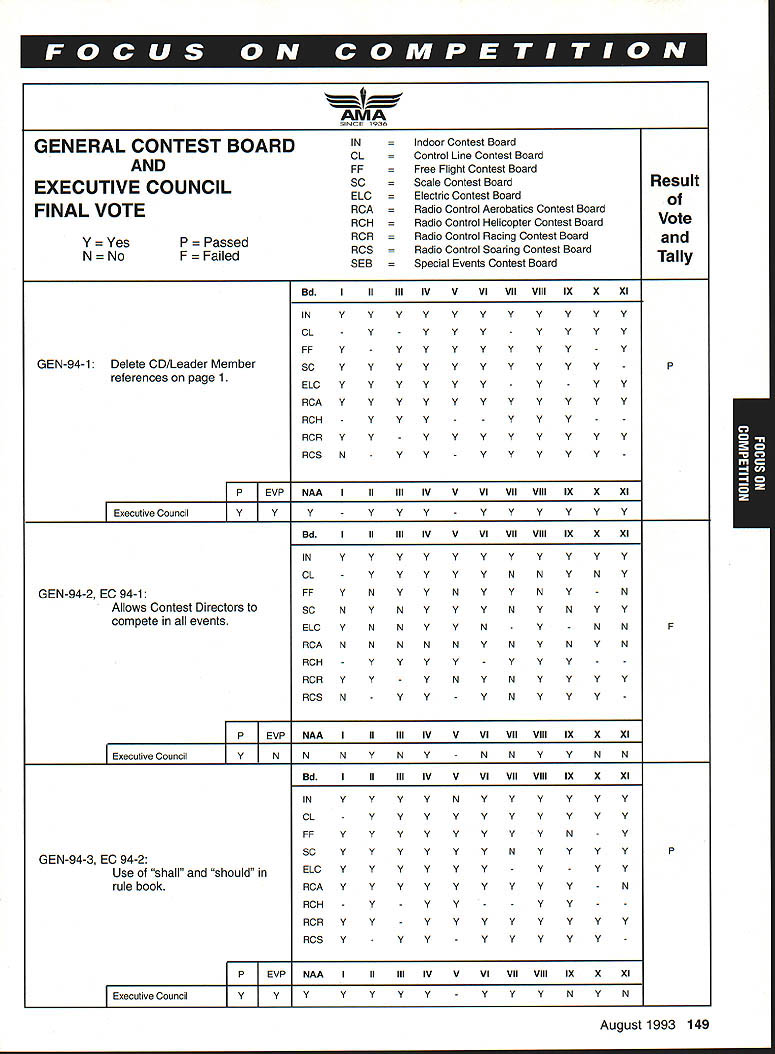
GENERAL CONTEST BOARD AND EXECUTIVE COUNCIL FINAL VOTE
Y = Yes P = Passed N = No F = Failed
IN = Indoor Contest Board CL = Control Line Contest Board FF = Free Flight Contest Board SC = Scale Contest Board ELC = Electric Contest Board RCA = Radio Control Aerobatics Contest Board RCH = Radio Control Helicopter Contest Board RCR = Radio Control Racing Contest Board RCS = Radio Control Soaring Contest Board SEB = Special Events Contest Board
- GEN-94-1: Delete CD/Leader Member references on page 1.
Result of Vote and Tally: P Executive Council: Y Y Y - Y - Y Y Y Y Y Y
- GEN-94-2, EC 94-1: Allows Contest Directors to compete in all events.
Result of Vote and Tally: F Executive Council: Y N N N Y N Y N Y - N Y N
- GEN-94-3, EC 94-2: Use of "shall" and "should" in rule book.
Result of Vote and Tally: P Executive Council: Y Y Y - Y - Y Y Y - Y N
August 1993
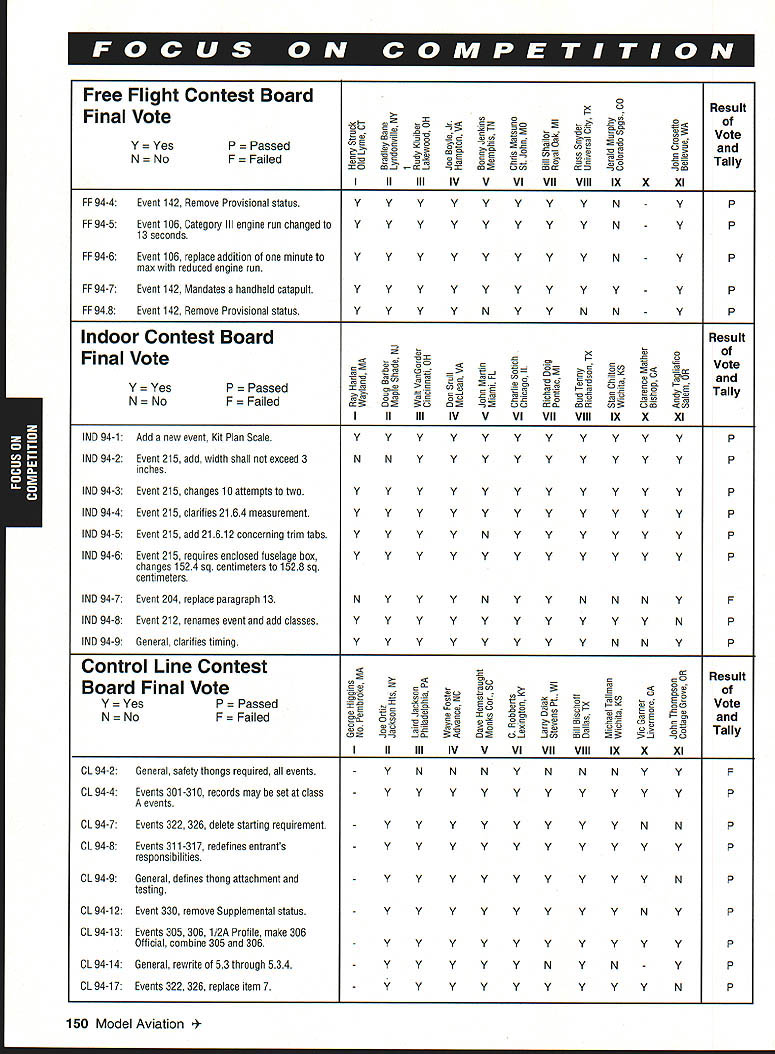
Free Flight Contest Board Final Vote
Y = Yes P = Passed N = No F = Failed
- FF 94-4: Event 142, remove provisional status. P
- FF 94-5: Event 106, Category III engine run changed to 13 seconds. P
- FF 94-6: Event 106, replace addition of one minute to max with reduced engine run. P
- FF 94-7: Event 142, mandates a handheld catapult. P
- FF 94-8: Event 142, remove provisional status. P
Indoor Contest Board Final Vote
Y = Yes P = Passed N = No F = Failed
- IND 94-1: Add a new event, Kit Plan Scale. P
- IND 94-2: Event 215, add, width shall not exceed 3 inches. P
- IND 94-3: Event 215, changes 10 attempts to two. P
- IND 94-4: Event 215, clarifies 21.6.4 measurement. P
- IND 94-5: Event 215, add 21.6.12 concerning trim tabs. P
- IND 94-6: Event 215, requires enclosed fuselage box, changes 152.4 sq. centimeters to 152.8 sq. centimeters. P
- IND 94-7: Event 204, replace paragraph 13. F
- IND 94-8: Event 212, renames event and adds classes. P
- IND 94-9: General, clarifies timing. P
Control Line Contest Board Final Vote
Y = Yes P = Passed N = No F = Failed
- CL 94-2: General, safety thongs required, all events. F
- CL 94-4: Events 301-310, records may be set at class A events. P
- CL 94-7: Events 322, 326, delete starting requirement. P
- CL 94-8: Events 311-317, redefines entrant's responsibilities. P
- CL 94-9: General, defines thong attachment and testing. P
- CL 94-12: Event 330, remove supplemental status. P
- CL 94-13: Events 305, 306, 1/2A Profile, make 306 Official, combine 305 and 306. P
- CL 94-14: General, rewrite of 5.3 through 5.3.4. P
- CL 94-17: Events 322, 326, replace item 7. P
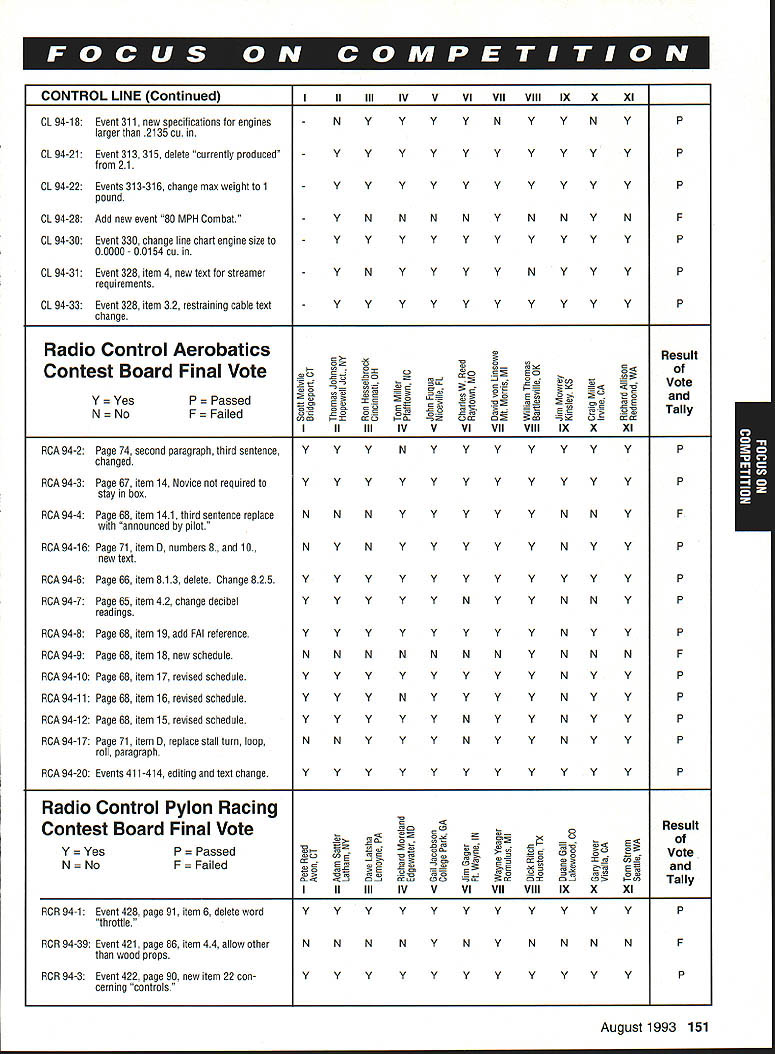
CONTROL LINE (Continued)
- CL 94-18: Event 311, new specifications for engines larger than .2135 cu. in. P
- CL 94-21: Event 313, 315, delete "currently produced" from 2.1. P
- CL 94-22: Events 313-316, change max weight to 1 pound. P
- CL 94-28: Add new event "80 MPH Combat." F
- CL 94-30: Event 330, change line chart engine size to 0.0000–0.0154 cu. in. P
- CL 94-31: Event 328, item 4, new text for streamer requirements. P
- CL 94-33: Event 328, item 3.2, restraining cable text change. P
Radio Control Aerobatics Contest Board Final Vote
Y = Yes P = Passed N = No F = Failed
- RCA 94-2: Page 74, second paragraph, third sentence, changed. P
- RCA 94-3: Page 67, item 14, Novice not required to stay in box. P
- RCA 94-4: Page 68, item 14.1, third sentence replace with "announced by pilot." P
- RCA 94-16: Page 71, item D, numbers 8 and 10, new text. P
- RCA 94-6: Page 68, item 8.1.3, delete. Change 8.2.5. P
- RCA 94-7: Page 65, item 4.2, change decibel readings. P
- RCA 94-8: Page 68, item 19, add FAI reference. P
- RCA 94-9: Page 68, item 18, new schedule. P
- RCA 94-10: Page 68, item 17, revised schedule. P
- RCA 94-11: Page 68, item 16, revised schedule. P
- RCA 94-12: Page 68, item 15, revised schedule. P
- RCA 94-17: Page 71, item D, replace stall turn, loop, roll paragraph. P
- RCA 94-20: Events 411-414, editing and text change. P
Radio Control Pylon Racing Contest Board Final Vote
Y = Yes P = Passed N = No F = Failed
- RCR 94-1: Event 428, page 91, item 6, delete word "throttle." P
- RCR 94-39: Event 421, page 86, item 4.4, allow other than wood props. F
- RCR 94-3: Event 422, page 90, new item 22 concerning "controls." P
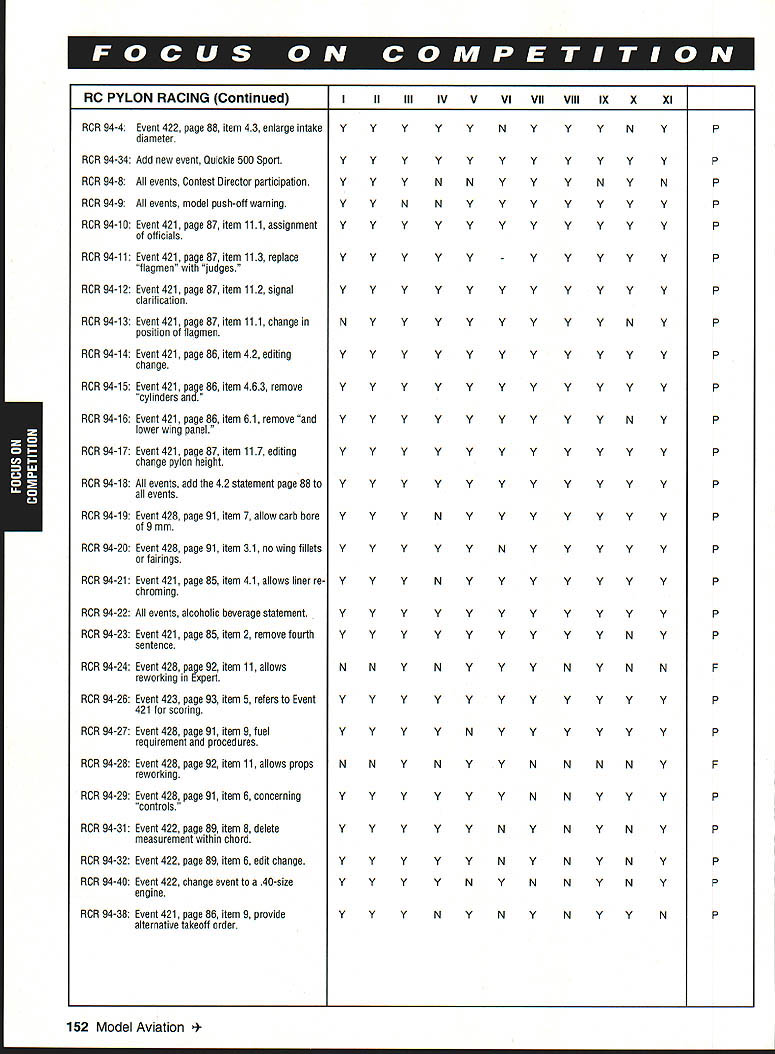
RC PYLON RACING (Continued)
- RCR 94-4: Event 422, page 88, item 4.3, enlarge intake diameter.
- RCR 94-34: Add new event, Quickie 500 Sport.
- RCR 94-8: All events, Contest Director participation.
- RCR 94-9: All events, model push-off warning.
- RCR 94-10: Event 421, page 87, item 11.1, assignment of officials.
- RCR 94-11: Event 421, page 87, item 11.3, replace "flagmen" with "judges."
- RCR 94-12: Event 421, page 87, item 11.2, signal clarification.
- RCR 94-13: Event 421, page 87, item 11.1, change in position of flagmen.
- RCR 94-14: Event 421, page 86, item 4.2, editing change.
- RCR 94-15: Event 421, page 86, item 4.6.3, remove "cylinders and."
- RCR 94-16: Event 421, page 86, item 6.1, remove "and lower wing panel."
- RCR 94-17: Event 421, page 87, item 11.7, editing change, pylon height.
- RCR 94-18: All events, add the 4.2 statement (page 88) to all events.
- RCR 94-19: Event 428, page 91, item 7, allow carb bore of 9 mm.
- RCR 94-20: Event 428, page 91, item 3.1, no wing fillets or fairings.
- RCR 94-21: Event 421, page 85, item 4.1, allows liner re-chroming.
- RCR 94-22: All events, alcoholic beverage statement.
- RCR 94-23: Event 421, page 85, item 2, remove fourth sentence.
- RCR 94-24: Event 428, page 92, item 11, allows reworking in Expert.
- RCR 94-26: Event 423, page 93, item 5, refers to Event 421 for scoring.
- RCR 94-27: Event 428, page 91, item 9, fuel requirement and procedures.
- RCR 94-28: Event 428, page 92, item 11, allows props reworking.
- RCR 94-29: Event 428, page 91, item 6, concerning "controls."
- RCR 94-31: Event 422, page 89, item 8, delete measurement within chord.
- RCR 94-32: Event 422, page 89, item 6, edit change.
- RCR 94-40: Event 422, change event to a .40-size engine.
- RCR 94-38: Event 421, page 86, item 9, provide alternative takeoff order.
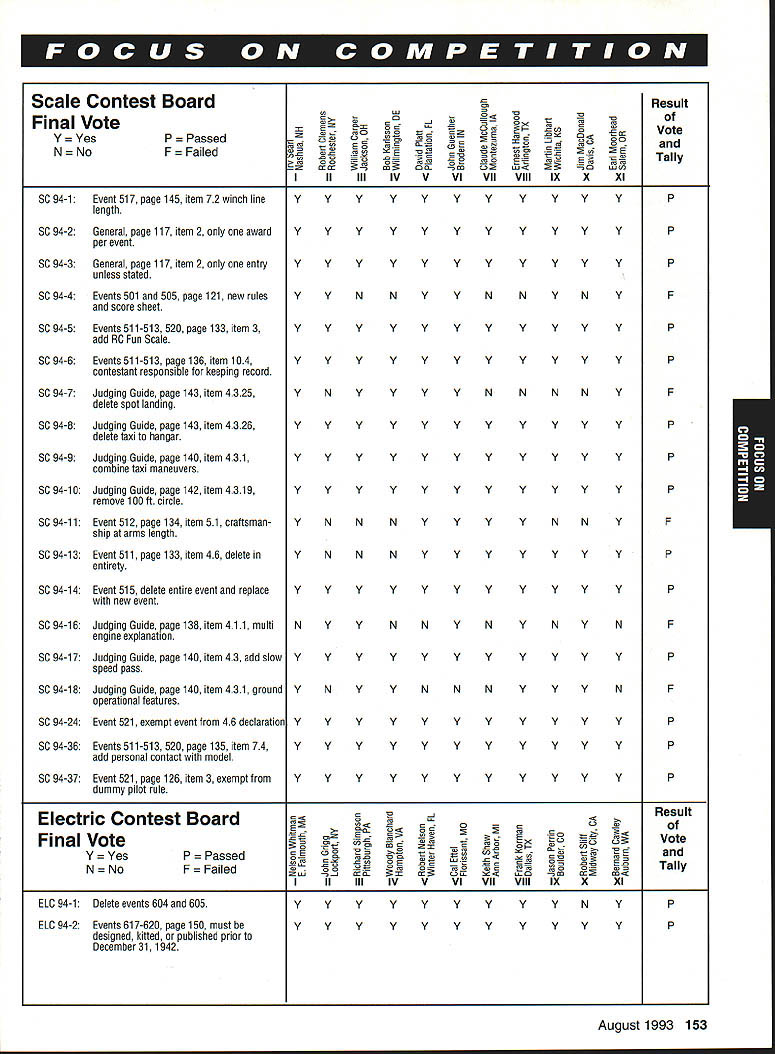
Scale Contest Board Final Vote
Y = Yes P = Passed N = No F = Failed
- SC 94-1: Event 517, page 145, item 7.2 winch line length.
- SC 94-2: General, page 117, item 2, only one award per event.
- SC 94-3: General, page 117, item 2, only one entry unless stated.
- SC 94-4: Events 501 and 505, page 121, new rules and score sheet.
- SC 94-5: Events 511-513, 520, page 133, item 3, add RC Fun Scale.
- SC 94-6: Events 511-513, page 136, item 10.4, contestant responsible for keeping record.
- SC 94-7: Judging Guide, page 143, item 4.3.25, delete spot landing.
- SC 94-8: Judging Guide, page 143, item 4.3.26, delete taxi to hangar.
- SC 94-9: Judging Guide, page 140, item 4.3.1, combine taxi maneuvers.
- SC 94-10: Judging Guide, page 142, item 4.3.19, remove 100 ft. circle.
- SC 94-11: Event 512, page 134, item 5.1, craftsmanship at arm's length.
- SC 94-13: Event 511, page 133, item 4.6, delete in entirety.
- SC 94-14: Event 515, delete entire event and replace with new event.
- SC 94-16: Judging Guide, page 138, item 4.1.1, multi-engine explanation.
- SC 94-17: Judging Guide, page 140, item 4.3, add slow speed pass.
- SC 94-18: Judging Guide, page 140, item 4.3.1, ground operational features.
- SC 94-24: Event 521, exempt event from 4.6 declaration.
- SC 94-36: Events 511-513, 520, page 135, item 7.4, add personal contact with model.
- SC 94-37: Event 521, page 126, item 3, exempt from dummy pilot rule.
Electric Contest Board Final Vote
Y = Yes N = No P = Passed F = Failed
- ELC 94-1: Delete events 604 and 605.
- ELC 94-2: Events 617-620, page 150, must be designed, kitted, or published prior to December 31, 1992.
Free Flight Results From the CIAM Meeting
Finally! We got a vote on whether mufflers should be required for F1C models, and the vote was an overwhelming NO.
This issue has stewed for years because it was never put to a direct vote by the CIAM—until now. How, then, did we get the poorly structured optional muffler rule last year? With the CIAM Bureau insisting that noise had to be controlled for all CIAM events, and a weak vote in the FF Technical meeting (six to four against the optional muffler rule—the U.S. voted against it), the optional muffler rule was adopted at the CIAM Plenary Meeting by a vote of 12 to 5. We have been working ever since to eliminate the detrimental effects of the rule.
First, Vince Mankowski, with a lot of input from F1C fliers, directed that no engine extensions would be allowed for our 1993 F1C team selection trials. Second, the combination of lobbying the FF Subcommittee members by mail and Vince Mankowski personally lobbying the CIAM Bureau Meeting in December 1992 convinced the Bureau to ban engine extensions for the 1993 World Championships at Lost Hills. This set the stage for the final, most important step at the 1993 CIAM meeting.
Kudos must be extended to Bob Waterman and Hardy Brodersen, who went to Finland at their own expense to talk to CIAM President Sandy Pimenoff (a past F1C World Champion himself) about why the F1C muffler wasn't needed and the kinds of problems it created. Sandy not only agreed, but also proposed wording for an agenda item from the Bureau, in effect eliminating F1C engine extensions. This proposal was coordinated with Ian Keynes, the FF Subcommittee chairman, who agreed to support it at the 1993 CIAM meeting.
At this point, we thought we had it made. Unfortunately, Sandy didn't get to the Bureau meeting on Wednesday, March 24, and when the question of whether to include the proposal on the agenda came up, it was tabled. Then things started to look iffy.
We were fortunate; buried in the control line section of the agenda was a misplaced item that applied to all FAI disciplines. In essence it asked the necessary question: What was each CIAM discipline going to do to meet the 96 dBA requirement that was now in the new (effective January 1993) Sporting Code?
This was the opening needed to address the issue in the FF Technical meeting Thursday, March 25. The discussion led to a Technical meeting vote of 10 to 1 to dump the optional muffler rule for F1C and return to the previous Sporting Code wording: no engine extensions. The next day the Plenary Meeting voted 20 to 4 to change back to the no-extension rule.
The change will be effective for the 1993 World Championships and starting on January 1, 1994. This does leave a window for the rest of 1993 for any F1C flier who wants to play around with an optional muffler.
As to the rest of the agenda, most of the controversial Swiss proposals were withdrawn as soon as it was clear they would be defeated. Thus, rubber motor heaters were not banned, nor was the use of individual thermal sniffing, and there are no changes to the F1C specifications other than that discussed above.
Two notable changes were adopted, though: if flyoffs are carried over to the morning of the following day, the first flight will be for a minimum of 10 minutes. If the Jury reduces the maximum due to adverse weather conditions, they may also elect to reduce the F1C motor run to five seconds. Both changes will be in effect for the 1993 World Championships.
There was much discussion about what to do with the events flown at the Junior World Championships. Many proposals were discussed, including substituting F1J for F1C, and going to F1G, F1H, and F1J instead of F1A, F1B, and F1C. It was decided not to adopt an interim solution now and then have to change next year to a more final one. So the next Junior cycle will be flown as it has been. By the next CIAM meeting, however, a permanent solution is to be ready for a vote. A committee headed by Ivan Horejsi has the task of developing it.
The main line of thinking appears to be toward limiting the timed functions on the Junior models. Examples might be F1A and F1B with DT only, and F1J with engine cutoff and DT only. The builder-of-the-model rule (for Juniors) is also being debated. If anybody would like to contribute thoughts to this endeavor, please send them to me.
The World Cup points allocation was adopted unanimously, as was the guide for organizers of Indoor competitions.
The proposed weight change for F1L: EZB to 1.0 grams failed, principally because of objections by the U.K. and Hungary. Both indicated that they actually favored increasing the weight beyond the present 1.2-gram minimum. As usual, the argument was that the heavier model would be easier for Juniors to build.
It reminded me of the argument to increase the F1H weight from 180 to 220 grams—because it would be easier for the Juniors to build. Guess what—this year they were arguing that we should have the Juniors fly F1A in the Junior World Championships because F1H was too difficult to fly! With this approach we should have the Juniors build everything out of solid balsa because that would be easier, then put the models on the shelf because they won't fly, and fly Senior models in competition.
Part 2, paragraph 2.2.2c: a wire enclosure around the TR circle will not be required. Normal AMA safety procedures will apply.
Part 2, paragraph 2.3.1: 1993 rules now allow for processing three models.
Part 2, paragraph 2.4.3: marking motors is not required. However, sharing motors between competitors is not allowed.
Part 2, paragraph 2.3.8: models need not be preprocessed by the NAC.
Part 4, paragraph 4.3.10: other sections of the team selection program redefine these paragraphs.
Part 4, paragraph 4.3.11: defining international team classification is not applicable.
Part 4, paragraph 4.3.12a: only the sentence "The organizers must appoint a panel of at least three FAI judges" is retained from this paragraph, and defines the TR Jury (not the FAI Jury).
Part 4, paragraphs 4.3.12b-c: only two timekeepers per entrant will be required. However, three can be used. The average of the watches will be used after applying sound judgment as to the validity of the recorded times.
Part 4, paragraph 4.3.13: colored lights or other effective visual signals will be used to notify the entrants of warnings.
Jury
- The Team Race (TR) Jury will be comprised of three people who are experienced in team race competition. The TR Jury will be selected by the contest organizers.
- The FAI Jury will consist of one appointed member who will have the authority to select two additional members on-site to resolve Jury matters. The appointed member will be experienced in F2C Team Race competition and will be selected by the contest organizer and approved by the AMA FAI Executive Committee.
Location and Time
- The Team Race event will be held at Whittier Narrows Recreation Area, South El Monte, California, October 2–3, 1993, and will be hosted by the Southern California Association of Team Racing.
- The Contest Director will be Kenn Smith.
- Discussion of contest procedures and processing of models will occur Friday evening, October 1, at a time and site to be determined.
Entry
- Open to all AMA and NAA members who will be eligible to represent the U.S.A. at the 1994 CL World Championships. NAA membership provides the requisite FAI sporting license.
- To qualify for a team position, reigning AMA-U.S.A. World Champions must declare in advance of the team selection that they will participate as a member of the U.S. team if they qualify, forfeiting any right to drop off the team and fly in the World Championships as a defending World Champion.
- Entry fee will be $100 per team. Pre-entry should be made by sending entry fees to Competitions Department, AMA Headquarters, 5151 E. Memorial Dr., Muncie, IN 47302, ATT: Penny Hudson. Pre-entry is strongly encouraged and must be postmarked no later than two weeks prior to the event to enable Headquarters to notify contest management of receipt of entry fees. Entry may be made on-site up to the instant that preliminary processing of models is complete.
- All fees collected on-site will be sent in full to AMA. Reimbursement for expenditures will be as outlined below.
- If a pre-entered participant is unable to attend, a refund will be granted if requested in writing to AMA HQ no later than 30 days after the event.
Budget
- Entry fees are intended to support the team members after reasonable amounts have been used to defray the cost of team selection.
- No more than 50% of the entry fees will be used for the costs of the team selection.
- Reimbursement of expenses for members of the TR Jury will be limited to mileage at current AMA-defined rates, and motel expenses at one-half double occupancy rate for a maximum of two nights.
- All expenses must be approved by the team selection chairman and submitted in writing to AMA with receipts.
Contact
Contact the organizers for motel and site directions:
- Kenn Smith: (714) 592-2100
F2A Speed Team Selection (East and West Events)
Jury
- The FAI Jury will consist of one appointed member experienced in F2A Speed competition, who may select two additional members on-site to resolve Jury matters. The appointed member will be selected by the contest organizer and approved by the AMA FAI Executive Committee.
Location and Time
Two sites will be used:
- East event: Dayton, Ohio; September 11–12, 1993; hosted by the Dayton Buzzin' Buzzards.
- West event: Whittier Narrows, near Los Angeles, California; September 25–26, 1993; hosted by the Control Line Speed Flyers of Southern California.
Discussion of contest procedures and processing of models may be required on the Friday evening preceding each event. Particulars will be available from the event organizers.
Entry
- Open to all AMA and NAA members who will be eligible to represent the United States at the 1994 CL World Championships. NAA membership provides the requisite FAI sporting license.
- To qualify for a team position, reigning World Champions must declare in advance of the team selection event that they will participate as a member of the U.S. team if they qualify, forfeiting any right to drop off the team and fly in the World Championships as a defending World Champion.
- Entry fee will be $50. Pre-entry should be made by sending entry fees to the Competitions Department, AMA HQ, 5151 E. Memorial Dr., Muncie, IN 47302, ATT: Penny Hudson.
- All entry fees collected on-site will be sent to AMA in full. All expenses will be reimbursed as noted below.
- If a pre-entered participant is unable to attend, a refund will be granted if requested in writing to AMA HQ no later than 30 days after an event.
Budget
- Entry fees are intended to support the team members after reasonable amounts have been used to defray the cost of the team selection.
- No more than 50% of the entry fees will be used for costs of the team selection.
- No monetary support shall be provided for any required judges; suitable voluntary help is required.
Contacts
- East: Bob Heywood (513) 890-7555
- West: Joe Brownlee (714) 895-1857
- Carlos Aloise: (714) 464-1916
Transcribed from original scans by AI. Minor OCR errors may remain.

