
FOCUS ON COMPETITION
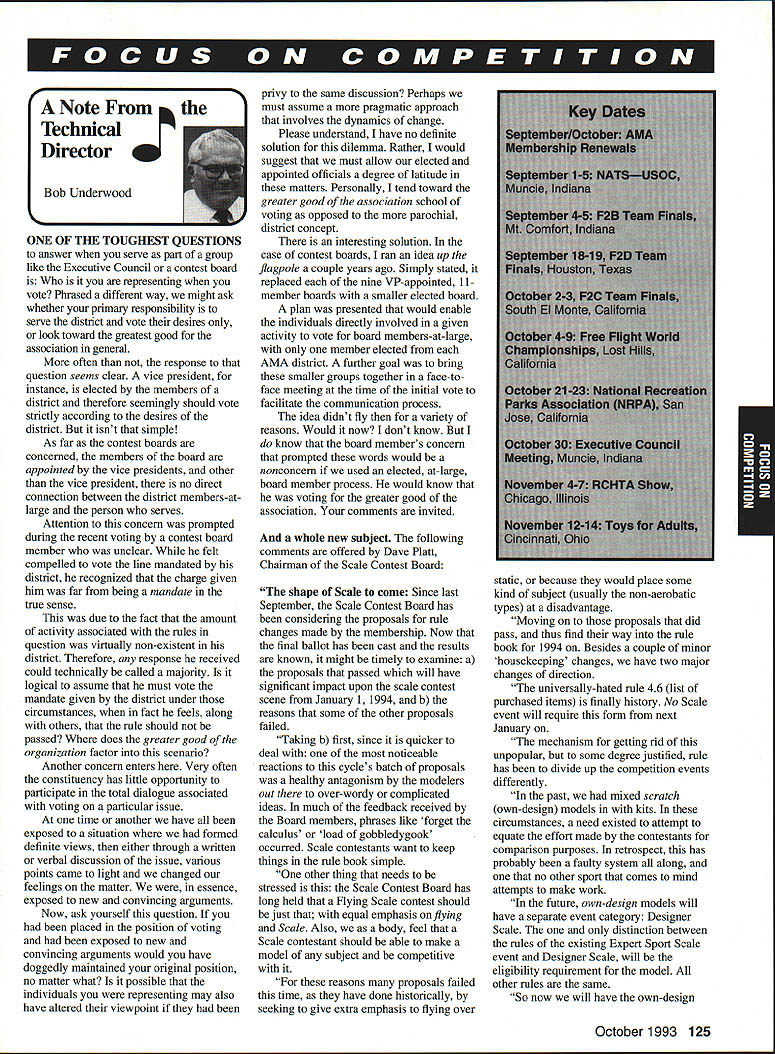
A Note From the Technical Director
Bob Underwood
One of the toughest questions to answer when you serve as part of a group like the Executive Council or a contest board is: Who are you representing when you vote? Phrased another way, should your primary responsibility be to serve the district and vote their desires only, or to look toward the greatest good for the association in general?
More often than not the response seems clear. A vice president, for instance, is elected by the members of a district and therefore seemingly should vote strictly according to the desires of the district. But it isn't that simple.
As far as the contest boards are concerned, the members of the board are appointed by the vice presidents, and other than the vice president there is no direct connection between the district members-at-large and the person who serves.
My attention to this concern was prompted during recent voting by a contest board member who was unclear about his responsibility. While he felt compelled to vote the line mandated by his district, he recognized that the charge given him was far from a mandate in the true sense. This was due to the fact that the amount of activity associated with the rules in question was virtually non-existent in his district; therefore, any response he received could technically be called a majority. Is it logical to assume he must vote the district mandate under those circumstances when, in fact, he and others feel the rule should not be passed? Where does the greater good of the organization factor in?
Another concern is that constituencies often have little opportunity to participate in the full dialogue associated with voting on a particular issue. At one time or another we have all formed definite views and then, through written or verbal discussion, been exposed to new and convincing arguments that changed our minds. If you had been placed in the position of voting and had been exposed to new arguments, would you have doggedly maintained your original position no matter what? It is possible that the individuals you represent may also have altered their viewpoint if they had been privy to the same discussion. Perhaps we must assume a more pragmatic approach that allows for the dynamics of change.
I have no definite solution for this dilemma. Rather, I suggest we allow our elected and appointed officials a degree of latitude in these matters. Personally, I tend toward the "greater good of the association" school of voting as opposed to a narrow, parochial district concept.
One interesting solution we proposed a couple of years ago would replace each of the nine VP-appointed, 11-member boards with smaller elected boards. The plan would enable individuals directly involved in a given activity to vote for board members-at-large, with only one member elected from each AMA district. A further goal was to bring these smaller groups together face-to-face at the time of the initial vote to facilitate communication. The idea didn't fly then for a variety of reasons. Would it now? I don't know. But I do know that the board member's concern that prompted these words would be a nonconcern if we used an elected at-large board-member process. He would know that he was voting for the greater good of the association. Your comments are invited.
---
Dave Platt — Chairman, Scale Contest Board
Shape of Scale
Since last September the Scale Contest Board has been considering proposals for rule changes made by the membership. Now that the final ballot has been cast and the results are known, it is timely to examine: (a) the proposals that passed and will have significant impact upon the scale contest scene as of January 1, 1994, and (b) the reasons some other proposals failed.
Taking (b) first: one of the most noticeable reactions to this cycle's batch of proposals was a healthy antagonism by modelers to over-wordy or complicated ideas. In much of the feedback received, phrases like "forget the calculus" or "load of gobbledygook" occurred. Scale contestants want to keep things in the rule book simple.
Another point that needs stressing is this: the Scale Contest Board has long held that a flying scale contest should emphasize both flying and scale equally. We also feel that a scale contestant should be able to make a model of any subject and be competitive with it. For these reasons many proposals failed this time, as they have historically — either because they sought to give extra emphasis to flying over static, or because they would place some kinds of subjects (usually the non-aerobatic types) at a disadvantage.
Moving on to the proposals that did pass and will be in the 1994 rule book: besides a couple of minor housekeeping changes, we have two major changes of direction.
- The universally hated Rule 4.6 (list of purchased items) is finally history. No Scale event will require this form beginning next January.
- The mechanism for removing this unpopular — though arguably justified in some respects — rule has been to divide the competition events differently.
In the past, we mixed scratch (own-design) models in with kits. In those circumstances, a need existed to attempt to equalize the effort made by contestants for comparison purposes. In retrospect, this was probably a faulty system, and one that no other sport that comes to mind attempts to make work.
In the future, own-design models will have a separate event category: Designer Scale. The one and only distinction between the rules of the existing Expert Sport Scale event and Designer Scale will be the eligibility requirement for the model. All other rules are the same.
So now we will have the own-design models competing against each other, and the kit/plan models doing the same thing, so no basis for unfairness prevails.
Of course, nobody says that an own-design model can only compete in Designer Scale. The contestant could enter regular Expert if he wanted to, although it's unlikely he'll want to. First, with Rule 4.6 gone, he'll be placed at a disadvantage to kit/plan entries if he does not qualify for the higher class. And then, with a model that qualifies for the higher class, he'll probably want to enter there.
Some have suggested that kit contestants might attempt to enter Designer Scale simply for prestige. Will the added prestige of entering the top category result in such wangle? Or will those kit contestants (many of whom could design their own model) now move up by doing so? Until now there was little point, competition-wise, to creating your own design. But in January that changes. There is a point: to fly with your peers.
What of contest organizers? How will the new class affect them? Very little, actually. The judging of the models, both statically and in flight, is the same for all classes — Sportsman, Expert, and Designer. All that's needed is to key the contestant's name with an S, E, or D to denote the division being flown, and then announce the results accordingly.
Lastly, sad news for a few (very few, we suspect): the oldest RC scale event of all, Precision Scale, is gone. For many years Precision lay in the doldrums, with hardly any contests being offered for it and consistently disappointing entry numbers. The board finally faced the reality that Precision's time is over. By deleting it from the rule book and offering the new top-level event (Designer) in its place — with rules that everyone already understands and no special requirements for the model or its documentation — it is hoped that clubs will offer Designer and that support for it will far exceed what Precision was getting. Time will tell.
There is also hope that Designer Scale will gain acceptance in other countries and eventually become a World Championship (WC) class. Before this can take place, however, the text must be translated into English — a task I hope to persuade Charlie to undertake.
---
F3C Report and World Championships
Horace Hagen
Judging at the 1993 World Championships (WC) was discussed next. As Chairman of the F3C Subcommittee (S/C) and with the permission of the 1993 F3C WC organizers, I hope to hold a judges' briefing prior to the WC to ensure each judge is familiar with the maneuver clarifications.
As Chairman of the F3C S/C, I attended the CIAM Bureau meeting held the day before the CIAM Plenary meeting. Japan made an offer to hold the F3A and F3C World Championships in Yokohama in 1995. The 1995 World Air Games to be held in Greece were discussed again, and the F3A, F3C, and F3D events are still included as World Championships.
During the CIAM Plenary meeting an unusual turn of events yielded strange results when the 1995 F3A, F3C, and F3D World Championships were voted on. The vote for the F3A WC went to Japan, who had really wanted the F3C WC only and assumed their chances would be improved if they offered WCs for F3A and F3C combined. The U.S.A. delegate made an alternate offer for the 1995 F3D WC. Thus, F3C may be the only category that will have its WC in Greece in 1995. Perhaps we will finally get out of the triple-WC Aerolympics mode and put 100 percent effort into each WC again.
If you have any questions about this year's F3C technical meeting or any suggestions for changes to the F3C program, please call me, Horace Hagen, at (908) 741-3097 (evenings) or (908) 957-3176 (daytime). Better yet, write to me at 15 Parkway Place, Red Bank, NJ 07701.
---
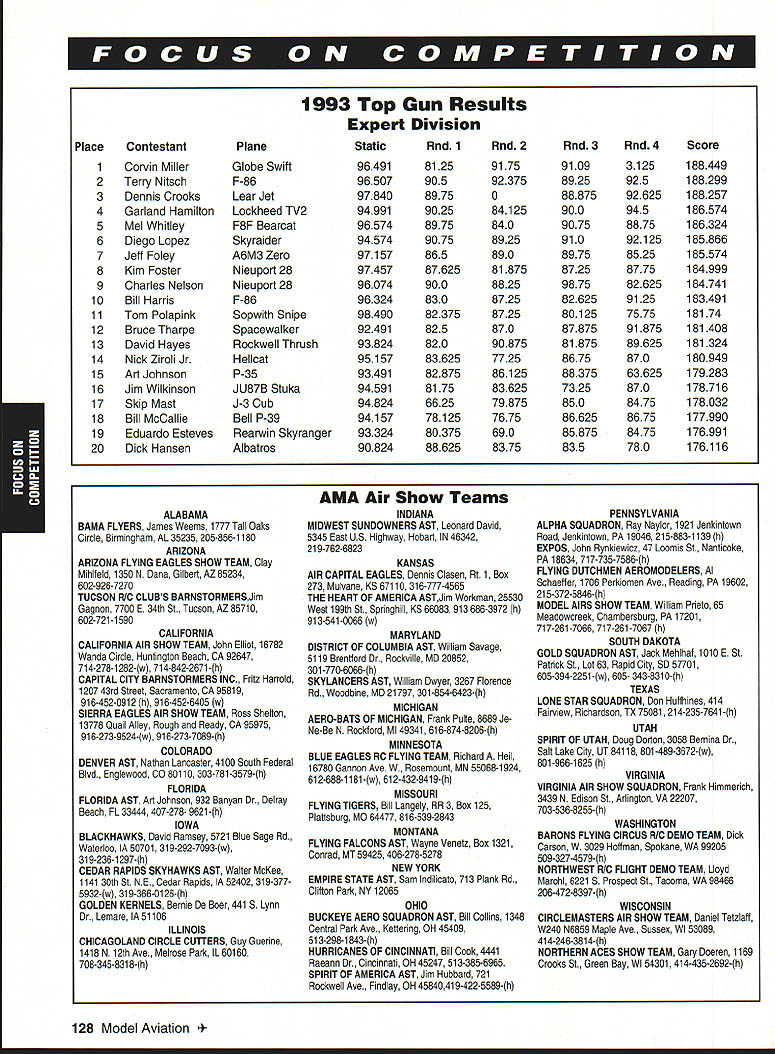
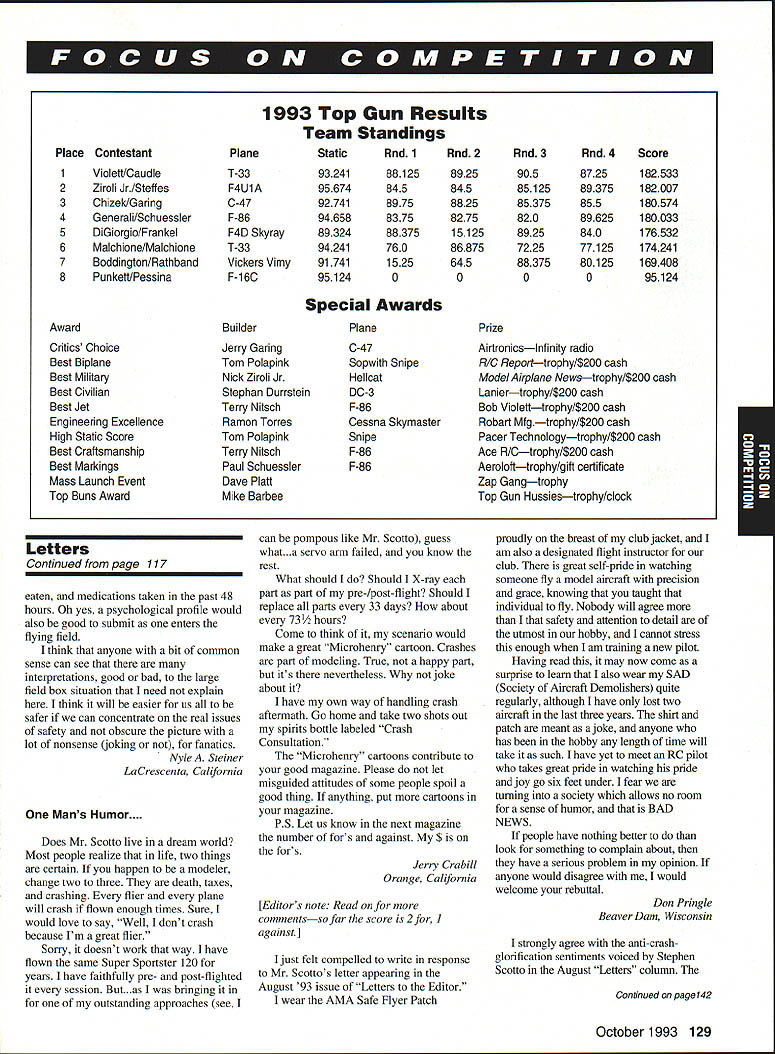
1993 Top Gun Results — Expert Division
Place Contestant Plane Static Rnd. 1 Rnd. 2 Rnd. 3 Rnd. 4 Score 1 Corvin Miller Globe Swift 96.491 81.25 91.75 91.09 93.125 188.449 2 Terry Nitsch F-86 96.507 90.50 92.375 89.25 92.50 188.299 3 Dennis Crooks Lear Jet 97.840 89.75 90.25 88.875 92.625 188.257 4 Garland Hamilton Lockheed TV2 94.991 90.25 84.125 90.00 94.50 186.574 5 Mel Whitley F8F Bearcat 96.574 89.75 84.25 90.75 88.75 186.324 6 Diego Lopez Skyraider 94.574 90.75 89.25 91.00 92.125 185.866 7 Jeff Foley A6M3 Zero 97.157 86.50 89.00 89.75 85.25 185.574 8 Kim Foster Nieuport 28 97.457 87.625 81.875 87.25 87.75 184.999 9 Charles Nelson Nieuport 28 96.074 90.00 88.25 98.75 82.625 184.741 10 Bill Harris F-86 96.324 83.00 87.25 82.625 91.25 183.491 11 Tom Polapink Sopwith Snipe 98.490 82.375 88.25 80.125 75.75 181.744 12 Bruce Tharpe Spacewalker 92.491 82.50 87.00 87.875 91.875 181.408 13 David Hayes Rockwell Thrush 93.824 82.00 90.875 81.875 89.625 181.324 14 Nick Ziroli Jr. Hellcat 95.157 83.625 77.25 86.75 87.00 180.949 15 Art Johnson P-35 93.491 82.875 86.125 88.375 63.625 179.283 16 Jim Wilkinson JU87B Stuka 94.591 81.75 83.625 73.25 87.00 178.716 17 Skip Mast J-3 Cub 94.824 66.25 79.875 85.00 84.75 178.032 18 Bill McCallie Bell P-39 94.157 78.125 76.75 86.625 86.75 177.990 19 Eduardo Esteves Rearwin Skyranger 93.324 80.375 69.00 85.875 84.75 176.991 20 Dick Hansen Albatros 90.824 88.625 83.75 83.50 78.00 176.116
Transcribed from original scans by AI. Minor OCR errors may remain.

