
Focus on Competition
A Note From the Technical Director
Bob Underwood
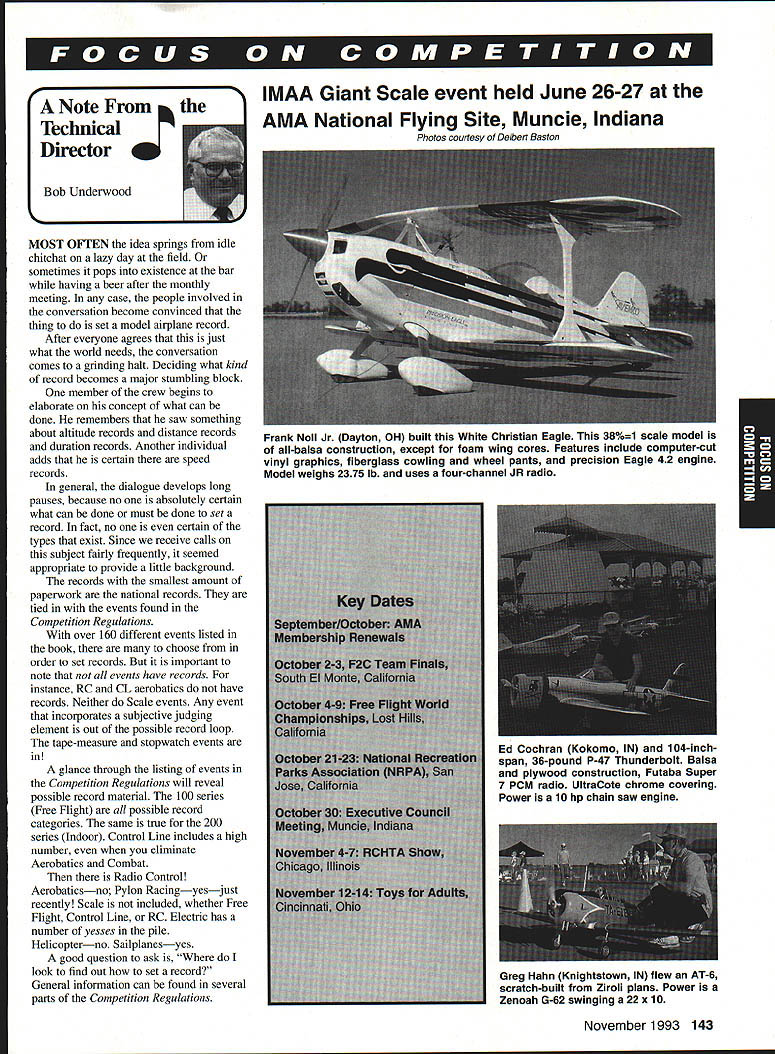
Most often the idea springs from idle chitchat on a lazy day at the field. Or sometimes it pops into existence at the bar while having a beer after the monthly meeting. In any case, the people involved in the conversation become convinced that the thing to do is set a model airplane record.
After everyone agrees that this is just what the world needs, the conversation comes to a grinding halt. Deciding what kind of record becomes a major stumbling block. One member begins to elaborate on his concept — altitude, distance, duration — while another is certain there are speed records. Long pauses develop because no one is absolutely certain what can be done or must be done to set a record. In fact, no one is even certain of the types that exist. Since we receive calls on this subject fairly frequently, it seemed appropriate to provide a little background.
National (AMA) records — the basics
The records with the smallest amount of paperwork are the national records. They are tied in with the events found in the Competition Regulations. With over 160 different events listed in the book, there are many to choose from in order to set records — but not all events have records. Any event that incorporates a subjective judging element is out of the possible-record loop (for example, Scale events and aerobatics judged subjectively). Tape-measure and stopwatch events are in.
A glance through the Competition Regulations will reveal possible record material:
- 100 series (Free Flight): all possible record categories.
- 200 series (Indoor): possible record categories.
- Control Line: many possible records (eliminate Aerobatics and Combat).
- Radio Control: mixed — Aerobatics (no), Pylon Racing (yes, recently), Scale (no), Electric (yes in several classes), Helicopter (no), Sailplanes (yes).
A good question to ask is, "Where do I look to find out how to set a record?" General information can be found in several parts of the Competition Regulations:
- Page 5, item 3.2 discusses sanctioning special record trials.
- Page 8 contains an entire section on records, including reporting procedures and other requirements.
- Specific-event rules often contain additional, tucked-away requirements (for example, certain Control Line record classes may only be set at particular event types — A, AA, etc.).
- A lengthy section regarding RC soaring (sailplanes) begins on page 114.
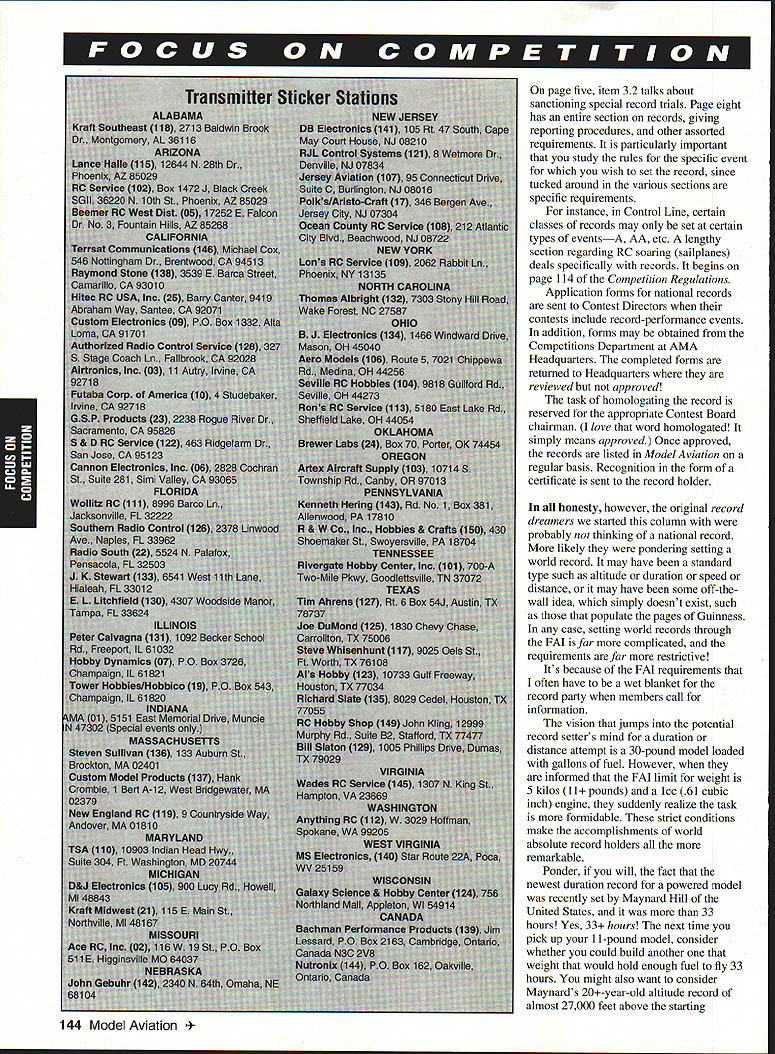
Application forms for national records are sent to Contest Directors when contests include record-performance events. Forms may also be obtained from the Competitions Department at AMA Headquarters. Completed forms are returned to Headquarters where they are reviewed; the task of homologating (approving) the record is reserved for the appropriate Contest Board chairman. Once approved, records are listed regularly in Model Aviation and a certificate is sent to the record holder.
World records (FAI) — more restrictive
Most original record dreamers are thinking bigger — world records. Setting world records through the FAI is far more complicated and the requirements far more restrictive. FAI limits often put a wet blanket on ambitious ideas: for example, a duration or distance attempt using a 30-pound model loaded with gallons of fuel becomes unrealistic when FAI limits include a maximum weight of 5 kilos (11 pounds) and strict engine-displacement restrictions. Such strict conditions make the accomplishments of FAI world-record holders all the more remarkable.
With world records, the act of flying the record is only a minor part of the work. After the flight there are strict reporting procedures:
- AMA Headquarters must be contacted within a short, specified period.
- FAI (in Paris) must be notified and an elaborate dossier prepared.
- It is imperative to obtain a copy of the FAI Sporting Code (from AMA Headquarters) to understand all requirements.
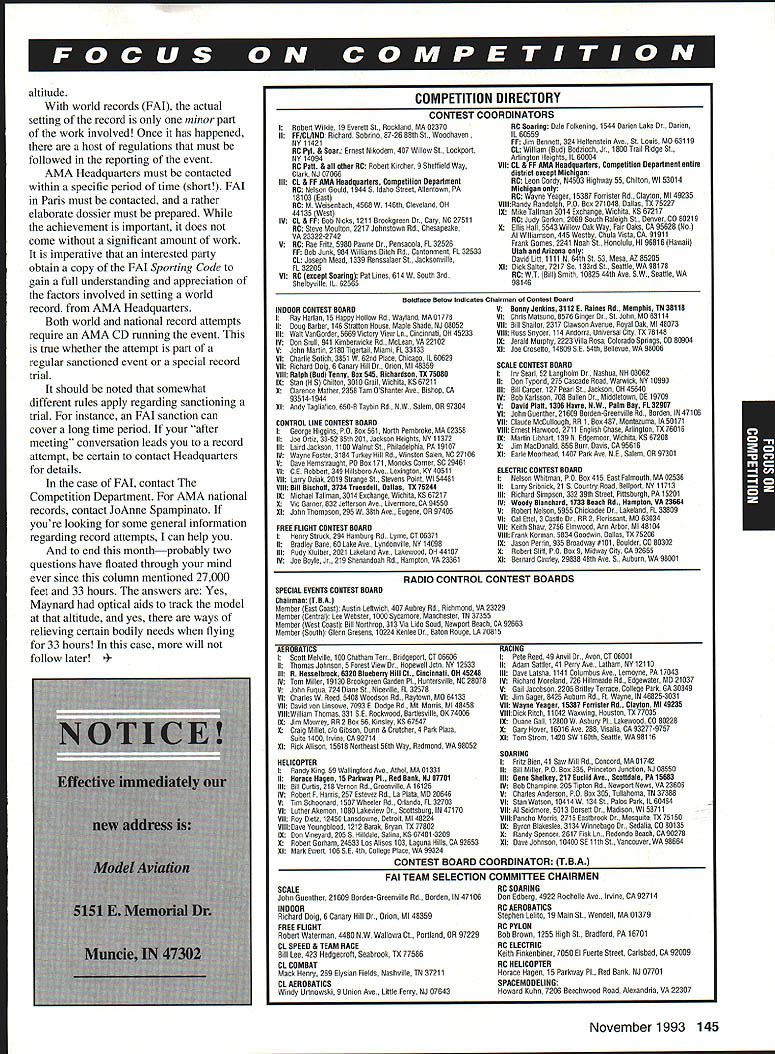
Both world and national record attempts require an AMA Contest Director running the event, whether it's part of a regular sanctioned contest or a special record trial. Sanctioning rules differ: for instance, an FAI sanction can cover a long time period. If your after-meeting conversation leads to a record attempt, contact Headquarters for details:
- For FAI matters: The Competition Department at AMA Headquarters.
- For AMA national records: JoAnne Spannampa.
- For general information: contact the Technical Director (Bob Underwood).
To answer two questions you may be wondering about Maynard Hill's records: yes, Maynard used optical aids to track his model at extreme altitude, and yes, there are methods for managing bodily needs during a 33-hour flight — more on that topic was promised to follow.
---
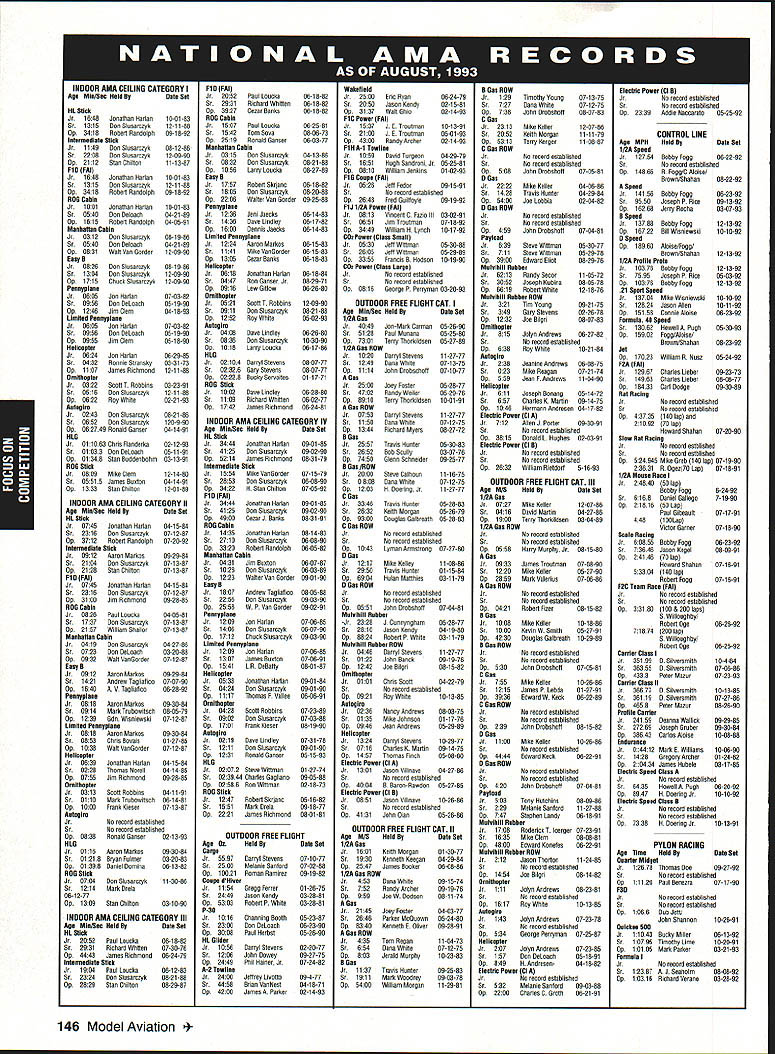
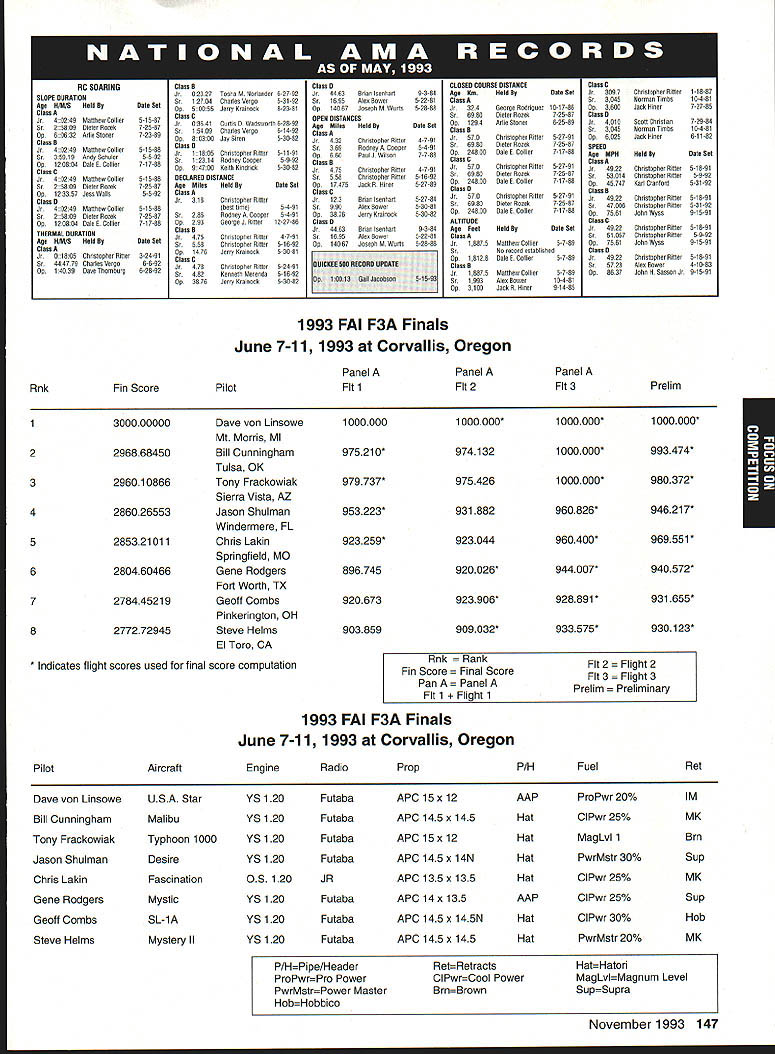
National AMA Records
AS OF MAY, 1993
1993 FAI F3A Finals June 7–11, 1993 — Corvallis, Oregon
Results (Final standings)
- 1. Dave von Linsowe — Final Score: 3000.00000
- Panel A Flight 1: 1000.000
- Panel A Flight 2: 1000.000*
- Panel A Flight 3: 1000.000*
- Preliminary: 1000.000*
- 2. Bill Cunningham — Final Score: 2968.68450
- Panel A Flight 1: 975.210*
- Panel A Flight 2: 974.132
- Panel A Flight 3: 1000.000*
- Preliminary: 993.474*
- 3. Tony Frackowiak — Final Score: 2960.10866
- Panel A Flight 1: 979.737*
- Panel A Flight 2: 975.426
- Panel A Flight 3: 1000.000*
- Preliminary: 980.372*
- 4. Jason Shulman — Final Score: 2860.26553
- Panel A Flight 1: 953.223*
- Panel A Flight 2: 931.882
- Panel A Flight 3: 960.826*
- Preliminary: 946.217*
- 5. Chris Lakin — Final Score: 2853.21011
- Panel A Flight 1: 923.259*
- Panel A Flight 2: 923.044
- Panel A Flight 3: 960.400*
- Preliminary: 969.551*
- 6. Gene Rodgers — Final Score: 2804.60466
- Panel A Flight 1: 896.745
- Panel A Flight 2: 920.026*
- Panel A Flight 3: 944.007*
- Preliminary: 940.572*
- 7. Geoff Combs — Final Score: 2784.45219
- Panel A Flight 1: 920.673
- Panel A Flight 2: 923.906*
- Panel A Flight 3: 928.891*
- Preliminary: 931.655*
- 8. Steve Helms — Final Score: 2772.72945
- Panel A Flight 1: 903.859
- Panel A Flight 2: 909.032*
- Panel A Flight 3: 933.575*
- Preliminary: 930.123*
- *Indicates flight scores used for final score computation
Legend:
- Rnk = Rank
- Fin Score = Final Score
- Pan A = Panel A
- Flt 1 = Flight 1
- Flt 2 = Flight 2
- Flt 3 = Flight 3
- Prelim = Preliminary
Equipment (Pilots and aircraft/equipment used)
- Dave von Linsowe
- Aircraft: U.S.A. Star
- Engine: YS 1.20
- Radio: Futaba
- Prop: APC 15 x 12
- P/H: AAP
- Fuel: ProPwr 20%
- Ret: IM
- Bill Cunningham
- Aircraft: Malibu
- Engine: YS 1.20
- Radio: Futaba
- Prop: APC 14.5 x 14.5
- P/H: Hat
- Fuel: ClPwr 25%
- Ret: MK
- Tony Frackowiak
- Aircraft: Typhoon 1000
- Engine: YS 1.20
- Radio: Futaba
- Prop: APC 15 x 12
- P/H: Hat
- Fuel: MagLvl 1
- Ret: Brn
- Jason Shulman
- Aircraft: Desire
- Engine: YS 1.20
- Radio: Futaba
- Prop: APC 14.5 x 14.5
- P/H: Hat
- Fuel: PwrMstr 30%
- Ret: Sup
- Chris Lakin
- Aircraft: Fascination
- Engine: O.S. 1.20
- Radio: JR
- Prop: APC 13.5 x 13.5
- P/H: Hat
- Fuel: ClPwr 25%
- Ret: MK
- Gene Rodgers
- Aircraft: Mystic
- Engine: YS 1.20
- Radio: Futaba
- Prop: APC 14 x 13.5
- P/H: AAP
- Fuel: ClPwr 25%
- Ret: Sup
- Geoff Combs
- Aircraft: SL-1A
- Engine: YS 1.20
- Radio: Futaba
- Prop: APC 14.5 x 14.5
- P/H: Hat
- Fuel: ClPwr 30%
- Ret: Hob
- Steve Helms
- Aircraft: Mystery II
- Engine: YS 1.20
- Radio: Futaba
- Prop: APC 14.5 x 14.5
- P/H: Hat
- Fuel: PwrMstr 20%
- Ret: MK
Abbreviation key (as listed):
- P/H = Pipe/Header
- ProPwr = Pro Power
- PwrMstr = Power Master
- Hob = Hobbico
- Rel = Retracts
- ClPwr = Cool Power
- Brn = Brown
- Hat = Hatori
- MagLvl = Magnum Level
- Sup = Supra
Transcribed from original scans by AI. Minor OCR errors may remain.

