
Focus on Competition
A Note From the Technical Director
Bob Underwood
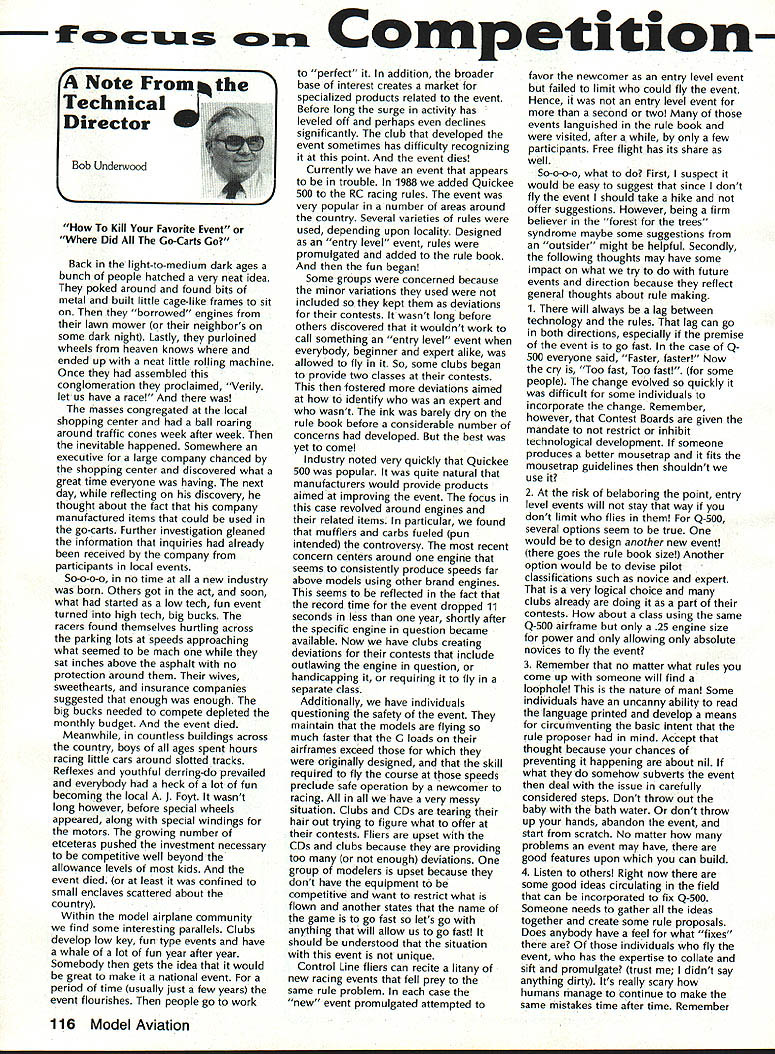
"How To Kill Your Favorite Event" or "Where Did All The Go‑Carts Go?"
Back in the light‑to‑medium dark ages a bunch of people hatched a neat idea. They poked around, found bits of metal and built little cage‑like frames to sit on. Then they "borrowed" engines from their lawn mower (or their neighbor's on some dark night) and purloined wheels from heaven knows where and ended up with a neat little rolling machine. Once assembled they proclaimed, "Verily, let us have a race!" And there was a race.
The masses congregated at the local shopping center and had a ball roaring around traffic cones week after week. Then the inevitable happened. An executive from a large company chanced by the shopping center, discovered what a great time everyone was having, and realized his company made items that could be used on go‑carts. Further investigation revealed inquiries had already been received by the company from participants in local events.
So‑o‑o‑o, in no time a new industry was born. Others got into the act, and soon what had started as a low‑tech, fun event turned high‑tech and big bucks. The racers found themselves hurtling across parking lots at speeds that seemed excessive, sitting inches above the asphalt with no protection. Wives, sweethearts and insurance companies suggested enough was enough. The big bucks needed to compete depleted monthly budgets. The event died.
Meanwhile, in countless buildings across the country boys (and girls) spent hours racing little cars around slotted tracks. Reflexes and youthful derring‑do prevailed and everybody had a heck of a lot of fun. But it wasn't long before special wheels appeared, along with special motor windings. The growing list of enhancements pushed the investment necessary to be competitive beyond most kids' allowances. The event diminished and was confined to small enclaves.
Within the model airplane community we find similar parallels. Clubs develop low‑key, fun events and have a whale of a time year after year. Somebody then suggests making it a national event. For a few years the event may flourish, then people work to "perfect" it. The broader interest creates a market for specialized products. Before long the surge levels off or declines significantly, and the club that developed the event sometimes has difficulty recognizing that the event has died.
Currently we have an event that appears to be in trouble. In 1988 we added Quickee 500 to the RC racing rules. The event was very popular in several areas around the country. Several varieties of local rules were used. Designed as an entry‑level event, rules were promulgated and added to the rule book. And then the fun began.
Some groups were concerned because the minor variations they used were not included, so they kept them as local deviations. It wasn't long before others discovered it wouldn't work to call something an "entry‑level" event when everybody, beginner and expert alike, was allowed to fly in it. Some clubs began to provide two classes at their contests. That fostered more deviations aimed at how to identify who was an expert and who wasn't. The ink was barely dry on the rule book before a considerable number of concerns had developed.
Industry noticed quickly that Quickee 500 was popular. Manufacturers naturally provided products aimed at improving performance. The focus in this case revolved around engines and related items — in particular mufflers and carburetors — which fueled (pun intended) controversy. A recent concern centers on one engine that consistently produces speeds far above models using other brands. This is reflected by the fact that the record time for the event dropped 11 seconds in less than a year shortly after that engine became available. Clubs have responded with deviations: outlawing the engine, handicapping it, or requiring it to fly in a separate class.
Additionally, individuals are questioning the safety of the event. They maintain models are flying so much faster that the G‑loads on airframes exceed those for which they were designed, and that the skill required to fly the course at those speeds precludes safe operation by newcomers. All in all, it's a messy situation. Clubs and contest directors are tearing their hair out trying to figure out what to offer at contests. Fliers are upset with CDs and clubs for providing too many — or not enough — deviations. One group complains they don't have the equipment to be competitive and want restrictions; another says the name of the game is to go fast, so allow anything that makes you faster. This problem is not unique.
Control Line fliers can recite a litany of new racing events that fell prey to the same rule problem. In each case the "new" event attempted to favor the newcomer as an entry‑level contest but failed to limit who could fly. Hence, it was not an entry‑level event for more than a second or two. Many of those events languished in the rule book or were visited, after a while, by only a few participants. Free flight has its share as well.
So, what to do? First, I suspect it would be easy to suggest that since I don't fly the event I should take a hike and not offer suggestions. However, being a firm believer in the "forest for the trees" syndrome, maybe some suggestions from an "outsider" might be helpful. The following thoughts reflect general principles about rule making and may help with future events and direction.
- There will always be a lag between technology and the rules. That lag can go both ways, especially if the premise of the event is to go very fast. In the case of Q‑500, one CD said, "Faster, faster!" Now the cry is, "Too fast, too fast!" The change evolved so quickly it was difficult for some to incorporate. Remember that Contest Boards are given the mandate not to restrict or inhibit technological development. If someone produces a better mousetrap and it fits the manufacturer's guidelines, shouldn't we use it?
- Entry‑level events will not stay that way if you don't limit who flies in them. For Q‑500, several options are possible. One is to design another new event. Another is to devise pilot classification such as novice and expert. That is logical and many clubs already do it. How about a class using the same Q‑500 airframe but only a .25 engine for power and only allowing absolute novices to fly?
- No matter what rules you make someone will find a loophole. This is human nature. Some have an uncanny ability to read printed language and develop means to circumvent the basic intent. Accept that thought because your chance of preventing it is about nil. If they want the edge they will find a way. Don't throw your baby out with the bath water. Don't abandon the event and start from scratch. No matter how many problems an event may have, there are good features upon which you can build.
- Listen to others. Right now there are some good ideas circulating in the field that can be incorporated to fix Q‑500. Someone needs to gather the ideas together and create rule proposals. Those who fly the event and have experience should make their feelings known and provide reasonable proposals. Don't just rant and rave.
There are examples of competitive forms that have managed growth well. Helicopters, for instance, have enjoyed significant advances. They use pilot classes with appropriate maneuver schedules and do not restrict equipment. Their only current problem is keeping abreast of rapidly improving pilot proficiency — maneuvers in beginning classes a few years ago are now flown at the international FAI level. They're doing something right.
Soaring is another example of a mature set of rules. Recent rule cycles have resulted in very few changes. Competitors seem satisfied and numbers participating rise year by year. The one exception is FAI participation, which went through a technology explosion a few years back. Much of that is settling down and we may see a resurgence.
There's nothing particularly new in this column. I felt compelled to remind us of some concerns as we approach a new rule cycle. Our 1992–93 rule book will be available soon and lots of folks will be pondering changes. Hopefully we will take a carefully considered approach. And you guys that fly Q‑500 — what are we going to do to help you out?
Until next month — which seems to come around in two weeks.
— Bob Underwood
Transcribed from original scans by AI. Minor OCR errors may remain.

