
Focus on Competition
Competitions Director
Chip Smith
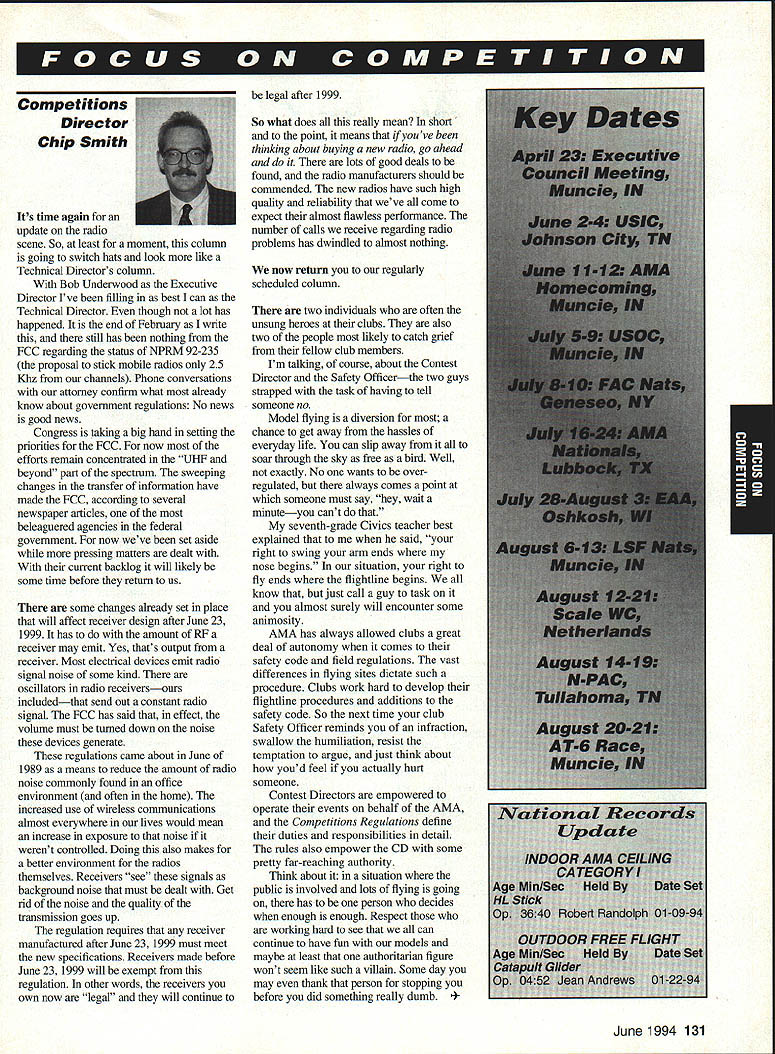
It's time again for an update on the radio scene. For a moment this column will switch hats and look more like the Technical Director's column.
With Bob Underwood as Executive Director I've been filling in as best I can as Technical Director. As I write this at the end of February there still has been nothing from the FCC regarding the status of NPRM 92-235 (the proposal to put mobile radios on 25 kHz channels). Phone conversations with our attorney confirm what we already know about government regulation: no news is good news.
Congress is taking a big hand in setting priorities for the FCC. For now most of the efforts remain concentrated in the "UHF and beyond" part of the spectrum. Sweeping changes in frequency allocation and transfer of information have made the FCC, according to several newspaper articles, one of the most beleaguered agencies in the federal government. With their current backlog it will likely be some time before they return to us.
There are some changes already set in place that will affect receiver design after June 23, 1999. It has to do with the amount of RF a receiver may emit — yes, that's output from a receiver. Most electrical devices emit radio signal noise of some kind. There are oscillators in radio receivers — ours included — that send out a constant radio signal. The FCC has said that, in effect, the volume must be turned down on the noise these devices generate.
These regulations originated in June 1989 as a means to reduce the amount of radio noise commonly found in office environments and homes. The increased use of wireless communications almost everywhere in our lives would mean increased exposure to that noise if it weren't controlled. Doing this also makes for a better environment for the radios themselves. Receivers "see" these signals as background noise that must be dealt with. Get rid of the noise and the quality of the transmission goes up.
The regulation requires that any receiver manufactured after June 23, 1999 must meet the new specifications. Receivers made before June 23, 1999 will be exempt from this regulation. In other words, the receivers you own now are legal and will continue to be legal after 1999.
So what does all this really mean? In short: if you've been thinking about buying a new radio, go ahead. There are lots of good deals to be found, and radio manufacturers should be commended. The new radios have such high quality and reliability that we've come to expect their almost flawless performance. The number of calls we receive regarding radio problems has dwindled to almost nothing.
We now return you to our regularly scheduled column.
Contest Directors and Safety Officers
There are two individuals who are often the unsung heroes at their clubs. They are also the two people most likely to catch grief from their fellow club members.
I'm talking, of course, about the Contest Director and the Safety Officer — the two people tasked with having to tell someone "no."
Model flying is a diversion for most; a chance to get away from the hassles of everyday life. You can slip away from it all to soar through the sky as free as a bird. Well, not exactly. No one wants to be over-regulated, but there always comes a point at which someone must say, "Hey, wait a minute — you can't do that." My seventh-grade civics teacher best explained it to me when he said, "Your right to swing your arm ends where my nose begins." In our situation, your right to fly ends where the flightline begins. We all know that, but just call a guy to task on it and you almost surely will encounter some animosity.
AMA has always allowed clubs a great deal of autonomy when it comes to their safety code and field regulations. The vast differences in flying sites dictate such a procedure. Clubs work hard to develop their flightline procedures and additions to the safety code. So the next time your club Safety Officer reminds you of an infraction, swallow the humiliation, resist the temptation to argue, and just think about how you'd feel if you actually hurt someone.
Contest Directors are empowered to operate their events on behalf of the AMA, and the Competitions Regulations define their duties and responsibilities in detail. The rules also empower the CD with some pretty far-reaching authority.
Think about it: in a situation where the public is involved and lots of flying is going on, there has to be one person who decides when enough is enough. Respect those who are working hard to see that we all can continue to have fun with our models and maybe at least that authoritarian figure won't seem like such a villain. Someday you may even thank that person for stopping you before you did something really dumb.
Analysis Of Proposals By Contest Boards
- Manufacturing — will current equipment continue to be made obsolete?
- Protests — will the change tend to eliminate a source of protests at meets, or are protests more likely?
- Model Processing Time — will the change tend to increase or decrease the time required to process models for competition?
- Designs — will the builder be given more or less freedom of choice in design?
- Contests — will the effort required to conduct a contest be increased or decreased?
- Present Models — will a modeler be able to effectively compete with current models, or will he have to build new ones?
- Effect on Competition — will the net effect of the proposed change, if passed, be to encourage or discourage contest participation?
Procedures
Rules Review Schedule
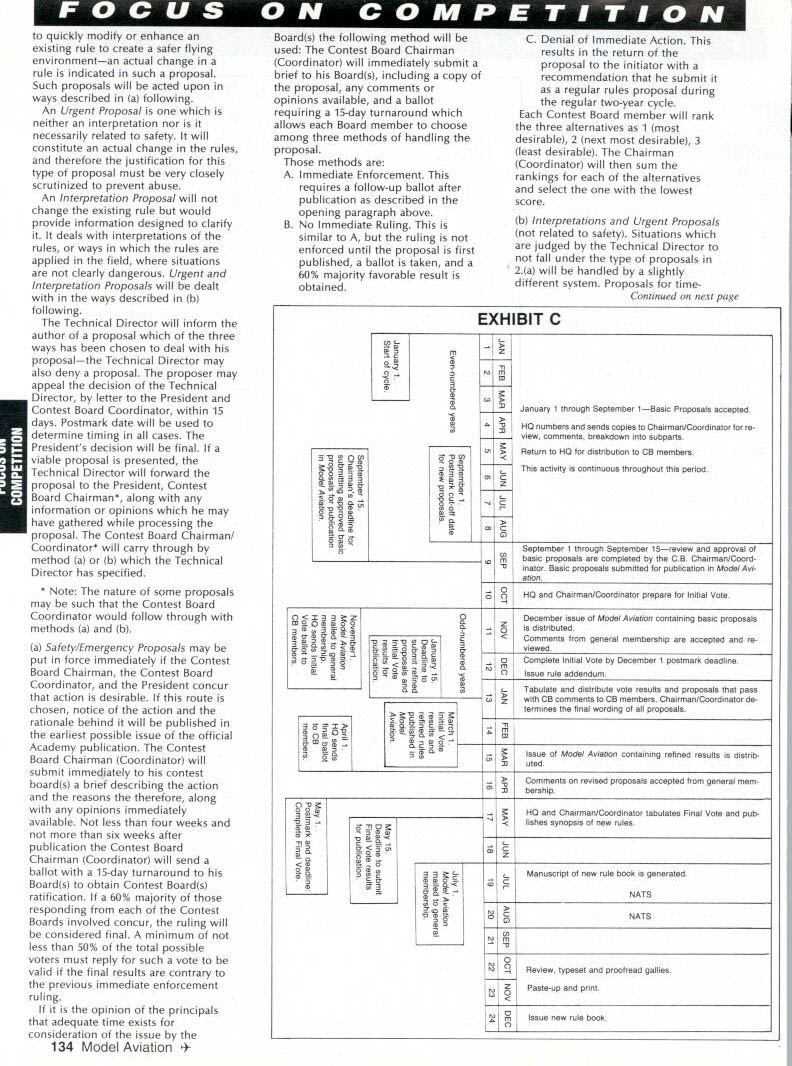
These procedures provide for a single two-year schedule (Exhibit C). Additional two-year schedules commence with the start of each even-numbered calendar year.
Proposal Preparation and Submittal
Any Open class AMA member may submit a rules change proposal by filling out a completed RULES CHANGE PROPOSAL FORM (see Exhibit A) and mailing it to AMA Headquarters by the specified postmark deadline (see Exhibit C). Upon receipt, Headquarters staff will review the proposal to assure it has been properly submitted (correct form used, properly filled out, required signatures, clearly stated proposals). If the proposal does not pass the review at Headquarters it will be returned to the proposer with an explanation of what is required to present it properly.
Types of Proposals
There are two basic types of proposals:
- Basic Rules Change Proposal — may be filed by any open AMA class member and affects one or more competition categories.
- Safety/Emergency, Urgent, and Interpretation Proposals — because of the relatively long time required to get a rules proposal through the normal process (two years), there are alternative paths for legislation which may be enacted quickly. The Technical Director will determine which category a proposal should fall into based on the content and the perceived dangers of delaying action.
- Safety/Emergency Proposals: Address problems that might result in loss of life or affect people's health. Their intent is to quickly modify or enhance an existing rule to create a safer flying environment — an actual change in a rule is indicated. Such proposals will be acted upon as described in method (a) below.
- Urgent Proposals: Neither an interpretation nor necessarily related to safety. It will constitute an actual change in the rules and therefore must be closely scrutinized to prevent abuse.
- Interpretation Proposals: Will not change the existing rule but provide information designed to clarify it. They deal with interpretations of the rules or their application in the field where situations are not clearly dangerous. Urgent and Interpretation Proposals will be dealt with as described in method (b) below.
The Technical Director will inform the author which of the three ways has been chosen to deal with a proposal. The Technical Director may disallow a proposal. The proposer may appeal the Technical Director's decision by letter to the President and Contest Board Coordinator within 15 days (postmark date will determine timing). The President's decision will be final.
If a viable proposal is presented, the Technical Director will forward the proposal to the President and Contest Board Chairman/Coordinator, along with any information or opinions gathered while processing the proposal. The Contest Board Chairman/Coordinator will proceed by method (a) or (b) as specified.
(a) Safety/Emergency Proposals may be put in force immediately if the Contest Board Chairman, the Contest Board Coordinator, and the President concur that action is desirable. If this route is chosen, notice of the action and the rationale behind it will be published in the earliest possible issue of the official Academy publication. The Contest Board Chairman/Coordinator will submit immediately to his contest board(s) a brief describing the action and reasons, along with any opinions gathered while processing the proposal. The Contest Board Chairman/Coordinator will send a ballot with a 15-day turnaround to his Board(s) to obtain ratification. If a 60% majority of those responding from each Contest Board concur, the ruling will be considered final. A minimum of not less than 50% of the total possible voters must reply for such a vote to be valid if the final results are contrary to the previous immediate enforcement ruling.
If the principals believe adequate time exists for consideration by the Board(s), the following method will be used: The Contest Board Chairman/Coordinator will immediately submit a brief to his Board(s), including a copy of the proposal, any comments or opinions available, and a ballot requiring a 15-day turnaround which allows each Board member to choose among three methods of handling the proposal.
Those methods are:
- A. Immediate Enforcement — requires a follow-up ballot after publication as described above.
- B. No Immediate Ruling — similar to A, but the ruling is not enforced until the proposal is first published, a ballot is taken, and a 60% majority favorable result is obtained.
- C. Denial of Immediate Action — results in the return of the proposal to the initiator with a recommendation that it be submitted as a regular rules proposal during the regular two-year cycle.
Each Contest Board member will rank the three alternatives as 1 (most desirable), 2 (next most desirable), 3 (least desirable). The Chairman/Coordinator will then sum the rankings for each alternative and select the one with the lowest score.
The intent is to provide a national standard (with particular respect to safety) for activity which is essentially local in nature but apparently popular in several areas.
Provisional/Supplemental Rules
Provisional and Supplemental rules are not intended to be included as part of official events in the National Model Airplane Championships but may be included in all other sanctioned contests. No records will be recognized for Provisional or Supplemental events.
FAI Rules
FAI rules are automatically part of the AMA rules. They normally require no AMA contest board action, so once passed by the FAI's Committee for International Aeromodeling (CIAM), they also become official for AMA. The AMA president and the appropriate contest board chairman and/or coordinator may determine the date of effectivity for AMA, however, in cases where earlier application than scheduled by the FAI would benefit AMA team selection or other FAI activities. FAI rules change proposals from the U.S. and U.S. participation in voting on proposals is in accordance with policy decisions of the AMA president and/or the Executive Council.
Proposal Numbering
The system outlined below shall be used by all contest boards. A standard basic numbering system for all categories will be helpful during contest board and headquarters administration and publication of proposals. A basic proposal numbering system will permit ready reference to any proposal by the general membership.
A proposal number should have three basic sections:
- Category for which the proposal is filed
- Year in which the proposal is to become effective
- Proposal number for a particular category (to be assigned by AMA Headquarters in order of proposal receipt)
Example:
- Category: RC
- Year proposal is effective: 76
- Proposal number: 1a*
Other category abbreviations:
- CL
- FF
- SC
- GEN
- IND
*Optional: if a basic proposal has component parts that should be voted on separately, a lower-case letter or a number may be added to designate each item.
Proposal Consideration
Single Category — Upon receipt of a new proposal from AMA Headquarters the contest board chairman shall review the submitted proposal for acceptability. There is no restriction on resubmittal of proposals which previously have been denied.
Proposals Affecting More Than One Category — In the case of a proposal affecting more than one category (i.e., General Rules), the proposal shall be sent by AMA Headquarters to the Contest Board Coordinator, who will determine its acceptability.
Proposal Distribution
If the contest board chairman/coordinator is satisfied that the proposal has been properly filed, he will notify AMA Headquarters to reproduce and distribute it to members of the appropriate board(s).
Contest Board Voting
The Contest Board Coordinator does not vote except as a member of the Special Events Contest Board; and the Special Events Contest Board votes only on issues presented to their Board. Members of the SECB do not vote on general rules proposals.
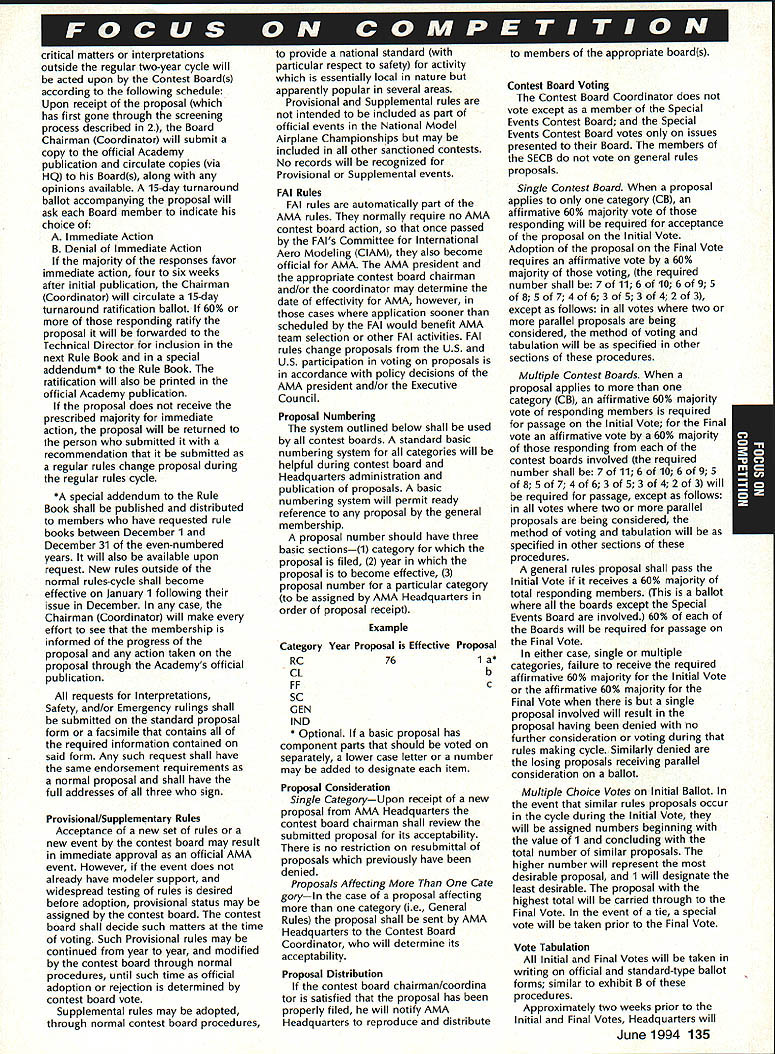
Single Contest Board — When a proposal applies to only one category, an affirmative 60% majority vote of those responding is required for acceptance of the proposal on the Initial Vote. Adoption of the proposal on the Final Vote requires an affirmative 60% majority of those voting (the required number shall be: 7 of 11; 6 of 10; 6 of 9; 5 of 8; 5 of 7; 4 of 6; 3 of 5; 3 of 4; 2 of 3), except as follows: in all votes where two or more parallel proposals are being considered, the method of voting and tabulation will be as specified in other sections of these procedures.
Multiple Contest Boards — When a proposal applies to more than one category, an affirmative 60% majority of responding members is required for passage on the Initial Vote; for the Final Vote an affirmative 60% majority of those responding from each of the contest boards involved (the required number as listed above) will be required for passage, except as specified elsewhere for parallel proposals.
A general rules proposal shall pass the Initial Vote if it receives a 60% majority of total responding members. (This is a ballot where all the boards except the Special Events Board are involved.) Sixty percent of each of the Boards will be required for passage on the Final Vote.
In either case, single or multiple categories, failure to receive the required affirmative 60% majority for the Initial Vote or the Final Vote will result in the proposal being denied with no further consideration or voting during that rules-making cycle. Similarly denied are those losing proposals receiving parallel consideration on a ballot.
Multiple Choice Votes on Initial Ballot — In the event that similar proposals occur during the Initial Vote, they will be assigned numbers beginning with 1 and concluding with the total number of similar proposals. The highest number will represent the most desirable proposal, and 1 the least desirable. The proposal with the highest total will be carried through to the Initial Vote. In the event of a tie, a special vote will be taken prior to the Final Vote.
Vote Tabulation
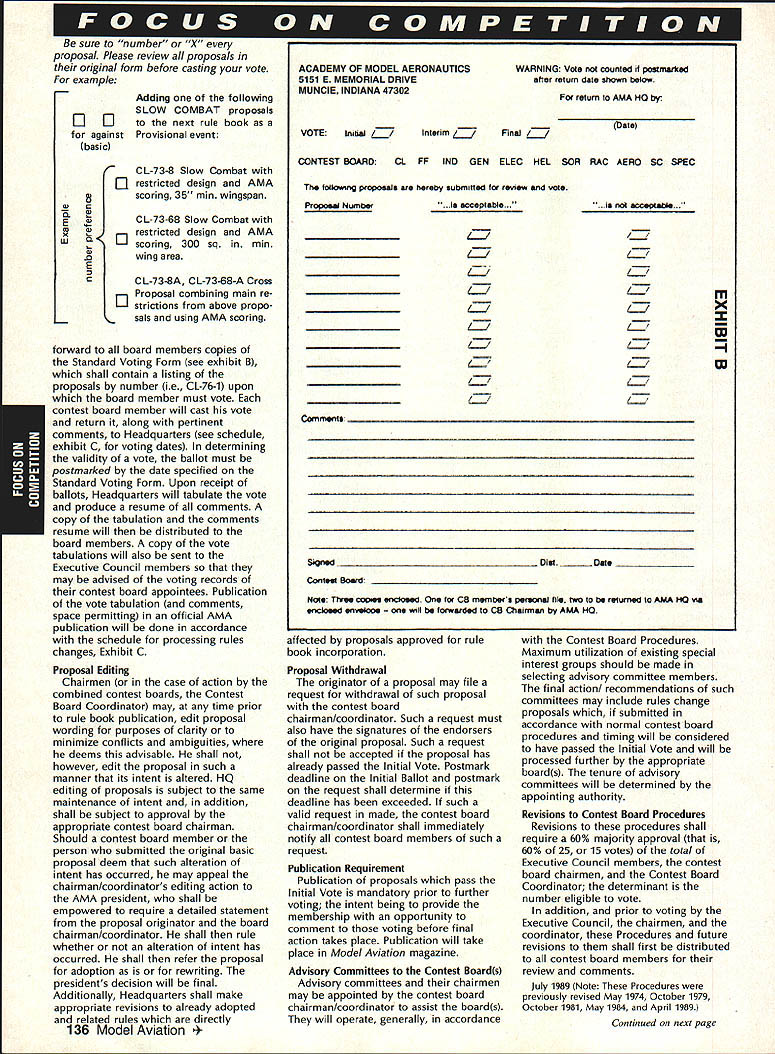
All Initial and Final Votes will be taken in writing on official and standard-type ballot forms (see Exhibit B).
Approximately two weeks prior to the Initial and Final Votes, Headquarters will forward to all board members copies of the Standard Voting Form (see Exhibit B), which shall contain a listing of the proposals by number (i.e., CL-76-1) upon which the board member must vote. Each contest board member will cast his vote and return it, along with pertinent comments, to Headquarters (see schedule, Exhibit C, for voting dates). In determining the validity of a vote, the ballot must be postmarked by the date specified on the Standard Voting Form. Upon receipt of ballots, Headquarters will tabulate the vote and produce a résumé of all comments. A copy of the tabulation and the comments résumé will then be distributed to the board members. A copy of the vote tabulations will also be sent to Executive Council members so they may be advised of the voting records of their contest board appointees. Publication of the vote tabulation (and comments, space permitting) in an official AMA publication will be done in accordance with the schedule for processing rules changes (Exhibit C).
Proposal Editing
Chairmen (or, in the case of action by the combined contest boards, the Contest Board Coordinator) may, at any time prior to rule book publication, edit proposal wording for purposes of clarity or to minimize conflicts and ambiguities where advisable. He shall not, however, edit the proposal in such a manner that its intent is altered. Headquarters editing of proposals is subject to the same maintenance of intent and, in addition, shall be subject to approval by the appropriate contest board chairman.
Should a contest board member or the person who submitted the original basic proposal deem that an alteration of intent has occurred, he may appeal the chairman/coordinator's editing action to the AMA president. The president shall be empowered to require a detailed statement from the proposal originator and the board chairman/coordinator. He shall then rule whether or not an alteration of intent has occurred and shall refer the proposal for adoption as is or for rewriting. The president's decision will be final.
Additionally, Headquarters shall make appropriate revisions to already adopted and related rules which are directly affected by proposals approved for rule book incorporation.
Proposal Withdrawal
The originator of a proposal may file a request for withdrawal of such proposal with the contest board chairman/coordinator. Such a request must also have the signatures of the endorsers of the original proposal. Such a request shall not be accepted if the proposal has already passed the Initial Vote. Postmark deadline on the Initial Ballot and postmark on the request shall determine if the deadline has been exceeded. If a valid request is made, the contest board chairman/coordinator shall immediately notify all contest board members.
Publication Requirement
Publication of proposals that pass the Initial Vote is mandatory prior to further voting; the intent is to provide the membership with an opportunity to comment to those voting before final action takes place. Publication will take place in Model Aviation magazine.
Advisory Committees to the Contest Board(s)
Advisory committees and their chairmen may be appointed by the contest board chairman/coordinator to assist the board(s). They will operate, generally, in accordance with the Contest Board Procedures. Maximum utilization of existing special interest groups should be made in selecting advisory committee members. The final action/recommendations of such committees may include rules change proposals which, if submitted in accordance with normal contest board procedures and timing, will be considered to have passed the Initial Vote and will be processed further by the appropriate board(s). The tenure of advisory committees will be determined by the appointing authority.
Revisions to Contest Board Procedures
Revisions to these procedures shall require a 60% majority approval (that is, 60% of 25, or 15 votes) of the total of Executive Council members, the contest board chairman, and the Contest Board Coordinator; the determinative number eligible to vote. In addition, and prior to voting by the Executive Council, the chairmen, and the coordinator, these Procedures and future revisions to them shall first be distributed to all contest board members for their review and comments.
July 1989 (Note: These Procedures were previously revised May 1974, October 1979, October 1981, May 1984, and April 1989.)
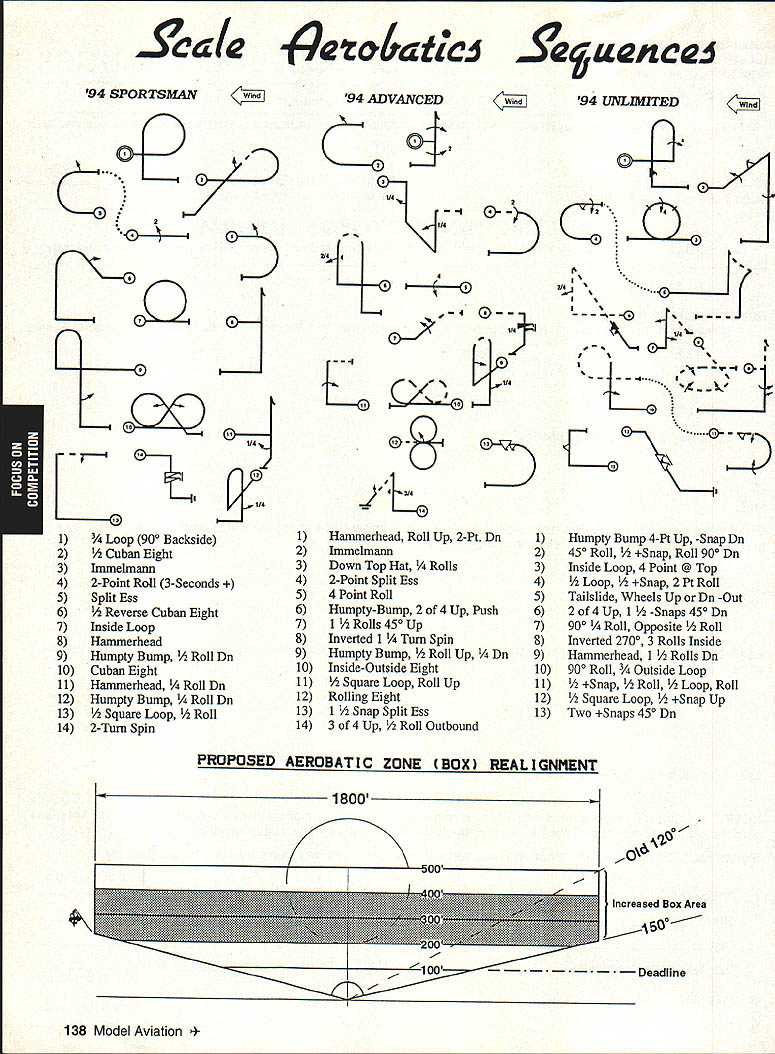
Scale Aerobatics Sequences
'94 SPORTSMAN (Wind)
- 3/4 Loop (90° Backside)
- 1/2 Cuban Eight
- Immelmann
- 2-Point Roll (3-Seconds +)
- Split Ess
- 1/2 Reverse Cuban Eight
- Inside Loop
- Hammerhead
- Humpty Bump, 1/2 Roll Down
- Cuban Eight
- Hammerhead, 1/4 Roll Down
- Humpty Bump, 1/4 Roll Down
- 1/2 Square Loop, 1/2 Roll
- 2-Turn Spin
'94 ADVANCED (Wind)
- Hammerhead, Roll Up, 2-Point Down
- Immelmann
- Down Top Hat, 1/4 Rolls
- 2-Point Split Ess
- 4-Point Roll
- Humpty-Bump, 2 of 4 Up, Push 1 1/2 Rolls 45° Up
- Inverted 1/4 Turn Spin
- Humpty Bump, 1/2 Roll Up, 1/4 Down
- Inside-Outside Eight
- 1/2 Square Loop, Roll Up
- Rolling Eight
- 1 1/2 Snap Split Ess
- 3 of 4 Up, 1/2 Roll Outbound
'94 UNLIMITED (Wind)
- Humpty Bump 4-Point Up, Snap Down
- 45° Roll, 1/2 + Snap, Roll 90° Down
- Inside Loop, 4-Point at Top
- 1/2 Loop, 1/2 + Snap, 2-Point Roll
- Tailslide, Wheels Up or On-Out
- 2 of 4 Up, 1 1/2 - Snaps 45° Down
- 90° 1/4 Roll, Opposite 1/2 Roll
- Inverted 270°, 3 Rolls Inside
- Hammerhead, 1 1/2 Rolls Down
- 90° Roll, 3/4 Outside Loop
- 1/2 + Snap, 3/4 Roll, 1/2 Loop, Roll
- 1/2 Square Loop, 1/2 + Snap Up
- Two + Snaps 45° Down
Proposed Aerobatic Zone (Box) Realignment
- 1800'
- 500'
- 400'
- 300'
- 200'
- 100'
- Old 120°
- Increased Box Area
- 150°
- Deadline
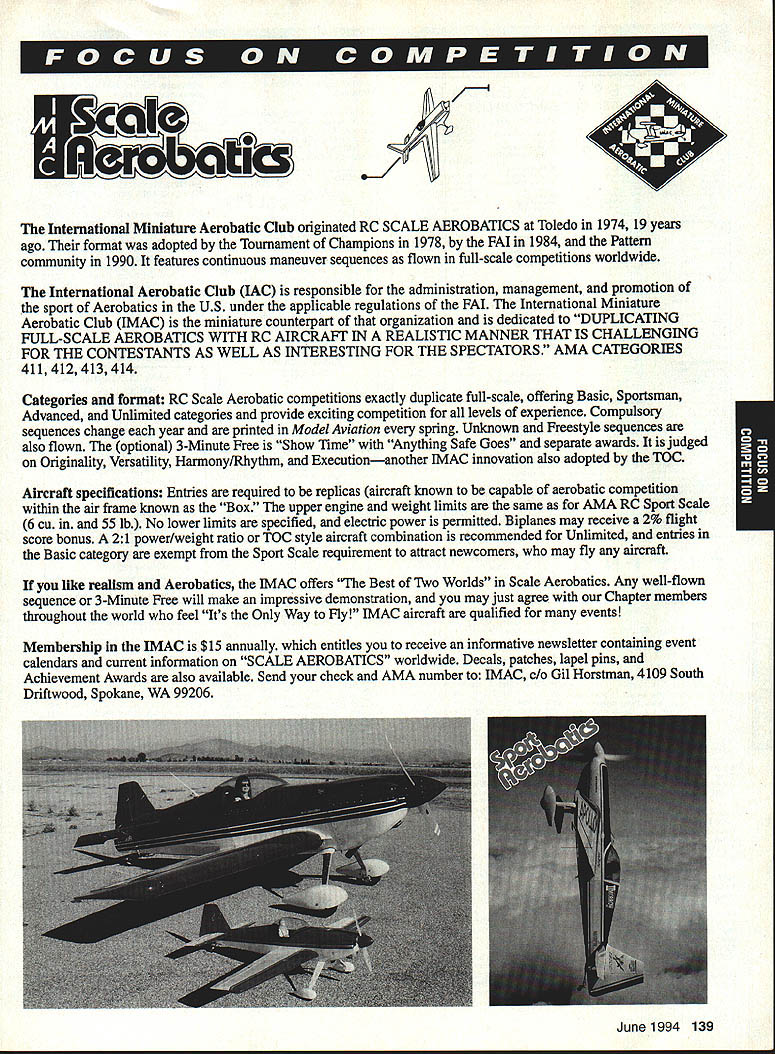
Scale Aerobatics
The International Miniature Aerobatic Club (IMAC) originated RC Scale Aerobatics at Toledo in 1974. Their format was adopted by the Tournament of Champions in 1978, by the FAI in 1984, and by the Pattern community in 1990. It features continuous maneuver sequences as flown in full-scale competitions worldwide.
The International Aerobatic Club (IAC) is responsible for the administration, management, and promotion of full-scale Aerobatics in the U.S. under applicable FAI regulations. IMAC is the miniature counterpart and is dedicated to "duplicating full-scale aerobatics with RC aircraft in a realistic manner that is challenging for the contestants as well as interesting for the spectators." (AMA Categories 411, 412, 413, 414.)
Categories and format:
- RC Scale Aerobatic competitions duplicate full-scale events, offering Basic, Sportsman, Advanced, and Unlimited categories and providing exciting competition for all levels of experience.
- Compulsory sequences change each year and are printed in Model Aviation every spring.
- Unknown and Freestyle sequences are also flown.
- The optional 3-Minute Free is "Show Time" with "Anything Safe Goes" and separate awards. It is judged on Originality, Versatility, Harmony/Rhythm, and Execution — another IMAC innovation adopted by the TOC.
Aircraft specifications:
- Entries are required to be replicas (aircraft known to be capable of aerobatic competition) within the airframe known as the "Box."
- Upper engine and weight limits are the same as for AMA RC Sport Scale (6 cu. in. and 55 lb.). No lower limits are specified, and electric power is permitted.
- Biplanes may receive a 2% flight score bonus.
- A 2:1 power/weight ratio or TOC-style aircraft combination is recommended for Unlimited.
- Entries in the Basic category are exempt from the Sport Scale requirement to attract newcomers, who may fly any aircraft.
If you like realism and aerobatics, IMAC offers "the best of two worlds" in Scale Aerobatics. Any well-flown sequence or 3-Minute Free will make an impressive demonstration. Many chapter members throughout the world feel "it's the only way to fly!" IMAC aircraft are qualified for many events.
Membership:
- IMAC membership is $15 annually and entitles you to receive an informative newsletter containing event calendars and current information on Scale Aerobatics worldwide.
- Decals, patches, lapel pins, and Achievement Awards are also available.
Send your check and AMA number to: IMAC, c/o Gil Horstman 4109 South Driftwood Spokane, WA 99206
Transcribed from original scans by AI. Minor OCR errors may remain.

