
Focus on Competition
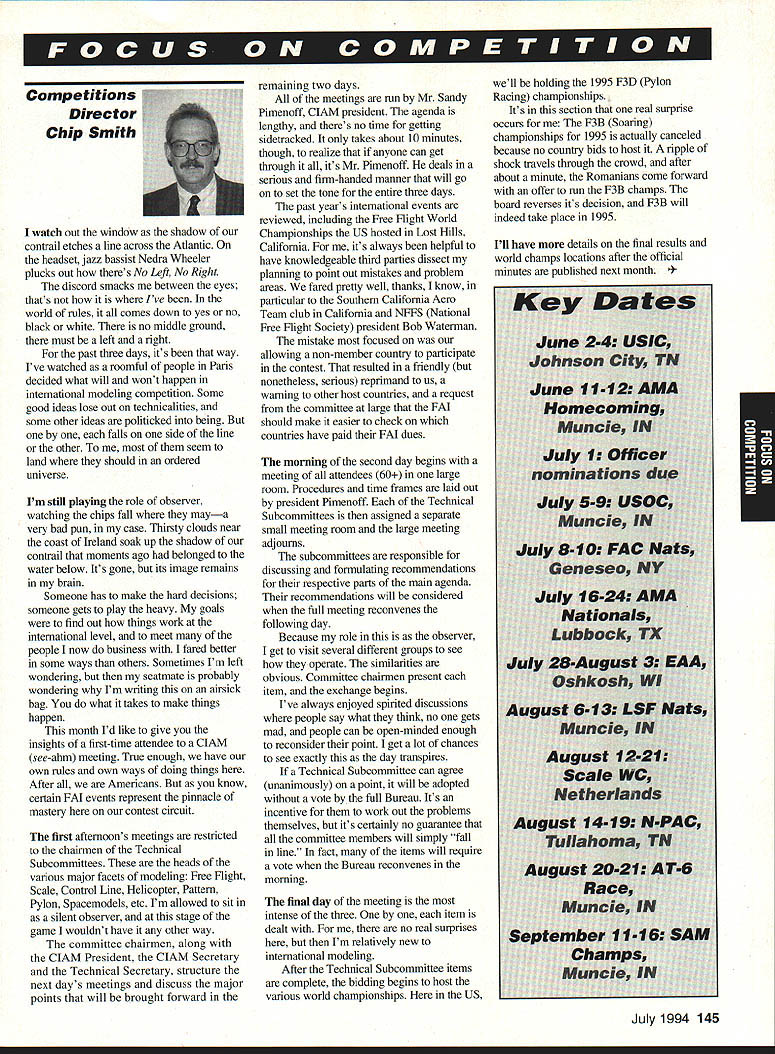
Competitions Director
Chip Smith
I watch out the window as the shadow of our contrail etches a line across the Atlantic. On the headset, jazz bassist Nedra Wheeler plucks out "There's No Left, No Right." The discord smacks me between the eyes: that's not how it is where I've been. In the world of rules, it all comes down to yes or no, black or white. There is no middle ground; there must be a left and a right.
For the past three days, it's been that way. I've watched as a roomful of people in Paris decided what will and won't happen in international modeling competition. Some good ideas lose out on technicalities, and some other ideas are politicked into being. But one by one, each falls on one side of the line or the other. To me, most of them seem to land where they should in an ordered universe.
I'm still playing the role of observer, watching the chips fall where they may—a very bad pun, in my case. Thirsty clouds near the coast of Ireland soak up the shadow of our contrail that moments ago had belonged to the water below. It's gone, but its image remains in my brain.
Someone has to make the hard decisions; someone gets to play the heavy. My goals were to find out how things work at the international level and to meet many of the people I now do business with. I fared better in some ways than others. Sometimes I'm left wondering, but then my seatmate is probably wondering why I'm writing this on an airsick bag. You do what it takes to make things happen.
First-time attendee: CIAM meeting
This month I'd like to give you the insights of a first-time attendee to a CIAM (see-ahm) meeting. True enough, we have our own rules and our own ways of doing things here. After all, we are Americans. But as you know, certain FAI events represent the pinnacle of mastery here on our contest circuit.
The first afternoon's meetings are restricted to the chairmen of the Technical Subcommittees. These are the heads of the various major facets of modeling:
- Free Flight
- Scale
- Control Line
- Helicopter
- Pattern
- Pylon
- Spacemodels
- etc.
I'm allowed to sit in as a silent observer, and at this stage of the game I wouldn't have it any other way. The committee chairmen, along with the CIAM President, the CIAM Secretary and the Technical Secretary, structure the next day's meetings and discuss the major points that will be brought forward in the remaining two days.
All of the meetings are run by Mr. Sandy Pimenoff, CIAM President. The agenda is lengthy, and there's no time for getting sidetracked. It only takes about ten minutes, though, to realize that if anyone can get through it all, it's Mr. Pimenoff. He deals in a serious and firm-handed manner that will go on to set the tone for the entire three days.
The past year's international events are reviewed, including the Free Flight World Championships the US hosted in Lost Hills, California. For me, it's always been helpful to have knowledgeable third parties dissect my planning to point out mistakes and problem areas. We fared pretty well, thanks in particular to the Southern California Aero Team and NFFS (National Free Flight Society) president Bob Waterman.
The mistake most focused on was our allowing a non-member country to participate in the contest. That resulted in a friendly (but nonetheless serious) reprimand to us, a warning to other host countries, and a request from the committee at large that the FAI should make it easier to check on which countries have paid their FAI dues.
Subcommittee process
The morning of the second day begins with a meeting of the attendees (60+) in one large room. Procedures and time frames are laid out by President Pimenoff. Each of the Technical Subcommittees is then assigned a separate small meeting room and the large meeting adjourns.
The subcommittees are responsible for discussing and formulating recommendations for their respective parts of the main agenda. Their recommendations will be considered when the full meeting reconvenes the following day.
Because my role in this is as the observer, I get to visit several different groups to see how they operate. The similarities are obvious. Committee chairmen present each item, and the exchange begins. I've always enjoyed spirited discussions where people say what they think, no one gets mad, and people can be open-minded enough to reconsider their point. I get a lot of chances to see exactly this as the day transpires.
If a Technical Subcommittee can agree (unanimously) on a point, it will be adopted without a vote by the full Bureau. It's an incentive for them to work out the problems themselves, but it's certainly no guarantee that all the committee members will simply "fall in line." In fact, many of the items will require a vote when the Bureau reconvenes in the morning.
Final day and bidding
The final day of the meeting is the most intense of the three. One by one, each item is dealt with. For me, there are no real surprises here, but then I'm relatively new to international modeling.
After the Technical Subcommittee items are complete, the bidding begins to host the various world championships. Here in the US, we'll be holding the 1995 F3D (Pylon Racing) championships.
It's in this section that one real surprise occurs for me: the F3B (Soaring) championships for 1995 are actually canceled because no country bids to host them. A ripple of shock travels through the crowd, and after about a minute the Romanians come forward and offer to run the F3B champs. The board reverses its decision, and F3B will indeed take place in 1995.
I'll have more details on the final results and world champs locations after the official minutes are published next month.
Transcribed from original scans by AI. Minor OCR errors may remain.

